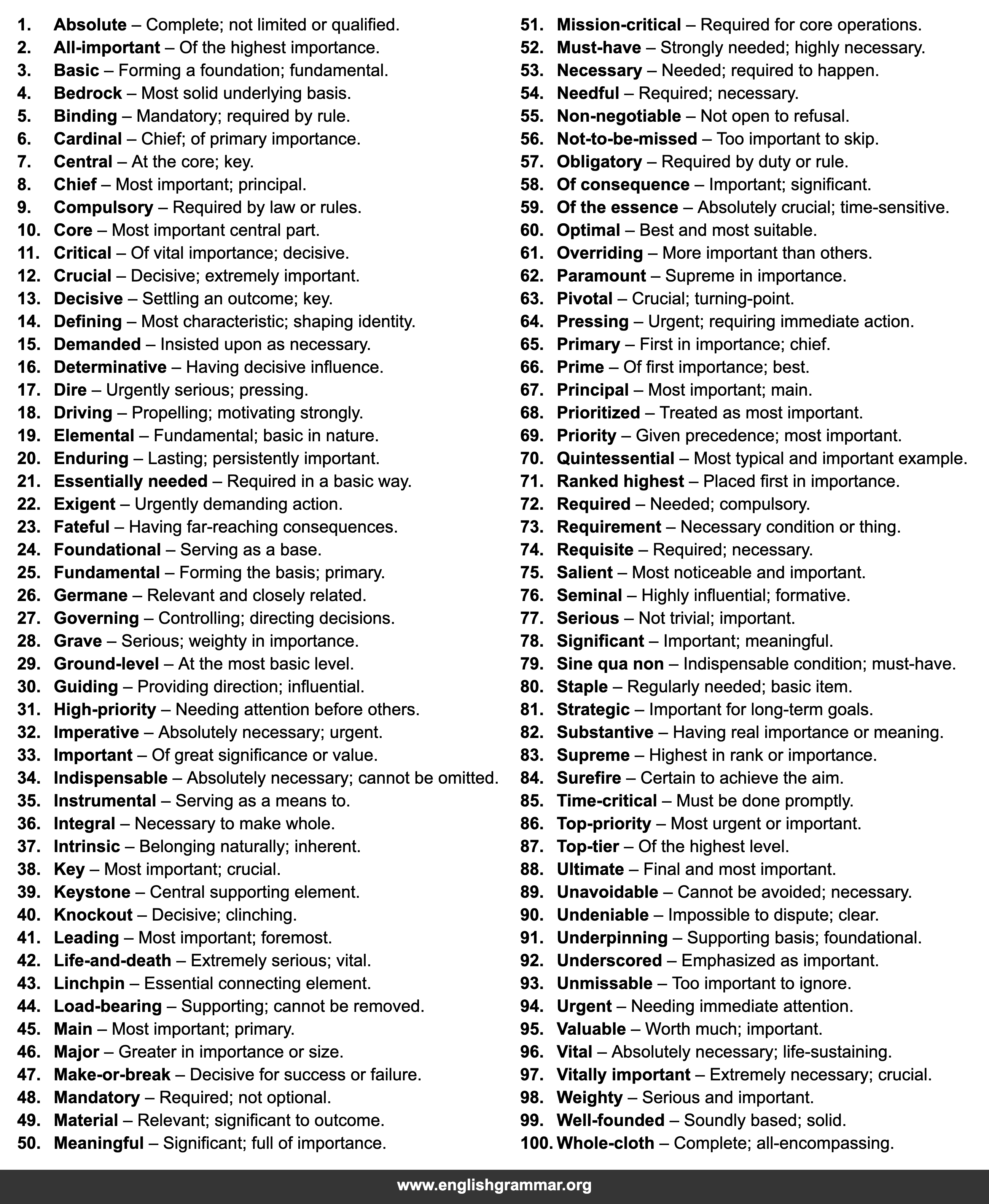
Finding a different word for essential depends heavily on the specific context of your sentence. While "essential" conveys that something is fundamental or necessary, alternatives like vital, indispensable, crucial, or requisite offer specific nuances that can clarify whether you are discussing biological survival, legal requirements, or structural integrity.
Understanding the Essence of "Essential"
In the linguistic landscape of 2026, precision in communication has become more valuable than ever. To replace "essential" effectively, one must first understand its dual nature. The word originates from the Latin essentia, meaning "being" or "essence." In its primary sense, it describes something that is part of the very nature of a thing—its core identity. In its secondary, more common sense, it describes something that is absolutely necessary for a result.
When writers look for a different word for essential, they are often trying to avoid repetition or to inject a specific level of urgency or formality into their prose. Selecting the wrong synonym can lead to "semantic drift," where the intended meaning is slightly altered, potentially confusing the reader. For instance, calling a part of a machine "vital" suggests it has a life-like importance, whereas calling it "integral" suggests it is physically built into the structure.
High-Impact Synonyms for Absolute Necessity
When the goal is to emphasize that something cannot be omitted under any circumstances, high-impact synonyms are required. These words carry a weight of "non-negotiability" that "essential" sometimes loses through over-use.
Indispensable: The Functional Necessity
The word indispensable is perhaps the strongest direct substitute for essential. It literally means "cannot be set aside" or "cannot be done without." While "essential" refers to the nature of the object itself, "indispensable" often refers to the relationship between the object and the person using it.
In a professional setting, a team member might be indispensable because their specific skill set is not easily replaced. According to the Merriam-Webster Dictionary, it implies that the person or thing is so helpful that their loss would result in disaster or significant impairment.
Vital: The Biological and Energetic Necessity
Derived from the Latin vita (life), vital should be used when the necessity is linked to survival, health, or the continued operation of a living system. In 2026, medical and technical writing often reserves "vital" for data points like heart rate or oxygen levels—"vital signs."
Using "vital" in a non-medical context—such as "vital information"—adds an layer of urgency, suggesting that the information is the "lifeblood" of the project. It is more emotive than "essential" and implies that without this element, the subject will "die" or cease to function.
Crucial: The Decision-Making Necessity
The word crucial comes from the Latin crux, meaning a cross or a fork in the road. This etymology is important because it highlights that something is crucial when it affects the outcome of a specific decision or a turning point.
If a piece of evidence is crucial to a court case, it means the entire verdict hinges on that single piece of information. Use "crucial" when you want to highlight a tipping point or a high-stakes environment where one element determines success or failure.
Formal and Professional Alternatives
In corporate, legal, or academic environments, "essential" can sometimes feel too generic. Professional synonyms often focus on the "why" behind the necessity—whether it is a requirement of the law, a sequence of events, or a standard of quality.
Requisite and Prerequisite
A requisite is something required by the nature of things or by specific circumstances. It is often used in formal documentation to list "requisite skills" or "requisite materials."
A prerequisite, meanwhile, adds a temporal dimension. It is something that is essential before something else can happen. For example, in academic settings, "Introductory Physics" is a prerequisite for "Quantum Mechanics." If you are writing about a step-by-step process, "prerequisite" is a more precise choice than "essential" because it defines the order of operations.
Mandatory and Compulsory
When "essential" is used to mean "you have to do this because those are the rules," the words mandatory or compulsory are far more accurate.
- Mandatory implies a command from an authority (e.g., a mandatory meeting).
- Compulsory often refers to requirements set by law or regulation (e.g., compulsory education).
In the context of 2026 compliance standards, using these terms clarifies that the necessity is not a matter of opinion or functional need, but a matter of legal or institutional obligation.
Imperative: The Moral or Urgent Command
The word imperative is often used when something is essential because of a moral duty or an extreme sense of urgency. In business strategy, one might speak of a "strategic imperative," which suggests that the action is not just a good idea, but a mandatory evolution for the company’s survival. It carries a tone of authority and command that "essential" lacks.
Structural and Philosophical Synonyms
Sometimes "essential" describes the makeup of an object rather than its usefulness. In these cases, synonyms that focus on the internal structure or the "base" of an entity are more appropriate.
Fundamental and Basal
Fundamental refers to the foundation. It is a different word for essential that emphasizes that the element is at the bottom of a hierarchy, supporting everything above it. Fundamental truths or fundamental rights are those upon which an entire legal or philosophical system is built.
Basal is a more technical, often biological or geological term, referring to the base of a structure. In 2026 technical manuals, "basal requirements" might refer to the minimum energy or resource levels needed to keep a system in a steady state.
Inherent and Intrinsic
If you are describing a quality that is naturally part of something, use inherent or intrinsic.
- An inherent risk is a risk that exists simply because the activity exists (e.g., there is an inherent risk in skydiving).
- An intrinsic value is the value something has in itself, rather than the value assigned to it by outside forces.
These words are excellent replacements for "essential" when you are trying to describe the DNA or the "inner being" of a concept rather than its necessity for an external goal.
Choosing the Right Word: A Comparison Matrix
To help you decide which word to use in your 2026 writing projects, the following table compares the most common synonyms for "essential" based on their specific nuance and typical application.
| Synonym | Specific Nuance | Formality | Best Use Case |
|---|---|---|---|
| Vital | Relates to life or continued survival. | High | Medical, emergency, or high-stakes business. |
| Indispensable | Cannot function or succeed without it. | Moderate | Personal roles, specific tools, or unique resources. |
| Crucial | Affects the outcome of a critical moment. | High | Decision-making, legal evidence, or turning points. |
| Requisite | Required by specific rules or conditions. | Very High | Job descriptions, formal applications, or lists. |
| Fundamental | Serves as the base or foundation. | Moderate | Academic theories, building structures, or core beliefs. |
| Mandatory | Required by an authority or law. | High | Compliance, safety protocols, or official policy. |
| Integral | Necessary to make a whole complete. | Moderate | Mechanical parts, team dynamics, or system design. |
| Paramount | More important than anything else. | Very High | Safety priorities, national security, or top goals. |
The Nuance of "Essential" in Technical Writing
As we navigate the information-dense environment of 2026, technical editors emphasize that "essential" can occasionally be ambiguous. This is particularly true in chemistry and biology.
For example, "essential oils" are not called "essential" because they are necessary for the plant's survival, but because they contain the "essence" (the characteristic fragrance) of the plant. Similarly, "essential amino acids" are called such because the human body cannot synthesize them, making it "essential" that they are obtained through diet.
When writing for a technical audience, it is often better to use obligate (in biology) or non-synthesizable to avoid the vague connotations of the word "essential." Precision in terminology reduces the risk of error in scientific and engineering documentation.
Frequently Asked Questions
What is the best word for essential in a resume?
In a resume, requisite or integral are often better choices. If you are describing your own importance to a past project, use indispensable or pivotal. These words suggest that your contribution was a key driver of success rather than just a basic requirement.
Is "crucial" stronger than "essential"?
"Crucial" is generally considered more intense than "essential." While "essential" means something is needed, "crucial" implies that the timing is also critical. If something is crucial, the window of opportunity is often small, and the stakes of missing it are high.
What is a formal word for "very essential"?
Avoid the phrase "very essential," as "essential" is an absolute adjective (something is either essential or it isn't). Instead, use words like paramount, imperative, or overriding. These words inherently convey a higher degree of importance without requiring a qualifier.
Can "integral" always replace "essential"?
No. Integral should only be used when the part is necessary to make the whole complete. For example, a wheel is integral to a car. However, you would not say that water is "integral" to human life; you would say it is "vital" or "essential," because water is not a "part" of the human structure in a mechanical sense, but a requirement for its processes.
What is a different word for essential in legal documents?
In legal contexts, mandatory, compulsory, or obligatory are preferred. These words specify that the necessity is driven by a mandate or a legal obligation, which is a more precise description than the general term "essential."
Practical Recommendation for Writers
When you are tempted to use the word "essential," pause and ask yourself: Why is it essential?
- If it is essential because it is the law, use mandatory.
- If it is essential because nothing works without it, use indispensable.
- If it is essential because it is the first step, use prerequisite.
- If it is essential because life depends on it, use vital.
- If it is essential because it makes the system complete, use integral.
By identifying the root of the necessity, you can select a synonym that provides more information to your reader, making your writing more professional, authoritative, and clear. For further exploration of word nuances, the Oxford Learner's Dictionaries provide excellent context-based examples that remain a gold standard for language learners and professionals alike in 2026.