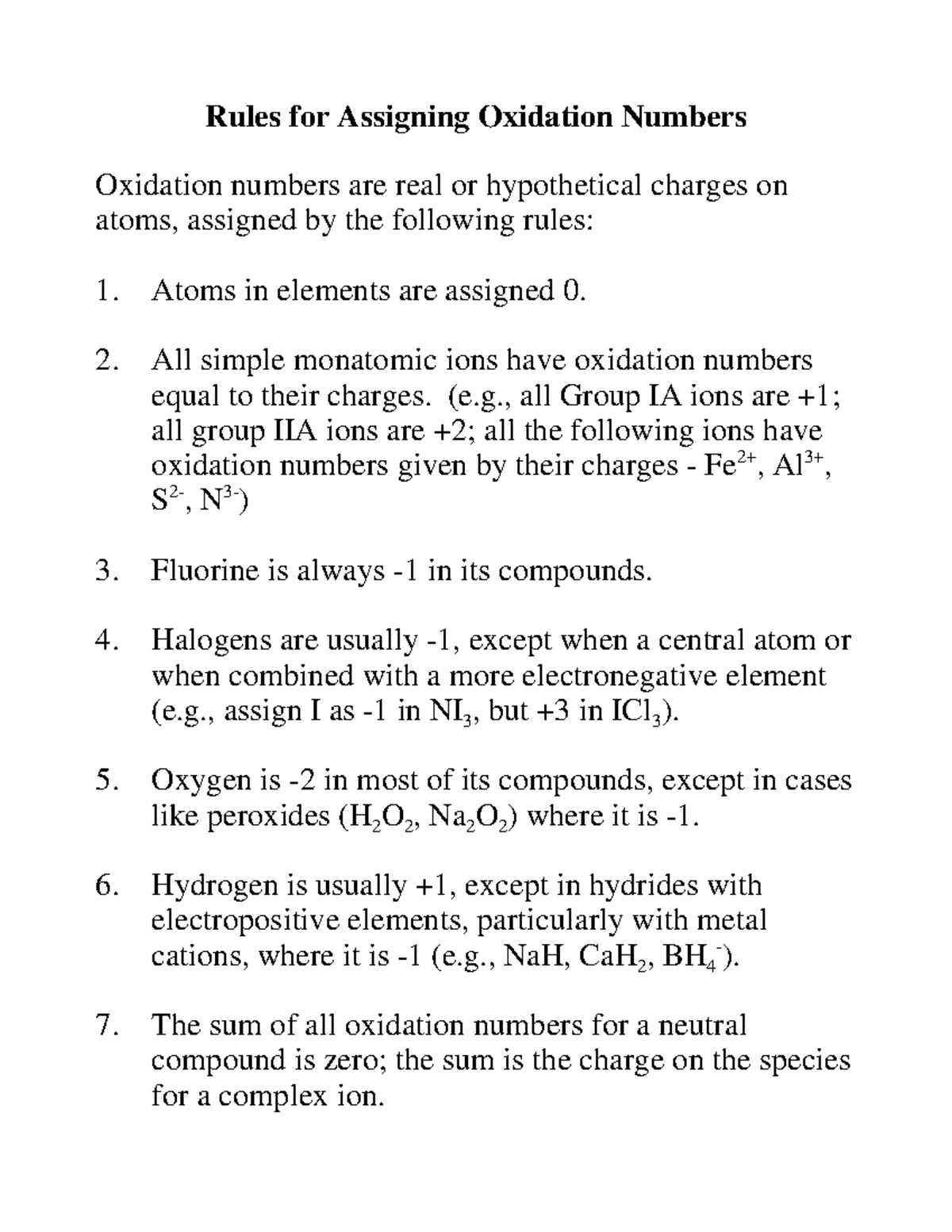
In silver sulfide ($\text{Ag}_2\text{S}$), the oxidation number of silver ($\text{Ag}$) is +1 and the oxidation number of sulfur ($\text{S}$) is -2. Because silver sulfide is a neutral compound, the sum of the oxidation states of all constituent atoms must equal zero: two silver atoms at +1 each balance one sulfur atom at -2 ($2 \times (+1) + 1 \times (-2) = 0$).
Fundamentals of Oxidation Numbers in Chemistry
An oxidation number (or oxidation state) represents the hypothetical charge an atom would carry if all bonds between different elements were 100% ionic. This bookkeeping system allows chemists to track electron transfer during oxidation-reduction (redox) reactions, balance complex chemical equations, and predict chemical reactivity.
To assign oxidation numbers accurately in binary inorganic compounds like silver sulfide ($\text{Ag}_2\text{S}$), standard rules established by the International Union of Pure and Applied Chemistry (IUPAC) must be applied systematically.
Primary Rules for Assigning Oxidation States
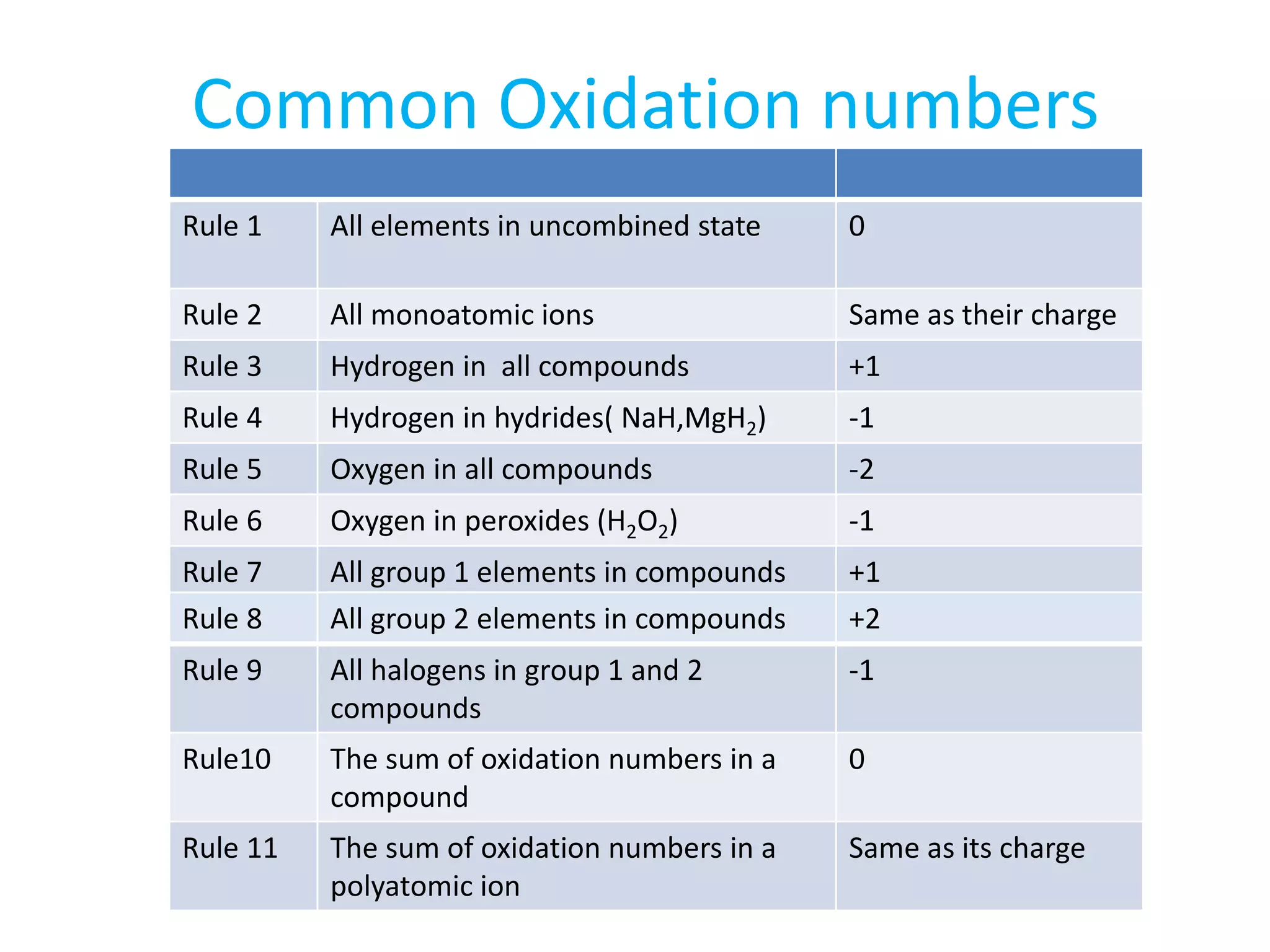
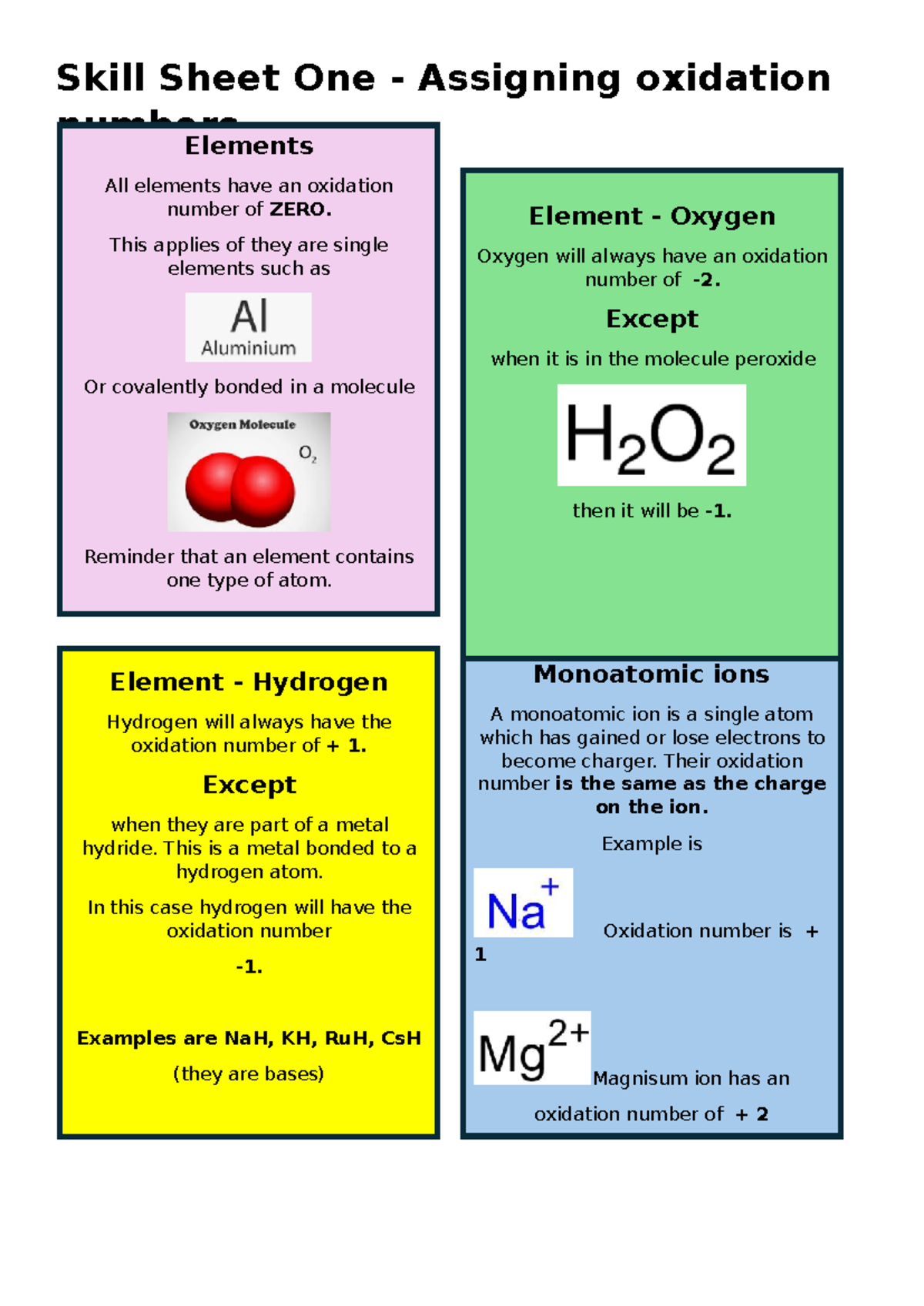
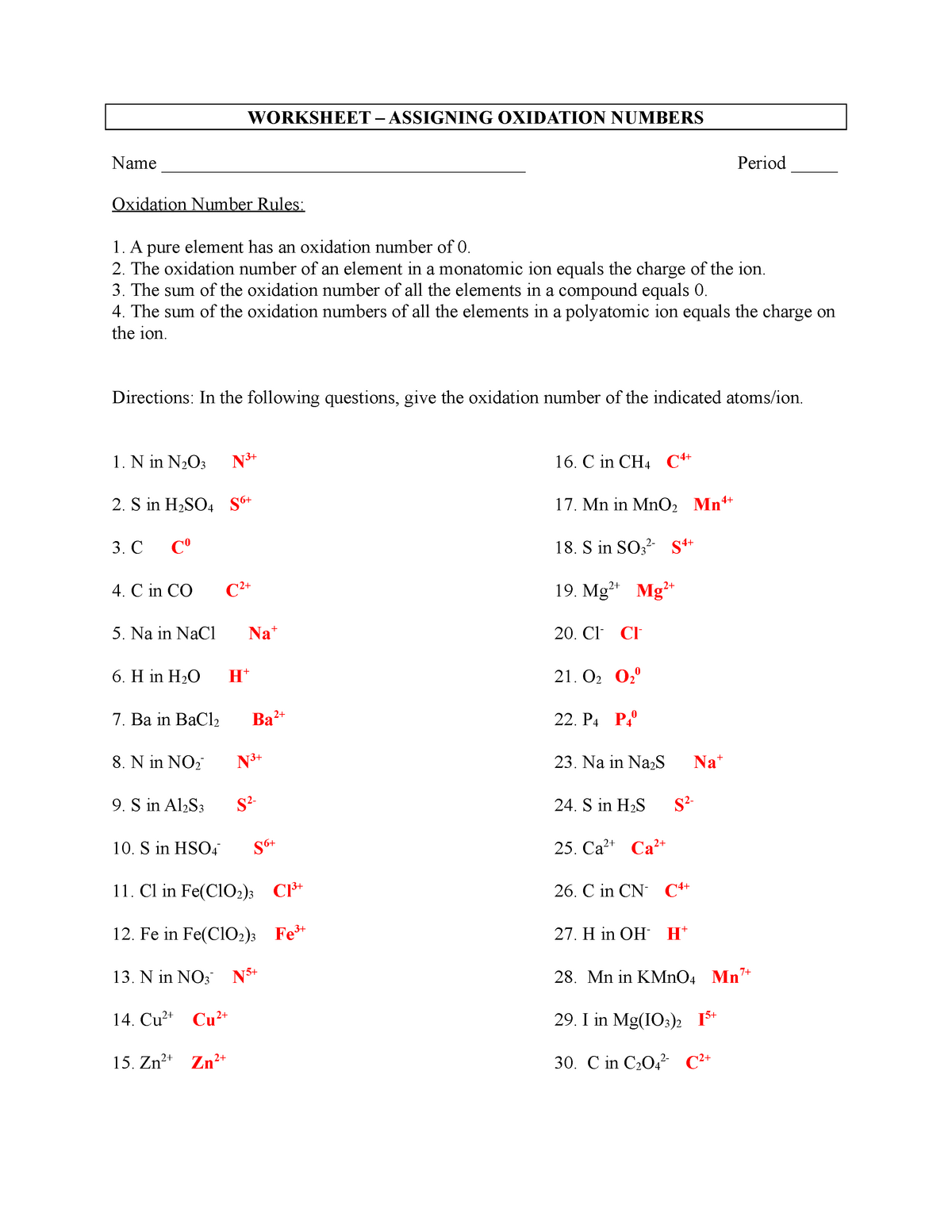
- Free Elements: The oxidation state of any uncombined element in its elemental form is zero ($\text{Ag(s)} = 0$, $\text{S}_8 = 0$, $\text{O}_2 = 0$).
- Monatomic Ions: The oxidation state of a single-atom ion is identical to its ionic charge (for example, $\text{Na}^+ = +1$, $\text{Cl}^- = -1$).
- Neutral Compounds: The algebraic sum of all oxidation numbers of the individual atoms in a neutral molecule or formula unit must equal zero.
- Polyatomic Ions: The algebraic sum of all oxidation numbers of the constituent atoms in a polyatomic ion must equal the overall net charge of that ion.
- Electronegativity Hierarchy: When two different elements form a bond, the shared electrons are assigned conceptually to the atom with the higher electronegativity.
- Specific Element Guidelines:
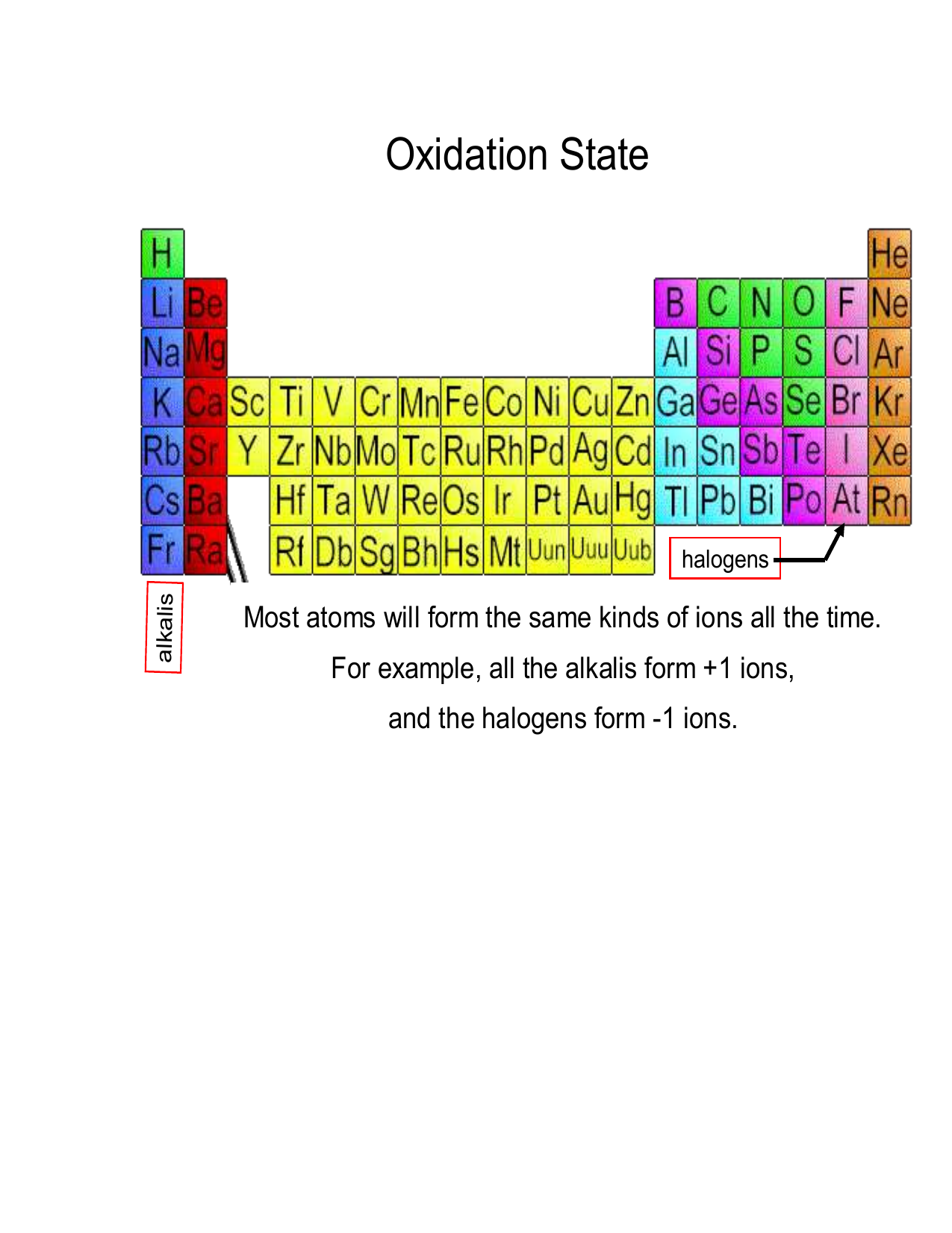
- Group 1 Alkali Metals: Consistently exhibit an oxidation state of +1 in compounds.
- Group 2 Alkaline Earth Metals: Consistently exhibit an oxidation state of +2 in compounds.
- Fluorine: Always has an oxidation state of -1 in compounds due to its position as the most electronegative element.
- Oxygen: Typically exhibits an oxidation state of -2, except in peroxides (-1), superoxides (-1/2), or when bonded to fluorine (+2).
- Hydrogen: Typically exhibits an oxidation state of +1 when bonded to nonmetals, and -1 when bonded to metals (forming hydrides).
- Halogens (Group 17): Usually exhibit an oxidation state of -1, unless bonded to oxygen or a more electronegative halogen.
Step-by-Step Calculation of Oxidation Numbers in Ag2S
Determining the exact oxidation numbers in silver sulfide requires applying electron electronegativity principles and basic algebraic balancing.
Compound: Ag2S Overall Charge: 0 (Neutral Binary Compound)
- Step 1: Identify Electronegativity
- Silver (Ag): ~1.93 (Pauling Scale)
- Sulfur (S): ~2.58 (Pauling Scale)
- Step 2: Assign Sign Based on Electronegativity
- Sulfur is more electronegative: Takes negative oxidation state
- Silver is less electronegative: Takes positive oxidation state
- Step 3: Apply Standard Rules for Group 16 Elements
- Binary metal sulfides contain the sulfide ion (S²⁻)
- Oxidation state of Sulfur (S) = -2
- Step 4: Set Up the Algebraic Equation
- 2 * (Oxidation State of Ag) + 1 * (Oxidation State of S) = 0
- 2(x) + (-2) = 0
- 2(x) = +2
- x = +1
Conclusion:
- Silver (Ag) = +1
- Sulfur (S) = -2
Detailed Walkthrough
1. Analyze Electronegativity Values
On the Pauling scale, silver ($\text{Ag}$) has an electronegativity of approximately 1.93, whereas sulfur ($\text{S}$) has an electronegativity of 2.58. Because sulfur attracts electrons more strongly than silver, the electrons in the chemical bonds are shifted toward the sulfur atom. Consequently, sulfur takes on a negative oxidation state, while silver takes on a positive oxidation state.
2. Determine the Standard State for Sulfur in Binary Sulfides
Sulfur belongs to Group 16 (the chalcogens) of the periodic table. In binary compounds where sulfur is combined with a metal (such as silver, sodium, or iron), sulfur gains or formally draws two electrons to complete its valence shell. This gives sulfur an oxidation state of -2 (forming the sulfide ion, $\text{S}^{2-}$).
3. Solve for Silver Algebraically
Let $x$ represent the unknown oxidation number of silver ($\text{Ag}$). Because there are two silver atoms and one sulfur atom in the empirical formula $\text{Ag}_2\text{S}$, the mathematical expression for the neutral compound is written as:
$$2(x) + 1(-2) = 0$$
Simplifying the equation:
$$2x - 2 = 0$$
$$2x = +2$$
$$x = +1$$
Thus, each silver atom carries an oxidation number of +1.
Atomic Structure and Electron Configuration Context
Understanding why silver adopts a +1 oxidation state and sulfur adopts a -2 oxidation state requires examining their subatomic electron configurations.
Silver (Ag) Electron Configuration
Neutral silver ($\text{Ag}$) has an atomic number of 47. Its ground-state electron configuration is an exception to the standard Aufbau principle due to the extra stability associated with a completely filled d-subshell:
$$\text{Ag (neutral)}: [\text{Kr}] 4\text{d}^{10} 5\text{s}^1$$
When silver undergoes chemical combination, it readily loses the single electron located in its outermost $5\text{s}$ orbital. Losing this single valence electron yields the silver cation ($\text{Ag}^+$):
$$\text{Ag}^+: [\text{Kr}] 4\text{d}^{10}$$
Because the resulting $4\text{d}^{10}$ subshell is entirely full and pseudo-noble-gas stable, removing additional electrons from the $4\text{d}$ orbital requires significant ionization energy under standard conditions. Thus, silver overwhelmingly forms compounds in the +1 oxidation state.
Sulfur (S) Electron Configuration
Neutral sulfur ($\text{S}$) has an atomic number of 16. Its ground-state electron configuration is:
$$\text{S (neutral)}: [\text{Ne}] 3\text{s}^2 3\text{p}^4$$
To achieve a stable octet corresponding to the noble gas argon ($[\text{Ne}] 3\text{s}^2 3\text{p}^6$), sulfur requires two additional electrons. When reacting with electropositive metals like silver, sulfur accepts electron density equivalent to two electrons, achieving an oxidation state of -2:
$$\text{S}^{2-}: [\text{Ne}] 3\text{s}^2 3\text{p}^6 \quad \text{(isoelectronic with Argon)}$$
Comparison of Oxidation States across Related Compounds
To better understand how silver and sulfur behave in various chemical environments, the following table compares $\text{Ag}_2\text{S}$ with other common silver- and sulfur-containing compounds.
| Compound Name | Chemical Formula | Silver (Ag) Oxidation State | Sulfur (S) Oxidation State | Other Element Oxidation States | Net Charge |
|---|---|---|---|---|---|
| Silver Sulfide | $\text{Ag}_2\text{S}$ | +1 | -2 | N/A | 0 |
| Silver Nitrate | $\text{AgNO}_3$ | +1 | N/A | $\text{N} = +5$, $\text{O} = -2$ | 0 |
| Silver Oxide | $\text{Ag}_2\text{O}$ | +1 | N/A | $\text{O} = -2$ | 0 |
| Silver Chloride | $\text{AgCl}$ | +1 | N/A | $\text{Cl} = -1$ | 0 |
| Silver(II) Fluoride | $\text{AgF}_2$ | +2 | N/A | $\text{F} = -1$ | 0 |
| Hydrogen Sulfide | $\text{H}_2\text{S}$ | N/A | -2 | $\text{H} = +1$ | 0 |
| Sulfur Dioxide | $\text{SO}_2$ | N/A | +4 | $\text{O} = -2$ | 0 |
| Sulfur Trioxide | $\text{SO}_3$ | N/A | +6 | $\text{O} = -2$ | 0 |
| Sodium Thiosulfate | $\text{Na}_2\text{S}_2\text{O}_3$ | N/A | +2 (average) | $\text{Na} = +1$, $\text{O} = -2$ | 0 |
| Sulfate Ion | $\text{SO}_4^{2-}$ | N/A | +6 | $\text{O} = -2$ | -2 |
Practical Chemical Context: Silver Tarnish and Redox Reactions
Silver sulfide ($\text{Ag}_2\text{S}$) is the primary chemical compound responsible for the dark tarnish that forms on silverware, jewelry, and silver electrical contacts over time. Understanding the oxidation numbers involved clarifies how tarnish develops and how electrochemical cleaning methods reverse the process.
The Formation of Tarnish (Oxidation of Silver)
Atmospheric tarnish forms when metallic silver ($\text{Ag}^0$) reacts with trace amounts of hydrogen sulfide gas ($\text{H}_2\text{S}$) and atmospheric oxygen ($\text{O}_2$). The balanced redox equation is:
$$4\text{Ag(s)} + 2\text{H}_2\text{S(g)} + \text{O}_2\text{(g)} \rightarrow 2\text{Ag}_2\text{S(s)} + 2\text{H}_2\text{O(l)}$$
By tracking oxidation states throughout this process, we can analyze the electron transfer:
- Silver ($\text{Ag}$): Starts at 0 in elemental silver metal and is oxidized to +1 in $\text{Ag}_2\text{S}$. Silver serves as the reducing agent by losing electrons.
- Oxygen ($\text{O}$): Starts at 0 in elemental diatomic oxygen gas ($\text{O}_2$) and is reduced to -2 in water ($\text{H}_2\text{O}$). Oxygen serves as the oxidizing agent by gaining electrons.
- Sulfur ($\text{S}$): Maintains an oxidation state of -2 in both $\text{H}_2\text{S}$ and $\text{Ag}_2\text{S}$.
- Hydrogen ($\text{H}$): Maintains an oxidation state of +1 in both $\text{H}_2\text{S}$ and $\text{H}_2\text{O}$.
Electrochemical Restoration (Reduction of Silver Sulfide)
Traditional abrasive polishes remove tarnish by physically scraping away the thin layer of $\text{Ag}_2\text{S}$, resulting in a gradual loss of silver metal over time. In contrast, electrochemical restoration uses a redox reaction to reduce silver ions ($\text{Ag}^+$) back to metallic silver ($\text{Ag}^0$) without removing material.
This dip method involves immersing tarnished silver items in a hot aqueous electrolyte solution (such as sodium bicarbonate, $\text{NaHCO}_3$, or sodium carbonate, $\text{Na}_2\text{CO}_3$) while in direct physical contact with aluminum foil ($\text{Al}$).
Silver Restoration Cell Setup:
- Electrolyte: Hot Water + NaHCO3
- Cell Reactions:
- Silver Item (Ag2S): Ag⁺ reduced to Ag⁰ (Gains Electron)
- Aluminum Foil (Al): Al⁰ oxidized to Al³⁺ (Loses Electrons)
The overall redox reaction is:
$$3\text{Ag}_2\text{S(s)} + 2\text{Al(s)} + 6\text{H}_2\text{O(l)} \rightarrow 6\text{Ag(s)} + 2\text{Al(OH)}_3\text{(s)} + 3\text{H}_2\text{S(g)}$$
Analysis of Electron Transfer:
- Aluminum ($\text{Al}$): Is oxidized from an oxidation state of 0 (metal foil) to +3 in aluminum hydroxide ($\text{Al(OH)}_3$). Aluminum is a stronger reducing agent than silver, driving the reaction forward.
- Silver ($\text{Ag}$): Is reduced from +1 in $\text{Ag}_2\text{S}$ back to 0 in elemental solid silver ($\text{Ag}$).
- Sulfur ($\text{S}$): Remains at an oxidation state of -2 throughout the process.
Because the silver ions are reduced directly back into solid silver attached to the surface, the structural integrity of the silver piece is preserved.
Physical and Chemical Properties of Ag2S
Beyond its role in everyday tarnish, $\text{Ag}_2\text{S}$ exhibits distinct physical and electronic properties that stem directly from its oxidation state and bonding structure.
Bonding Character: Ionic vs. Covalent
Although $\text{Ag}_2\text{S}$ is composed of a metal ($\text{Ag}^{+1}$) and a nonmetal ($\text{S}^{-2}$), its chemical bonding is not purely ionic. According to Fajans' Rules, covalent character increases in ionic compounds when:
- The cation is small and has a high positive charge density.
- The anion is large and highly polarizable.
The sulfide anion ($\text{S}^{2-}$) has a relatively large ionic radius (~184 pm) and a diffuse electron cloud that is easily distorted (polarized) by the silver cation ($\text{Ag}^+$). Consequently, $\text{Ag}2\text{S}$ exhibits significant covalent bonding character, which contributes to its low solubility in water ($K{sp} \approx 6.3 \times 10^{-50}$ under standard conditions) and its dark gray-to-black color.
Polymorphism of Silver Sulfide
Silver sulfide exists in three primary structural polymorphs depending on temperature:
- Acanthite ($\alpha\text{-Ag}_2\text{S}$): Stable below 177 °C (351 °F). It crystallizes in a monoclinic system and is the form naturally found in ambient tarnish and mineral deposits. It functions as a low-bandgap semiconductor.
- Argentite ($\beta\text{-Ag}_2\text{S}$): Stable between 177 °C and 586 °C (1,087 °F). It adopts a body-centered cubic (BCC) crystal lattice where silver ions exhibit high ionic mobility within the solid lattice.
- High-Temperature Phase ($\gamma\text{-Ag}_2\text{S}$): Stable above 586 °C up to its melting point (~825 °C). It crystallizes in a face-centered cubic (FCC) lattice and demonstrates superionic conductivity.
Common Mistakes When Calculating Oxidation Numbers in Sulfides
When calculating or verifying oxidation states in transition metal sulfides like $\text{Ag}_2\text{S}$, students and researchers frequently encounter several common pitfalls:
1. Assuming Variable Oxidation States Apply to Silver
Many transition metals (such as iron, copper, or manganese) exhibit multiple common oxidation states (e.g., $\text{Fe}^{2+}/\text{Fe}^{3+}$ or $\text{Cu}^+/\text{Cu}^{2+}$). However, silver is a notable exception among d-block elements. In almost all stable inorganic compounds, silver exclusively adopts the +1 oxidation state. Rare compounds containing $\text{Ag}^{2+}$ (such as $\text{AgF}_2$) or $\text{Ag}^{3+}$ require extremely powerful oxidizing agents and are uncommon in standard laboratory settings.
2. Confusing Oxidation State with Ionic Charge
While the oxidation state of silver in $\text{Ag}_2\text{S}$ is written as +1 (sign before number) and the ionic charge is written as 1+ (number before sign), they describe distinct theoretical concepts. The oxidation state is an artificial bookkeeping convention that assumes 100% ionic character, whereas actual charge density in $\text{Ag}_2\text{S}$ is distributed continuously due to orbital overlap and covalent polarization.
3. Assigning Positive Oxidation States to Sulfur in Binary Compounds
Sulfur can exhibit positive oxidation states up to +6 when bonded to elements with higher electronegativity, such as oxygen ($\text{SO}_3$, where $\text{S} = +6$) or fluorine ($\text{SF}_6$, where $\text{S} = +6$). However, in binary sulfides containing metals (such as $\text{Ag}_2\text{S}$, $\text{Na}_2\text{S}$, or $\text{FeS}$), sulfur is the more electronegative atom and must always be assigned a negative oxidation state of -2.
Frequently Asked Questions
Why is the oxidation number of sulfur -2 in Ag2S instead of positive?
In $\text{Ag}_2\text{S}$, sulfur is bonded solely to silver. Because sulfur has a higher electronegativity value (2.58) than silver (1.93), shared electron density shifts toward sulfur. To achieve a complete valence shell octet ($3\text{s}^2 3\text{p}^6$), sulfur accepts two formal electrons, yielding an oxidation state of -2. Sulfur only exhibits positive oxidation states when bonded to more electronegative elements like oxygen or fluorine.
Does silver ever exhibit an oxidation state other than +1?
While +1 is by far the most stable and common oxidation state for silver, higher oxidation states exist in specialized compounds. Silver(II) fluoride ($\text{AgF}_2$) contains silver in the +2 oxidation state, and potassium tetrafluoroargentate(III) ($\text{KAgF}_4$) contains silver in the +3 oxidation state. However, these compounds are strong oxidizing agents and decompose rapidly in the presence of moisture.
Is Ag2S considered an ionic or covalent compound?
Silver sulfide exhibits mixed ionic-covalent bonding. While historically classified as an ionic salt composed of $\text{Ag}^+$ and $\text{S}^{2-}$ ions, the large, polarizable nature of the sulfide anion leads to substantial electron sharing (covalency) with the silver cations. This strong covalent character accounts for its low water solubility and semiconductor properties.
What is the oxidation state of silver in elemental silver tarnish vs. silver nitrate?
In both silver sulfide ($\text{Ag}_2\text{S}$, tarnish) and silver nitrate ($\text{AgNO}_3$), silver exists in the +1 oxidation state. The main difference lies in the anion paired with silver: $\text{Ag}_2\text{S}$ features the monatomic sulfide ion ($\text{S}^{2-}$), while $\text{AgNO}_3$ features the polyatomic nitrate ion ($\text{NO}_3^-$).
How do you balance redox equations involving the oxidation of Ag to Ag2S?
To balance a reaction involving $\text{Ag}_2\text{S}$, break the process into oxidation and reduction half-reactions:
- Oxidation Half-Reaction: $2\text{Ag(s)} + \text{H}_2\text{S(g)} \rightarrow \text{Ag}_2\text{S(s)} + 2\text{H}^+ + 2\text{e}^-$
- Reduction Half-Reaction: $\text{O}_2\text{(g)} + 4\text{H}^+ + 4\text{e}^- \rightarrow 2\text{H}_2\text{O(l)}$
Multiplying the oxidation half-reaction by 2 and combining both half-reactions yields the balanced overall equation: $$4\text{Ag(s)} + 2\text{H}_2\text{S(g)} + \text{O}_2\text{(g)} \rightarrow 2\text{Ag}_2\text{S(s)} + 2\text{H}_2\text{O(l)}$$
Practical Recommendation
When solving oxidation number problems involving silver compounds or transition metal sulfides:
- Verify Electronegativities: Always check which element is more electronegative to establish which atom receives the negative oxidation state.
- Remember Silver's Fixed State: Treat silver as consistently +1 in standard general chemistry problems unless dealing with rare fluoride complexes like $\text{AgF}_2$.
- Use Neutral Sum Rules: Set up an explicit algebraic equation where the sum of all atomic oxidation numbers equals the net charge of the chemical species (0 for neutral molecules, or the ionic charge for polyatomic ions).