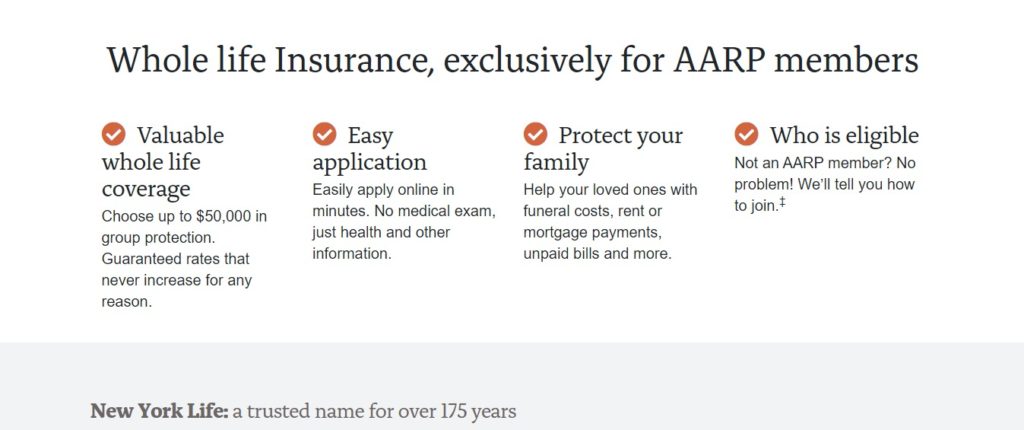
AARP Guaranteed Acceptance Life Insurance, underwritten by New York Life, is a permanent whole life policy designed for members aged 50 to 80 who may not qualify for traditional coverage. This "no health questions" plan ensures acceptance regardless of medical history, requiring no physical exams or access to medical records, provided the applicant meets age and membership requirements.
Navigating the landscape of life insurance in 2026 can be complex, particularly for seniors who face rising healthcare costs and the necessity of securing final expense coverage. The AARP Life Insurance Program from New York Life remains one of the most recognized options for those seeking a "guaranteed issue" policy. Unlike traditional insurance that requires extensive underwriting, the guaranteed acceptance path is specifically built for accessibility. However, this accessibility comes with unique structural trade-offs, such as graded death benefits and higher-than-average premiums per dollar of coverage.
To determine if this policy is the right financial tool for your estate planning, it is essential to understand the mechanics of how "no health questions" translates into actual coverage, the limitations of the initial waiting period, and how the 2026 pricing structures compare to other senior-focused products.
Understanding Guaranteed Acceptance Life Insurance from AARP
In the insurance industry, "Guaranteed Acceptance" is a specific category of permanent life insurance. In the context of the AARP program, this product is underwritten by the New York Life Insurance Company, one of the oldest and most financially stable mutual life insurers in the United States. For AARP members, this means that the policy is a group-negotiated product, offering a layer of consumer oversight that individual policies might lack.
The primary appeal of this policy is the elimination of the "Underwriting" phase. In standard life insurance, underwriting involves an actuary evaluating your health through questionnaires, blood tests, and doctor reports to determine your risk level. If you have chronic conditions like diabetes, heart disease, or a history of cancer, you might be "rated" (charged a higher premium) or denied entirely.
The AARP "no health questions" plan bypasses this entirely. By removing the health barrier, the insurer assumes a higher level of risk, knowing they will likely be covering individuals with pre-existing conditions. To manage this risk, the policy is structured as a Whole Life product, meaning it does not expire as long as premiums are paid, and it carries a "Graded Death Benefit."
Eligibility and Membership Requirements
To apply for the AARP life insurance with no health questions, there are three primary pillars of eligibility that remain consistent in 2026.
1. Active AARP Membership
The program is exclusively available to AARP members. If you are not currently a member, you must join before or during the application process. As of 2026, membership typically costs a small annual fee (approximately $16), which grants access not only to insurance products but also to various discounts and advocacy resources. It is important to note that your spouse can also apply for coverage if they meet the age requirements, often leveraging a single household membership.
2. Age Limits
The "Guaranteed Acceptance" plan is strictly age-gated.
- Most States: Applicants must be between the ages of 50 and 80.
- New York: Due to specific state insurance regulations, the maximum age for new applicants in New York is typically 75. If you are outside these age brackets—for instance, if you are 45 or 85—you will not be eligible for this specific guaranteed product, though other final expense products may exist in the broader market.
3. State Availability
While the AARP program is available nationally, specific policy riders and maximum coverage amounts can vary slightly based on the state of residence. New York Life must comply with the Department of Insurance regulations in each specific state, which can affect the "free look" period duration and the exact interest rate paid on returned premiums during the initial waiting period.
How the "No Health Questions" Policy Works
When you apply for this policy, the application process is notably brief. You are asked for your name, address, date of birth, and social security number. You are not asked about your smoking status, weight, recent hospitalizations, or terminal diagnoses.
Because the insurer is "blind" to your health status, they utilize two mechanisms to protect the pool of insured individuals:
- Fixed Premiums: Your premium is determined by your age at the time of enrollment. Once you are accepted, your premium is locked in for the life of the policy. It will never increase, regardless of how your health changes in the future or how the economy fluctuates.
- Cash Value Accumulation: As a permanent whole life policy, a small portion of your premium goes into a cash value account. Over many years, this policy builds a modest "surrender value." While not intended as an investment vehicle, this cash value provides a layer of permanence that term insurance lacks.
The Two-Year Waiting Period (Graded Death Benefit)
The most critical technical aspect to understand about "no health questions" insurance is the Graded Death Benefit, often referred to as the two-year waiting period. This is the industry-standard "trade" for not asking health questions.
How the Graded Benefit Operates
If the insured individual passes away from natural causes (illness, old age, disease) within the first two years of the policy being active, the full face value (the death benefit) is not paid out to the beneficiaries. Instead, the beneficiaries receive a refund of all premiums paid to date, plus a specific percentage of interest—usually 10%.
- Example: If you have a $10,000 policy and pay $100 a month, and you pass away due to a heart attack in month 18, your beneficiary would receive the $1,800 paid in, plus $180 (10% interest), totaling $1,980.
The Accidental Death Exception
The waiting period generally does not apply to accidental deaths. If the insured passes away due to a covered accident (such as a car crash or a fall) starting from day one of the policy, the full death benefit is typically paid out. This distinction is vital for those who may be in poor health but are still active and at risk of accidental injury.
Coverage After Two Years
Once the policy has been in force for 24 months (two full years), the "grading" period ends. From day one of the third year onwards, the full death benefit is payable for any cause of death, provided the premiums have been paid consistently.
Coverage Limits and Benefit Amounts in 2026
The AARP Guaranteed Acceptance plan is designed for "Final Expenses"—costs associated with funerals, burials, small remaining debts, or medical bills. It is not intended to replace a high-value term policy for income replacement or mortgage protection.
In 2026, the coverage limits generally range from:
- Minimum: $2,500
- Maximum: $25,000
While $25,000 might seem low compared to employer-sponsored plans, it is often the maximum amount an insurer is willing to risk on a "no questions asked" basis. For many seniors, this amount is sufficient to cover a modern funeral, which The National Funeral Directors Association (NFDA) notes can often exceed $10,000 depending on the region and services selected.
| Feature | AARP Guaranteed Acceptance Plan Details |
|---|---|
| Medical Exam Required | No |
| Health Questions | None |
| Acceptance | Guaranteed for AARP Members (Ages 50–80) |
| Premium Status | Fixed (Will not increase) |
| Death Benefit Type | Graded (2-year waiting period for natural death) |
| Maximum Coverage | Generally up to $25,000 |
| Policy Type | Permanent Whole Life |
| Cash Value | Yes (Builds slowly over time) |
Comparing AARP Guaranteed Acceptance vs. Simplified Issue
Before committing to the "no health questions" path, it is important to distinguish it from Simplified Issue life insurance. AARP and New York Life also offer a "Permanent Life" plan that does ask health questions but does not require a medical exam.
Simplified Issue (The "Health Questions" Version)
If you can answer "No" to a few basic health questions (regarding terminal illness, recent hospitalizations, or major organ failure), you might qualify for the Simplified Issue plan.
- Advantage: There is usually no two-year waiting period. The full benefit is available from day one.
- Cost: Premiums are typically lower than the Guaranteed Acceptance version because the insurer has screened out the highest-risk individuals.
- Benefit: Higher coverage limits (often up to $50,000 or more) may be available.
When to Choose No Health Questions
You should only opt for the Guaranteed Acceptance plan if you have health conditions that would cause you to be denied for the Simplified Issue plan. If you are in relatively good health, paying for a "no health questions" policy means you are subsidizing the risk of people who are much sicker than you, and you are unnecessarily subjecting your beneficiaries to the two-year waiting period.
Costs and Premium Stability
The cost of AARP's "no health questions" plan is higher per thousand dollars of coverage than almost any other type of life insurance. This is due to Adverse Selection, a term used by the National Association of Insurance Commissioners (NAIC) to describe the tendency of those with higher risks to purchase insurance.
2026 Premium Factors
- Age at Entry: A 55-year-old will pay significantly less than a 75-year-old for the same $10,000 benefit.
- Gender: In most states, rates are gender-distinct, with women typically paying less than men due to longer life expectancies.
- Payment Frequency: You can usually choose between monthly, quarterly, or annual payments. Annual payments sometimes offer a small discount.
Because this is a whole life policy, your premiums remain "level." As inflation impacts the economy in 2026, the real-world cost of your premium effectively decreases over time, while the death benefit remains fixed.
Pros and Cons of AARP Guaranteed Acceptance
Pros
- Certainty of Approval: No one is turned away for health reasons. This provides peace of mind for those with chronic illnesses.
- Simplified Application: The process can be completed in minutes online or by mail without waiting for doctor records.
- Permanent Coverage: Unlike term insurance, this policy cannot be canceled by the insurer due to your age or health.
- AARP/New York Life Reputation: Backed by the financial strength of New York Life, ensuring the company can meet its long-term obligations.
Cons
- The Waiting Period: The two-year graded benefit is a significant risk if the insured passes away early from natural causes.
- Cost: It is the most expensive way to buy life insurance.
- Low Benefit Cap: A $25,000 maximum might not be enough for those with significant debt or complex estate needs.
- Membership Requirement: You must maintain your AARP membership to apply and, in some cases, to keep the group rate benefits active.
Common Mistakes to Avoid
When exploring AARP life insurance with no health questions, many consumers fall into predictable traps.
1. Buying Too Early or Too Late: If you are healthy at 50, buying a guaranteed issue policy is a mistake. You will pay much more than you need to. Conversely, waiting until 80 to buy coverage can result in premiums that are prohibitively expensive relative to the benefit.
2. Misunderstanding the "No Health Questions" Clause: Some people assume this means they can get $100,000 in coverage instantly. As explained, the "no questions" aspect is inextricably linked to the $25,000 cap and the two-year wait.
3. Failing to Update Beneficiaries: In 2026, digital estate management is more common, but many still neglect to update their beneficiaries after life changes like divorce or the death of a spouse. Because this is a permanent policy, it may sit in a drawer for 20 years; regular reviews are essential.
How to Apply for Coverage
The application process for the AARP Guaranteed Acceptance Life Insurance program is designed for ease of use.
- Request a Quote: Visit the AARP Life Insurance Program website to use their calculator. You will enter your age, state, and desired coverage amount.
- Verify Membership: Ensure your AARP membership is active. You will need your membership number for the application.
- Complete the Form: Since there are no health questions, you simply provide your personal details and designate your beneficiaries.
- Review the "Free Look" Period: After you receive your policy documents in the mail, you typically have 30 days (this varies by state) to review the terms. If you decide the policy isn't right for you, you can cancel it and receive a full refund of any premiums paid during that window.
Frequently Asked Questions
Does AARP life insurance require a medical exam?
No. The Guaranteed Acceptance Life Insurance plan specifically excludes medical exams, blood tests, and health questionnaires. Acceptance is guaranteed for eligible AARP members within the age range of 50 to 80 (75 in New York).
What happens if I stop paying my premiums?
Because this is a whole life policy, it may have a small cash value. If you stop paying, the policy will eventually lapse. However, depending on the accumulated cash value, you may have the option to use that value to keep the policy in force for a limited time or receive a small "reduced paid-up" policy. Generally, if you stop paying in the first few years, the policy simply terminates without a payout.
Can the insurance company cancel my policy if I get sick?
No. Once your application is accepted and the policy is issued, the New York Life Insurance Company cannot cancel your coverage due to changes in your health. As long as you continue to pay your premiums on time, the coverage remains in effect for the rest of your life.
Is the 10% interest on the waiting period taxable?
Generally, the refund of premiums is not taxable as it is a return of your own money. However, the 10% interest paid on top of those premiums may be considered taxable income to the beneficiary. It is advisable to consult a tax professional regarding IRS guidelines for death benefit distributions.
Can I have more than one AARP life insurance policy?
Yes, AARP members often hold multiple types of coverage, such as a Term Life policy and a Guaranteed Acceptance policy. However, there are total coverage limits per person across the entire AARP program, which New York Life will verify during the application process.
Practical Recommendation
If you are an AARP member in 2026 and have been denied life insurance elsewhere due to a serious health condition—such as a recent stroke, active cancer treatment, or chronic kidney disease—the AARP Guaranteed Acceptance Life Insurance plan is an excellent safety net. It ensures that your family will not be burdened with the immediate costs of your final arrangements.
However, before applying, you should always attempt to qualify for a "Simplified Issue" policy first. If you can honestly answer a few health questions, you can bypass the two-year waiting period and secure a lower premium. The "no health questions" policy should be viewed as a "last resort" option that provides valuable protection when no other options are available. Always read the summary of benefits carefully to ensure you understand the specific graded death benefit rules for your state of residence.