World War II was shaped by pivotal military engagements that fundamentally altered strategic momentum, industrial logistics, and geopolitical outcomes. Battles such as Midway, Stalingrad, El Alamein, Kursk, and Normandy destroyed enemy offensive capabilities, shifted strategic initiative to Allied forces, and ultimately dictated the final collapse of Axis powers across Europe and the Pacific.
Defining a Turning Point: Strategic vs. Tactical Victory in World War II
Military historians differentiate between tactical victories—winning an isolated engagement—and strategic turning points, which permanently alter the trajectory of a conflict. During World War II, the vast scale of global industrial production, total war mobilization, and multi-theater operations meant that individual tactical wins rarely decided the outcome of the war. Instead, a genuine turning point occurred when an engagement stripped an armed force of its operational momentum, irrecoverably depleted its specialized manpower or industrial assets, or permanently forced it onto the strategic defensive.
Between 1939 and 1942, Axis forces maintained the operational initiative across Western Europe, Eastern Europe, North Africa, and the Pacific Basin. Through doctrine centered on rapid maneuver warfare, tactical air support, and aggressive naval expansion, Germany and Japan dictated where and when campaigns were fought.
The strategic balance reversed between mid-1942 and mid-1944. During this timeframe, key engagements systematically dismantled the structural advantages of the Axis powers. Factors that elevated a battle to a decisive turning point included:
- Irreplaceable Asset Attrition: The loss of highly specialized personnel—such as veteran naval aviators or trained tank commanders—and war matériel that industrial bases could not replace in time.
- Shift in Strategic Initiative: The transition where a belligerent loses the capability to conduct major offensive operations and is restricted to defensive reactions.
- Logistical and Economic Disruption: Securing or losing vital supply corridors, maritime lanes, and natural resources like oil fields and industrial centers.
- Coalition Dynamics: Operations that relieved operational pressure on coalition allies or enabled multi-front pressure against a central power.
Understanding these mechanics explains why specific battles redefined global history, while other massive engagements remained localized operational victories.
The 5 Pivotal Battles That Changed World War II
- WORLD WAR II TURNING POINTS (1942-1944)
- Pacific Theater
- Battle of Midway (Jun 1942) (IJN fleet carrier power broken)
- European & African Theaters
- Battle of Stalingrad (Aug 1942 - Feb 1943) (6th Army destroyed; Eastern Front reversed)
- Second Battle of El Alamein (Oct - Nov 1942) (Suez & Middle East oil protected; Africa won)
- Battle of Kursk (Jul - Aug 1943) (German armor broken; Soviet initiative absolute)
- Battle of Normandy (Jun - Aug 1944) (Second Front opened; Western Europe freed)
- Pacific Theater
1. Battle of Midway (June 4–7, 1942) – Decisive Pacific Shift
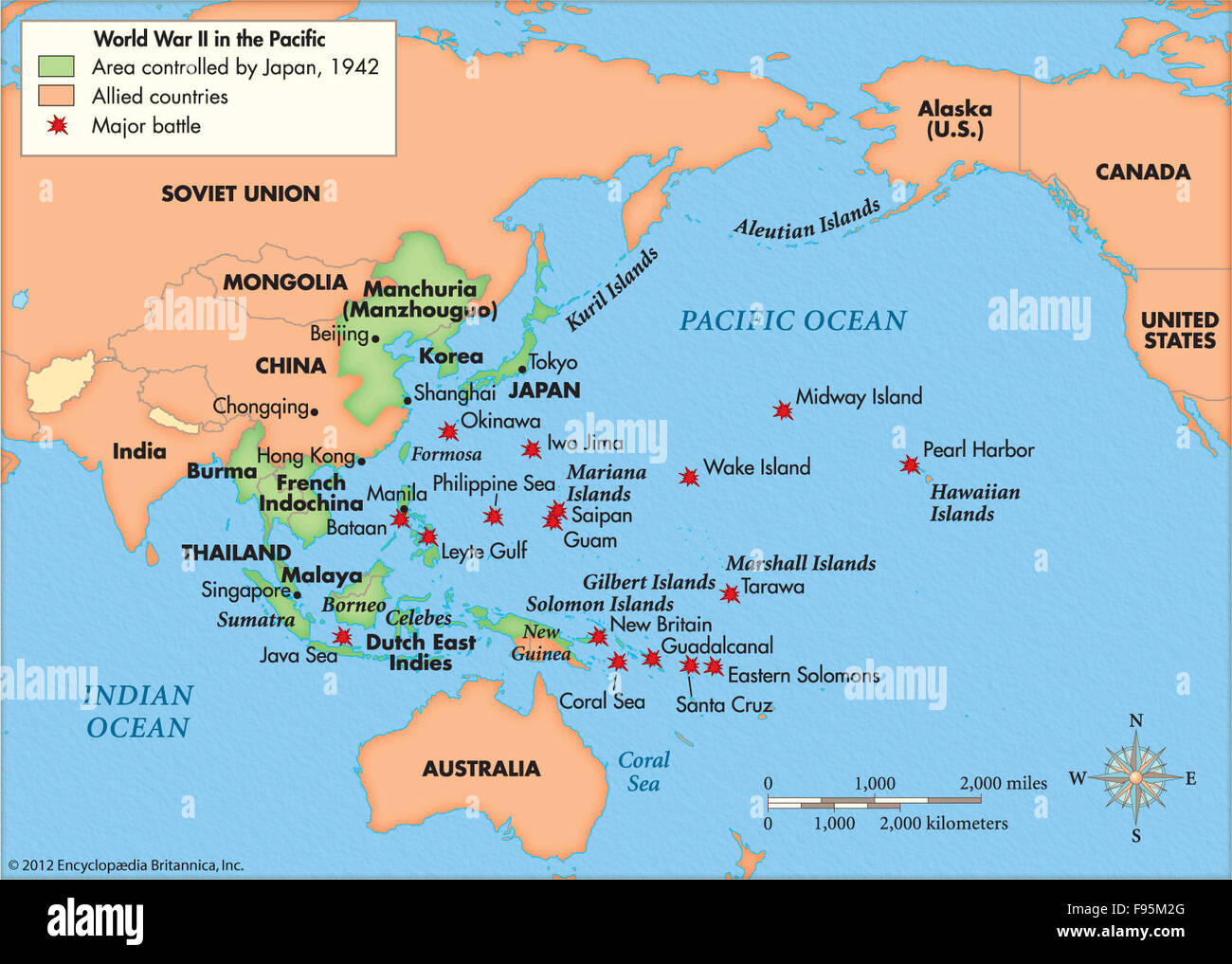
Following the attack on Pearl Harbor in December 1941, the Imperial Japanese Navy (IJN) expanded rapidly across the Pacific, seizing Southeast Asia, the Philippines, and key island groups. To eliminate the remaining threat posed by the U.S. Pacific Fleet aircraft carriers, Admiral Isoroku Yamamoto planned a trap to capture Midway Atoll, drawing U.S. forces into a decisive naval engagement.
Strategic Context and Operational Execution
The U.S. Navy held a critical intelligence advantage. Codebreakers at Station HYPO in Hawaii, led by Commander Joseph Rochefort, partially cracked the Japanese naval code JN-25b. This allowed Pacific Fleet Commander Admiral Chester W. Nimitz to anticipate the exact timing, strength, and location of the Japanese strike force.
When the IJN's First Air Fleet (Kido Butai), commanded by Vice Admiral Chuichi Nagumo, launched air strikes against Midway on June 4, 1942, American carrier forces centered on USS Enterprise, USS Hornet, and the hastily repaired USS Yorktown were already positioned northeast of the island.
The engagement hinged on a critical window on the morning of June 4. While Japanese strike aircraft were rearming on carrier decks, U.S. Douglas SBD Dauntless dive bombers from Enterprise and Yorktown launched a coordinated dive-bombing attack. Within minutes, three Japanese fleet carriers—Akagi, Kaga, and Soryu—were set ablaze by direct hits on armaments and aviation fuel. A fourth carrier, Hiryu, launched a counterstrike that heavily damaged Yorktown, but was destroyed by U.S. bombers later that afternoon.
| Category | Japanese Fleet Air Arm Losses at Midway |
|---|---|
| Carriers Lost | 4 of 4 participating fleet carriers |
| Naval Aviators Lost | 110+ elite flight crew members |
| Strategic Result | Permanent end of IJN carrier offensive dominance |
Strategic Impact
The Battle of Midway halted Japanese naval expansion. Japan lost all four participating fleet carriers, along with over 100 irreplaceable veteran pilots and technicians. The United States lost one carrier (Yorktown) and a destroyer (Hammann).
Beyond material losses, Midway permanently shifted the strategic initiative in the Pacific. Japan could not replace its lost carriers or trained aviators at a pace matching U.S. industrial output. Within two months, the U.S. launched its first major offensive at Guadalcanal, initiating an unbroken strategic advance toward the Japanese mainland.
2. Second Battle of El Alamein (October 23 – November 11, 1942) – Securing the Mediterranean
By mid-1942, Field Marshal Erwin Rommel's Axis forces (Panzer Army Africa) had advanced across North Africa into Egypt, stopping just 60 miles west of Alexandria at the railroad halt of El Alamein. Axis control of Egypt threatened to sever Britain's access to the Suez Canal—the maritime lifeline to British India and Australasia—and offered Axis armies a route into the oil-rich regions of the Middle East.
Operational Execution and Tactical Mechanics
General Bernard Montgomery assumed command of the British Eighth Army in August 1942 and initiated a systematic buildup of armor, artillery, and infantry. Supported by air superiority from the Royal Air Force, Montgomery prepared Operation Lightfoot, a methodical attrition attack designed to punch through dense Axis minefields (known as "Devil's Gardens") and destroy Axis armor in a controlled battle of firepower.
| Army | Men | Tanks | Artillery Pieces |
|---|---|---|---|
| Eighth Army (Allied) | ~195,000 men | 1,029 tanks | 908 artillery pieces |
| Panzer Army (Axis) | ~116,000 men | 547 tanks | 552 artillery pieces |
Launched on the night of October 23, 1942, Operation Lightfoot opened with an artillery barrage from over 800 guns. Infantry divisions cleared paths through the minefields under fire, followed by armored divisions. Rommel launched counterattacks, but severe fuel shortages caused by Allied naval attacks on Mediterranean supply convoys crippled Axis mobility.
On November 2, Montgomery launched Operation Supercharge, forcing a breach in the Axis defensive line. Realizing his armor was broken and fuel reserves exhausted, Rommel ordered a retreat on November 4, abandoning large quantities of equipment and non-motorized Italian units.
Strategic Impact
The Allied victory at El Alamein ended Axis expansion in North Africa. Combined with the Allied amphibious landings in French North Africa (Operation Torch) days later in November 1942, the victory trapped Axis forces in Tunisia, leading to their surrender in May 1943.
El Alamein secured the Suez Canal, protected Middle Eastern oil reserves, and cleared the way for the Allied invasion of Sicily and the Italian mainland, opening a third front that diverted German divisions from Western Europe and the Soviet Union.
3. Battle of Stalingrad (August 23, 1942 – February 2, 1943) – The Eastern Front's Fatal Blow
In June 1942, Adolf Hitler launched Case Blue (Operation Braunschweig), a massive summer offensive targeting the industrial assets of Southern Russia and the vital oil fields of the Caucasus. The German 6th Army, commanded by General Friedrich Paulus, was tasked with securing the flank of the advance by capturing Stalingrad, an industrial hub along the Volga River.
The Siege and Operation Uranus
The battle developed into one of the bloodiest engagements in human history. German aerial bombardment reduced Stalingrad to rubble, creating an urban battleground ideally suited for close-quarters infantry defense. General Vasily Chuikov’s 62nd Army held a narrow strip of land along the western bank of the Volga, forcing the 6th Army into grinding urban warfare (Rattenkrieg).
As German forces consumed resources fighting inside the city, Soviet Red Army commanders—Marshal Georgi Zhukov and Marshal Aleksandr Vasilevsky—prepared a strategic counteroffensive. On November 19, 1942, the Red Army launched Operation Uranus, a double envelopment targeting weak Hungarian, Romanian, and Italian divisions guarding the 6th Army's northern and southern flanks.
- Soviet Northern Spearhead
- Soviet Southern Spearhead
- German 6th Army Trapped Inside Stalingrad Pocket (~265,000 men)
- Failed Luftwaffe Airlift
Within four days, the Soviet pincers met at Kalach-na-Donu, encircling roughly 265,000 German and Axis soldiers inside the Stalingrad pocket. Attempts by Field Marshal Erich von Manstein to break through to the encircled army failed (Operation Winter Storm), while the Luftwaffe’s attempt to resupply the pocket by air fell far short of daily requirements. Severely weakened by starvation, frostbite, and ammunition exhaustion, Paulus surrendered the remaining 91,000 Axis troops on February 2, 1943.
Strategic Impact
Stalingrad permanently shifted the strategic balance on the Eastern Front. Axis combat forces suffered over 800,000 total casualties, including the absolute loss of an entire field army and substantial frontline equipment.
The battle shattered the myth of German military invincibility, boosted global Allied morale, and forced the Wehrmacht into a strategic retreat across the Soviet Union from which it never recovered.
4. Battle of Kursk (July 5 – August 23, 1943) – The End of German Armor Supremacy
Following the disaster at Stalingrad, German command sought to regain the strategic initiative on the Eastern Front by destroying a massive Red Army bulge (salient) extending into German lines around the city of Kursk. Code-named Operation Citadel, the planned offensive aimed to encircle multiple Soviet armies using armored pincers from the north and south.
Defense-in-Depth and the Battle of Prokhorovka
Forewarned of the attack through British intelligence (ULTRA) and Soviet spy networks, Red Army commanders converted the Kursk salient into the most heavily fortified defense network in history. Under Marshal Zhukov, the Red Army constructed six defensive belts extending up to 150 miles deep, incorporating millions of anti-tank mines, miles of anti-tank trenches, and thousands of artillery emplacements (Pak-fronts).
| Category | Kursk Defensive Strength (Soviet Preparation) |
|---|---|
| Mine Density | Up to 3,000 anti-tank mines per kilometer of front |
| Defensive Belts | 6 distinct operational zones |
| Anti-tank Guns | 20,000+ guns positioned in concentrated strongpoints |
When Germany launched Operation Citadel on July 5, 1943, using its newest heavy armor—including Tiger I and Panther tanks—the assault stalled in the Soviet defensive zones. In the north, the German Ninth Army made minimal gains. In the south, the 4th Panzer Army pushed deeper, culminating on July 12 in the massive armored engagement near Prokhorovka, where hundreds of Soviet and German armored vehicles fought at point-blank range.
Unable to achieve an operational breakthrough and facing the Allied landings in Sicily on July 10, Hitler cancelled Operation Citadel on July 13. The Red Army immediately launched planned counter-offensives (Operation Kutuzov and Operation Rumyantsev), liberating Orel, Belgorod, and Kharkov.
- Soviet Northern Front (Rokossovsky)
- KURSK SALIENT DEFENSES (3,000 mines/km | Deep Anti-Tank Artillery Belts)
- German 4th Panzer Army (Hoth)
- Collision at Prokhorovka (July 12)
Strategic Impact
Kursk was a turning point because it marked the first time a German summer offensive was repulsed before achieving an operational breakthrough. The Wehrmacht suffered heavy casualties in specialized armored formations and lost irreplaceable equipment.
From August 1943 onward, the Red Army maintained the strategic initiative along the entire Eastern Front, launching a continuous series of offensives that drove German forces back to Berlin.
5. Battle of Normandy / Operation Overlord (June 6 – August 30, 1944) – Opening the Western Front
Since 1941, Soviet leader Joseph Stalin had urged his Western Allies to open a major second front in Western Europe to relieve the strain on Soviet forces. On June 6, 1944 (D-Day), the Supreme Headquarters Allied Expeditionary Force (SHAEF), commanded by General Dwight D. Eisenhower, launched Operation Overlord—the largest amphibious invasion in history.
Operation Overlord Breakdown
Landing across five beach sectors in Normandy, France (Utah, Omaha, Gold, Juno, and Sword), Allied forces established a foothold in occupied Western Europe.
| Beach Sector | Assigned Forces | Key Defensive & Tactical Challenges |
|---|---|---|
| Utah | U.S. 4th Infantry Div. | Flooded inland causeways, light resistance |
| Omaha | U.S. 1st & 29th Inf. Div | High bluffs, intact German 352nd Division |
| Gold | British 50th Inf. Div. | Heavy coastal fortifications, quick breakout |
| Juno | Canadian 3rd Inf. Div. | Reefs, minefields, strong concrete bunkers |
| Sword | British 3rd Inf. Div. | Armored counterattack by 21st Panzer Div. |
Supported by naval bombardment, air power, and a deception plan (Operation Fortitude) that kept key German reserve forces near the Pas-de-Calais, the Allies landed over 156,000 troops on the first day despite heavy resistance at Omaha Beach.
Following weeks of brutal warfare in the Normandy hedgerow terrain (bocage), U.S. forces under General Omar Bradley launched Operation Cobra on July 25, breaching the German left flank. This allowed General George S. Patton’s U.S. Third Army to sweep into open countryside, encircling tens of thousands of German troops in the Falaise Pocket alongside British and Canadian forces.
By late August 1944, Allied forces had liberated Paris, crossing the Seine and driving German forces back toward the Reich border.
- ALLIED AMPHIBIOUS LANDINGS (D-Day: June 6, 1944 - 156,000+ Men)
- Bocage Hedgerow Fighting
- Operation Cobra Breakout (General Bradley - July 25, 1944)
- Falaise Pocket Encirclement (Destruction of German Army Group B)
- Liberation of Paris & Advance
Strategic Impact
Operation Overlord established a permanent Western Front, trapping Germany in a multi-front land war. The battle crippled German forces in the West, resulting in over 400,000 German casualties and the loss of critical war matériel.
The liberation of France deprived Germany of key economic resources, submarine bases along the Atlantic coast, and radar early-warning systems, accelerating the final collapse of the Third Reich.
Comparative Analysis of the Pivotal Battles
The following detailed matrix compares the parameters, operational factors, and strategic impacts of these five battles:
| Battle Name | Dates | Primary Theater | Key Belligerents | Core Operational Factor | Immediate Strategic Consequence |
|---|---|---|---|---|---|
| Midway | June 4–7, 1942 | Pacific Ocean | United States vs. Japan | Cryptanalysis (JN-25b) & Carrier Dive-Bombing | Destroyed IJN carrier force; ended Japanese offensive expansion in the Pacific. |
| Second El Alamein | Oct 23 – Nov 11, 1942 | North Africa | Great Britain/Commonwealth vs. Germany & Italy | Methodical Attrition & Minefield Clearance | Secured Suez Canal & oil reserves; led to evacuation of Axis forces from Africa. |
| Stalingrad | Aug 23, 1942 – Feb 2, 1943 | Eastern Europe | Soviet Union vs. Germany, Romania, Italy, Hungary | Close-Quarters Urban Warfare & Encirclement | Destroyed German 6th Army; permanently broke Axis momentum in the East. |
| Kursk | July 5 – Aug 23, 1943 | Eastern Europe | Soviet Union vs. Germany | Deep Fortified Networks & Anti-Tank Belts | Ended German capacity to launch major summer offensives in Europe. |
| Normandy (Overlord) | June 6 – Aug 30, 1944 | Western Europe | US, UK, Canada vs. Germany | Combined Amphibious Assault & Air Dominance | Reopened Western Front; liberated Western Europe; forced a two-front land war. |
Technological, Tactical, and Logistical Innovations
These five battles were defined not only by soldier bravery, but also by breakthroughs in technology, logistics, and military doctrine that redefined mid-20th-century warfare.
Signal Intelligence and Cryptanalysis
Radio intelligence played a decisive operational role at Midway and Normandy. At Midway, U.S. cryptanalysts' ability to decipher Japanese naval codes allowed commanders to position numerical inferiors in an ideal ambush position.
Similarly, the British ULTRA program decrypted German Enigma transmissions, providing Allied leaders with detailed knowledge of German troop movements, strength reports, and supply lines prior to El Alamein, Kursk, and Normandy.
| Battle | Intelligence System | Tactical Advantage Gained |
|---|---|---|
| Midway | Station HYPO (JN-25b) | Ambushed 4 IJN carriers near Midway |
| El Alamein | ULTRA (Enigma) | Targeted supply convoys; calculated fuel limits |
| Kursk | Lucy Spy Ring & ULTRA | Built defense belts at exact assault points |
| Normandy | Operation Fortitude | Kept 15th Army tied down at Pas-de-Calais |
Defense-in-Depth and Anti-Tank Doctrine
The battles at Stalingrad and Kursk reshaped defensive tactics against Blitzkrieg armor tactics. At Kursk, the Soviet Red Army integrated intelligence, logistics, and engineering to build dense defensive belts.
Rather than relying on fixed lines like France's Maginot Line, Red Army doctrine emphasized layered defense zones with mobile anti-tank reserves (Pak-fronts), minefield traps, and immediate operational counter-offensives. This approach defeated massed armored thrusts.
| Concept / Strategy | Description |
|---|---|
| Blitzkrieg Concept | Concentrated armor penetration at weak points. |
| Soviet Counter-Strategy | Layered minefields force armor into pre-targeted artillery kill zones (Pak-fronts), supported by operational-level tank reserves. |
Combined Arms and Artificial Harbor Logistics
Operation Overlord required unprecedented engineering and logistical innovations to sustain over one million troops without an immediate deep-water port.
The Allies built artificial floating harbors (Mulberry Harbors), laid a flexible pipeline across the English Channel (PLUTO) to deliver fuel, and utilized thousands of specialized armored vehicles ("Funnies") to clear obstacles, lay bridges, and neutralize bunkers during the initial assault.
| Innovation | Details |
|---|---|
| Mulberry Harbors | Pre-fabricated artificial ports towed across the Channel |
| PLUTO Pipeline | Undersea pipeline supplying millions of gallons of fuel |
| Specialized Armor | Modified tanks designed for mine-clearing and bunker breaching |
Common Historical Misconceptions
Evaluating World War II battles requires separating long-standing myths from verified archival evidence.
Misconception 1: "Kursk Was Stopped Solely Because of Allied Landings in Sicily"
While Hitler cited the Allied invasion of Sicily (Operation Husky) on July 10, 1943, as a reason to suspend Operation Citadel, modern military historians note that the offensive was already failing. German armor had suffered catastrophic attrition in the Soviet defensive networks, particularly in the northern sector, making a strategic breakthrough unlikely regardless of events in the Mediterranean.
Misconception 2: "The Battle of Midway Was Won Purely by Chance"
Popular accounts often present the destruction of three Japanese aircraft carriers within fifteen minutes as an accident of luck. While timing played a role, the victory was the result of long-term cryptanalysis, accurate aerial recon, flexible operational planning, and the tactical decisions made by American dive-bomber squad commanders.
Misconception 3: "Operation Overlord Was the Single Reason Germany Lost the War"
While D-Day was vital for liberating Western Europe and preventing Soviet domination of the entire continent, the Wehrmacht had already been severely depleted on the Eastern Front. By June 1944, the Red Army had destroyed vast numbers of German divisions; D-Day ensured that Germany was squeezed in a multi-front warfare scenario it could not sustain.
Frequently Asked Questions
Why is the Battle of Britain not included in this top list of turning points?
The Battle of Britain (July–October 1940) was a strategic victory that prevented an immediate German amphibious invasion (Operation Sea Lion) and kept Great Britain active in the war. However, it did not break the German army's ground capabilities or shift the strategic offensive initiative away from Germany across the global war theaters, as occurred later at Midway, Stalingrad, and El Alamein.
Which battle resulted in the highest number of casualties during World War II?
The Battle of Stalingrad remains the deadliest single engagement in military history, with estimated total casualties (military and civilian) exceeding 1.8 to 2 million. This includes over 800,000 Axis casualties and more than 1.1 million Red Army casualties.
How did industrial output affect the final outcomes of these battles?
Industrial capacity directly sustained the operational victories. While tactical engagements destroyed physical assets, the United States and the Soviet Union possessed superior manufacturing bases capable of rapidly replacing lost tanks, aircraft, and ships. Axis industrial facilities in Germany and Japan lacked access to sufficient raw materials—such as crude oil and rubber—and faced continuous strategic bombing campaigns.
Could Axis forces have won the war if they had captured Stalingrad?
Capturing Stalingrad would have cut the Volga River supply route, severely disrupting Soviet war material movement. However, historical analysis suggests it would not have automatically ended the war. The Red Army retained vast operational depth, industrial centers behind the Ural Mountains, and substantial reserve armies that could still launch strategic counter-offensives against extended Axis lines.
What role did deception operations play in the success of the Normandy invasion?
Deception operations, primarily Operation Fortitude, were vital to the success of Operation Overlord. By using dummy equipment, fake radio traffic, and double agents, the Allies convinced German high command that the main invasion would occur at the Pas-de-Calais rather than Normandy. This delayed the deployment of powerful German armored reserves for days after D-Day.
Strategic Lessons and Next Actions for Historical Analysis
Studying the turning points of World War II illustrates how military success relies on a combination of intelligence, logistical planning, industrial output, and adaptable operational doctrine. Combat power alone rarely guarantees success without secure supply networks and operational flexibility.
To deepen your understanding of World War II military strategy:
- Examine Primary Sources: Review official operational records, combat after-action reports, and war diaries available through institutions like the U.S. Army Center of Military History or the National Archives.
- Analyze Logistics Networks: Compare the fuel, material, and transport requirements of Blitzkrieg campaigns against long-term Allied supply chains like the Lend-Lease program and Liberty ship operations.
- Study Multi-Domain Warfare: Investigate how modern combined-arms concepts—integrating land, sea, air, and signal intelligence—originated during these strategic engagements.