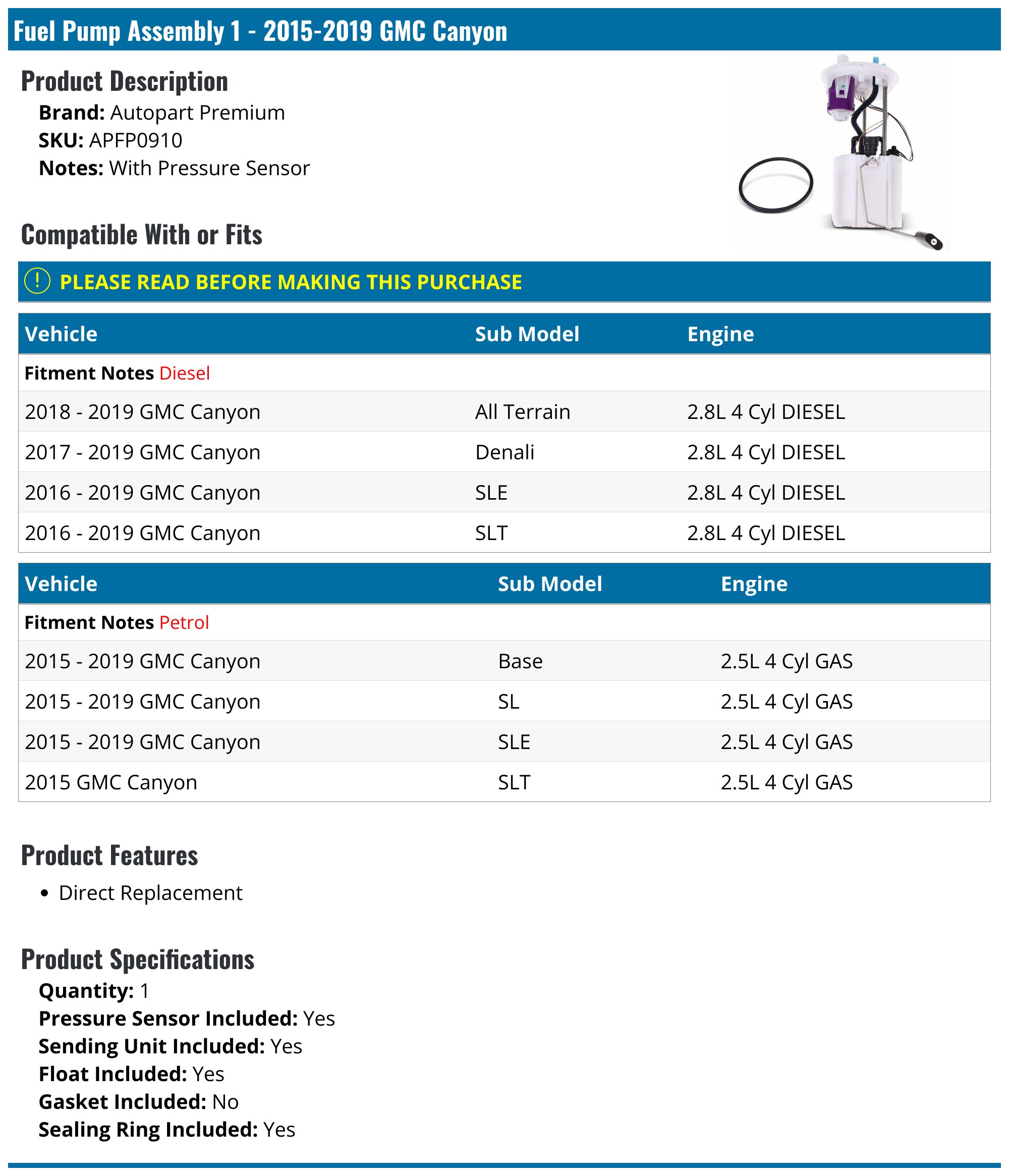
Every version of the 2017 GMC Canyon features a standard fuel tank capacity of 21.0 US gallons (79.5 liters / 17.5 Imperial gallons). This uniform capacity applies across all trim levels, cab styles (Extended Cab and Crew Cab), bed lengths (5'2" short box and 6'2" long box), and engine options, including the 2.5L 4-cylinder, 3.6L V6, and 2.8L Duramax Turbo-Diesel.
2017 GMC Canyon Fuel Tank Specifications Overview
When evaluating midsize pickup trucks, fuel capacity serves as a foundational metric for predicting maximum driving range, planning long-distance towing routes, and budgeting routine operational costs. In the 2017 GMC Canyon, General Motors implemented a single, standardized fuel tank design across the entire vehicle lineup. Whether a driver selects a base-level Extended Cab work truck or a top-tier Denali Crew Cab Long Box, the fuel tank holds exactly 21.0 US gallons.
| Specification | Detail |
|---|---|
| Total Capacity | 21.0 US Gallons (79.5 Liters) |
| Tank Location | Driver-side, Inboard of Frame Rails |
| Tank Material | High-Density Polyethylene (HDPE) |
| Low Fuel Reserve | Approx. 2.0 to 2.5 Gallons Remaining |
Uniformity Across Body Styles and Trim Levels
In many truck classes, manufacturers offer varying tank sizes based on wheelbase, cab configuration, or box length. For the second-generation Canyon platform (GMT31XX shared with the Chevrolet Colorado), GM streamlined manufacturing by using a uniform tank shell.
- Extended Cab / 6'2" Bed: 21.0 gallons
- Crew Cab / 5'2" Short Bed: 21.0 gallons
- Crew Cab / 6'2" Long Bed: 21.0 gallons
- Trim Levels (SL, Canyon, SLE, SLT, All Terrain, Denali): 21.0 gallons
Tank Construction and Location
The fuel tank in the 2017 Canyon is constructed from blow-molded High-Density Polyethylene (HDPE) plastic. Polyethylene offers several structural advantages over traditional steel tanks: it resists internal corrosion caused by ethanol-blended fuels, reduces overall vehicle curb weight, and absorbs minor underbody impacts without cracking.
The tank is positioned along the inner left (driver-side) frame rail, forward of the rear axle. This placement protects the fuel cell inside the high-strength steel frame structure in the event of a side-impact collision. Additionally, off-road variants like the All Terrain package feature protective transfer case and underbody shields to safeguard vital chassis components from rock strikes and ground clearance hazards.
Engine Options, Fuel Types, and Octane Requirements
The 2017 model year marked a significant powertrain update for the GMC Canyon lineup. GM introduced an updated 3.6L V6 engine (code LGX) paired with an 8-speed automatic transmission, while continuing to offer the base 2.5L gas engine and the high-efficiency 2.8L Duramax Turbo-Diesel. Each engine option mandates specific fuel formulations and octane ratings to ensure optimal combustion efficiency and component longevity.
1. 2.5L 4-Cylinder Gas Engine (LCV)
- Engine Type: Naturally Aspirated Direct Injection I4
- Power Output: 200 hp @ 6,300 RPM | 191 lb-ft torque @ 4,400 RPM
- Recommended Fuel: Regular Unleaded Gasoline (87 Octane / 87 AKI)
- Ethanol Tolerance: Up to E10 (10% Ethanol) or E15 (15% Ethanol max, if labeled approved by GM). Not Flex-Fuel (E85) compatible.
The 2.5L engine acts as the base powertrain, designed primarily for light-duty fleet applications and daily commuting. It utilizes direct fuel injection and variable valve timing (VVT) to maintain complete combustion on standard 87-octane pump gas. Premium fuel is not required and offers no performance gains for this powertrain.
2. 3.6L V6 Gas Engine (LGX)
- Engine Type: Direct Injection V6 with Active Fuel Management (AFM)
- Power Output: 308 hp @ 6,800 RPM | 275 lb-ft torque @ 4,000 RPM
- Transmission: 8-Speed Automatic (Hydra-Matic 8L45)
- Recommended Fuel: Regular Unleaded Gasoline (87 Octane / 87 AKI)
- Ethanol Tolerance: Maximum E10/E15. Not Flex-Fuel (E85) compatible.
Introduced for the 2017 model year, the 3.6L LGX V6 replaced the older LFX engine. It incorporated cylinder deactivation (Active Fuel Management), shutting down two cylinders under light load conditions to conserve fuel. The engine control unit (ECU) is tuned to run on standard 87-octane fuel. While higher octane fuel can be used without damaging the engine, the factory engine mapping does not require premium fuel under standard driving conditions.
3. 2.8L Duramax Turbo-Diesel Engine (LWN)
- Engine Type: Inline 4-Cylinder Turbocharged Diesel
- Power Output: 181 hp @ 3,400 RPM | 369 lb-ft torque @ 2,000 RPM
- Recommended Fuel: Ultra-Low Sulfur Diesel (ULSD) (15 ppm sulfur maximum)
- Biodiesel Blend Tolerance: Up to B5 (5% Biodiesel) standard; up to B20 (20% Biodiesel) only where authorized in specific commercial fleet configurations meeting GM guidelines.
The 2.8L Duramax requires ULSD to protect the Diesel Particulate Filter (DPF) and Selective Catalytic Reduction (SCR) exhaust aftertreatment systems. Using high-sulfur diesel fuel will rapidly contaminate the DPF, lead to severe emissions equipment failures, and void engine warranties.
Diesel Exhaust Fluid (DEF) Capacity
Diesel models feature a separate dedicated Diesel Exhaust Fluid (DEF) tank alongside the primary fuel system.
- DEF Tank Capacity: Approximately 5.4 US gallons (20.4 liters).
- Fill Location: Located behind the fuel filler door, adjacent to the green diesel fuel cap.
- Consumption Rate: Typically requires a DEF refill every 3,000 to 5,000 miles, depending on payload and towing severity.
Official EPA Fuel Economy and Theoretical Driving Range
Driving range on a single 21.0-gallon tank varies considerably depending on the engine, drivetrain configuration (2WD vs. 4WD), and driving environment. Data provided by the U.S. Department of Energy's FuelEconomy.gov allows owners to calculate expected distances between fill-ups.
The theoretical maximum highway range is calculated using the full 21.0-gallon tank capacity multiplied by the highway MPG rating. However, because drivers should never run a fuel tank completely dry, realistic range estimates account for a 2-gallon safety buffer (calculating range based on 19.0 usable gallons).
2017 GMC Canyon Fuel Economy & Range Matrix
| Engine & Drivetrain | Transmission | EPA City MPG | EPA Hwy MPG | EPA Comb MPG | Max Theoretical Hwy Range | Realistic Hwy Range (19 Gal Usable) |
|---|---|---|---|---|---|---|
| 2.5L I4 2WD | 6-Speed Manual | 19 | 26 | 22 | 546 miles | ~494 miles |
| 2.5L I4 2WD | 6-Speed Automatic | 20 | 26 | 22 | 546 miles | ~494 miles |
| 2.5L I4 4WD | 6-Speed Automatic | 19 | 24 | 21 | 504 miles | ~456 miles |
| 3.6L V6 2WD | 8-Speed Automatic | 18 | 25 | 20 | 525 miles | ~475 miles |
| 3.6L V6 4WD | 8-Speed Automatic | 17 | 24 | 19 | 504 miles | ~456 miles |
| 2.8L Diesel 2WD | 6-Speed Automatic | 22 | 30 | 25 | 630 miles | ~570 miles |
| 2.8L Diesel 4WD | 6-Speed Automatic | 20 | 28 | 23 | 588 miles | ~532 miles |
Note: Models equipped with the All Terrain package, aggressive off-road tires, or higher axle ratios experience slightly reduced overall efficiency compared to standard highway trim configurations.
Real-World Driving Range Factors and Efficiency Variables
While official EPA figures establish standardized baselines, operational variables directly alter the mileage and total distance achieved on a single 21-gallon tank.
- Factors Reducing Real-World Driving Range
- Towing & Heavy Payload: Increases Engine Load
- Off-Road Tires / Lift: Increases Drag & Weight
- Ethanol Content (E15): Lower Energy Density
- Cold Winter Weather: Slower Warm-up & Drag
1. Towing Heavy Loads and Payload Demands
The 2017 GMC Canyon boasts a maximum towing capacity of up to 7,000 lbs for the 3.6L V6 and 7,700 lbs for the 2.8L Duramax diesel (when properly equipped with the trailering package). However, pulling a heavy trailer creates significant aerodynamic drag and requires constant engine torque.
- 3.6L V6 Under Tow: Expect fuel economy to drop to 10–14 MPG when towing trailers exceeding 4,000 lbs. Under these conditions, the effective highway range on a 21-gallon tank drops to 200–260 miles.
- 2.8L Duramax Under Tow: Due to high low-end torque (369 lb-ft), the diesel engine maintains higher thermal efficiency under load, typically delivering 14–18 MPG while towing. This yields a towing range of 280–350 miles.
2. Aerodynamic Modifications and Aftermarket Accessories
Midsize trucks are sensitive to changes in frontal surface area and ground clearance. Installing common aftermarket upgrades creates parasitic drag:
- Lift Kits and Suspension Leveling: Raising the front end increases air resistance underneath the chassis, reducing highway fuel efficiency by 1 to 2 MPG.
- All-Terrain / Mud-Terrain Tires: Heavy-ply off-road tires increase rolling resistance and rotational mass, cutting city and highway economy by up to 10%.
- Roof Racks and Bed Racks: Carrying kayaks, roof boxes, or rooftop tents disrupts smooth airflow, leading to a noticeable drop in highway range.
3. Ambient Temperature and Seasonal Fuel Blends
Fuel density changes with extreme ambient temperatures. During winter months, fuel refiners supply "winter-blend" gasoline, which contains higher levels of volatile hydrocarbons like butane to aid cold starting. Winter gasoline contains roughly 1.5% to 3% less energy per gallon than summer blends.
Furthermore, cold engine oil, thickened transmission fluids, and extended idling to warm up the cabin reduce cold-weather fuel range by 10–15% compared to warm-weather highway cruising.
4. Oxygenated Fuels and Ethanol Blends
Standard E10 unleaded gasoline contains 10% ethanol by volume. Ethanol holds approximately 33% less energy per gallon than pure gasoline. If operating a 2017 Canyon on E15 fuel, drivers may notice a minor reduction in total miles per tank (1% to 2%) due to the lower energy density of higher ethanol concentration.
Fuel Gauge Behavior, Low Fuel Indicator, and Tank Reserve
Understanding the operation of the 2017 GMC Canyon fuel level sensor prevents unexpected fuel exhaustion and protects internal fuel system hardware.
Fuel Sender Assembly Operation
The fuel level in the tank is measured by a floating sender unit integrated into the fuel pump module. The sender uses a variable resistor to transmit an electrical signal to the Body Control Module (BCM), which then displays the fuel level on the instrument cluster driver information center (DIC).
Reserve Volume and Low Fuel Warning
When the fuel gauge needle reaches the red "E" marker, or when the Driver Information Center displays a "Low Fuel" message, the tank is not completely empty.
- Trigger Threshold: The low fuel light typically illuminates when there are approximately 2.0 to 2.5 US gallons remaining in the tank.
- Safety Margin Distance: On a 3.6L V6 model averaging 20 MPG, illumination of the low fuel light indicates that the driver has roughly 40 to 50 miles of cautious driving range remaining before total starvation occurs.
- Diesel Specific Warning: In 2.8L Duramax models, driving on extremely low fuel risks pulling air into the high-pressure fuel injection lines, which can lead to engine stalling and hard-restarting issues requiring manual system priming.
Hydrodynamic Cooling of the Electric Fuel Pump
In all gasoline-powered 2017 Canyon models, the electric fuel pump is physically submerged inside the fuel tank module. Liquid gasoline acts as a coolant and lubricant for the internal electric pump motor during operation.
Running the tank down to absolute empty on a regular basis exposes the top of the pump assembly to air. Without full liquid submersion:
- The electric motor operates at higher internal temperatures, causing premature thermal wear on internal windings and bearings.
- The pump inlet screen risks drawing concentrated sediment, condensation rust, or particulate debris off the very bottom of the tank floor.
- Air ingestion can cause transient fuel pressure drops, leading to cylinder misfires under load.
Best Practice: Refill the tank when the fuel level reaches 1/4 remaining to ensure continuous cooling of the pump and prevent fuel starvation on steep inclines.
Fuel System Maintenance and Long-Term Care
To maintain designed fuel economy standards and prevent premature component failure over the lifespan of a 2017 GMC Canyon, adhere to established fuel system maintenance protocols published by General Motors.
| Engine Type | Maintenance Task | Interval |
|---|---|---|
| Gas Engines (2.5L / 3.6L) | Fuel Cap Seals Check | Every 15,000 Miles |
| Gas Engines (2.5L / 3.6L) | Top Tier Fuel Use | Continuous |
| Gas Engines (2.5L / 3.6L) | Intake Valve Cleaning | Every 45,000 - 60,000 Miles |
| Diesel Engine (2.8L Duramax) | Fuel Filter Replacement | Every 15,000 Miles (or via DIC Monitor) |
| Diesel Engine (2.8L Duramax) | DEF System Inspection | At Every Oil Change |
| Diesel Engine (2.8L Duramax) | Water Drain Procedure | Immediate upon "Water in Fuel" Light |
Diesel Fuel Filter Maintenance (2.8L Duramax)
Unlike gasoline models, which feature a non-serviceable fuel strainer integrated into the in-tank module, the 2.8L Duramax diesel engine uses an external frame-mounted fuel filter assembly equipped with a built-in water separator.
- Replacement Interval: GM recommends replacing the diesel fuel filter every 15,000 miles or whenever the DIC displays the "Change Fuel Filter" prompt (whichever comes first).
- Water-in-Fuel Sensor: If the fuel filter housing traps excess condensation water from poor-quality diesel fuel, a warning light activates on the dashboard. The water bowl must be drained manually using the valve located at the base of the filter filter housing to prevent high-pressure fuel pump (CP4) damage.
- System Bleeding: After changing the diesel filter, cycle the ignition to the "ON" position (without starting) several times to allow the lift pump to prime the system and purge trapped air before engine ignition.
Direct Injection Care (Gas Engines)
Both the 2.5L I4 and 3.6L V6 engines utilize Gasoline Direct Injection (GDI). Direct injection sprays high-pressure fuel directly into the combustion chamber rather than onto the back of the intake valves.
Because fuel does not wash over the intake valves, carbon deposits can accumulate on the valve stems over time. To minimize carbon buildup and maintain smooth idling:
- Use TOP TIER™ detergent gasoline, which contains additive packages that minimize combustion chamber deposits. Refer to the official TOP TIER™ Licensed Brands directory to find qualified retail fuel stations.
- Consider applying a professional intake valve cleaner through the vacuum port every 45,000 to 60,000 miles to remove persistent carbon buildup.
Frequently Asked Questions
Does the 2017 GMC Canyon Crew Cab Long Bed have a larger fuel tank?
No. All body configurations—including the Crew Cab Long Bed (6'2" box)—use the exact same 21.0-gallon fuel tank. The longer frame length on the extended wheelbase chassis is utilized for structural cross-members and driveshaft spacing rather than an enlarged fuel tank shell.
What type of gas should I use in a 2017 GMC Canyon 3.6L V6?
The 2017 GMC Canyon 3.6L V6 engine is engineered to operate on standard 87 Octane (Regular Unleaded) gasoline. Mid-grade (89 octane) or Premium (91/93 octane) fuels are acceptable but do not provide noticeable performance gains or improved fuel economy under normal operating conditions.
How far can the 2017 GMC Canyon Diesel drive on one tank of fuel?
Under ideal highway driving conditions, a 2WD 2.8L Duramax diesel model rated at 30 MPG highway can theoretically achieve up to 630 miles on a full 21.0-gallon tank. In real-world combined driving, owners typically achieve 480 to 550 miles per tank before needing to refill.
How many gallons remain when the GMC Canyon low fuel light turns on?
The low fuel warning light typically illuminates when there are approximately 2.0 to 2.5 gallons of usable fuel left in the tank. Depending on your engine type and driving conditions, this leaves a safety cushion of roughly 35 to 55 miles to locate a gas station.
Can I run Flex-Fuel (E85) in my 2017 GMC Canyon?
No. The 2017 GMC Canyon gas engines (2.5L I4 and 3.6L V6) are not Flex-Fuel compatible. They are designed to run on unleaded gasoline containing no more than 10% to 15% ethanol (E10/E15). Filling the tank with E85 flex fuel will cause severe fuel trim errors, illumination of the Check Engine Light, and potential fuel system component corrosion.
Practical Action Steps for Owners
- Calculate Safe Refueling Intervals: Multiply your personal average MPG by 18 (leaving a 3-gallon buffer) to determine your realistic vehicle range per tank. Reset your Trip A odometer at every fill-up to monitor your driving range accurately.
- Adhere to Diesel Filter Intervals: If operating a 2.8L Duramax, change the fuel filter every 15,000 miles without exception. Fuel system contamination in high-pressure diesel systems can result in costly repairs.
- Use Quality Fuel: Consistently fill up at TOP TIER™ certified stations to ensure optimal fuel detergent levels, reducing direct-injection valve fouling and injector clogging over time.
- Protect the Fuel Pump: Avoid routinely driving with the fuel gauge needle dipping into the bottom red section to protect the submerged electric fuel pump from overheating and premature wear.