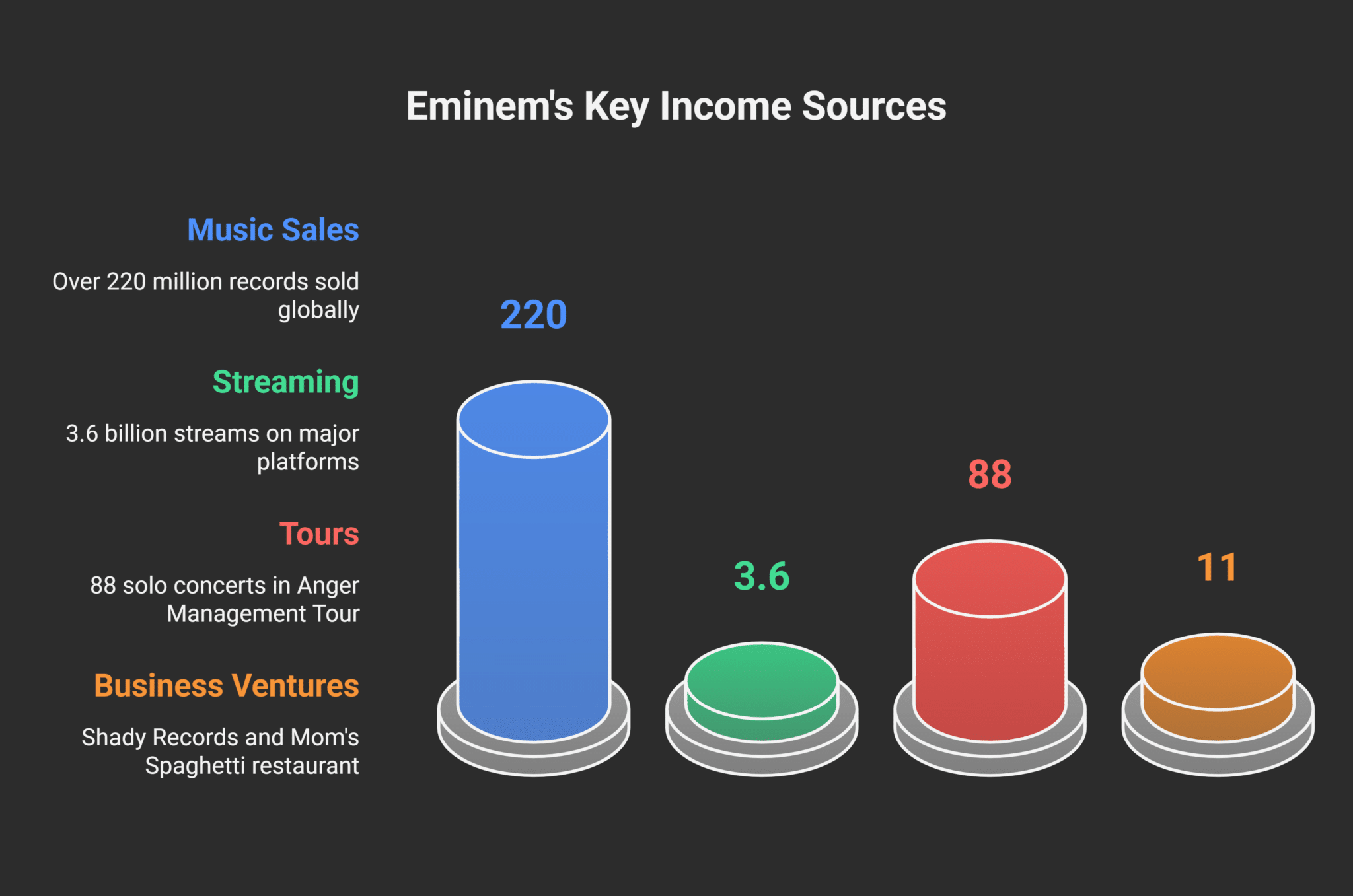
In 2013, Eminem’s estimated net worth sat between $140 million and $160 million, fueled by the monumental release of The Marshall Mathers LP 2. The album served as a commercial juggernaut, moving 792,000 copies in its first week in the United States and finishing the year as one of the highest-selling global releases.
The year 2013 represented a critical juncture in Marshall Mathers’ career. After the massive success of Recovery in 2010, which shifted his sound toward a more anthemic, stadium-rock influenced hip-hop, the industry waited to see if he could maintain his commercial dominance. With the announcement of The Marshall Mathers LP 2 (MMLP2), Eminem signaled a return to his roots, albeit with the technical precision of a veteran. This period was not merely a "comeback" but a consolidation of his status as one of the few legacy artists capable of moving physical units in an increasingly digital and streaming-focused market.
The Financial Landscape: Eminem’s 2013 Net Worth
Estimating the net worth of a high-profile artist like Eminem involves looking at accumulated assets, catalog valuation, and the specific "cash king" earnings reported for the fiscal year. In 2013, Forbes listed Eminem among the top earners in hip-hop, though he often trailed moguls like Dr. Dre, Diddy, and Jay-Z because his wealth was primarily derived from music sales and touring rather than diverse business empires like spirits, electronics, or clothing lines.
Core Income Streams
Eminem’s wealth in 2013 was anchored by three primary pillars:
- Music Royalties: As one of the best-selling artists of the 2000s, his "back catalog" (including The Slim Shady LP, The Marshall Mathers LP, and The Eminem Show) continued to generate millions of dollars annually through synchronized licensing, digital downloads, and the early stages of streaming revenue.
- Shady Records: While the label had seen its peak in the mid-2000s with 50 Cent, in 2013 it remained a functional entity with a roster including Slaughterhouse and Yelawolf. Eminem’s role as an executive provided a secondary layer of corporate income.
- Live Performances: Although 2013 was not a year of a massive global tour (that would follow in 2014 with the Monster Tour), his appearances at major festivals and select European dates commanded multi-million dollar performance fees.
Asset Valuation
Beyond liquid cash, Eminem’s net worth included significant real estate holdings, primarily in Michigan. His 17,000-square-foot mansion in Rochester Hills and his primary residence in Clinton Township represented millions in equity. Furthermore, the valuation of his publishing rights—which he has historically guarded closely—added a massive "paper" value to his overall net worth, often estimated by financial analysts to be the most valuable part of his estate.
Detailed Sales Analysis of The Marshall Mathers LP 2
The release of The Marshall Mathers LP 2 on November 5, 2013, was the definitive musical event of the fourth quarter. It wasn't just an album; it was a brand exercise that leveraged the nostalgia of his most famous work (the original 2000 MMLP) to drive sales in a period where the music industry was struggling with declining physical sales.
First Week Performance
In the United States, MMLP2 debuted at number one on the Billboard 200. The 792,000 copies sold in the first week were staggering for the time, marking the second-largest opening week of 2013, trailing only Justin Timberlake’s The 20/20 Experience. This performance proved that Eminem’s "Stan" base remained loyal and willing to purchase full-priced albums rather than relying solely on individual track downloads.
Global Market Reach
The album’s success was not limited to the domestic market. In the United Kingdom, it sold over 143,000 copies in its first week, becoming the first American artist to achieve seven consecutive UK number-one albums. By the end of 2013, less than two months after its release, the album had been certified Double Platinum by the RIAA, signifying 2 million units shipped (including track-equivalent sales).
Single Success and Revenue Multipliers
The financial success of the album was bolstered by four major singles that dominated the charts in 2013:
- "Berzerk": A tribute to old-school Rick Rubin-produced hip-hop, it was certified 3x Platinum.
- "Survival": Integrated into the Call of Duty: Ghosts marketing campaign, providing a massive corporate licensing payout.
- "Rap God": A viral sensation that set a Guinness World Record for the most words in a hit single, driving massive YouTube ad revenue.
- "The Monster" (feat. Rihanna): A radio-friendly powerhouse that reached Number 1 on the Billboard Hot 100, ensuring the album remained in the top 10 for months.
Comparative Sales Data: 2013 vs. Previous Eras
To understand the magnitude of Eminem’s 2013 performance, it is necessary to compare it to his historical benchmarks. While he did not reach the 1.7 million first-week sales of the year 2000, his 2013 numbers outperformed almost every other contemporary rapper.
| Album Title | Release Year | First Week Sales (US) | Total 2013 Impact/Status |
|---|---|---|---|
| The Marshall Mathers LP | 2000 | 1,760,000 | Diamond Certified (Legacy) |
| The Eminem Show | 2002 | 1,322,000 | Diamond Certified (Legacy) |
| Recovery | 2010 | 741,000 | 4x Platinum by 2013 |
| The Marshall Mathers LP 2 | 2013 | 792,000 | 2x Platinum (Year-end) |
| Magna Carta Holy Grail (Jay-Z) | 2013 | 527,000 | Platinum |
| Nothing Was the Same (Drake) | 2013 | 658,000 | Platinum |
The table illustrates that in 2013, Eminem was still outperforming younger titans like Drake and established peers like Jay-Z in terms of raw "pure" album sales. This is a testament to the demographic reach of his music, which appealed to both the aging "Gen X" fans and a new generation of listeners.
The "Call of Duty" and Brand Partnership Factor
A significant portion of Eminem’s 2013 income came from strategic partnerships. The song "Survival" was premiered within the reveal trailer for Call of Duty: Ghosts. In the 2013 fiscal landscape, these types of "synch" deals (synchronization of music with visual media) were incredibly lucrative.
Industry analysts estimated that the partnership with Activision (the publisher of Call of Duty) included not just a flat fee for the song's use, but also a massive cross-promotional budget that reduced the marketing costs Eminem’s label, Interscope, had to spend. This effectively increased the profit margin on every album sold, as the game’s marketing acted as a multi-million dollar commercial for the album itself.
Catalog Longevity and Recurring Revenue
In 2013, Eminem was one of the few artists whose older albums consistently charted on the "Catalog Albums" chart. For instance, Curtain Call: The Hits (2005) remained a steady seller throughout the year. This recurring revenue is vital for a high net worth because it requires zero additional marketing spend.
The "Eminem Catalog" in 2013 was estimated to be worth hundreds of millions of dollars if sold to a private equity firm—a trend that became popular years later in the 2020s. At the time, Mathers retained most of his publishing through his company, Joel Martin’s 8 Mile Style, and his own Shady Music. This ownership meant that every time "Lose Yourself" played in a stadium or "Till I Collapse" was used in a gym playlist, the majority of that revenue flowed directly to his estate.
Spending and Philanthropy: The Shady Side of Wealth
While the media focused on his earnings, Eminem’s net worth was also managed through controlled spending and significant charitable contributions. In 2013, the Marshall Mathers Foundation continued its work in the Detroit area, focusing on at-risk youth and social programs.
Unlike many of his contemporaries who flaunted wealth through "bling" culture, Mathers was known for a relatively frugal lifestyle regarding personal luxury items, preferring to invest in high-end recording equipment and personal security. This disciplined approach to wealth management ensured that his net worth remained stable even during the years he was not actively releasing music.
Looking Back from 2026: Why 2013 Mattered
From the perspective of 2026, 2013 stands out as the year Eminem proved he could bridge the gap between the "CD era" and the "Streaming era." MMLP2 was his last truly massive physical sales success before the industry shifted almost entirely to DSP (Digital Service Provider) metrics.
The financial success of 2013 provided the capital for Eminem to continue his career on his own terms, leading to later projects like Revival, Kamikaze, and Music To Be Murdered By. It also solidified his position as a "safe bet" for festivals and promoters, ensuring his earning potential remained in the tens of millions for the subsequent decade.
Key Factors for 2013 Financial Dominance:
- The Rubin-Dre Duo: Having both Rick Rubin and Dr. Dre as executive producers added a level of prestige that justified a premium price point for the "Deluxe Edition" of the album.
- Technical Skill as a Product: In 2013, "lyricism" was having a moment of resurgence. Eminem sold his speed and complexity as a unique selling point that couldn't be easily replicated by other artists.
- The Rihanna Connection: By 2013, Rihanna was a global touring force. The collaboration on "The Monster" ensured Eminem remained relevant to the pop-leaning demographic, significantly boosting digital single sales.
FAQ
What was Eminem's highest-selling album in 2013?
The highest-selling album was The Marshall Mathers LP 2, which was released in November 2013. It sold nearly 800,000 copies in its first week in the US and ended the year with approximately 1.7 million units sold domestically.
How did Eminem's 2013 net worth compare to Jay-Z or Dr. Dre?
In 2013, Eminem’s net worth (approx. $140M–$160M) was lower than Jay-Z’s (approx. $500M) and Dr. Dre’s (approx. $350M–$450M). This was because Jay-Z had diversified into sports management and spirits, while Dr. Dre was on the verge of the massive Apple-Beats deal. Eminem remained focused primarily on the music business.
Did "Rap God" contribute significantly to his wealth?
Yes, but primarily through digital longevity and licensing. While it didn't sell as many "units" as a pop song like "The Monster," its viral nature drove millions of views to his Vevo/YouTube channel, which generated substantial ad-sense revenue and cemented his brand as the premier lyricist in the genre.
Was Eminem the best-selling artist of 2013?
He was one of the best-selling, but globally, he was often in competition with pop stars like Justin Timberlake and One Direction. Within the hip-hop genre, however, he was the undisputed leader in pure album sales for 2013.
What happened to the Shady Records profits in 2013?
Shady Records profits in 2013 were reinvested into the label's roster. While the label did not have a "multi-platinum" hit from its other artists that year, the brand's association with the MMLP2 rollout helped maintain the cultural relevance of the entire Shady/Aftermath/Interscope umbrella.
Final Financial Recommendation
For those analyzing historical music industry trends, the 2013 Eminem data serves as a blueprint for brand revitalization. Mathers succeeded by leaning into his heritage (the MMLP name) while updating his sound for contemporary radio. If you are an artist or manager looking to replicate this success, the "2013 strategy" suggests that focusing on high-quality physical releases, strategic corporate partnerships (like Call of Duty), and a strong "hero" single (like "The Monster") remains the most effective way to maximize net worth during an album cycle.