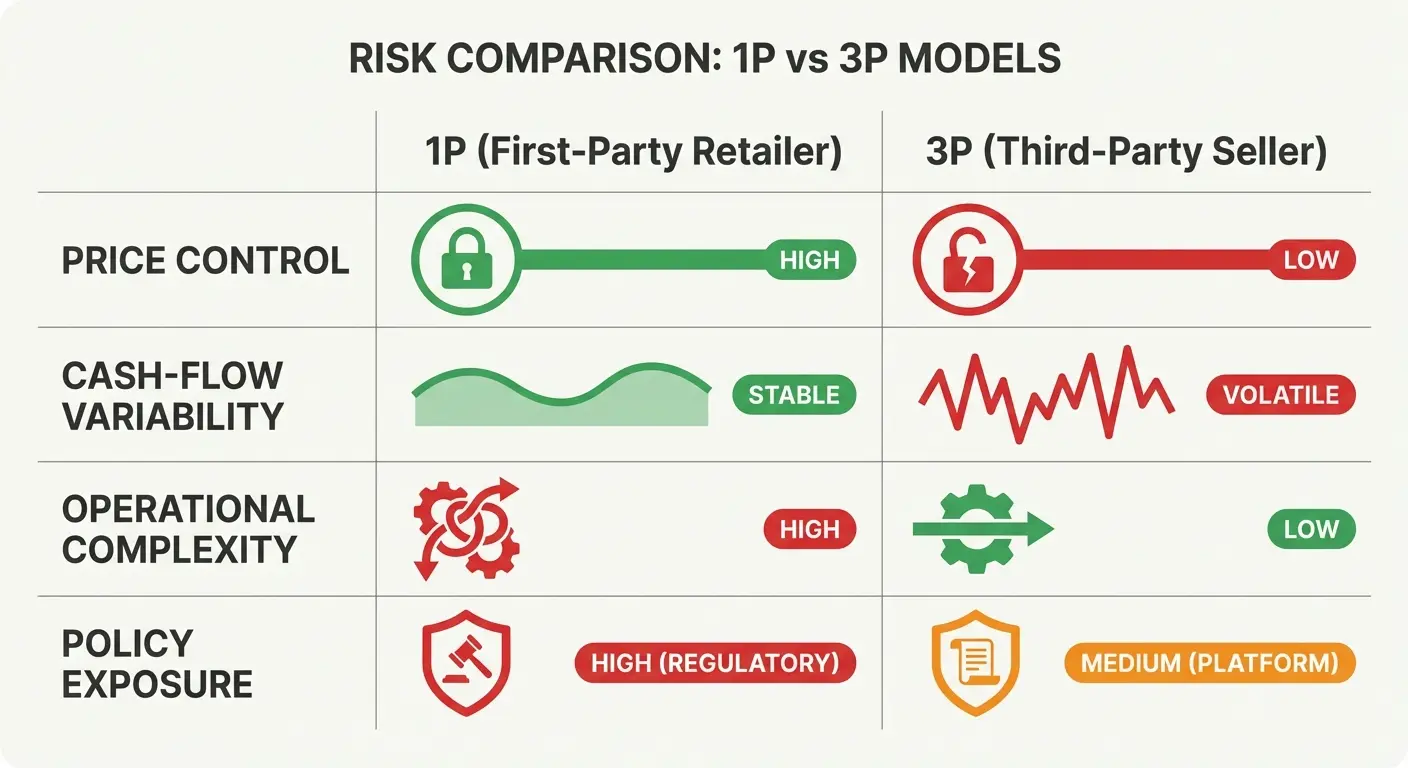
The decision between Amazon 1P (First-Party) and 3P (Third-Party) depends on whether your brand prioritizes logistical simplicity and volume or pricing control and data ownership. In 2026, the 3P model is the dominant choice for brands seeking higher margins and price stability, while 1P remains best for high-volume manufacturers who prefer a traditional wholesale relationship.
For over two decades, the tension between selling to Amazon and selling on Amazon has shaped the retail landscape. As we navigate 2026, the distinction between these two models has become more than just a logistical choice; it is a fundamental strategic pivot that determines a brand's long-term viability and profitability.
Understanding the Fundamentals: What is Amazon 1P?
In the 1P (First-Party) model, your brand acts as a wholesale vendor. You sell your inventory directly to Amazon in bulk, and Amazon takes ownership of the products. From the consumer's perspective, these items are labeled as "Ships from and sold by Amazon.com."
The 1P relationship is managed through Vendor Central. Historically, this was an invitation-only program reserved for established brands with significant existing demand. While Amazon’s automated procurement systems now handle much of the "buying," the core relationship remains a B2B (Business-to-Business) transaction. Your primary goal in 1P is to fulfill purchase orders (POs) sent by Amazon and manage the "trade spend" (allowances and fees) that comes with the partnership.
The perceived benefit of 1P is the "Amazon seal of approval." Many shoppers still associate "Sold by Amazon" with higher levels of trust and reliability. Additionally, the 1P model simplifies the retail process for the manufacturer; once the goods are received by Amazon’s warehouse and the PO is closed, the brand’s job—in theory—is done. However, as we will explore, this simplicity comes at a significant cost to control and margin.
Navigating the Marketplace: What is Amazon 3P?
In the 3P (Third-Party) model, your brand acts as the retailer. You sell your products directly to the end consumer using Amazon as a marketplace platform. This relationship is managed through Seller Central. You maintain ownership of the inventory until a customer makes a purchase.
Within the 3P model, there are two primary fulfillment paths:
- Fulfillment by Amazon (FBA): You ship your inventory to Amazon’s fulfillment centers, and they handle the picking, packing, shipping, and customer service. These products are eligible for Amazon Prime.
- Fulfillment by Merchant (FBM): You handle the storage and shipping of products directly to the consumer.
The 3P model has seen meteoric growth because it offers brands total control over their listing content, inventory levels, and—most importantly—their retail pricing. In 2026, with the maturation of Amazon Brand Registry, 3P sellers have access to almost all the advertising and brand-building tools that were once exclusive to 1P vendors.
Direct Comparison: 1P (Vendor Central) vs. 3P (Seller Central)
To understand which model wins for your brand, it is essential to compare the operational realities of each. The following table breaks down the critical differences that impact your bottom line and brand health.
| Feature | 1P (Vendor Central) | 3P (Seller Central) |
|---|---|---|
| Relationship | Wholesale (B2B) | Retail (B2C) |
| Pricing Control | Amazon sets the retail price | You set the retail price |
| Ownership of Inventory | Amazon owns it once received | You own it until the customer buys |
| Payment Terms | Net 30, 60, or 90 days | Every 14 days |
| Sales Margins | Lower (Wholesale prices) | Higher (Retail prices minus fees) |
| Fees | Slotting, Co-op, Freight, Damage allowances | Referral fee (avg. 15%), FBA fees |
| Customer Data | Very limited | Comprehensive (Brand Analytics) |
| Inventory Management | Based on Amazon’s POs | You decide how much to stock |
| Marketing Tools | Full access to Amazon Ads | Full access (via Brand Registry) |
Financial Implications: Costs, Fees, and Profitability
Profitability is the most common reason brands migrate from 1P to 3P. In a 1P environment, the "negotiations" with Amazon often feel one-sided. Every year, Amazon may ask for increased "co-op" fees or marketing allowances to maintain your placement. Furthermore, 1P vendors are often hit with chargebacks—fines for small infractions in shipping or labeling that can eat into already thin wholesale margins.
In contrast, the 3P model's fee structure is more transparent, though not necessarily "cheap." You pay a referral fee (usually 15%) and FBA fees based on the size and weight of the product. However, because you are selling at the retail price rather than a wholesale price, the "gross profit per unit" is typically significantly higher in the 3P model.
For example, if a product retails for $100:
- 1P Model: You sell it to Amazon for $50. After co-op fees and chargebacks, you might net $42.
- 3P Model: You sell it to the customer for $100. After a $15 referral fee and $10 in FBA/shipping costs, you net $75.
Even after accounting for the additional labor required to manage a 3P account, the 3P model usually yields a higher return on investment (ROI) for brands with high-value products.
The Battle for Pricing Control and MAP Enforcement
Perhaps the most significant disadvantage of the 1P model is the loss of pricing control. Amazon’s pricing algorithm is designed to match the lowest price found anywhere on the internet (price matching). If a rogue unauthorized seller discounts your product on another site, Amazon will automatically drop their retail price to match it.
This "race to the bottom" can trigger a cascade of issues:
- MAP Violations: Minimum Advertised Price (MAP) policies are nearly impossible to enforce when Amazon is the one breaking them.
- Channel Conflict: Brick-and-mortar retailers or other e-commerce partners may stop carrying your product if Amazon is constantly undercutting them.
- Profitability Death Spiral: If Amazon cannot maintain its desired margin because they are forced to price-match low-quality competitors, they may "CRaP" your product (Can't Realize a Profit), which leads to a halt in POs and a loss of visibility.
In the 3P model, you are the seller of record. You set the price. While you still have to be competitive to win the "Buy Box," you have the final say. This allows brands to maintain a premium image and protect their margins across all sales channels.
Data Ownership and Customer Insight
In 2026, data is as valuable as the products themselves. The 3P model provides a wealth of information through Amazon Brand Analytics. You can see search frequency ranks, market basket analysis (what else people bought with your product), and repeat purchase behavior.
The 1P model is notoriously a "black box." Amazon shares very little data about who is buying your products or how they are interacting with your brand. For companies that rely on data to drive product development or multi-channel marketing strategies, the 3P model is the clear winner. By understanding the customer journey on Seller Central, brands can optimize their listings and advertising spend with a degree of precision that Vendor Central simply does not allow.
The Operational Burden: Complexity vs. Control
While 3P offers more control and profit, it requires more "heavy lifting."
- Customer Service: In 3P, you are responsible for responding to customer inquiries (unless using FBA, where Amazon handles some logistics-related queries).
- Tax Compliance: Selling 3P means you are the retailer, which involves complex sales tax nexus considerations, although Amazon now collects and remits sales tax for most U.S. states under Marketplace Facilitator laws.
- Inventory Risk: If your 3P inventory doesn't sell, you are paying storage fees. In 1P, once Amazon buys it, the inventory risk (mostly) shifts to them.
For a lean brand with limited headcount, the "hands-off" nature of 1P can be appealing. However, most modern brands find that the cost of hiring an agency or a dedicated e-commerce manager to handle the 3P operational load is easily offset by the increased margins.
The Rise of the Hybrid Model in 2026
For many large-scale brands, the answer to "1P vs. 3P" isn't one or the other—it's both. The hybrid model allows a brand to enjoy the benefits of both platforms while mitigating their respective risks.
How a Hybrid Strategy Works:
- 1P for Core Heroes: Use 1P for your high-volume, "bread and butter" products that require massive distribution and where Amazon's automated ordering provides a stable baseline.
- 3P for New Launches: Use 3P to launch new products. This allows you to control the initial price, gather data, and build "social proof" (reviews) before potentially moving them to 1P.
- 3P for Long-Tail Items: Keep niche or low-volume items on 3P where Amazon’s procurement bots might otherwise ignore them.
- 3P as a Backup: If Amazon fails to send a PO for a 1P item, having a 3P listing ensures the product remains available for Prime customers, preventing a "stock-out" that could hurt your search rankings.
Choosing the Winner: Factors for Your Brand Decision
Which model wins for your brand? The "winner" is determined by your specific business goals and infrastructure.
- Product Margin: If your margins are thin, 1P co-op fees will kill your profitability. 3P is likely your only path to success.
- Internal Resources: Do you have the staff to manage daily pricing, customer service, and inventory shipments? If not, 1P is a simpler transition from traditional retail.
- Brand Protection: Is maintaining a premium, consistent price across the web critical? If so, 3P is the only way to ensure Amazon doesn't tank your retail price.
- Catalog Size: Brands with thousands of SKUs often find 1P easier to manage at scale, whereas "digitally native" brands with 10–50 SKUs almost always find 3P more rewarding.
In the current landscape of 2026, the market has shifted heavily toward Seller Central (3P). Amazon itself has signaled this shift by focusing more on marketplace growth and less on its own retail acquisitions. For most brands entering or expanding on the platform today, the 3P model offers the agility and financial upside required to compete in an increasingly crowded digital storefront.
Frequently Asked Questions
1. Can I switch from 1P to 3P if I am already on Vendor Central? Yes, but it must be handled carefully. Amazon used to aggressively "brand gate" 1P vendors, preventing them from selling 3P. While this has loosened, the best approach is to start a 3P account and gradually transition SKUs. Abruptly stopping 1P shipments can sometimes lead to account health issues or loss of the Buy Box if Amazon still has "Ships from and sold by Amazon" inventory in stock.
2. Does 1P have better SEO or search placement? In the past, 1P products were thought to receive a slight boost in search rankings. In 2026, this is largely a myth. Amazon's A10 algorithm prioritizes sales velocity, conversion rate, and customer reviews. A well-managed 3P listing with high conversion will consistently outrank a stagnant 1P listing.
3. Which model is better for international expansion? The 3P model (Seller Central) is generally better for global expansion. With Amazon Global Selling, you can manage multiple marketplaces (UK, Germany, Japan, etc.) from a unified interface. 1P expansion usually requires separate invitations and negotiations with regional Amazon buyers in each country.
4. How do payment cycles differ between the two? This is a major cash-flow consideration. 3P sellers generally get paid every 14 days. 1P vendors are subject to traditional wholesale terms, which can be Net 60 or even Net 90. For growing brands that need to reinvest in inventory quickly, the 14-day 3P cycle is a significant advantage.
5. Is the "Ships from and sold by Amazon" badge still important for conversion? While it still carries some weight with older demographics, most modern shoppers prioritize the Prime badge over the "Sold by Amazon" label. As long as your 3P product is "Fulfilled by Amazon" (FBA), you will see very little, if any, drop in conversion rate compared to a 1P listing.
Practical Next Action
If you are currently a 1P vendor feeling the squeeze of declining margins and lost pricing control, your next step is to conduct a 3P Feasibility Audit. Calculate your "Net Take-Home" per unit on Seller Central after all referral and FBA fees, and compare it to your current 1P Net. If the 3P model shows a 15% or higher increase in margin, begin the process of enrolling in Brand Registry and setting up a Seller Central account to test a hybrid approach.