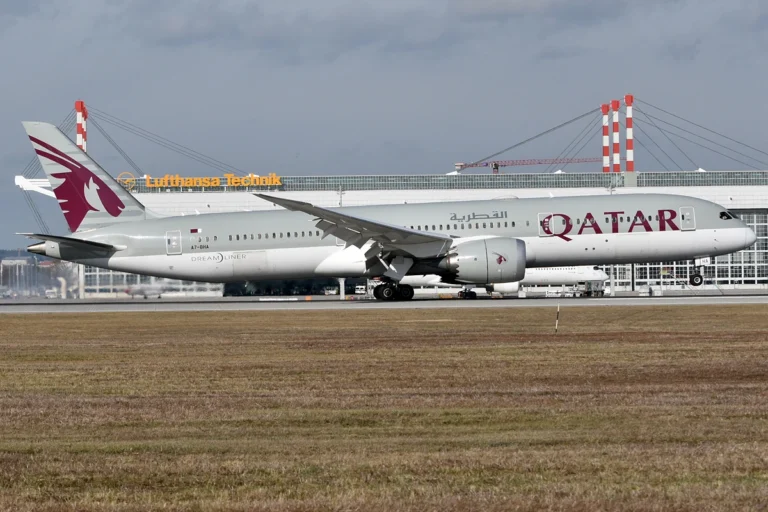
A Boeing 787 emergency landing is a critical safety procedure initiated by flight crews to address urgent mechanical, medical, or security threats. While the term often causes concern, these landings are executed using highly regulated protocols and the aircraft’s advanced redundant systems. The Boeing 787 Dreamliner is designed to handle significant failures, ensuring a high probability of a safe outcome even under extreme duress.
In the world of modern aviation, the Boeing 787 Dreamliner represents a shift toward "more-electric" aircraft architecture. This technical evolution significantly influences how the aircraft behaves during an emergency. Whether it is a precautionary diversion due to a sensor malfunction or a high-stakes return to the tarmac following an engine shutdown, the 787 is equipped with specific failsafes that distinguish it from older widebody generations. As of 2026, the 787 remains a cornerstone of global long-haul fleets, and its safety record continues to be defined by how its sophisticated systems respond when things go wrong.
The Anatomy of a 787 Emergency Landing
When a "787 emergency landing" occurs, it is rarely a sudden, chaotic event. Instead, it is the result of a structured decision-making process. Pilots categorize these events into three primary tiers: precautionary landings, emergency landings, and forced landings.
Precautionary Diversions vs. Declared Emergencies
A precautionary landing occurs when a system indicates a potential issue that does not pose an immediate threat to the flight but warrants an early end to the journey. For instance, a "Door Synoptic" warning or a minor hydraulic leak might prompt a pilot to land at the nearest suitable airport.
In contrast, a declared emergency—often signaled by the distress call "Mayday" or the urgency call "Pan-Pan"—indicates a situation that requires immediate assistance or priority handling from Air Traffic Control (ATC). In a 787, a declared emergency might involve smoke in the cabin, a significant loss of thrust, or a total failure of one of the aircraft’s primary electrical channels.
The Flight Crew's Role: Aviate, Navigate, Communicate
Regardless of the aircraft type, the crew follows the "Aviate, Navigate, Communicate" hierarchy. On the 787, the "Aviate" portion is assisted by sophisticated fly-by-wire (FBW) systems. If an engine fails, the aircraft’s flight control computers automatically compensate for the asymmetrical thrust, helping the pilot maintain a stable heading while they consult the Quick Reference Handbook (QRH).
The QRH is a pilot's "bible" during an emergency. It contains checklists for every conceivable failure. Because the 787 utilizes electronic flight bags (EFBs), pilots can quickly search for specific malfunctions, and the aircraft’s onboard maintenance system often populates the relevant checklists automatically on the multi-function displays (MFDs).
Technical Redundancies: Why the 787 is Resilient
The Boeing 787’s design is fundamentally different from its predecessors, such as the 767 or 777. These differences play a vital role in how the aircraft manages emergencies.
The More-Electric Architecture
Traditional aircraft use "bleed air" (hot compressed air from the engines) to power systems like air conditioning and wing anti-icing. The 787 eliminated most bleed air systems in favor of high-voltage electricity. While this makes the aircraft more fuel-efficient, it places a massive burden on the electrical system.
To counter the risk of a total power loss, the 787 features:
- Four Engine-Driven Generators: Two on each engine, providing massive amounts of redundant power.
- Two Auxiliary Power Unit (APU) Generators: These can be started mid-flight to replace lost engine power.
- The Ram Air Turbine (RAT): If all engines and the APU fail, a small wind turbine deploys from the belly of the aircraft. This turbine spins in the slipstream to provide essential hydraulic and electrical power to the flight controls and basic instruments.
Composite Material Integrity
The 787 is primarily made of carbon-fiber-reinforced polymers (CFRP). In the event of a hard emergency landing, these materials respond differently than traditional aluminum. Composites are incredibly strong and do not fatigue in the same way metal does, but they also require specialized inspection techniques (such as ultrasonic testing) after an emergency landing to ensure no "delamination" or internal structural damage has occurred.
Notable 787 Emergency Landing Case Studies
To understand the reality of 787 emergency landings, one must look at historical incidents and how the aircraft's systems performed under pressure.
The 2013 Lithium-Ion Battery Crisis
Early in its service life, the 787 faced a series of emergency landings due to thermal runaway in its lithium-ion batteries. On January 16, 2013, an All Nippon Airways (ANA) 787 made an emergency landing in Takamatsu, Japan, after pilots received battery malfunction alerts and smelled smoke. This led to a global grounding of the fleet. Boeing eventually redesigned the battery enclosure and charging system, adding a stainless steel "containment box" and a dedicated vent to ensure that even if a battery fails, smoke and heat are diverted outside the aircraft.
Engine Failures and the Trent 1000
The Rolls-Royce Trent 1000 engines, used on many 787s, experienced issues with intermediate-pressure turbine (IPT) blades. This led to several instances where engines had to be shut down mid-flight, necessitating emergency landings. The 787's ETOPS (Extended-range Twin-engine Operational Performance Standards) certification is critical here. It allows the aircraft to fly for up to 330 minutes (5.5 hours) on a single engine, ensuring that even over the remotest parts of the Pacific or Atlantic, the aircraft can reach a diversion airport safely.
Recent Flight Deck Anomalies
In 2024 and 2025, several high-profile incidents involved sudden altitude drops or "nose-dives," such as the LATAM Flight 800 incident. While many of these were attributed to external factors or cockpit seat switch malfunctions rather than the aircraft’s core flight systems, they resulted in emergency landings to provide medical care to injured passengers. These events highlighted the 787’s ability to remain structurally sound even during high-G-force maneuvers.
Procedures During the Landing Phase
Once a pilot has decided to land the 787, several technical factors come into play.
Fuel Management: The Lack of a Jettison System
Unlike many older widebody aircraft, the standard Boeing 787-8 does not always come equipped with a fuel jettison (dump) system. This is because the aircraft is designed with a high Maximum Landing Weight (MLW) that is very close to its Maximum Takeoff Weight (MTOW).
In an emergency, a 787 can land "heavy" without dumping fuel. While an overweight landing requires a thorough inspection afterward, the 787's robust landing gear and composite wing structure are designed to absorb the higher energy of such a landing. This saves precious minutes in a time-sensitive emergency, as pilots do not need to circle to burn or dump fuel.
Braking and Stopping Performance
The 787 uses electric brakes rather than traditional hydraulic ones. This system provides more precise control and better feedback to the aircraft’s anti-skid systems. During an emergency landing on a short runway, the electric brakes, combined with the 787’s large carbon brake discs, offer superior stopping power.
| Feature | Impact on Emergency Landing |
|---|---|
| Electric Brakes | Faster response time and independent control of each wheel for maximum stopping power. |
| Fly-by-Wire | Protects the aircraft from stalling or over-stressing the airframe during violent maneuvers. |
| Composite Hull | High fire resistance and structural integrity; does not melt as quickly as aluminum in fire scenarios. |
| RAT Deployment | Ensures pilot retains control even in a total dual-engine power loss. |
| Large MFDs | Provides clear, prioritized "synoptic" pages that show exactly which system has failed. |
Passenger Safety and Evacuation Protocols
If the emergency landing results in a "ground evacuation," the 787 is designed to be cleared of all passengers in under 90 seconds, even with half the exits blocked.
The 787’s evacuation slides are powered by compressed gas and must deploy reliably in extreme winds. Furthermore, because the 787 sits relatively high off the ground, the slides are longer and more robust than those on narrowbody aircraft. Cabin crew are trained to manage the "flow" of passengers, ensuring that the high-stress environment does not lead to a bottleneck at the doors.
Comparison: 787 vs. Other Widebody Emergency Handling
How does the 787 compare to the Airbus A350 or the older Boeing 777 in an emergency?
- Architecture: The A350 uses a mix of hydraulic and electric systems, whereas the 787 is more heavily reliant on the electrical grid. This means a 787 pilot focuses more on electrical bus management during a failure.
- Display Logic: The 787 uses a "quiet, dark" cockpit philosophy. In an emergency, only the failed systems are highlighted, reducing the cognitive load on the pilot compared to older 777 models.
- Overweight Landing: The 787 is generally more capable of immediate overweight landings than the 747 or older A330s, which often must dump fuel to avoid structural damage upon touchdown.
Frequently Asked Questions
How long can a Boeing 787 fly on one engine?
The Boeing 787 is certified for ETOPS-330, meaning it can fly for up to 330 minutes (5.5 hours) on a single engine to reach an emergency landing site. This allows the aircraft to operate the world’s most remote routes safely.
Does the 787 have a fuel dump system?
The fuel jettison system is an option on the 787-8 but is standard on the larger 787-9 and 787-10. However, even without it, the 787 is structurally capable of performing an overweight emergency landing if the situation is urgent.
Is the 787 safer than other planes in an emergency?
While no aircraft is "invincible," the 787’s composite structure and electrical redundancies provide a modern safety margin. Its ability to maintain flight control through the Ram Air Turbine and its advanced fire suppression systems make it one of the safest aircraft in the sky as of 2026.
What causes most 787 emergency landings?
Statistically, most emergency landings (for all aircraft, including the 787) are caused by medical emergencies on board or minor technical "nuisance" warnings rather than catastrophic mechanical failures.
Can a 787 land itself in an emergency?
Yes, if the airport is equipped with an Instrument Landing System (ILS) and the aircraft’s systems are functioning, the 787 can perform an Autoland. This is particularly useful if the crew is dealing with high workloads or low visibility during the emergency.
Final Recommendations for Passengers and Personnel
For passengers, the most important takeaway is that an "emergency landing" is a controlled procedure. The 787 is a testament to modern engineering, designed to be flown safely even when multiple systems fail. Always follow the instructions of the cabin crew, as their training is specifically tailored to the 787’s unique exit and safety configurations.
For aviation professionals and enthusiasts, monitoring the NTSB (National Transportation Safety Board) or EASA (European Union Aviation Safety Agency) reports on 787 incidents remains the best way to understand the evolving safety landscape of this aircraft. As we move through 2026, the continued refinement of 787 maintenance protocols ensures that "emergency" remains a rare and manageable occurrence in the life of the Dreamliner.