The 12-chapter life insurance practice refers to the standardized pre-licensing curriculum required to obtain a Life Insurance Producer license. This structured study path covers fundamental concepts, policy types, legal provisions, and ethical standards. Mastering these chapters ensures candidates meet state-level competency requirements for underwriting, policy administration, and consumer protection in the 2026 insurance market.
Obtaining a life insurance license in 2026 remains a rigorous process, designed to ensure that every agent possesses a deep understanding of the financial instruments they sell. The "12-chapter" framework is the industry-standard method for organizing this vast amount of information into digestible, logical segments. Whether you are using a national provider like Kaplan or ExamFX, or a state-specific curriculum, the core principles across these twelve sections remain the foundation of professional insurance practice.
The Foundation of Pre-Licensing Education
Before a candidate can sit for the state regulatory exam, most jurisdictions require a specific number of "pre-licensing hours." The 12-chapter structure aligns with the National Association of Insurance Commissioners (NAIC) Uniformity Standards, ensuring that an agent licensed in one state has a knowledge base comparable to an agent in another.
In 2026, the complexity of life insurance products—ranging from traditional term policies to sophisticated indexed universal life (IUL) contracts—necessitates a structured approach. The practice materials are not merely about passing a test; they are designed to prevent "errors and omissions" (E&O) claims later in an agent's career. By moving through these chapters sequentially, a student builds from basic definitions of risk to the complexities of tax-qualified retirement plans.
Chapter 1: General Insurance Principles and Risk Management
The first chapter establishes the "why" behind insurance. It defines risk as the uncertainty of financial loss and distinguishes between pure risk (which is insurable) and speculative risk (which is not). Candidates learn about the various methods of handling risk: avoidance, retention, sharing, reduction, and transfer.
Insurance is the transfer of risk. This section also introduces the Law of Large Numbers, which is the mathematical foundation of the industry. It explains that as the number of similar exposure units increases, the predictability of future losses becomes more accurate. Understanding this concept is vital for grasping how insurance companies remain solvent while paying out millions in claims.
Chapter 2: Legal Concepts and the Insurance Contract
Life insurance policies are legal contracts, and this chapter covers the four essential elements required for any contract to be legally binding: Agreement (Offer and Acceptance), Consideration, Competent Parties, and Legal Purpose.
A significant portion of this chapter is dedicated to the unique characteristics of insurance contracts. Unlike a car purchase, an insurance policy is a contract of adhesion, meaning it is drafted by one party (the insurer) and must be accepted or rejected as a whole by the other (the applicant). Because of this, any ambiguity in the contract is legally resolved in favor of the policyholder. Other key terms covered include aleatory (unequal exchange of value), unilateral (only one party is legally bound), and conditional.
Chapter 3: Life Insurance Basics and Term Policies
This chapter marks the transition into specific product knowledge. It defines the basic parties to a life insurance contract: the insurer, the insured, the owner, and the beneficiary. It then dives deep into Term Life Insurance, often called "pure protection."
Term insurance is temporary and provides a death benefit only if the insured dies during the specified period. Students must distinguish between Level Term, Decreasing Term (often used for mortgages), and Increasing Term. A critical 2026 focus is on Return of Premium (ROP) riders, which have seen a resurgence in popularity as consumers seek to recoup costs if they outlive their policy term.
Chapter 4: Whole Life and Permanent Insurance Products
Unlike term insurance, permanent insurance is designed to last a lifetime and includes a savings component known as cash value. Chapter 4 explores the mechanics of Ordinary (Straight) Whole Life, where premiums are level and the cash value equals the face amount at age 100 (or 120, depending on the updated mortality tables used in 2026).
Variations of whole life, such as Limited-Pay Life (e.g., Paid-up at 65) and Single Premium Whole Life, are also examined. The focus here is on the "guarantees" offered by these policies—guaranteed death benefits, guaranteed cash value growth, and guaranteed level premiums.
Chapter 5: Flexible and Variable Life Insurance
As the financial markets evolved, so did life insurance. This chapter covers Universal Life (UL), which offers "unbundled" components. In a UL policy, the owner can adjust the premium payments and the death benefit.
This section also introduces Variable Life and Variable Universal Life (VUL). Because these products invest cash values in sub-accounts (similar to mutual funds), they are considered securities. In 2026, students are reminded that selling these products requires not only a state insurance license but also a federal securities registration (such as a Series 6 or 7). The chapter emphasizes the lack of guarantees in variable products and the requirement for a "prospectus" at the time of sale.
Chapter 6: Annuities and Retirement Funding
While life insurance protects against the risk of dying too soon, annuities protect against the risk of living too long (outliving one's income). This chapter is often the most challenging for students due to the variety of payout options.
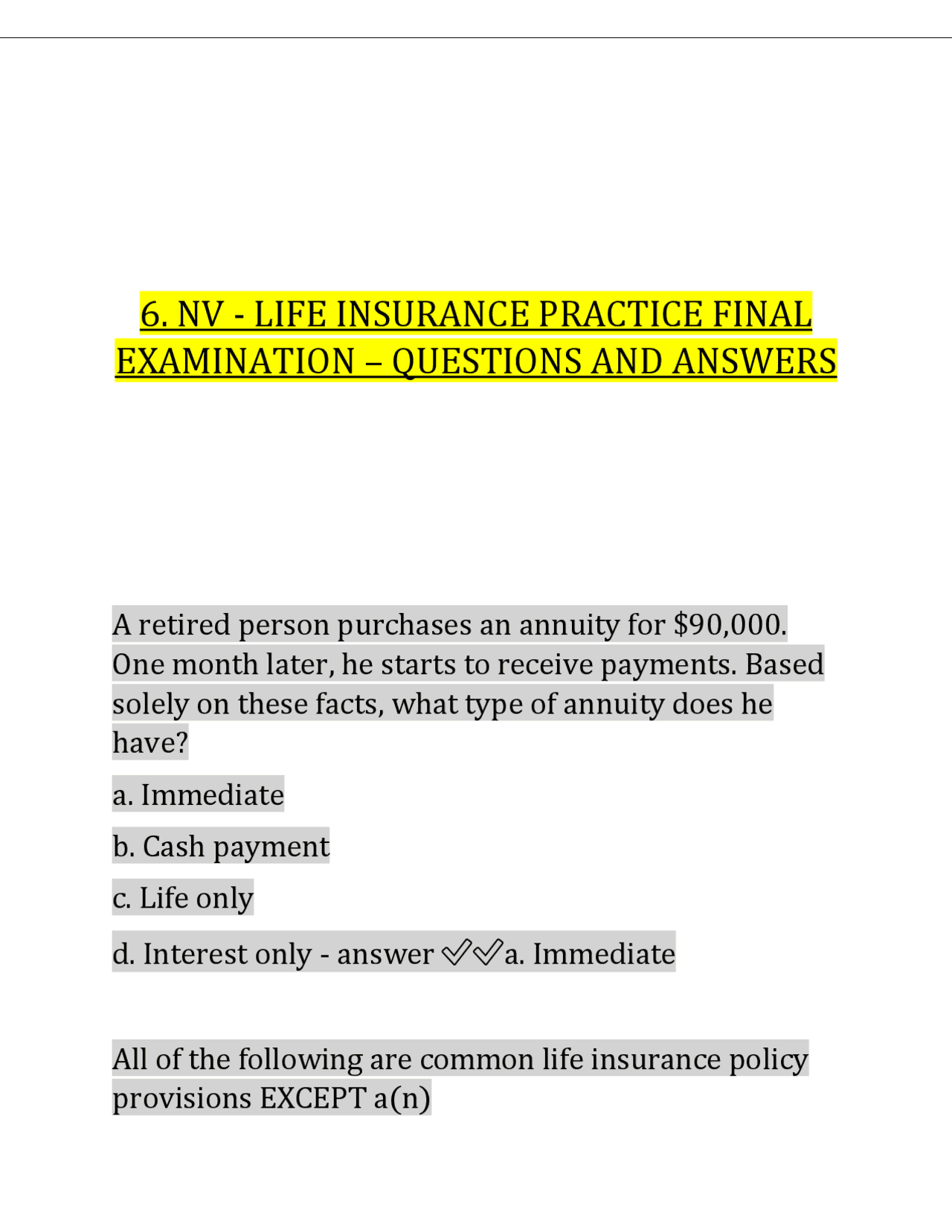
Students learn the difference between Immediate Annuities (SPIA) and Deferred Annuities. In 2026, there is a heavy emphasis on Fixed Indexed Annuities (FIAs), which provide a floor against market losses while allowing for some growth based on a market index. Understanding the "Accumulation Period" versus the "Annuity (Pay-out) Period" is a core requirement for the licensing exam.
Chapter 7: Mandatory and Optional Policy Provisions
The NAIC developed standard provisions to protect consumers. Chapter 7 details the Entire Contract Provision, which states that the policy and the application constitute the entire agreement. It also covers the Incontestability Clause, which prevents an insurer from denying a claim due to misstatements after the policy has been in force for two years.
Other essential provisions include the Grace Period (usually 30 or 31 days), Reinstatement rules, and the Misstatement of Age or Gender provision. Unlike other errors that might void a policy, a mistake in age or gender simply results in an adjustment of the death benefit to what the premium would have purchased at the correct age.
Chapter 8: Beneficiaries, Dividends, and Settlement Options
This chapter focuses on what happens when a policy pays out. It distinguishes between Primary and Contingent beneficiaries and explains the legal implications of Revocable versus Irrevocable beneficiary designations.
If the policy is a "participating" policy (usually issued by mutual insurers), the owner may receive dividends. These are not guaranteed and are considered a return of excess premium. Students must memorize the "CRAPO" acronym for dividend options: Cash, Reduction of Premium, Accumulation at Interest, Paid-up Additions, and One-year Term. Furthermore, the chapter covers Settlement Options, such as Life Income, Fixed Period, and Fixed Amount, which dictate how the death benefit is distributed to the beneficiary.
Chapter 9: Life Insurance Policy Riders
Riders are "add-ons" that customize a policy. The 12-chapter practice includes a thorough review of the Waiver of Premium rider, which keeps the policy in force if the insured becomes totally disabled.
Other common riders include:
- Accidental Death Benefit (Double Indemnity): Pays a multiple of the face amount if death is accidental.
- Guaranteed Insurability Rider (GIR): Allows the purchase of additional insurance at specific ages without a medical exam.
- Payor Benefit: Often used in juvenile insurance to waive premiums if the parent dies or becomes disabled.
- Accelerated Death Benefit (Living Needs): Allows a terminally ill insured to access a portion of the death benefit while still alive.
Chapter 10: Underwriting, Group Life, and Policy Issue
Underwriting is the process of risk selection and classification. Chapter 10 explains how insurance companies use the application, medical exams, the Medical Information Bureau (MIB), and credit reports to determine if an applicant is a Standard, Substandard (rated), or Preferred risk.
This chapter also covers Group Life Insurance, typically issued as annually renewable term insurance to employees. A key concept here is the Conversion Privilege, which allows an employee to convert their group coverage to an individual permanent policy within 31 days of leaving the job without proving insurability.
Chapter 11: Taxation, Retirement Plans, and Social Security
Taxation is a major component of the 2026 curriculum. Generally, life insurance death benefits are received income tax-free by the beneficiary. However, if a policy is surrendered for cash, any "gain" (cash value minus premiums paid) is taxable as ordinary income.
This chapter also addresses Modified Endowment Contracts (MECs). If a policy is funded too quickly (failing the "7-Pay Test"), it loses its favorable tax status on withdrawals. Additionally, the chapter provides an overview of Qualified Retirement Plans like IRAs, 401(k)s, and Keogh plans, as well as the basic structure of Social Security survivor and retirement benefits.
Chapter 12: Professional Ethics and State Insurance Laws
The final chapter is often state-specific. It covers the powers of the Insurance Commissioner (or Director/Superintendent), licensing requirements, and the consequences of unfair trade practices.
Unfair trade practices include:
- Rebating: Offering a portion of the commission or anything of value to a client as an inducement to buy.
- Twisting: Making a misleading comparison of policies to induce a client to drop their current coverage for a new one.
- Defamation: Making false or malicious statements about a competitor's financial condition.
Comparison of Primary Life Insurance Categories (2026 Standards)
The following table summarizes the core differences between the primary policy types studied in the 12-chapter practice.
| Feature | Term Life Insurance | Whole Life Insurance | Universal Life Insurance |
|---|---|---|---|
| Duration | Temporary (specific years) | Permanent (to age 100/120) | Permanent (flexible) |
| Premium | Lowest; stays level for term | Level; fixed for life | Flexible; can be adjusted |
| Cash Value | None | Guaranteed growth | Variable growth (market-linked) |
| Death Benefit | Fixed | Guaranteed; Fixed | Flexible (Option A or B) |
| Complexity | Simple | Moderate | High |
| Main Use | Maximum protection/Low cost | Lifetime protection/Savings | Flexibility/Wealth Transfer |
Strategies for Mastering the 12 Chapters
Success in the 12-chapter life insurance practice requires a disciplined study schedule. In 2026, most students utilize digital platforms that offer adaptive learning—meaning the software identifies which of the 12 chapters you are struggling with and provides extra practice in those areas.
- Follow the Sequence: Do not skip to Chapter 5 (Universal Life) before mastering Chapter 2 (Contracts). The curriculum is designed to be cumulative.
- Focus on "Key Terms": Each chapter contains bolded vocabulary. The licensing exam is often a test of vocabulary as much as it is a test of concepts.
- Take Chapter Quizzes: Do not move to a new chapter until you are scoring at least 80% on the current chapter's quiz.
- Simulate the Exam: Once you have completed all 12 chapters, take at least three full-length practice exams to build stamina for the 2–3 hour state test.
Common Questions Regarding Life Insurance Practice
How long does it take to complete the 12-chapter course?
Most candidates require between 20 and 40 hours of study time to thoroughly grasp the 12-chapter curriculum. This is often spread over two to three weeks for those working full-time. In 2026, many intensive "boot camp" programs exist that condense this material into a 3-to-5 day window, though retention is generally higher with a longer study period.
What is the passing score for the 12-chapter practice exams?
While each state has its own passing threshold, most professional practice courses require a score of 70% to 75% to receive a certificate of completion. It is widely recommended that students aim for a consistent 80% or higher on practice exams before attempting the actual state licensing test to provide a safety margin for exam-day stress.
Do I need to be a math expert to pass the life insurance exam?
No. While there are mathematical concepts involved, such as the Law of Large Numbers or calculating a policy's "cost basis," the 2026 licensing exam focuses more on the application of laws, provisions, and definitions. Most required calculations are basic arithmetic that can be performed with a standard calculator provided at the testing center.
Are the 12 chapters the same in every state?
The core "national" content (Chapters 1 through 11) is approximately 80-90% identical across all U.S. states because it is based on the NAIC model laws. Chapter 12 is where the most variation occurs, as it covers the specific statutes, rules, and regulations of your particular state's Department of Insurance.
What happens if I fail one of the chapter tests?
In most modern 2026 e-learning platforms, if you fail a chapter test, you are required to review the material before the system allows you to retake the quiz. This ensures you do not move on to more complex topics (like Annuities) without understanding the fundamentals (like Life Basics).
Final Recommendation for Aspiring Agents
To successfully navigate the 12-chapter life insurance practice, treat your study time as your first professional assignment. Prioritize understanding the intent behind insurance laws—which is almost always to protect the consumer. By viewing the material through the lens of a "fiduciary" or a professional advisor, the technical details of the 12 chapters will feel less like abstract rules and more like the essential tools of your new trade. Once you complete the 12 chapters, register for your state exam immediately while the information is fresh, and ensure you have all your pre-licensing documentation ready for the 2026 regulatory filing.