The J-1 Visa is a non-immigrant exchange visitor visa issued by the United States Department of State designed for individuals approved to participate in work- and study-based exchange visitor programs. Its central objective is to foster mutual understanding between the people of the United States and other nations through the exchange of educational and cultural visitors.
Introduction to the J-1 Visa Exchange Visitor Program
The United States J-1 Visa program stands as a cornerstone of international educational and cultural exchange. Established under the Mutual Educational and Cultural Exchange Act of 1961 (commonly known as the Fulbright-Hays Act), the program enables foreign nationals to travel to the United States to teach, study, research, demonstrate special skills, or receive training.
Unlike standard work visas like the H-1B, which prioritize employment and labor market demands, the J-1 visa places paramount importance on the exchange of ideas, knowledge, and cultural perspectives. Participants are expected to return to their home countries upon the completion of their program to share the experiences and expertise they acquired in the United States.
Navigating the J-1 visa landscape requires an understanding of diverse categories, stringent eligibility requirements, sponsorship prerequisites, financial validations, and legal obligations such as the foreign residency requirement. This guide provides an exhaustive overview of the program, detailing how it functions, who qualifies, and what participants can expect throughout their exchange journey.
Core Objectives and Legislative Foundation
The primary legislative mandate of the J-1 visa program is to increase mutual understanding between the people of the United States and the people of other countries by means of educational and cultural exchanges. By bringing foreign scholars, students, specialists, and professionals into American communities, institutions, and workplaces, the program achieves several strategic policy goals:
- Educational Enrichment: Enhancing American academic institutions through diverse global perspectives and specialized international research collaborations.
- Professional Development: Equipping foreign nationals with cutting-edge technical skills, pedagogical practices, and industry standards utilized in the United States.
- Cultural Diplomacy: Building enduring personal and professional relationships that transcend geopolitical boundaries, fostering long-term international goodwill.
The United States Department of State designates public and private entities to act as program sponsors. These sponsors assume responsibility for selecting participants, issuing the requisite documentation, and monitoring activities to ensure compliance with federal regulations set forth in Title 22 of the Code of Federal Regulations (CFR), Part 62.
J-1 Visa Categories and Participant Profiles
The J-1 visa program is not a monolithic category; rather, it encompasses a wide array of designated streams tailored to specific professional and educational profiles. Each category maintains unique duration limits, eligibility criteria, and operational rules.
1. Research Scholar and Professor
Designed for foreign nationals coming to the United States to conduct research, observe, or consult at research institutions, museums, libraries, post-secondary accredited educational institutions, or similar programmatic sites. Professors teach or do related research, while research scholars primarily conduct research, observe, or consult.
2. Short-Term Scholar
Professors, research scholars, specialists, or persons of similar education or expertise coming to the United States on a short-term basis for lecture, observation, consulting, training, or conducting research. The maximum duration for this category is strictly six months, with no extensions permitted.
3. Specialist
Individuals who are experts in a field of specialized knowledge or skill coming to the United States for up to one year to observe, consult, or demonstrate special skills in institutions of learning, museums, or similar organizations.
4. Trainee and Intern
- Trainee: Individuals with a degree or professional certificate from a foreign post-secondary academic institution and at least one year of prior work experience abroad, or at least five years of work experience abroad in the occupational field, seeking to enhance their skills in their specialized field.
- Intern: Students currently enrolled in and pursuing a degree at a foreign post-secondary academic institution, or graduates who have graduated from such an institution no more than 12 months prior to their program start date, seeking to obtain structured workplace experience.
5. College and University Student
Foreign nationals studying toward a degree or participating in a non-degree program (such as a semester abroad) at an accredited post-secondary educational institution in the United States. This category also encompasses Academic Training, which allows students to engage in employment related to their major field of study.
6. Secondary School Student
Young foreign nationals (typically aged 15 to 18.5 at the start of the program) coming to the United States to study in a grade 9 through 12 curriculum at public or private secondary schools while living with an American host family or in an approved boarding school.
7. Au Pair
Young adults aged 18 to 26 entering the United States to reside with an American host family, provide limited childcare services, and pursue up to six hours of academic credit at an accredited post-secondary institution.
8. Summer Work Travel
Foreign college and university students spending their summer vacations in the United States working in seasonal jobs to experience American culture and practice English language proficiency.
Comparison of Selected J-1 Visa Categories
To better understand the structural differences among the most common J-1 categories, review the comparative matrix below:
| Category | Target Audience | Maximum Duration | Employment Permitted? | Subject to 2-Year Rule (INA 212(e))? |
|---|---|---|---|---|
| Research Scholar | Academics, Ph.D. holders, experienced researchers | 5 Years | Yes (with sponsor approval) | Frequently yes (Skills List / Government Funding) |
| Short-Term Scholar | Visiting academics and experts | 6 Months | Limited to programmatic activities | Possible |
| Intern | Current students or recent grads (within 12 months) | 12 Months | Yes (structured internship only) | Possible |
| Trainee | Professionals with degrees/experience | 18 Months (12 for hospitality) | Yes (structured training plan only) | Frequently yes |
| Summer Work Travel | Enrolled foreign post-secondary students | 4 Months | Yes (seasonal jobs) | Rarely (unless government funded) |
Sponsorship and the Form DS-2019
A fundamental principle of the J-1 visa process is that applicants cannot apply directly to a United States embassy or consulate without first securing sponsorship.
The Role of the Sponsor
The program sponsor is the organizational entity designated by the U.S. Department of State to administer the exchange visitor program. Sponsors can be academic institutions, government agencies, non-profit organizations, or private corporations. The sponsor is legally responsible for:
- Screening and selecting eligible applicants.
- Issuing the Certificate of Eligibility for Exchange Visitor Status (Form DS-2019).
- Providing orientation and cross-cultural programming.
- Monitoring the progress and welfare of the exchange visitor throughout their stay.
- Ensuring compliance with all regulatory reporting obligations via the Student and Exchange Visitor Information System (SEVIS).
Obtaining the Form DS-2019
Once an applicant is accepted into a designated program, the sponsor generates a Form DS-2019 via SEVIS. This document contains a unique SEVIS identification number (starting with the letter "N"), program category codes, dates of validity, and a breakdown of estimated financial support. The physical or electronically transmitted Form DS-2019 is required for paying the SEVIS fee, scheduling the consular interview, and entering the United States.
Financial Requirements and Insurance Mandates
Participation in the J-1 program entails specific financial and regulatory compliances that must be maintained continuously.
Proof of Financial Support
Sponsors must verify that every exchange visitor possesses sufficient financial resources to cover all living expenses, tuition (if applicable), and travel costs for themselves and any accompanying dependents (J-2 holders) for the duration of the program. Funds may derive from the sponsor, personal savings, home government scholarships, or institutional grants.
Mandatory Health Insurance
Federal regulations mandate that all J-1 exchange visitors and their accompanying J-2 dependents maintain medical insurance coverage throughout their stay in the United States. Failure to maintain continuous coverage results in the immediate termination of J-1 status.
The policy must meet specific minimum standards established by the Department of State:
- Medical benefits of at least $100,000 per accident or illness.
- Repatriation of remains in the amount of $25,000.
- Medical evacuation coverage to the home country amounting to $50,000.
- A deductible not to exceed $500 per accident or illness.
- Underwriting by an insurance corporation meeting specific U.S. government rating criteria, or backed by the exchange visitor's home government.
The Two-Year Foreign Residence Requirement (INA 212(e))
One of the most consequential legal aspects of the J-1 visa program is the Two-Year Foreign Residence Requirement, codified under Section 212(e) of the Immigration and Nationality Act (INA).
Who Is Subject to INA 212(e)?
An exchange visitor becomes subject to the two-year rule if their program falls under any of the following criteria:
- Government Funding: The program is financed in whole or in part directly or indirectly by the United States government or the government of the visitor's home country.
- The Skills List: The participant's field of specialized knowledge or skill appears on the Department of State's Exchange Visitor Skills List for their country of citizenship or last legal permanent residence.
- Graduate Medical Education: The exchange visitor entered the United States to receive graduate medical education or training.
Implications of the Rule
If an individual is subject to INA 212(e), they are legally prohibited from changing their status within the United States to H-1B, L-1, permanent residence (Green Card), or certain other non-immigrant categories until they have resided and been physically present in their home country for an aggregate total of at least two years following the completion of their J-1 program.
Waivers of the Requirement
Subject individuals who wish to bypass the two-year home residency rule may apply for a waiver under one of five statutory grounds:
- No Objection Statement: A formal diplomatic note from the home country's government stating they have no objection to the visitor remaining in the U.S. (Not available to medical graduates).
- Exceptional Hardship: Demonstrating that departure would cause exceptional hardship to a U.S. citizen or lawful permanent resident spouse or child.
- Persecution: Proving that the visitor would be subject to persecution upon returning home.
- Request by an Interested U.S. Government Agency (IGA): An executive U.S. agency sponsors a waiver request because the visitor's departure would be detrimental to its programmatic interests.
- Conrad State 30 Program: Specifically for medical doctors who agree to practice full-time in federally designated underserved health professional shortage areas for three years.
Application Steps: From Sponsorship to Arrival
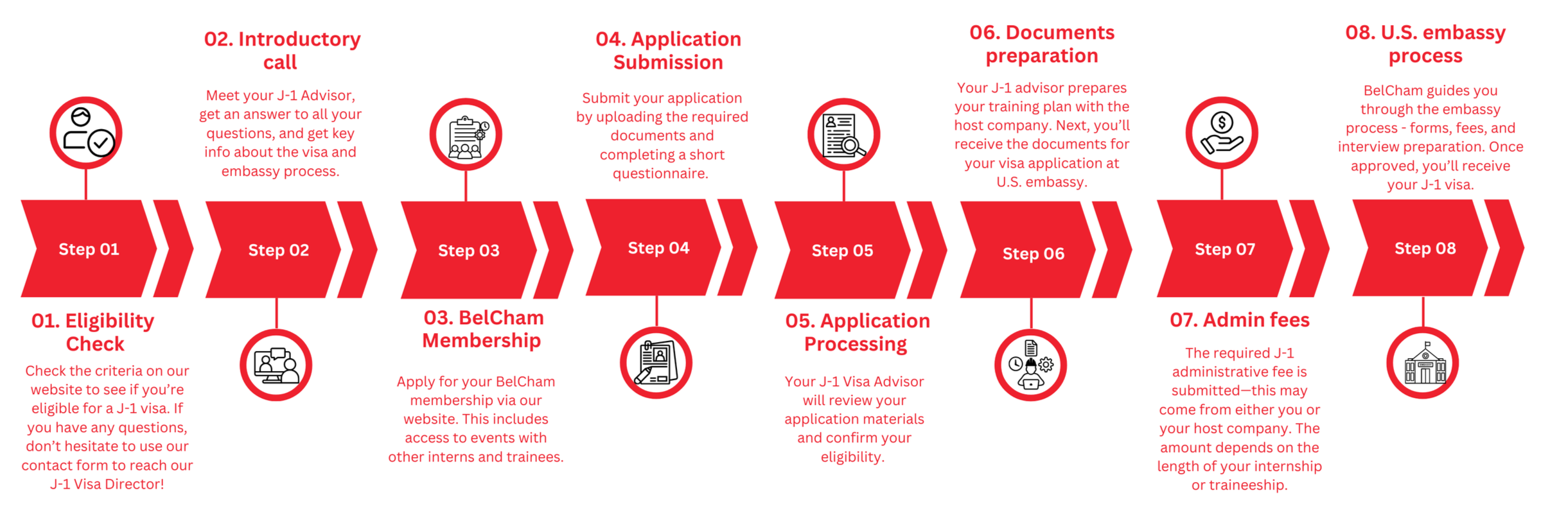
Securing a J-1 visa follows a structured multi-step administrative pathway. Understanding this sequence ensures that applicants meet strict deadlines and avoid common processing bottlenecks.
- Secure Sponsorship
- Receive Form DS-2019
- Pay SEVIS I-901 Fee
- Complete DS-160
- Consular Interview
- U.S. Border Entry
Step 1: Secure Program Acceptance and Sponsorship
An applicant must apply to and be accepted by a designated J-1 sponsor organization, university, research lab, or corporate host.
Step 2: Receive the Form DS-2019
The sponsor processes the intake data through SEVIS and issues the official Form DS-2019. The applicant reviews all biographical and programmatic data for accuracy.
Step 3: Pay the SEVIS I-901 Fee
Before scheduling a visa interview, every principal applicant must pay the mandatory SEVIS I-901 fee online via the official government portal (fmjfee.com), retaining the receipt for visa processing.
Step 4: Complete Form DS-160 (Online Nonimmigrant Visa Application)
Applicants complete the electronic Visa Application (Form DS-160), upload a compliant digital photograph, and pay the non-refundable MRV (Machine Readable Visa) application fee.
Step 5: Schedule and Attend the Consular Interview
Applicants book an interview appointment at the nearest U.S. Embassy or Consulate. Required documentation generally includes:
- A valid passport.
- Form DS-2019.
- Form DS-160 confirmation page.
- SEVIS fee payment receipt.
- Supporting financial documentation and proof of ties to the home country demonstrating non-immigrant intent.
Step 6: Entry into the United States
Upon visa approval, the traveler presents the passport, visa counterfoil, and original Form DS-2019 to Customs and Border Protection (CBP) officers at the port of entry. Upon admission, CBP issues an electronic Form I-94 recording the authorized duration of stay as "D/S" (Duration of Status), meaning the individual may remain lawfully in the U.S. as long as their DS-2019 remains valid and they comply with program rules.
Frequently Asked Questions
What happens if my J-1 program ends and I want to stay in the U.S.?
If you are not subject to the two-year home residency rule (INA 212(e)), or if you have obtained a formal waiver, you may explore options to change status to another non-immigrant category—such as an H-1B work visa, O-1 extraordinary ability visa, or F-1 student visa—provided the application is filed before your J-1 grace period expires.
Can my spouse and children accompany me on the J-1 visa?
Yes. Spouses and unmarried children under the age of 21 may apply for J-2 dependent visas. J-2 dependents are eligible to apply for employment authorization (EAD) through U.S. Citizenship and Immigration Services (USCIS) after arriving in the U.S., provided the income generated is not used to support the primary J-1 holder.
What is the "Grace Period" following the completion of a J-1 program?
Upon the successful completion of a J-1 program and all related academic or professional activities, exchange visitors are granted a standard 30-day grace period. During this window, individuals may travel domestically within the United States or prepare for departure. They are not permitted to work or re-enter the U.S. using the J-1 visa during this time.
Can I transfer my J-1 sponsorship to another institution?
Yes, J-1 program transfers are permitted under specific circumstances, such as a researcher moving to a new university lab. The transfer must be initiated and approved by the responsible officers (RO/ARO) of both the current and receiving sponsor organizations before the current program end date, ensuring continuous maintenance of legal status.
How do I prove that I intend to return to my home country after my program?
Because the J-1 visa is a non-immigrant category, consular officers evaluate whether the applicant has strong economic, familial, or professional ties to their home country. Evidence of ties may include home property ownership, family obligations, job offers awaiting upon return, or enrollment in a home-country degree program.
Expert Recommendations for Program Success
Successfully navigating the J-1 visa program requires meticulous administrative oversight and strict compliance with U.S. immigration laws. To ensure a seamless exchange experience, adhere to the following professional guidelines:
- Maintain Open Communication: Keep your designated sponsor's Responsible Officer (RO) informed of any changes to your residential address, email, telephone number, or employment/academic status within 10 days of the change.
- Monitor Insurance Compliance: Never allow your mandatory health insurance coverage to lapse. Keep digital and physical copies of your insurance policy and certificate handy at all times.
- Verify Travel Validation: Before traveling internationally during your program, ensure that your Form DS-2019 bears a valid travel signature from your sponsor's RO or ARO (usually valid for one year for scholars, or six months for students).
- Track Deadlines: Note your program end date and utilize your 30-day grace period effectively for departure or status transition planning.