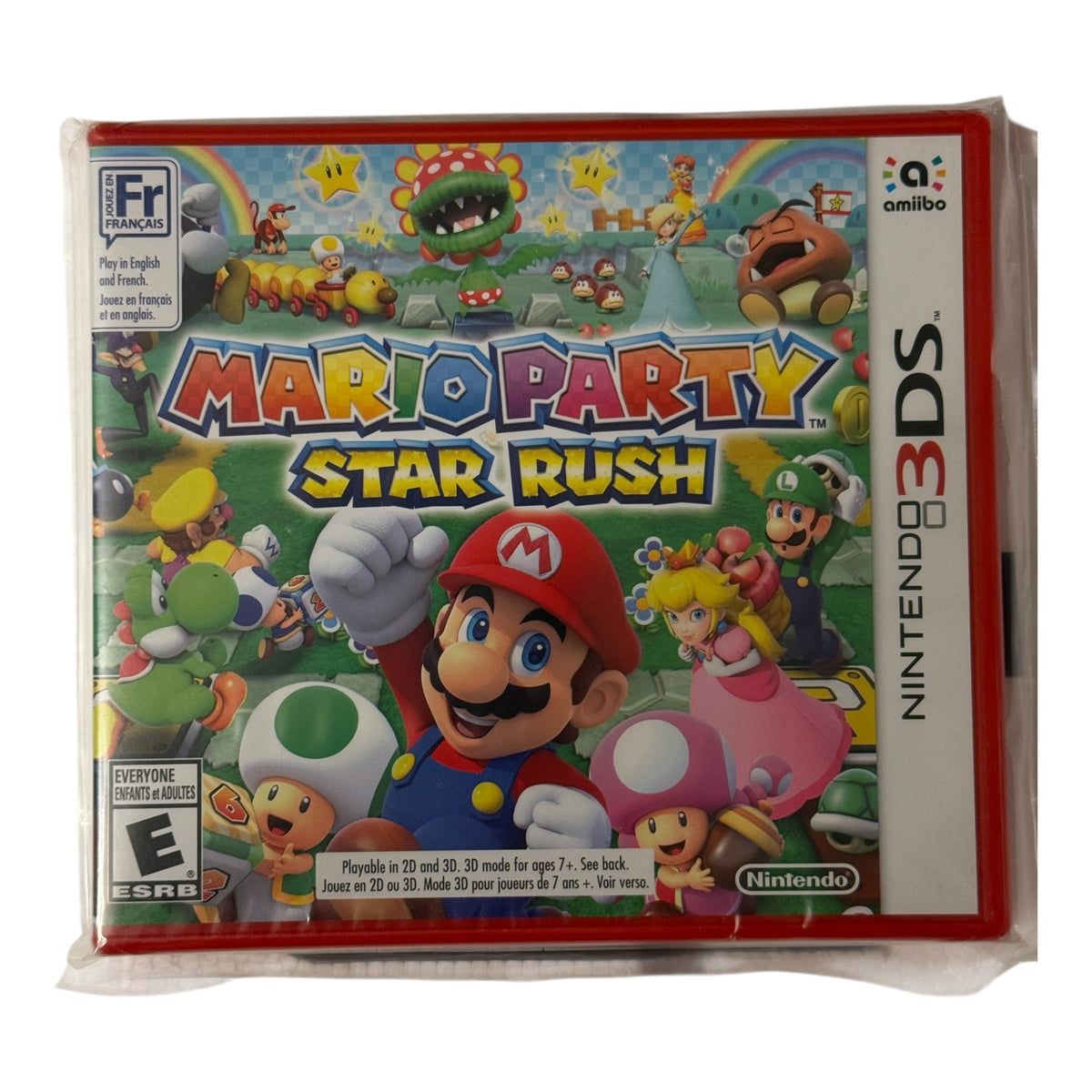
Mario Party Star Rush represents a significant mechanical shift for the long-running digital board game franchise, prioritizing speed and player agency by removing the controversial "car" mechanic and introducing simultaneous movement. Released originally for the Nintendo 3DS, it offers a varied collection of modes that emphasize strategy over pure luck, making it one of the most mechanically distinct entries in the series' history.
In the landscape of 2026, the Nintendo 3DS has transitioned from a primary handheld to a cherished legacy platform. Collectors and enthusiasts revisiting the library often find themselves looking at Mario Party Star Rush not just as a sequel, but as an experimental turning point for developer Nd Cube. While the "car" mechanic—where all players traveled together in a single vehicle—defined the early 2010s era of the series, Star Rush was the title that finally broke the party apart, allowing players to roam free.
This review examines the game's mechanics, its diverse range of modes, and how it holds up as a multiplayer experience a decade after its debut. We will analyze the technical performance, the depth of the "Toad Scramble" mode, and whether the game’s reliance on local wireless play remains a viable way to enjoy the title today.
The Core Philosophy: Speed and Simultaneous Play
The most jarring change for returning players in Star Rush is the lack of waiting. In traditional Mario Party titles, players take turns one by one, which often leads to significant downtime, especially in four-player sessions. Star Rush solves this by implementing simultaneous turns.
In the primary mode, everyone rolls their dice and moves at the exact same time. This design choice fundamentally changes the "flow" of a match. You are no longer a passive observer of your friends' turns; you are actively plotting your path, eyeing potential allies, and rushing toward bosses simultaneously. This reduces the average game length significantly, making it a much better fit for a portable system where play sessions might be shorter.
The Removal of the Linear Path
Unlike the board games of the Nintendo 64 or GameCube eras, Star Rush utilizes a grid-based movement system. Players are not restricted to a set path; they can move in any direction (up, down, left, right) provided they have the roll count to support it. This introduces a layer of spatial strategy that was largely absent from previous handheld entries like Mario Party: Island Tour. You must calculate the most efficient route to reach a Star or a Boss, factoring in the movement of your opponents who are moving at the very same moment.
Toad Scramble: The Defining Game Mode
The heart of Mario Party Star Rush is Toad Scramble. In this mode, every player starts as a generic Toad (colored Red, Blue, Yellow, or Green). The goal is to navigate a non-linear board to collect Stars, which are earned by defeating bosses that appear at various points on the map.
The Ally System
Because you start as a Toad, the "main" Mario cast (Mario, Luigi, Peach, etc.) act as allies scattered across the board. Landing on or passing a character allows them to join your party. This is not just a cosmetic change; the ally system is the deepest strategic element in the game:
- Dice Modification: Each ally has a unique die. For example, Mario might have a die with higher numbers but more risk, while Daisy might have a die more focused on consistent mid-range movement.
- Support in Minigames: In boss battles and specific minigames, your allies appear on screen and assist you. They contribute their own scores or attacks, meaning a player with three allies has a massive mathematical advantage over a player with none.
- Map Interaction: Allies can help you pick up extra coins or items on the board as you pass them.
The race to recruit allies creates a frantic early-game scramble. Do you head straight for the boss to get the first strike, or do you take a detour to pick up Rosalina or Donkey Kong to bolster your power for the rest of the game? This risk-reward calculation is what gives Star Rush its staying power.
Boss Battles as Star Generators
In Toad Scramble, you don't buy Stars from a shop. Instead, Stars are primarily awarded for performance in Boss Battles. When a player reaches a boss space, a transition occurs, and all players are pulled into a specialized minigame.
These battles are often multi-stage affairs. For instance, in a battle against King Boo, players might need to carry light sources to expose him before attacking. The player who reaches the boss first gets a head start, but others can join the fray mid-battle. The player who deals the final blow or earns the most points in the encounter receives the Star. This creates a high-stakes environment where the lead can shift in a matter of seconds.
Expanding the Experience: Secondary Game Modes
While Toad Scramble is the main attraction, Star Rush is packed with several other modes that experiment with the Mario Party formula in different ways.
Coinathlon
Coinathlon is perhaps the most addictive secondary mode. It removes the board game element entirely and replaces it with a race. Three players (or AI) compete in a series of rapidly repeating minigames designed specifically to generate coins. Every coin you collect moves your character forward one space on a track.
- Intensity: The minigames loop and increase in difficulty.
- Items: You can pick up items to hinder your opponents, such as lightning bolts to slow them down or inklings to obscure their screens.
- Skill-Based: This mode is almost entirely skill-based. There are no dice rolls; if you are better at the minigames, you will win.
Balloon Bash
For those who miss the "classic" Mario Party feel, Balloon Bash is the closest equivalent. It features smaller, more linear boards where players collect coins to trade for Stars. While it still uses simultaneous movement, the maps are tighter, and the focus is on popping coin balloons and reaching the Star merchant. It serves as a middle ground between the experimental Toad Scramble and the traditional series roots.
Rhythm Recital
A departure from the competitive nature of the game, Rhythm Recital is a cooperative mode where players use the touchscreen to play instruments in time with classic Mario music. While charming, it lacks the depth of the other modes and serves more as a brief diversion than a core reason to play.
Challenge Tower
This is a single-player focused mode that functions like a 3D version of Minesweeper. You must climb a massive tower, identifying "electric" spaces based on color cues. It is surprisingly difficult and requires a high degree of logic and spatial awareness.
Mario Party Star Rush Technical Specifications and Performance
As a late-lifecycle 3DS title, Star Rush is visually polished. The character models are vibrant, and the framerate remains stable even when multiple allies and effects are on the screen during boss battles.
| Feature | Specification / Detail |
|---|---|
| Platform | Nintendo 3DS / 2DS Family |
| Developer | Nd Cube |
| Release Date | November 4, 2016 (NA) |
| Primary Controls | Circle Pad, Buttons, Stylus (select minigames) |
| Multiplayer Type | Local Wireless (Up to 4 players) |
| Download Play | Supported (via "Party Guest" version) |
| Amiibo Support | Yes (NFC reader required for older 3DS models) |
| Storage Requirement | ~3,000 blocks (Digital version) |
The "Party Guest" Solution
One of the most consumer-friendly features of Star Rush was the Mario Party Star Rush - Party Guest software. In an era where most multiplayer games required every player to own a copy, Nintendo allowed users to download a free "Guest" version from the eShop.
This was not a limited demo. When connected to a player who owned the full game, "Guest" players had access to the entire multiplayer experience. While the 3DS eShop has since closed its doors for new purchases, those who already have the Guest software on their systems can still utilize this feature today. This makes Star Rush one of the easiest 3DS games to play with a group, provided the hardware is present.
Evaluation of Minigame Quality
A Mario Party game is only as good as its minigames. Star Rush features over 50 minigames, categorized into Free-for-All, Boss Battles, Coinathlon, and Bowser games.
The shift toward simultaneous play means many minigames are designed to be played quickly and independently. You will find fewer "waiting" games where players take turns hitting a block. Instead, the focus is on reaction time, pattern recognition, and touchscreen precision.
- Pros: The games feel "snappy." There is very little filler. The Boss Battles are genuinely creative and feel like mini-adventures rather than just simple tasks.
- Cons: Because they are designed for quick handheld play, some minigames can feel a bit shallow compared to the more complex offerings on home consoles like Mario Party Superstars.
Amiibo Integration and Utility
Nintendo heavily promoted the "Super Mario" line of Amiibo alongside Star Rush. In this game, Amiibo serve as a "power-up" mechanism.
- Toad Scramble: Tapping a compatible Amiibo (like Mario, Luigi, or Peach) brings that character into the game as an ally from turn one. They often come equipped with a rare item, giving the player a significant early-game advantage.
- Special Dice: Amiibo can unlock specialized dice blocks that are otherwise difficult to obtain.
- Save Data: You can save specific items to the Amiibo to bring into future sessions.
While not necessary to enjoy the game, the Amiibo functionality provides a tangible "cheat code" feel that can be fun for younger players or those looking to break the game's difficulty balance.
Comparing Star Rush to Other 3DS Entries
The Nintendo 3DS hosted three distinct Mario Party titles. Understanding where Star Rush fits helps in deciding if it is the right choice for your collection.
- Mario Party: Island Tour (2013): Focused on "linear races" to the end of the board. It felt very traditional but suffered from a lack of depth and a heavy reliance on luck.
- Mario Party Star Rush (2016): The experimental "speed" entry. It is widely considered the best of the three due to the simultaneous turns and the strategic Ally system.
- Mario Party: The Top 100 (2017): A "greatest hits" collection of minigames. It lacked a robust board game mode, making it feel more like a minigame gallery than a full Mario Party experience.
Star Rush strikes the best balance between a "full" game and a portable-friendly experience. It respects the player's time more than almost any other entry in the series.
Potential Drawbacks and Limitations
Despite its innovations, Star Rush is not without flaws. The Toad Scramble mode, while deep, can become repetitive if played solo. The AI is competent but lacks the unpredictable nature of human players.
Furthermore, the game's identity as a "Toad" focused game means that for much of the match, you aren't actually playing as your favorite character unless you manage to recruit them. For fans who want to play as Waluigi or Yoshi from start to finish, the recruitment mechanic can be frustrating.
Finally, in 2026, the reliance on Local Wireless is a hurdle. Unlike modern Switch titles that feature robust online matchmaking, Star Rush requires your friends to be in the same room with their own 3DS systems. This "couch co-op" requirement is a nostalgic strength for some, but a logistical nightmare for others.
FAQ: Common Questions About Mario Party Star Rush
Can I play Mario Party Star Rush on a Nintendo 2DS or New 2DS XL?
Yes. Mario Party Star Rush is fully compatible with all systems in the Nintendo 3DS family, including the original 3DS, 3DS XL, 2DS, New 3DS, and New 2DS XL. On "New" models, the NFC reader is built into the bottom screen for Amiibo support; on older models, you would need the external NFC Reader/Writer accessory.
Does the game support online multiplayer?
No. Mario Party Star Rush is strictly a local multiplayer experience. You can play with up to four people, but they must be within local wireless range (typically the same room). There is no "Nintendo Network" online play for this title.
Is the "Party Guest" version still available?
As of 2026, the Nintendo 3DS eShop is closed for new downloads. If you did not download the "Party Guest" version before the shop's closure, the only way to play multiplayer is for every participant to have a physical copy of the game. However, if it is already in your "Redownloadable" list, you can still fetch it.
How many minigames are included in Star Rush?
The game features 53 minigames in total. While this is a lower count than some console entries, the games are specifically designed for the 3DS hardware and the simultaneous play mechanic, ensuring they are optimized for the platform's unique controls.
Do I need Amiibo to finish the game?
Absolutely not. Amiibo are entirely optional. They provide shortcuts, such as starting with an ally or getting a special die, but all content in the game can be unlocked and enjoyed without ever touching an Amiibo to the screen.
Final Recommendation: A Handheld Hidden Gem
Mario Party Star Rush is a masterclass in adapting a sedentary console experience for a mobile environment. By stripping away the slow pace of turn-based movement and replacing it with the dynamic Toad Scramble, Nd Cube created a game that feels modern even by 2026 standards.
If you have access to multiple 3DS systems and a group of friends, Star Rush is arguably the best multiplayer experience on the platform. Its focus on strategy, recruitment, and boss battles offers a depth that the series often lacks. While the single-player experience is somewhat thin, the sheer ingenuity of the "simultaneous turn" system makes it a mandatory play for anyone interested in the evolution of the Mario Party franchise.
Next Step: If you are looking to purchase Star Rush in 2026, prioritize finding a physical "World Edition" or regional cartridge, as digital availability is no longer an option for new users. Ensure your console's wireless switch is functional, as the game's true magic lies in its local connectivity.