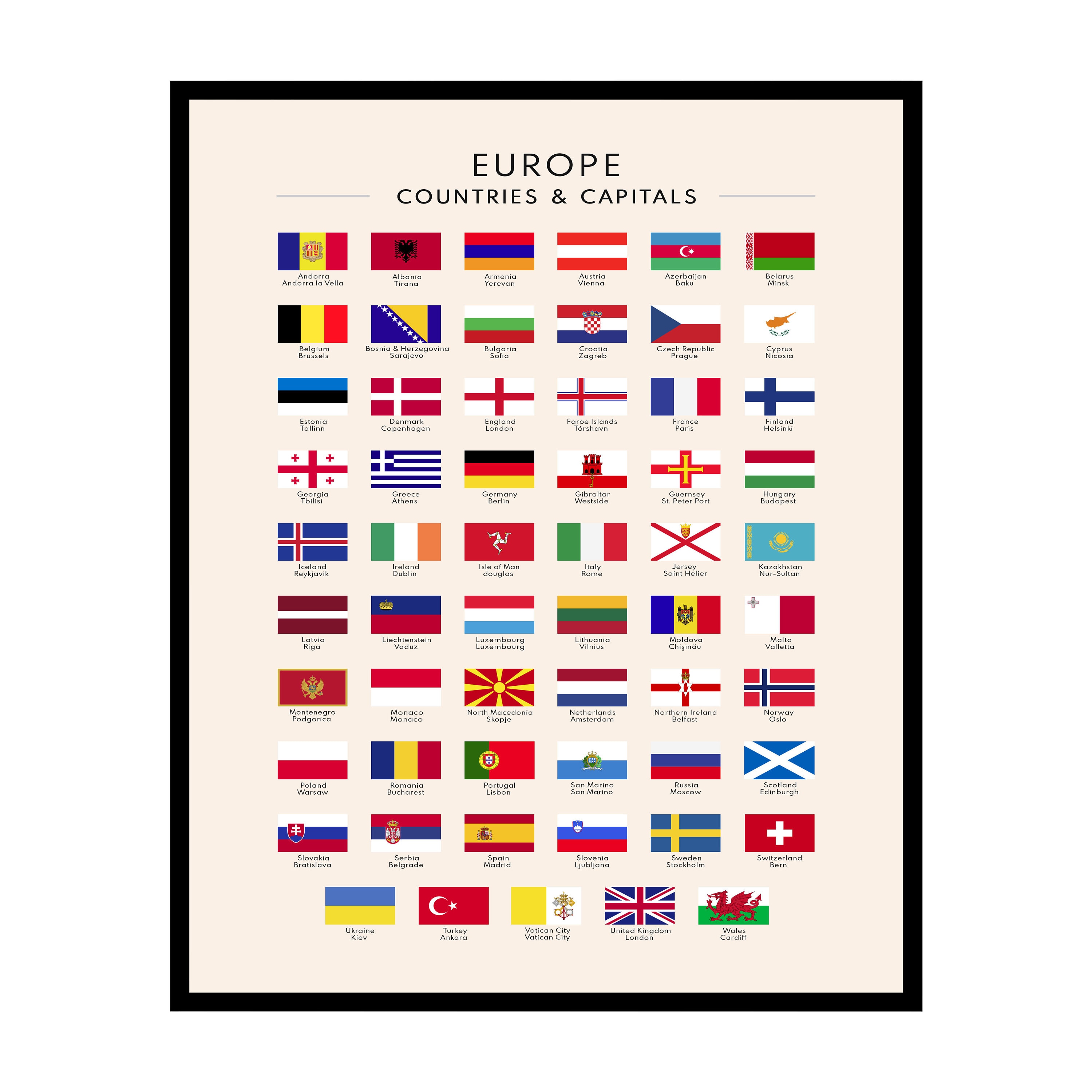
European flags represent a complex tapestry of historical heraldry, revolutionary ideals, and regional identities. This overview provides a structured guide to the sovereign flags of Europe as of 2026, detailing their design origins, color symbolism, and the vexillological patterns that group these nations together into distinct cultural and geographic families.
Understanding European Flag Categorizations
The study of flags, known as vexillology, reveals that European flags are rarely arbitrary. Most belong to specific "families" of design based on shared history, religious affiliations, or political movements. In 2026, while the political landscape of the continent continues to evolve, the flags of the 44 to 50 sovereign states (depending on the inclusion of transcontinental nations) remain the primary markers of national identity.
To navigate a concise list, one must first understand the three most common layouts:
- The Tricolor: Derived largely from the influence of the French Revolution, these flags use three stripes of equal size, either horizontal or vertical.
- The Nordic Cross: Characterized by an off-center cross reaching the edges of the flag, symbolizing Christianity and the shared heritage of Northern Europe.
- The Heraldic Shield: Flags that prominently feature a coat of arms or a specific national emblem, often dating back to medieval dynasties.
The Nordic Cross: Northern Europe’s Unified Aesthetic
The Nordic Cross is one of the oldest and most recognizable design patterns in the world. The design originated with the Dannebrog (the flag of Denmark), which is documented as far back as the 14th century.
Denmark, Sweden, and Norway
The Danish flag consists of a white cross on a red field. According to legend, it fell from the sky during the Battle of Lindanise in 1219. This established the "Nordic Cross" template. Sweden adopted a yellow cross on a blue field, colors derived from the Swedish coat of arms. Norway, however, added a "fimbriation"—a thin border—to its cross. The Norwegian flag features a blue cross outlined in white on a red field, intentionally incorporating the colors of both Denmark and Sweden while nodding to the French tricolor’s democratic ideals.
Finland and Iceland
Finland’s flag, adopted after its independence from Russia, features a blue cross on a white field, representing the "land of a thousand lakes" and the white snow of the Finnish winter. Iceland’s flag is essentially the inverse of Norway’s color scheme, with a red cross outlined in white on a blue field, symbolizing the island's volcanic fires and its surrounding Atlantic waters.
The Influence of the French Tricolor: Western and Central Europe
The French Tricolore (Blue, White, Red) revolutionized flag design in the late 18th century. It replaced complex heraldic banners with simple vertical stripes representing "Liberté, Égalité, Fraternité." This layout became a template for republicanism across the continent.
Vertical Tricolors
- France: The blue and red are the traditional colors of Paris, while white represents the Bourbon monarchy, brought together to symbolize national unity.
- Ireland: Green represents the Gaelic tradition, orange represents the followers of William of Orange, and white symbolizes the hope for a lasting peace between them.
- Belgium: Taking inspiration from the French layout but using the colors of the Duchy of Brabant (Black, Yellow, Red), Belgium’s stripes are vertical to distinguish it from the horizontal stripes of the Netherlands.
- Italy: Often called the Il Tricolore, it uses Green, White, and Red. While similar to the French flag, the green is said to represent the country's plains and the Mediterranean maquis.
Horizontal Tricolors
Horizontal stripes are more common in Central and Eastern Europe.
- The Netherlands: The oldest tricolor in continuous use, featuring Red, White, and Blue. Originally "Prince’s Flag" (Orange, White, Blue), the orange stripe was eventually replaced by red for better visibility at sea.
- Germany: The Black, Red, and Gold (Schwarz-Rot-Gold) stripes represent the 19th-century movement for a unified German state. These colors are linked to the uniforms of the Lützow Free Corps.
- Luxembourg: Often confused with the Netherlands, Luxembourg’s flag uses a lighter shade of "sky blue" and a different aspect ratio (3:5 or 1:2).
The Pan-Slavic Colors: Eastern Europe and the Balkans
In the mid-19th century, the Prague Slavic Congress of 1848 defined the Pan-Slavic colors: Blue, White, and Red. These colors were inspired by the flag of Russia and were adopted by many Slavic nations seeking independence from the Austro-Hungarian and Ottoman Empires.
Russia, Serbia, and Slovakia
The Russian Federation uses a horizontal white, blue, and red tricolor. Serbia utilizes the same colors but in a different order (Red, Blue, White) and adds a state coat of arms featuring a double-headed eagle. Slovakia and Slovenia also use the white-blue-red horizontal arrangement, distinguishing themselves by placing their national shields on the "hoist" side (the side near the flagpole) to avoid confusion with the Russian flag.
Distinct Balkan Designs
- Albania: A stark departure from the tricolor, featuring a black double-headed eagle on a solid red field, dating back to the 15th-century hero Skanderbeg.
- Bosnia and Herzegovina: A modern design adopted in 1998, featuring a yellow triangle (representing the country's shape and its three constituent peoples) and a row of stars on a blue field.
- Croatia: A red-white-blue tricolor with the "Chequy" (checkerboard) shield, a symbol associated with Croatian identity since the Middle Ages.
The Baltic States: Unique Color Palettes
The Baltic states—Estonia, Latvia, and Lithuania—regained their original flags after the collapse of the Soviet Union. Their designs are notably distinct from their neighbors.
- Estonia: The Blue, Black, and White stripes represent the sky, the soil (and the dark jackets of the peasantry), and the pursuit of purity and light.
- Latvia: One of the world's oldest flags, featuring a specific "Latvian Red" (carmine) with a narrow white stripe in the center. Legend says it originated from a white sheet stained by a wounded leader's blood.
- Lithuania: The Yellow, Green, and Red stripes represent the sun/prosperity, the forests/hope, and the blood shed for the nation.
Southern Europe and the Mediterranean
Flags in the Mediterranean region often reflect maritime history or specific royal lineages.
- Spain: The Rojigualda features two red horizontal stripes and a central yellow stripe that is twice the width of the red ones. It houses the Spanish coat of arms, which includes the Pillars of Hercules.
- Portugal: Divided vertically into green (hope) and red (blood), with the armillary sphere and the traditional Portuguese shield at the intersection.
- Greece: Nine horizontal stripes of blue and white, representing the nine syllables of the motto "Eleftheria i Thanatos" (Freedom or Death). The white cross in the canton represents Eastern Orthodox Christianity.
Comprehensive Table of Sovereign European Flags
This table provides a quick reference for the flags of major European nations, including their primary colors and identifying features as of 2026.
| Country | Flag Type | Primary Colors | Notable Features |
|---|---|---|---|
| Austria | Horizontal Triband | Red, White | Three equal horizontal stripes; red-white-red. |
| Bulgaria | Horizontal Tricolor | White, Green, Red | Green replaces the blue of the Pan-Slavic set. |
| Czech Republic | Per Pall / Bicolor | White, Red, Blue | A blue triangle at the hoist with white and red stripes. |
| Denmark | Nordic Cross | Red, White | White cross on a red field; oldest continuous flag. |
| France | Vertical Tricolor | Blue, White, Red | Equal vertical stripes; the "Tricolore." |
| Germany | Horizontal Tricolor | Black, Red, Gold | Colors of the 19th-century democratic movement. |
| Greece | Striped with Canton | Blue, White | Nine stripes with a white cross in the top-left. |
| Hungary | Horizontal Tricolor | Red, White, Green | Represents strength (red), faithfulness (white), hope (green). |
| Ireland | Vertical Tricolor | Green, White, Orange | Symbolizes peace between traditions. |
| Italy | Vertical Tricolor | Green, White, Red | Derived from the French design. |
| Poland | Horizontal Bicolor | White, Red | Simple two-stripe design; white on top. |
| Spain | Horizontal Triband | Red, Yellow | Central yellow stripe is double-width (Spanish fess). |
| Switzerland | Square Flag | Red, White | One of only two square national flags in the world. |
| Ukraine | Horizontal Bicolor | Blue, Yellow | Represents blue skies over yellow wheat fields. |
| United Kingdom | Superimposed Crosses | Blue, Red, White | The "Union Jack"; combines England, Scotland, and Ireland. |
The Vexillology of Microstates and Special Entities
Europe is home to several microstates with flags that often follow very specific heraldic rules.
The Holy See (Vatican City)
The Vatican flag is unique for being perfectly square (1:1 ratio). It consists of two vertical bands of yellow and white. The white band contains the crossed Keys of Saint Peter and the Papal Tiara. It is one of the few flags in the world that violates the "Rule of Tincture" in heraldry (placing gold/yellow next to silver/white), which signifies its special status.
Monaco and San Marino
Monaco’s flag is red and white, identical to the colors of Indonesia but with different proportions. San Marino features two horizontal bands of white and blue with the national coat of arms in the center, representing the clouds and the sky above Mount Titano.
The European Union Flag
While not a national flag, the European Union flag is ubiquitous across the continent in 2026. It features a circle of 12 gold stars on a blue background. The number 12 is symbolic of perfection and unity, rather than the number of member states. This flag was originally designed for the Council of Europe in 1955 before being adopted by the EU's predecessor.
Common Mistakes in Flag Identification
Due to the shared history of European nations, several flags appear remarkably similar to the untrained eye. Distinguishing them requires looking at aspect ratios, color shades, and symbols.
- Ireland vs. Italy: Ireland uses Green, White, and Orange. Italy uses Green, White, and Red.
- Luxembourg vs. The Netherlands: Both use Red, White, and Blue horizontal stripes. However, Luxembourg’s blue is a much lighter shade, and the flag is often longer (1:2 ratio) compared to the Dutch 2:3 ratio.
- Monaco vs. Poland: Both use Red and White. Monaco has Red on top, while Poland has White on top. Furthermore, Monaco’s flag is more "squat" with a 4:5 ratio.
- Romania vs. Chad: While not both in Europe, the flag of Romania (Blue, Yellow, Red vertical) is nearly identical to the flag of Chad. The Romanian blue is typically a slightly different cobalt shade.
Historical Evolution and Design Standards
By 2026, most European flags have been standardized by national laws or international bodies like the International Organization for Standardization (ISO). These standards define the exact "Pantone" or "CMYK" color values to ensure consistency in digital and physical manufacturing.
The evolution of these flags often mirrors the continent's history. For example, the "fimbriation" seen in the UK’s Union Jack (the thin white borders around the red crosses) is a technical requirement to prevent "color on color" according to heraldic laws. Similarly, the shift from 1:1 square flags to the more common 2:3 or 3:5 ratios reflects the needs of naval signaling and modern display standards.
FAQ: European Flag Overview
Why do so many European flags have the same colors?
Most European flags use red, white, and blue because of two primary historical influences: the Pan-Slavic movement and the French Revolution. Additionally, red and white were the most common colors in medieval heraldry because they were the easiest dyes to produce and provided high contrast on the battlefield.
Which European flag is the oldest?
The flag of Denmark (the Dannebrog) is widely considered the oldest continuously used national flag in the world, with its origins dating back to at least the 14th century.
Are all European flags rectangular?
No. Switzerland and the Vatican City use square flags (1:1 ratio). While most other nations use rectangular flags, the proportions vary significantly; for example, the United Kingdom uses a 1:2 ratio, making it twice as long as it is high, while Belgium uses a nearly square 13:15 ratio.
What is the meaning of the stars on the EU flag?
The 12 stars on the European Union flag do not represent the number of member countries. Instead, the number 12 was chosen as a symbol of unity, solidarity, and harmony among the peoples of Europe, much like the 12 signs of the zodiac or the 12 hours on a clock face.
Why does the UK flag look different from others?
The United Kingdom’s flag, the Union Jack, is a "composite" flag. It overlays the Red Cross of St George (England), the White Saltire of St Andrew (Scotland), and the Red Saltire of St Patrick (Ireland). It does not include a symbol for Wales because Wales was considered a Principality of England when the flag was first designed in 1606.
Recommended Next Actions
For those looking to deepen their understanding of European flags beyond a simple list, consider the following steps:
- Study Heraldic Rules: Learn the "Rule of Tincture" to understand why certain colors are never placed directly next to others in European designs.
- Explore Sub-National Flags: Many European regions, such as Bavaria (Germany), Catalonia (Spain), and Brittany (France), have flags with histories as rich as national ones.
- Consult Vexillological Databases: Organizations like the International Federation of Vexillological Associations (FIAV) provide technical data on the exact proportions and construction sheets for every European flag.
- Visit National Museums: In many European capitals, the original "first flags" of the nation are preserved in military or historical museums, providing a direct link to the revolutionary or monarchical past.