American Risk Retention Group (ARRG) auto insurance is a specialized liability coverage solution designed primarily for commercial transportation entities, such as trucking companies and niche fleet operators. Unlike traditional commercial insurance, ARRG operates as a member-owned entity where policyholders are also owners, allowing for tailored risk management and potentially lower premiums through shared risk and collective bargaining power.
Risk Retention Groups (RRGs) occupy a unique space in the American insurance landscape. To understand how American Risk Retention Group auto insurance functions in 2026, one must look past the surface of standard "off-the-shelf" policies and examine the federal framework that allows these entities to bypass certain state-level regulations. This guide provides a deep dive into the mechanics, benefits, and risks associated with choosing an RRG for your commercial auto needs.
The Legal Framework: The Liability Risk Retention Act (LRRA)
The foundation of any risk retention group, including the American Risk Retention Group, is the Liability Risk Retention Act of 1986. This federal law was enacted in response to the insurance crisis of the 1980s, when many businesses found it impossible to obtain affordable liability coverage. The LRRA allows businesses with similar risks to form their own insurance company to provide liability coverage to their members.
Under this act, an RRG is chartered and licensed in a single state (the "domiciliary" state) but is permitted to operate in all other states without having to follow the full suite of licensing requirements in those secondary jurisdictions. For a trucking fleet or a commercial transport business, this means that an RRG like American Risk Retention Group can provide consistent coverage across state lines, which is essential for long-haul operations.
However, it is vital to note that the LRRA only covers liability insurance. By law, an RRG cannot provide personal lines of insurance (like individual homeowner or private passenger auto insurance), workers' compensation, or first-party property coverage (such as collision or comprehensive coverage for the vehicles themselves).
How American Risk Retention Group Auto Insurance Works
The American Risk Retention Group operates on a "member-owner" model. This structure fundamentally changes the relationship between the insured and the insurer. When a commercial fleet signs up for coverage, they are not just buying a policy; they are making a capital contribution to the group.
Membership and Capital Contributions
To join the American Risk Retention Group, a business must typically meet specific underwriting criteria that ensure they align with the group's risk profile. Most RRGs in the transportation sector focus on high-risk or highly specialized industries, such as:
- Long-haul trucking and logistics.
- Waste hauling and environmental services.
- Public transport, including taxis and limousines.
- Specialized delivery services.
Upon acceptance, members often pay a one-time or periodic capital contribution. This money serves as the surplus for the insurance company, providing the financial cushion required by regulators. In 2026, these contributions are often managed through digital equity portals, allowing members to track their "ownership" stake in the group.
Liability-Only Focus
Because of federal restrictions, American Risk Retention Group focuses exclusively on third-party liability. This includes:
- Bodily Injury Liability: Coverage for medical expenses and legal fees if a member's vehicle causes injury to another person.
- Property Damage Liability: Coverage for damage caused by a member's vehicle to someone else's property (e.g., another vehicle, a building, or a guardrail).
To secure "full coverage" (including physical damage for their own trucks), members often join a sister organization known as a Purchasing Group (PG), or they purchase a separate inland marine or physical damage policy from a traditional carrier.
Comparing RRGs to Traditional Commercial Auto Insurance
Choosing between the American Risk Retention Group and a standard commercial carrier like Progressive or Travelers involves weighing the benefits of ownership against the safety nets of the admitted market.
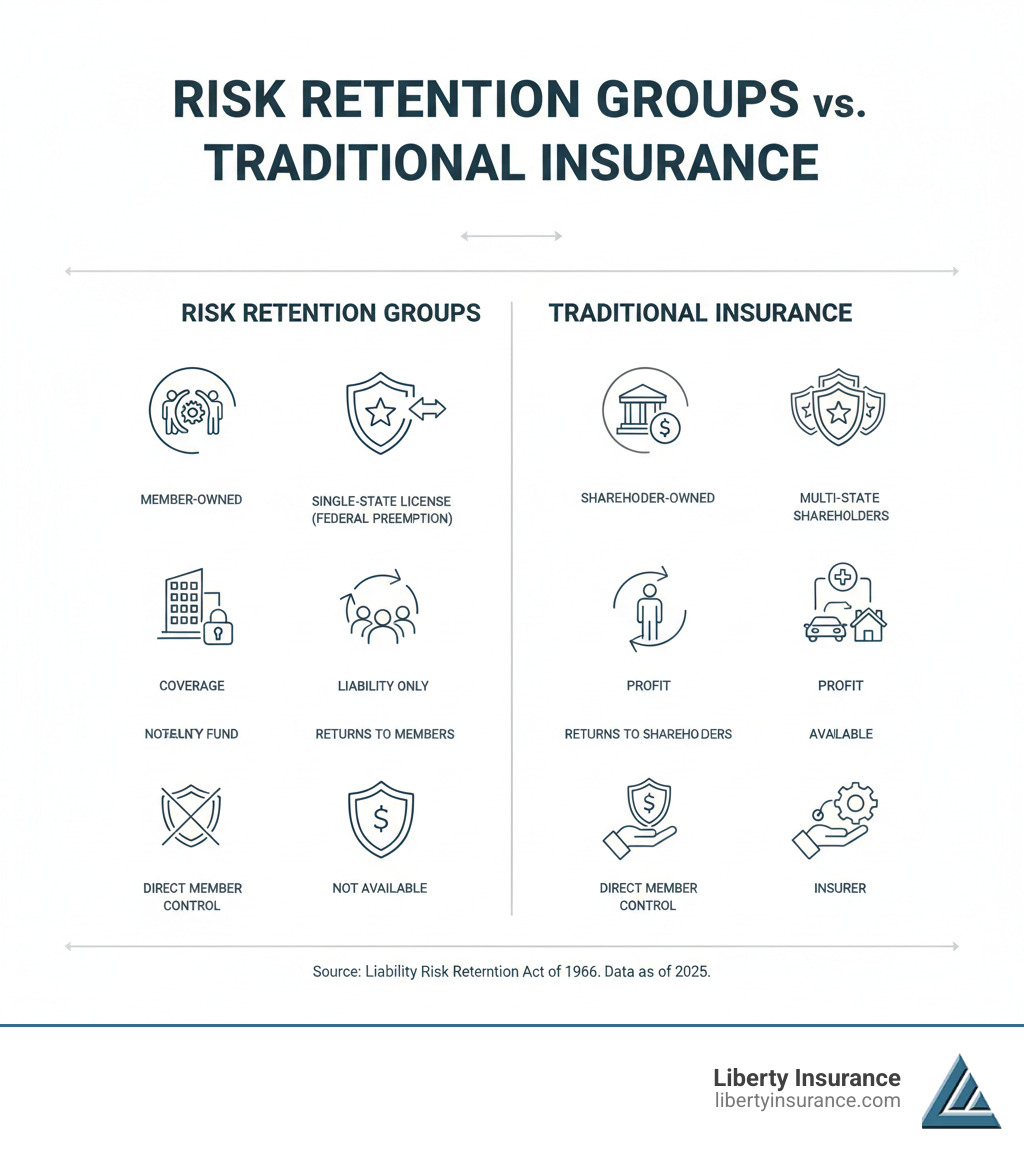
| Feature | American Risk Retention Group (RRG) | Traditional Commercial Insurer |
|---|---|---|
| Ownership | Member-owned (Policyholders are owners) | Stockholder or Mutual-owned |
| Regulation | Domiciliary state (Federal pre-emption) | Regulated by every state where they sell |
| Coverage Scope | Liability ONLY (under LRRA) | Liability, Physical Damage, Cargo, etc. |
| Guaranty Fund | No protection from state guaranty funds | Protected by state guaranty funds |
| Pricing | Often more stable; based on group loss | Market-driven; can fluctuate significantly |
| Capital | Requires capital contribution/membership fee | No upfront capital required (premiums only) |
The Advantages of the RRG Model in 2026
In the current 2026 insurance climate, where "social inflation" and high nuclear verdicts have driven traditional commercial auto premiums to record highs, the American Risk Retention Group offers several distinct advantages.
1. Stable and Competitive Premiums
Because the members are the owners, there is no "profit motive" in the traditional sense. Excess profits are often returned to members in the form of dividends or used to offset future premium increases. This leads to a more stable pricing environment compared to the volatile commercial auto market.
2. Specialized Claims Handling
Standard insurers handle a massive variety of claims. An RRG like American Risk Retention Group typically specializes in one industry (e.g., trucking). This means their claims adjusters and legal teams are experts in the specific regulations, safety standards, and litigation environment of that industry. This expertise can lead to more efficient claim resolutions and lower legal costs.
3. Risk Management and Safety Programs
Since the group's financial health depends on the safety of its members, the American Risk Retention Group places a heavy emphasis on loss control. Members are often required to adopt specific safety technologies, such as advanced telematics, AI-driven dashcams, and rigorous driver training programs. In 2026, these groups often provide members with proprietary data analytics to help them identify and mitigate high-risk behaviors before an accident occurs.
Critical Risks and Considerations
While the benefits are significant, the American Risk Retention Group is not without its drawbacks. Potential members must perform due diligence before committing their capital.
Lack of State Guaranty Fund Protection
This is perhaps the most significant risk of any RRG. Traditional insurers participate in state guaranty funds, which act as a safety net. If a traditional insurer goes bankrupt, the state fund steps in to pay outstanding claims. RRGs are federally prohibited from participating in these funds. If the American Risk Retention Group were to become insolvent, members could be left responsible for their own claims and could lose their initial capital contributions.
Financial Solvency Monitoring
Because RRGs are not subject to the same level of oversight in every state, members must be proactive in monitoring the financial health of the group. It is essential to review the group's A.M. Best Rating or other financial strength indicators. A rating of "A-" (Excellent) or better is generally considered the standard for commercial viability. You can verify financial ratings and regulatory filings through the National Association of Insurance Commissioners (NAIC).
Limited Coverage Scope
As mentioned, the inability to provide physical damage or cargo insurance within the same legal entity can be an administrative hurdle. Businesses must manage multiple policies and ensure there are no gaps between the RRG liability coverage and the physical damage coverage provided elsewhere.
Steps to Evaluate American Risk Retention Group Auto Insurance
If you are considering moving your fleet's coverage to an RRG, follow these technical steps to ensure a sound decision:
- Review the Feasibility Study: Most RRGs have an initial feasibility study or an annual report that outlines their target loss ratios and historical performance.
- Analyze the Reinsurance Structure: Even though an RRG retains risk, they almost always purchase "reinsurance" to protect against catastrophic losses. Ask for details on who their reinsurers are and what their "attachment points" (the dollar amount where reinsurance kicks in) are.
- Audit the Risk Management Requirements: Ensure your fleet can actually comply with their safety mandates. If the RRG requires 2026-standard AI telematics and your fleet is older, the cost of upgrading technology may offset the premium savings.
- Consult the Domiciliary Regulator: Check with the insurance department of the state where the RRG is chartered (common states include Vermont, South Carolina, and Montana) to see if there have been any regulatory actions or concerns. Information can often be found via the National Risk Retention Association (NRRA).
Common Misconceptions About RRGs
Many fleet owners shy away from RRGs due to a lack of understanding. One common myth is that RRGs are "unregulated." In reality, they are strictly regulated by their domiciliary state and must adhere to the National Association of Insurance Commissioners (NAIC) accounting standards.
Another misconception is that they are only for companies that "can't get insurance elsewhere." While some RRGs cater to distressed risks, many of the most successful RRGs are comprised of "best-in-class" operators who are tired of subsidizing the poor safety records of other companies in the traditional insurance pool.
The Role of Telematics in 2026 RRG Underwriting
By 2026, the integration of real-time data has become the primary driver for ARRG underwriting. Unlike traditional policies that may only review a company's "loss runs" once a year, the American Risk Retention Group often utilizes continuous underwriting. This means premiums can fluctuate (within a set range) based on actual monthly safety scores. For high-performing fleets, this provides an immediate financial reward for maintaining safety standards, a feature often lacking in the rigid structures of traditional admitted carriers.
FAQs
Can an RRG provide coverage for my personal car?
No. Under the Liability Risk Retention Act (LRRA), RRGs are strictly limited to commercial liability insurance for businesses with similar risks. They cannot write personal lines of insurance, such as private homeowner or individual auto policies.
What happens if the American Risk Retention Group goes out of business?
Because RRGs are not members of state guaranty funds, there is no government-backed safety net. Policyholders may be responsible for paying their own outstanding claims, and any capital they invested in the group could be lost. This makes checking the financial strength and reinsurance of the group critical.
Does American Risk Retention Group cover physical damage to my trucks?
Directly, no. An RRG is legally restricted to liability coverage. However, many RRGs facilitate physical damage coverage through an affiliated Purchasing Group or a separate partnership with a traditional insurance company to provide a "seamless" package for the member.
Is an RRG the same as a Captive Insurance company?
They are related but different. A "Single-Parent Captive" is owned by one large company to insure its own risks. A Risk Retention Group is a specific type of "Group Captive" that must be owned by its members and is governed by federal law (the LRRA), allowing it to operate across state lines more easily than other captive types.
Are RRGs legal in all 50 states?
Yes. The federal Liability Risk Retention Act allows an RRG licensed in one state to provide liability insurance to members in all other states. While they must register with the insurance department in each state where they operate, those states cannot impose the same licensing and filing requirements as they do for traditional insurers.
Recommendation for Fleet Owners
If your commercial fleet has a strong safety culture and you are facing volatile premiums in the traditional market, the American Risk Retention Group auto insurance model is a viable and often superior alternative. However, it should only be pursued if you are willing to become an active participant in risk management and have the financial stability to provide an upfront capital contribution. Prioritize groups with an A.M. Best rating of A- or higher and ensure you have a clear strategy for secondary coverages like physical damage and cargo insurance.