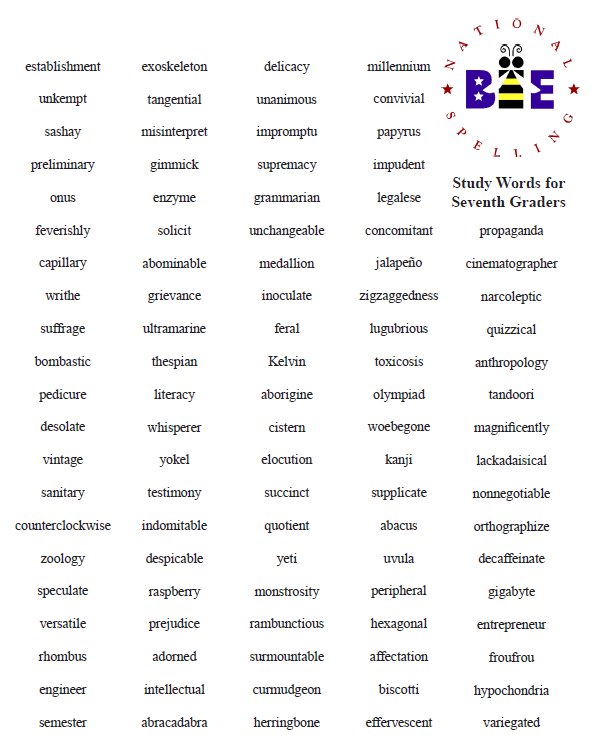
Advanced spelling bee words represent the pinnacle of linguistic precision, challenging competitive spellers with obscure etymologies, complex morphological roots, and irregular orthographic patterns derived from dozens of source languages. Preparing for elite spelling competitions requires moving far beyond basic memorization to master phonological rules, historical language shifts, and systematic study frameworks.
The Anatomy of Advanced Spelling Bee Words
To understand why advanced spelling bee words are uniquely difficult, one must examine their structural complexity and historical origins. Unlike standard English vocabulary, which relies on relatively predictable phonetic patterns, championship-tier words frequently retain the spelling conventions of their native languages. These terms act as linguistic fossils, carrying the exact orthographic signatures of Old English, Latin, Ancient Greek, Arabic, French, German, and numerous other tongues.
When a speller encounters a word like eudaemonia, they are not merely recalling a sequence of letters; they are navigating the transliteration rules of Ancient Greek diphthongs. Similarly, words derived from French—such as bouillabaisse or croquembouche—demand an understanding of silent consonants, nasal vowels, and historical shifts in pronunciation that often diverge sharply from modern English phonetic norms.
Furthermore, advanced words are characterized by length, unusual letter combinations, and dense internal morphology. Prefixes, roots, and suffixes are stacked upon one another, creating intricate linguistic architecture. Recognizing these building blocks is essential for accurate spelling under high-pressure competitive conditions.
The Role of Etymology and Language of Origin
Etymology is the single most powerful tool in a competitive speller's arsenal. Knowing the language of origin provides an immediate framework for decoding how a word should be spelled. Without etymological awareness, advanced spelling bee words appear as random strings of letters. With it, they reveal logical, rule-bound structures.
Key Language Families and Their Orthographic Rules
- Ancient Greek Roots: Greek-derived words frequently feature the "ph" sound spelled with ph, the "k" sound spelled with ch (as in chiastic), and the "rh" combination at the beginning of words (as in rhapsody). The letter y is also heavily utilized instead of i within Greek roots.
- Latin Roots: Latin terms often follow specific suffix patterns (such as -ious, -osity, or -itude) and frequently double consonants following short, stressed vowels. Understanding Latin verb stems helps spellers determine whether a noun ends in -ance or -ence, -able or -ible.
- Germanic Origins: Words imported from German often preserve distinctive consonant clusters, such as sch, tz, or pf, and tend to feature compound structures where multiple base words are joined together.
- Romance Languages (French, Italian, Spanish): French borrowings frequently preserve silent terminal letters, the "zh" sound represented by g or j, and complex vowel digraphs like eau or ou.
| Language of Origin | Common Phonetic Clue | Orthographic Marker | Example Word |
|---|---|---|---|
| Ancient Greek | "f" sound | Ph | pharaoh |
| Latin | Noun forming suffix | -ia / -ium | symposium |
| German | Initial "sh" sound | Sch | schadenfreude |
| French | Nasalized vowel / silent ending | -et / -ique | boutique |
Essential Strategies for Systematic Study
Memorizing a dictionary is an impossible and ineffective strategy for mastering advanced spelling bee words. Instead, elite competitors rely on systematic study methodologies that prioritize pattern recognition, root analysis, and active recall.
Building a Root-Based Vocabulary
Spellers should categorize their study lists by morphemes rather than alphabetical order. By studying all words containing the root chron (time) or graph (writing) simultaneously, the student internalizes the spelling of the root itself, making it immune to errors regardless of the surrounding prefixes and suffixes.
Leveraging Pronunciation and Etymological Clues
During a spelling bee, competitors have the right to ask the pronouncer several clarifying questions. Knowing how to use these questions strategically is a vital skill:
- Requesting the definition: Ensures the speller understands the semantic context, avoiding confusion between homophones or similarly sounding terms.
- Asking for the part of speech: Nouns, verbs, and adjectives often utilize different grammatical endings.
- Inquiring about alternate pronunciations: Pronouncers will often give a secondary pronunciation that emphasizes silent letters or foreign phonemes to help the speller.
- Requesting the language of origin: Unlocks the applicable orthographic rules associated with that specific linguistic tradition.
Common Pitfalls and How to Avoid Them
Even highly prepared spellers fall victim to predictable traps during high-stakes competitions. Recognizing these vulnerabilities allows students to adjust their study habits and mental discipline.
Over-Reliance on Intuitive Phonics
English orthography is notoriously irregular. Spellers who rely purely on how a word sounds ("phonetic spelling") will invariably fail on advanced lists. Words like pharaoh, colonel, or ptarmigan defy intuitive phonetic translation. Competitors must train themselves to trust established etymological rules over intuitive sound-it-out methods.
Fatigue and Mental Burnout
Studying advanced spelling bee words requires intense cognitive load. Marathon study sessions often lead to diminishing returns and careless errors. Structured, spaced repetition schedules—utilizing digital flashcard systems or physical index cards—yield significantly better long-term retention than cramming.
Frequently Asked Questions About Advanced Spelling Bee Words
How many words are typically on an advanced spelling bee study list?
Official spelling bee study lists, such as those provided by the Scripps National Spelling Bee, often span several hundred words, but competitive spellers generally master vocabularies exceeding several thousand words by drawing from comprehensive spelling resources, unabridged dictionaries, and etymological guides.
Are silent letters always consistent in foreign-derived words?
Not always, but they generally follow the historical orthography of the source language. For instance, French borrowings frequently retain silent final consonants unless a suffix is added that forces the consonant to be pronounced.
What is the most effective way to practice for a spelling bee alone?
Solo practice is most effective when utilizing active recall methods, such as voice-recording spelling lists and testing oneself, writing words down on a physical whiteboard to build muscle memory, and practicing the official questioning protocol aloud.
How can I determine if a word is of Greek or Latin origin?
Look for structural markers: Greek words frequently contain combining forms like micro, macro, poly, or tele, and utilize the letter y internally. Latin words more commonly feature standard English-style prefixes like sub, trans, inter, and standard noun/adjective suffixes.
What is the best daily routine for spelling bee preparation?
A balanced daily routine includes 30 minutes of root-word analysis, 30 minutes of testing via flashcards or dictation, and regular review of missed words in a dedicated error log.
Practical Next Steps for Competitive Spellers
To transition from intermediate proficiency to elite-tier spelling performance, establish a disciplined, multi-phase preparation plan. Begin by acquiring official spelling bee study guides and compiling a personalized error log of every misspelled word encountered during practice. Master the top fifty Greek and Latin roots, as these unlock thousands of derivative terms. Finally, practice under simulated competition conditions with a timer and a proctor to build the emotional resilience required to spell complex, unfamiliar words under pressure.