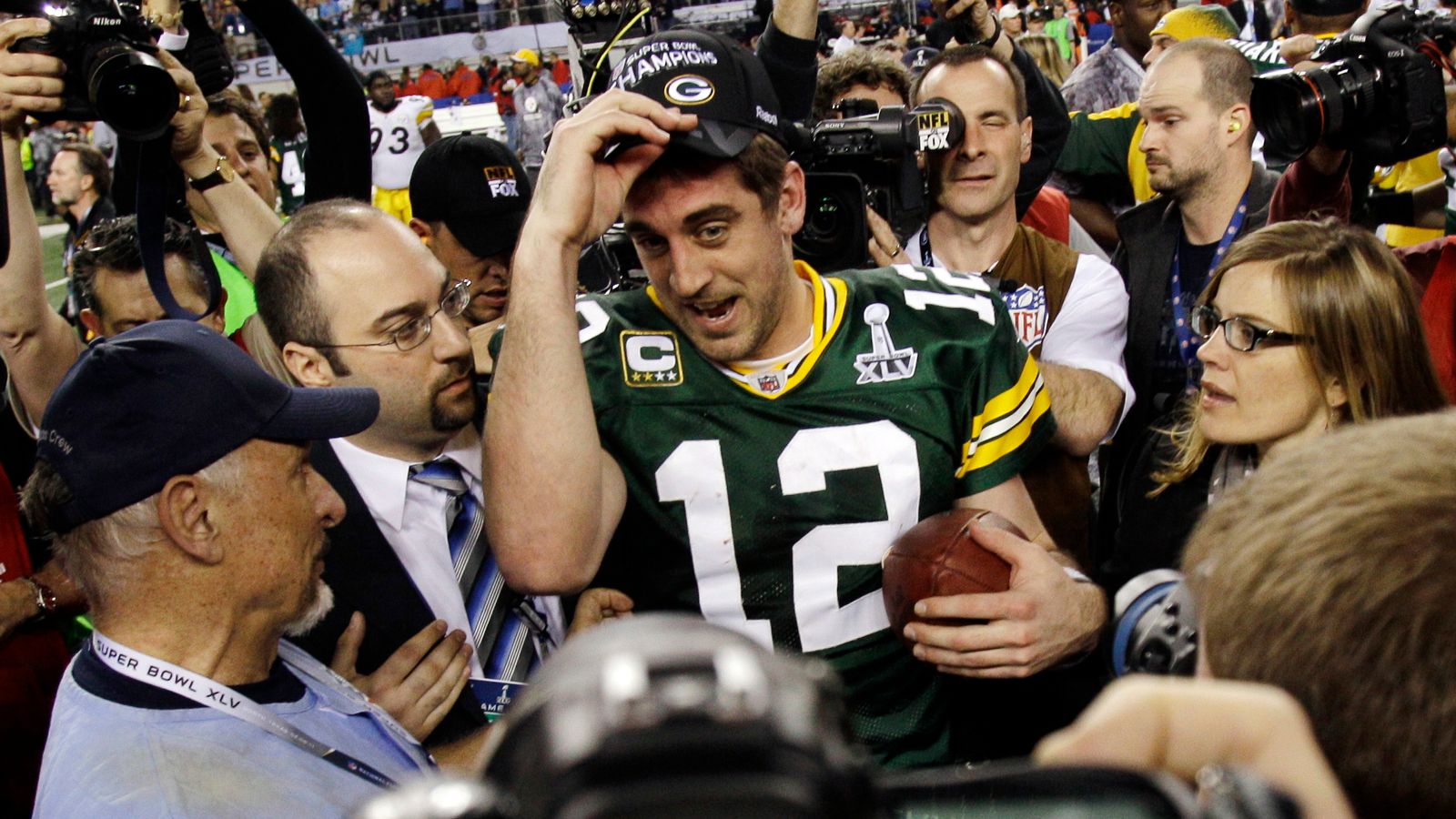
The legacy of Aaron Rodgers is defined by an unparalleled combination of individual statistical efficiency, arm talent, and a transformative influence on the quarterback position. As one of the most decorated players in NFL history, his career is anchored by four Most Valuable Player (MVP) awards, a Super Bowl XLV championship, and a career passer rating that remains among the highest in the history of professional football.
The Statistical Foundation of Excellence
To understand the scope of Aaron Rodgers’ career, one must look first at the metrics that established his reputation as perhaps the most precise passer in the history of the sport. Throughout his tenure, Rodgers consistently led the league in touchdown-to-interception ratio—a statistic that serves as the gold standard for quarterback decision-making and ball security.
Rodgers’ efficiency is not merely a product of short-range passing or safe play-calling. He redefined the "big play" by combining vertical passing accuracy with a near-total avoidance of turnovers. During his peak years with the Green Bay Packers, his ability to manipulate defensive coverage allowed him to extend plays outside the pocket, a skill set that forced defenses to play deeper and abandon traditional schemes.
His career passer rating is a direct consequence of this efficiency. While many quarterbacks have flirted with greatness over shorter spans, Rodgers maintained an elite level of play for over a decade. His ability to protect the football while simultaneously maintaining a high completion percentage and a high yards-per-attempt average created an offensive baseline that allowed his teams to remain competitive regardless of the defensive personnel on the field.
Tactical Mastery: The Art of the Hard Count
Beyond raw statistics, Rodgers’ legacy is inextricably linked to his cerebral approach to the game. His mastery of the "hard count"—a technique used to draw defenders offside by simulating a snap cadence—became a weapon in itself. This was not a gimmick; it was a calculated method of gaining free plays.
By forcing defenders to jump into the neutral zone, Rodgers frequently earned a "free play" where he could take deep, high-risk shots down the field with the knowledge that a penalty would negate any negative result. This tactical nuance reflects his deeper understanding of the NFL rulebook and the psychology of defensive fronts. It transformed the pre-snap process from a logistical necessity into a strategic advantage, forcing opposing defensive coordinators to exercise extreme discipline to avoid giving away free yards and momentum.
The Green Bay Era and the Super Bowl XLV Milestone
The core of Rodgers’ historical narrative is built upon his long tenure with the Green Bay Packers. Selecting him in the first round of the 2005 NFL Draft, the organization eventually transitioned from Brett Favre to Rodgers in 2008. The pressure to succeed a legendary predecessor was immense, yet Rodgers established his own identity almost immediately.
The pinnacle of this era remains the 2010 season, culminating in a victory in Super Bowl XLV against the Pittsburgh Steelers. Rodgers was named the game’s Most Valuable Player, delivering a clinical performance that validated his status as a championship-caliber leader. That season serves as the bridge between his emergence as an elite talent and his subsequent run of individual accolades throughout the 2010s.
His ability to lead a team that frequently faced significant roster churn defines the "carry factor" often discussed by analysts. Whether working with elite wide receivers like Davante Adams or elevating undrafted free agents, Rodgers’ consistent level of play provided a constant north star for the organization.
Evolution of the Quarterback Position
Rodgers represents the bridge between the traditional pocket-passing era of the 1990s and early 2000s and the modern era of the mobile, improvisational playmaker. While he was never categorized as a "running quarterback" in the vein of dual-threat signal-callers, his movement skills were arguably the most vital secondary component of his success.
He utilized his feet not to gain yardage in a design-run capacity, but to reset the geometry of the play. By rolling out or scrambling to the perimeter, he forced linebackers and safeties to vacate their zones, creating passing lanes that did not exist at the snap. This version of mobility—functional, situational, and devastatingly accurate—changed how defensive coordinators defend the pocket. They could no longer prioritize edge pressure alone; they had to maintain lane integrity at the risk of Rodgers exposing the secondary on broken plays.
Comparative Context: Rodgers in the All-Time Pantheon
When analyzing his place among the greats, such as Tom Brady, Peyton Manning, and Drew Brees, the conversation often shifts toward the weight of multiple championships versus the weight of individual brilliance.
| Metric | Contextual Importance |
|---|---|
| MVP Awards | Rodgers stands among the few with four, showcasing peak dominance. |
| Passer Rating | Historically high; reflects sustained efficiency over 15+ seasons. |
| TD/INT Ratio | Best in NFL history; represents elite decision-making. |
| Championships | One Super Bowl win; often the subject of debate regarding the "Greatest of All Time" status. |
While Brady’s seven titles remain the benchmark for team success, Rodgers’ legacy is championed by those who value his superior touchdown-to-interception efficiency and the "eye test" of his throwing mechanics. His release speed, footwork, and ability to throw from non-traditional platforms made him the prototype for the modern quarterback’s arm talent.
Addressing the "What-If" Narrative
A significant portion of the discourse surrounding Rodgers involves the "what-if" scenarios regarding his limited number of Super Bowl appearances. Critics often point to the Packers' repeated exits in the NFC Championship games as a primary critique of his career. However, a technical analysis of these games often reveals that the failures were rarely the result of quarterback performance.
This leads to the realization that Rodgers’ legacy is a study in the complexity of team-building. Despite having one of the most efficient offensive engines in NFL history, the team’s inability to consistently field a top-tier defense or provide a sustained special teams advantage often left the burden of victory entirely on his shoulders. This specific dynamic—a singular talent constantly straining against the limitations of a broader roster structure—has become a foundational element of his career arc.
FAQ: Understanding the Career of Aaron Rodgers
Why is Aaron Rodgers often cited as the most talented passer in NFL history? It stems from his technical precision, his ability to throw from any platform, and his unparalleled touchdown-to-interception ratio. Unlike many peers, he combines high-volume production with a conservative approach to ball security.
How does Rodgers’ MVP status compare to other legends? His four MVP awards place him in an elite class, surpassed only by Peyton Manning’s five. This metric is frequently used to argue that, at his absolute peak, no player provided more value to their team than Rodgers.
What impact did the transition from the Packers to the New York Jets have on his legacy? The move, which occurred in the final chapter of his career, shifted the focus toward his ability to mentor younger players and adapt to new offensive schemes outside the singular system he inhabited for nearly two decades. It serves as a final litmus test for his longevity.
Is Aaron Rodgers a first-ballot Hall of Famer? Yes. His statistical records, MVP count, and overall impact on the strategy and aesthetics of the position make his induction a certainty upon his eligibility.
How did Rodgers influence modern quarterback training? His emphasis on footwork, unconventional release angles, and the use of the hard count has become a curriculum point for developing quarterbacks. He proved that physical arm talent must be paired with extreme mental manipulation of the defense.
Recommendations for Further Study
To fully appreciate the legacy of Aaron Rodgers, one should examine the game film from his 2011 and 2020 seasons—arguably his two most dominant years. Comparing his mechanical consistency across two decades provides the most compelling evidence of his craft. For those interested in the tactical evolution of the game, searching for "All-22" coach’s film on the Green Bay Packers' offensive schemes from 2010 to 2015 offers the best perspective on how he dismantled defensive structures.
His career serves as a masterclass in professional preparation, high-level decision-making under pressure, and the transition from a highly touted prospect to the undisputed face of a franchise.