The 2025 geothermal tax credit landscape expands federal incentives for geothermal heat pumps and deep geothermal energy under Sections 25D and 48/48E of the Internal Revenue Code. Homeowners maintain a 30% uncapped tax credit, while commercial and tax-exempt entities leverage direct pay, transferability, and stackable bonus credits that can elevate total tax savings above 50%.
Understanding the 2025 Geothermal Incentive Baseline
Federal tax incentives for geothermal heating, cooling, and power generation underwent significant structuring following the implementation of the Inflation Reduction Act (IRA). The core framework divides geothermal technology into two primary pathways: residential installations governed by Internal Revenue Code (IRC) Section 25D and commercial or utility-scale systems governed by IRC Section 48 and Section 48E. Understanding this structural division is critical for property owners, developers, and tax professionals navigating system design, capital deployment, and tax optimization.
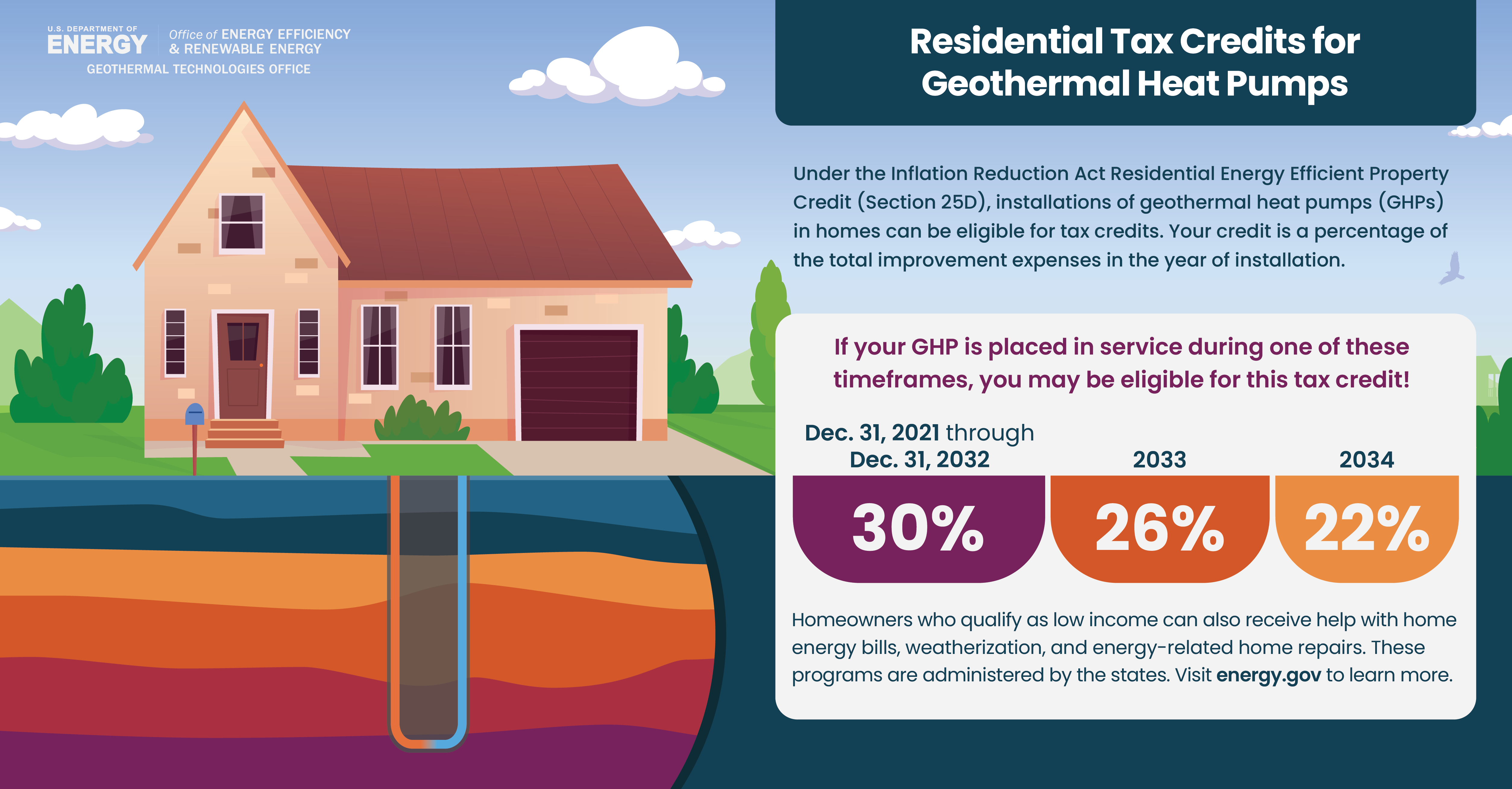
For residential installations, the Residential Clean Energy Credit (Section 25D) provides a straightforward, nonrefundable tax credit equal to 30% of the total expenditures for qualified geothermal heat pump property installed in a residence. This 30% credit rate remains stable through 2032 before stepping down to 26% in 2033 and 22% in 2034. Unlike commercial investments, residential geothermal credits do not impose prevailing wage or apprenticeship mandates, nor do they enforce strict domestic content minimums, making the tax equity calculation straightforward for individual taxpayers.
- Residential (Section 25D): 30% Uncapped Base Credit (2022–2032)
- Commercial (Section 48/48E):
- 6% Base Rate
- 30% Full Rate (with PWA/Capacity Rules)
- +Bonus Adders (Up to 50%+)
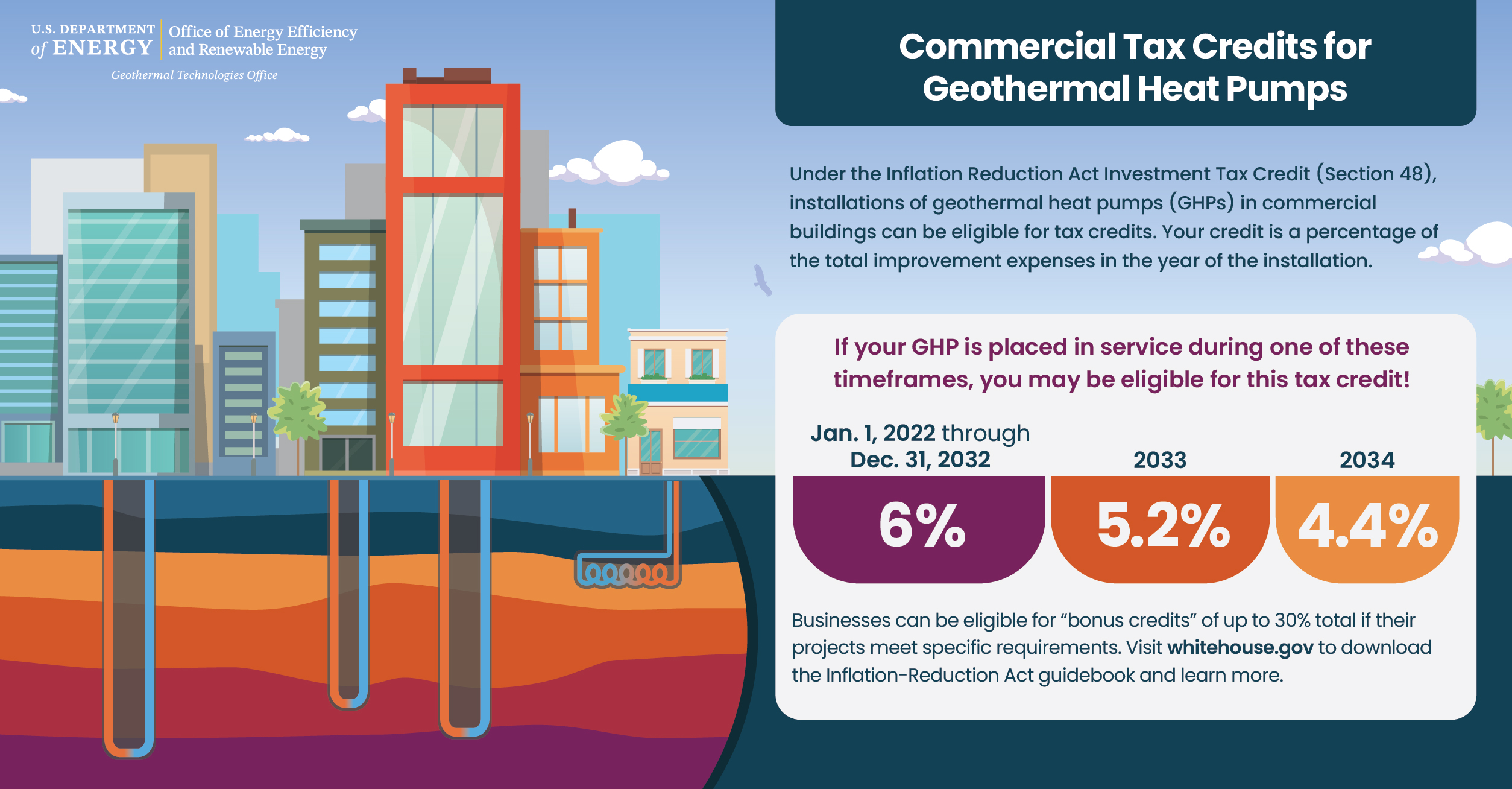
On the commercial side, 2025 marked the formal operational transition to technology-neutral clean energy tax credits under Section 48E for electricity generation, while thermal energy installations—such as geothermal district heating and commercial ground-source heat pump (GSHP) loops—continue under refined Section 48 Investment Tax Credit (ITC) rules. Commercial projects start with a base rate of 6%, which scales up to a full 30% credit when developers satisfy Prevailing Wage and Apprenticeship (PWA) requirements or build systems under 1 megawatt (MW) in maximum net output.
Residential Geothermal Incentives: Section 25D Rules
The residential geothermal tax credit under Section 25D covers 30% of the total installed cost of a ground-source heat pump system. Because ground-source systems require sub-surface drilling, trenching, ground loop installation, and indoor heat distribution equipment, capital expenditures are significantly higher than conventional air-source heat pumps. However, Section 25D places no dollar cap on total qualifying expenditures, allowing high-capacity residential systems to claim substantial single-year tax credits.
To qualify, the geothermal system must be installed in a home used as a residence by the taxpayer located in the United States. While primary residences qualify, secondary homes and vacation properties are also eligible if they are used by the taxpayer as a residence and not rented out to tenants for extended periods. Rental properties typically do not qualify under Section 25D, though landlords may qualify for commercial incentives under Section 48.
Qualifying Residential Costs (30% Credit Applies):
- Sub-surface Drilling & Trenching
- Ground-Loop Piping & Fluid Distribution
- Ground-Source Heat Pump Unit (ENERGY STAR Certified)
- Internal Thermal Ductwork / Hydronic Piping Retrofits
- Direct Labor, Engineering, and Permitting Fees
Eligible Costs and Included System Components
The Internal Revenue Service (IRS) permits taxpayers to include both equipment costs and direct installation expenses in the total basis calculation. Eligible cost categories include:
- Geothermal Heat Pump Assembly: The internal heat pump cabinet, compressor, desuperheater, and heat exchangers.
- Ground Loop Circuit: Closed-loop polyethylene piping, vertical borehole drilling, grouting, horizontal trenching, header piping, and heat transfer fluids.
- On-Site Labor Costs: On-site preparation, assembly, structural modifications, and piping integration performed by licensed contractors.
- Advanced Control Systems: Thermostats, variable-frequency drives, and integrated energy management controls installed specifically to operate the geothermal unit.
- Ductwork and Hydronic Interface: Ductwork modification or radiant floor piping installed to distribute thermal energy generated by the geothermal system.
Equipment that serves solely as an auxiliary back-up heating system—such as electric resistance strip heaters or fossil-fuel backup furnaces—cannot be included in the basis calculation. Similarly, costs related to emergency home generator hookups or non-essential electrical panel upgrades unrelated to system operation are excluded. Detailed guidance on eligible residential clean energy expenditures can be reviewed through the IRS Clean Energy and Vehicle Credits Portal.
Commercial Geothermal Incentives: Section 48, Section 48E, and Wage Requirements
Commercial real estate owners, corporate facility operators, and industrial heat users face a dynamic credit structure governed by IRC Section 48 (for thermal energy heat pumps) and Section 48E (for zero-emission electricity production). Under Section 48, commercial geothermal property qualifies for an initial base credit rate of 6% of the eligible tax basis. To secure the full 30% tier, commercial projects must meet specific statutory criteria established by the Department of the Treasury.
Commercial Credit Tier Determination:
- Project < 1 MW AC / Thermal Equivalent: Qualifies for Full 30% Base Credit
- Project ≥ 1 MW AC / Thermal Equivalent: Requires PWA Compliance to Reach 30% (Otherwise 6%)
Prevailing Wage and Apprenticeship (PWA) Requirements
For systems with a maximum net output of 1 megawatt or greater (measured in thermal equivalent or electrical AC output), project developers must ensure that all laborers and mechanics employed by contractors and subcontractors are paid prevailing wages determined by the U.S. Department of Labor under the Davis-Bacon Act. Additionally, a minimum percentage of total construction labor hours—typically 15%—must be performed by qualified apprentices registered with the Federal Apprenticeship System or a recognized state agency.
Failure to meet or cure PWA non-compliance drops the baseline credit rate from 30% down to 6%, drastically altering project return-on-investment (ROI) figures. Small-scale commercial projects below the 1 MW threshold automatically qualify for the 30% rate without tracking PWA hours, making smaller commercial retrofits highly cost-effective.
Stackable Bonus Credits: Energy Communities, Domestic Content, and Low-Income Adders
Commercial geothermal projects can stack multiple statutory bonus adders on top of the baseline 30% credit rate, potentially bringing total federal tax incentives to 50% or more of total system costs.
- Baseline Credit (30%)
- Domestic Content Bonus (+10%)
- Energy Community Bonus (+10%)
- Low-Income Category Adder (+10% to +20%)
- Potential Federal Tax Credit: Up to 50% - 70%
Domestic Content Bonus (+10%)
To qualify for the 10 percentage point domestic content adder, 100% of any structural steel or iron components used in the project must be produced in the United States. Additionally, manufactured components—such as heat pump compressors, heat exchangers, valves, and control boards—must meet a minimum percentage of domestic manufacture. Treasury regulations mandate that manufactured components meet a 40% domestic content threshold for projects beginning construction before 2025, scaling up to 55% for projects starting after 2026.
Energy Community Bonus (+10%)
Commercial installations qualify for an additional 10 percentage point tax credit if located within a recognized "Energy Community." The tax code identifies three primary types of energy communities:
- Brownfield Sites: Properties designated as brownfields under EPA federal programs.
- Fossil Fuel Employment Areas: Metropolitan Statistical Areas (MSAs) or non-MSAs that have a higher-than-average unemployment rate and a threshold level of employment related to the extraction, processing, or storage of coal, oil, or natural gas.
- Coal Closure Census Tracts: Census tracts (and adjoining tracts) in which a coal mine closed after 1999 or a coal-fired electric generating unit was retired after 2009.
Project locations can be verified through data tools provided by the U.S. Department of Energy Geothermal Technologies Office.
Low-Income Economic Benefit Adders (+10% or +20%)
Under Section 48(e), competitive annual allocations permit clean energy projects installed on low-income residential buildings or in low-income communities to receive an additional 10% to 20% credit boost. Because geothermal heat pumps drastically lower energy bills for low-income residents, district energy initiatives targeting affordable housing developments compete effectively for these limited allocations.
Direct Pay and Credit Transferability: Transforming Non-Profit and Commercial Financing
Prior to the Inflation Reduction Act, tax-exempt organizations—such as local municipalities, public schools, rural electric cooperatives, non-profit hospitals, and tribal governments—could not directly benefit from federal clean energy tax credits without entering complex tax equity partnership structures. The statutory inclusion of Direct Pay (Elective Pay under Section 6417) and Credit Transferability (Section 6418) permanently altered this dynamic.
- Elective Pay (Section 6417)
- Tax-Exempt Entities
- File IRS Form 3800
- Cash Payment/Refund
- Credit Transferability (Section 6418)
- Taxable Corporations
- Sell Tax Credits for Cash
- Third-Party Buyer
Elective Pay (Section 6417) for Tax-Exempt Entities
Under Section 6417, tax-exempt entities treat qualifying geothermal tax credits as an overpayment of federal income tax. The IRS issues a direct cash payment to the entity equal to the full value of the credit claimed on IRS Form 3800. This enables public universities, school districts, and municipal utilities to design, construct, and own large-scale geothermal ground-loop fields with a direct federal capital offset of 30% to 50% or higher.
To receive direct pay, entities must complete the mandatory IRS pre-registration process through the IRS Energy Credits Online portal before filing their annual tax return or Form 990-T. The IRS issues a registration number for each qualifying property, which must be included on the tax filing.
Credit Transferability (Section 6418) for Commercial Developers
Commercial businesses with insufficient tax liability to absorb large 30%+ tax credits can sell their generated clean energy credits to unrelated third-party corporate buyers for cash under Section 6418. Key statutory rules governing transferability include:
- Cash Considerations: Payments for transferred credits must be made strictly in cash.
- Tax Exempt Status: Payments received by the transferor are tax-exempt, and payments made by the transferee are non-deductible.
- One-Time Transfer Limitation: Credits can only be transferred once; third-party buyers cannot resell credits to other entities.
- Penalty Risk: Transferees are responsible for credit recapture risk if equipment is decommissioned prematurely, making robust indemnity agreements and insurance policies standard practice in credit transfer transactions.
2025 Geothermal Incentives Comparison Matrix
The following table synthesizes key operational, financial, and regulatory differences across residential, commercial, and tax-exempt geothermal credit classifications.
| Feature / Criteria | Residential (Section 25D) | Commercial (Section 48 / 48E) | Tax-Exempt Entities (Section 6417 Direct Pay) |
|---|---|---|---|
| Primary Base Credit Rate | 30% of total installed cost | 6% base / 30% with PWA or <1 MW net capacity | 30% base (subject to PWA for ≥1 MW) |
| Applicable Expiration / Step-Down | 30% (2022–2032), 26% (2033), 22% (2034) | Transitions to Tech-Neutral (48E) in 2025 | Tied to Section 48/48E statutory schedule |
| Uncapped Dollar Spending | Yes (No dollar limit on qualifying expenses) | Yes (Based on eligible tax basis) | Yes (Based on qualifying capital cost) |
| Prevailing Wage & Apprenticeship | Not Required | Required for systems ≥1 MW to achieve 30% rate | Required for systems ≥1 MW to achieve 30% rate |
| Domestic Content Bonus (+10%) | Not Applicable | Available (Must meet steel, iron, and component rules) | Available (Subject to domestic phase-in penalties if missed) |
| Energy Community Bonus (+10%) | Not Applicable | Available (Brownfields, fossil fuel areas, coal tracts) | Available |
| Transferability / Monetization | Nonrefundable (Carries forward to future years) | Transferable to third parties under Sec. 6418 | Direct Cash Refund under Sec. 6417 (Elective Pay) |
| Primary IRS Form | IRS Form 5695 | IRS Form 3468 / Form 3800 | IRS Form 3800 + Pre-Registration Number |
Technical Eligibility Criteria and Installation Standards
Tax credits require strict compliance with established equipment standards and installation protocols. Systems installed without verified certifications risk audit disallowance and tax credit recapture.
Technical Compliance Flow:
- System Design
- ENERGY STAR / AHRI Certified Heat Pump
- Qualified Ground Loop Installation
- IRS Filing Documentation
Residential Equipment Certification (Section 25D)
To qualify for the Section 25D tax credit, residential geothermal heat pump units must meet technical efficiency criteria established by the ENERGY STAR program in effect at the time of installation. Standard requirements cover three primary configurations:
- Water-to-Air Systems: Must meet specific Energy Efficiency Ratio (EER) and Coefficient of Performance (COP) standards validated under Air-Conditioning, Heating, and Refrigeration Institute (AHRI) / ISO 13256-1 testing protocols.
- Water-to-Water Systems: Must meet baseline EER and COP levels under AHRI / ISO 13256-2 benchmarks.
- Direct Expansion (DX) Systems: Must meet designated EER and COP performance thresholds under AHRI 870 rating specifications.
Homeowners can verify if specific equipment models are registered by referencing certified model directories on the ENERGY STAR Geothermal Heat Pumps Portal.
Ground Loop Engineering and Thermal Media Criteria
The subsurface ground loop represents a capital-intensive portion of a geothermal heat pump installation. Qualifying systems must use ground loops designed in accordance with local climate considerations, soil conductivity ratings, and recognized design standards—such as those published by the International Ground Source Heat Pump Association (IGSHPA). Ground loops can be structured as:
- Closed-Loop Vertical: Boreholes drilled 150 to 400 feet deep, sealed with high-thermal-conductivity bentonite grout to protect groundwater aquifers.
- Closed-Loop Horizontal: Pipe circuits placed in horizontal trenches 4 to 8 feet below the surface, suitable where land acreage is abundant.
- Surface Water Loops: Sealed piping circuits submerged in an adjacent, thermally adequate pond or lake.
- Open-Loop Systems: Well water drawn directly from a supply well, passed through a heat exchanger, and returned to a discharge well or surface body. Open-loop systems must comply with local environmental discharge regulations to remain eligible.
Strategic Financial Planning and Step-by-Step Implementation
Securing federal geothermal tax incentives requires a structured execution strategy covering technical sizing, contractor selection, pre-registration (for direct pay), and tax compliance.
- Step 1: System Engineering & Sizing
- Load calculation (Manual J / ISO 13256)
- Step 2: Contractor Vetting & PWA Planning
- Verify AHRI/IGSHPA credentials & wage rules
- Step 3: IRS Pre-Registration (Direct Pay Entities)
- Submit system data to IRS Online Portal
- Step 4: Installation & Commissioning
- Retain final invoices, AHRI certificates, and permits
- Step 5: Tax Filing & Claim Submission
- Attach Form 5695 (Residential) or Form 3468 (Commercial)
Step 1: Conduct Heating and Cooling Load Calculations
Before purchasing equipment, request a comprehensive heat-loss/heat-gain calculation (Manual J for residential or Manual N for commercial properties) from a qualified mechanical engineer or HVAC contractor. Over-sizing or under-sizing a geothermal system leads to operational inefficiencies and unnecessary capital expense. The load calculations establish the required ton capacity and thermal loop design.
Step 2: Vet Contractors and Establish Prevailing Wage Metrics
Verify that your installation contractor holds valid IGSHPA certification or state mechanical licensing. For commercial installations of 1 MW or greater, explicitly state in contractor agreements that workers must receive prevailing wages and that apprentice ratio obligations must be tracked using certified payroll software.
Step 3: Complete Pre-Registration for Tax-Exempt Direct Pay
If claiming Elective Pay under Section 6417, tax-exempt entities must complete the online pre-registration process through the IRS Energy Credits Online portal prior to placing the asset in service. Obtain the mandatory registration number issued by the IRS for inclusion on tax returns.
Step 4: Retain Equipment Documentation and Certificates
Collect and store all essential technical documentation, including:
- Itemized contractor invoices separating equipment costs, labor expenses, and loop drilling fees.
- AHRI certificates demonstrating that the specific heat pump model matches ENERGY STAR criteria.
- Site plans, borehole drilling logs, and municipal plumbing/environmental permits.
- Certified payroll records (for commercial systems subject to PWA rules).
Step 5: File Required IRS Tax Forms
File the appropriate IRS schedules during the annual tax filing cycle for the tax year in which the system was fully placed in service:
- Residential Claims: Complete and attach IRS Form 5695 (Residential Clean Energy Credits) to Form 1040.
- Commercial Claims: Complete IRS Form 3468 (Investment Credit) and attach it to Form 1120 or Form 1065, referencing Form 3800.
- Elective Pay Claims: File IRS Form 3800 (General Business Credit) along with Form 990-T, including the pre-registration tracking number.
Frequently Asked Questions
Can I claim the residential geothermal tax credit for an existing home retrofit?
Yes. The Section 25D tax credit applies equally to existing primary residences, secondary homes, and newly constructed residential properties. It does not matter whether the geothermal heat pump replaces an existing fossil fuel furnace or is installed as part of an addition. However, residential rental properties that you do not live in do not qualify under Section 25D, though they may qualify under commercial Section 48 rules.
Does the federal geothermal tax credit cover ductwork modifications?
Yes, provided the ductwork modifications are directly necessary to distribute the thermal energy generated by the geothermal heat pump. If existing ductwork is structurally inadequate or deteriorated, the cost of installing or modifying ductwork to interface with the geothermal system can be included in the total expenditure basis. Generalized home renovations unrelated to thermal distribution cannot be included.
How does the 2025 technology-neutral tax credit (Section 48E) affect geothermal energy?
Section 48E transitions clean electricity generation tax incentives into a technology-neutral framework for facilities placed in service after December 31, 2024. For geothermal electricity production facilities, Section 48E maintains a 30% baseline credit (subject to PWA rules) as long as the facility achieves a net-zero greenhouse gas emissions rate. Geothermal heating and cooling properties continue to operate under Section 48 thermal investment tax credit guidelines.
What happens if my residential tax credit exceeds my total federal income tax liability?
The Section 25D residential tax credit is nonrefundable, meaning it cannot reduce your tax liability below zero to yield a direct tax refund check in the year of installation. However, unused credit amounts carry forward automatically to the following tax year. You can roll over remaining credit balances to offset future federal income tax obligations for as long as the Section 25D program remains active.
Can state geothermal rebates or utility incentives reduce my federal tax credit baseline?
Yes. Financial incentives received for installing geothermal systems are treated differently depending on their source. Utility rebates are typically subtracted from your total purchase price before calculating your 30% federal tax credit basis under IRC Section 136. Conversely, state-administered tax credits or state grant programs generally do not reduce your federal tax basis, although state tax credits may count as taxable income under federal income tax law.
Actionable Next Steps
To capture maximum savings from the evolving geothermal tax credit landscape, take the following actions:
- Schedule an On-Site Thermal Assessment: Work with a certified ground-source heat pump designer to assess soil conditions, drilling access, and structural HVAC integration.
- Request Itemized Proposals: Require prospective HVAC contractors to separate equipment costs, ground loop drilling expenses, and internal duct or hydronic distribution work on written bids.
- Confirm Regulatory & Wage Compliance: For commercial projects over 1 MW, verify that contractors have systems in place to track Davis-Bacon prevailing wages and apprenticeship hours before signing contracts.
- Consult a Certified Tax Professional: Review your projected tax liability or entity eligibility (such as Direct Pay under Section 6417) to optimize tax equity structures, transferability agreements, and bonus credit claims prior to system commissioning.