Securing life insurance after reaching the age of 80 involves navigating a highly specialized segment of the financial services market where choices are narrow, underwriting criteria are stringent, and costs are substantially higher than policies purchased in earlier decades. For seniors and their families looking to cover final expenses, pay off remaining debts, or leave a legacy, understanding the landscape requires cutting through marketing noise to focus on fundamental structural realities.
The single most critical fact about life insurance for seniors over 80 years old is that traditional term life insurance is virtually unavailable, making simplified-issue final expense whole life or guaranteed acceptance policies the dominant, albeit expensive, options. Because life expectancy at age 80 statistically limits the duration a carrier can collect premiums before paying a death benefit, underwriting models shift dramatically. Recognizing this core reality allows applicants to avoid wasting time on products designed for younger demographics and instead focus on policies tailored specifically to octogenarians.
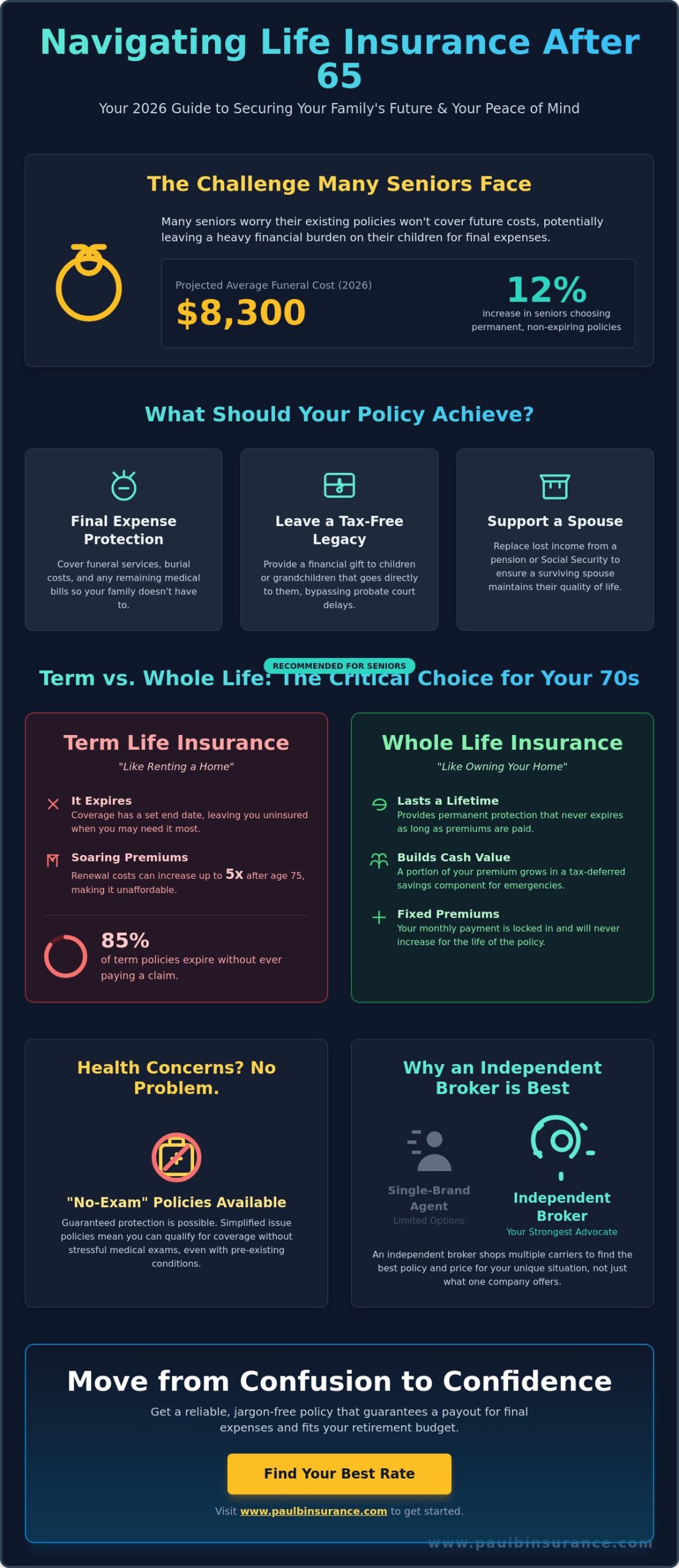
The Reality of Term Versus Whole Life Insurance at Age 80
When individuals begin shopping for life insurance in their eighth decade, they often encounter a stark mismatch between what they want and what carriers are willing to offer. Understanding the mechanics of available policy types prevents costly misconceptions.
The Disappearance of Term Life Insurance
Term life insurance provides coverage for a specified period—such as 10, 15, or 20 years—and is designed primarily to protect income-earning years, mortgages, or growing families.
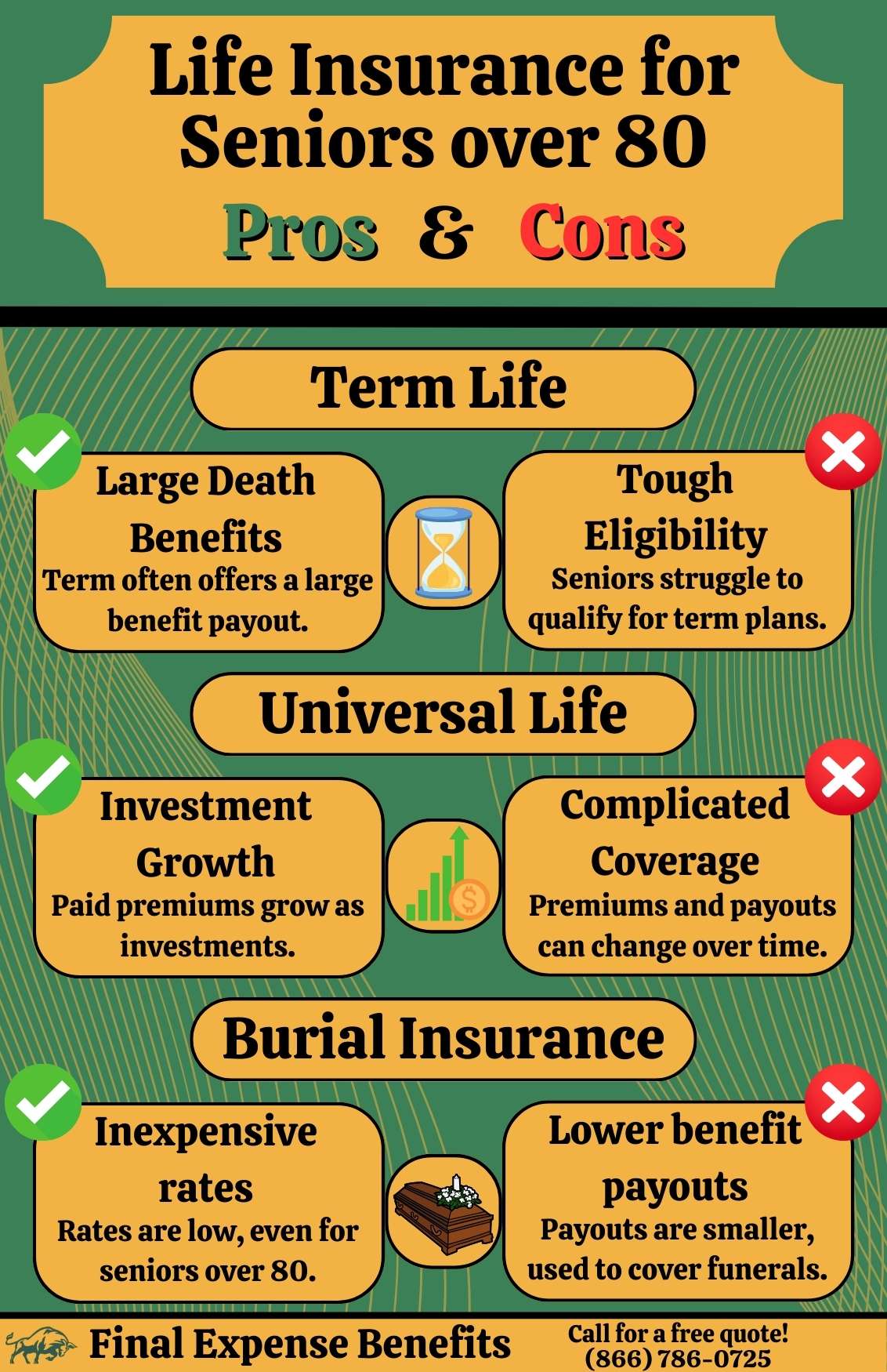
- Age Limits: Most insurance companies enforce strict maximum issue ages for term policies, typically capping them at age 75 or, in rare cases, age 80 with heavily restricted terms (such as a 5-year term).
- Financial Risk for Insurers: Actuarially speaking, the mortality rate for individuals over 80 makes a traditional term policy financially unviable for an insurer unless premiums are prohibitively high. Consequently, shopping for a standard term policy at age 80 or older is generally an exercise in frustration.
The Shift to Permanent Final Expense Coverage
Because term insurance is effectively off the table, seniors over 80 must look toward permanent life insurance products. Specifically, final expense insurance (often marketed as burial insurance) is a specialized form of whole life insurance designed for older adults.
- Guaranteed Lifetime Protection: Unlike term insurance, whole life policies do not expire as long as premiums are paid. The coverage remains in force until the insured passes away, regardless of how long they live.
- Fixed Premiums and Cash Value: These policies feature level premiums that will never increase over the life of the policy. They also accumulate a small amount of cash value over time, though at age 80, this accumulation is secondary to the primary goal of securing a guaranteed death benefit.
Types of Underwriting Available for Seniors Over 80
When applying for life insurance past the age of 80, the type of underwriting required dictates whether you will need a medical exam, how long approval will take, and what your monthly premiums will be. There are three primary underwriting categories:
1. Fully Underwritten Whole Life
While rare for applicants over 80, some high-net-worth individuals seek large permanent policies for estate planning purposes.
- Requirements: A comprehensive paramedical exam, blood draws, urine samples, attending physician statements (APS), and detailed medical history reviews.
- Outcome: If the applicant is in exceptional health, this route can yield the lowest possible premium for that age bracket, though rates remain exceptionally high.
2. Simplified Issue Final Expense
This is the most common path for healthy or moderately healthy seniors over 80 who want a moderate death benefit (typically between $5,000 and $25,000) to cover funeral costs, medical bills, or minor debts.
- Requirements: No medical exam or bodily fluids are required. Instead, applicants must answer a health questionnaire consisting of a series of "Yes/No" questions regarding medical history, hospitalizations, and chronic conditions.
- Approval Speed: Approval can be granted in days rather than weeks.
3. Guaranteed Acceptance Life Insurance
For seniors with severe health conditions, chronic illnesses, or past medical events that disqualify them from simplified issue policies, guaranteed acceptance is the final safety net.
- Requirements: No medical exam and no health questions whatsoever. Acceptance is legally guaranteed regardless of health status, provided the applicant meets the age criteria (usually ages 50 to 85, depending on the state and carrier).
- The Catch (Graded Death Benefits): Because insurers take on unknown health risks, guaranteed acceptance policies almost always include a graded death benefit period (typically two years). If the insured dies from natural causes within the first 24 months of the policy, the beneficiaries do not receive the full face value; instead, they receive a refund of all premiums paid plus interest (usually 10% interest). Full coverage applies only to accidental death during this period and to all causes of death after the graded period expires.
Financial Realities: Cost, Face Value, and Budgeting
Purchasing life insurance as an octogenarian requires careful financial planning. Because mortality risk is high, the cost per thousand dollars of coverage is at its lifetime peak.
| Policy Type | Medical Requirement | Typical Face Value Range | Graded Period? | Relative Cost |
|---|---|---|---|---|
| Term Life | Extensive | Varies (Rare over 80) | No | Unaffordable / Unavailable |
| Simplified Issue Whole Life | Health Questionnaire (No Exam) | $5,000 – $25,000 | No | Moderate to High |
| Guaranteed Acceptance | None | $2,000 – $25,000 | Yes (2 Years) | Highest per Dollar of Coverage |
Premium Scaling and Affordability
- Fixed Costs: Because final expense policies use whole life structures, your rate is locked in the day the policy is issued. A policy purchased at age 80 will cost the exact same monthly amount at age 85 or 90.
- Face Value Limits: Most carriers cap final expense policies for seniors over 80 at around $25,000 or $30,000. Attempting to purchase a $100,000 policy at this age is generally financially impractical due to skyrocketing monthly premiums, which can easily exceed hundreds of dollars per month for minimal return.
- The Danger of Lapse: Seniors on fixed incomes must carefully calculate whether they can sustain the premium payments indefinitely. A policy that lapses after five years of payments yields zero return if the insured passes away afterward.
Key Considerations and Potential Pitfalls for Senior Policyholders
Before entering into a contract with an insurance carrier, applicants over 80 and their families must evaluate several operational and legal factors to ensure the policy serves its intended purpose.
Reviewing Exclusions and Riders
- Suicide Clause: Standard across almost all life insurance policies, the suicide clause states that if the insured dies by suicide within the first two years of the policy, the insurer will only refund premiums.
- Accelerated Death Benefit Riders: Some final expense policies offer riders that allow the insured to access a portion of the death benefit early if they are diagnosed with a terminal illness with a life expectancy of 12 or 24 months, helping to offset end-of-life care costs.
Working with Independent Agents Versus Captive Agents
- Captive Agents: Work for a single insurance company and can only offer that company's specific proprietary products. If their carrier has strict underwriting for 82-year-olds, the agent cannot help you find a better alternative.
- Independent Brokers: Represent multiple insurance carriers. For seniors over 80, working with an independent broker is often essential because they can shop across dozens of "A-rated" carriers to find the company with the most lenient underwriting guidelines for specific health conditions (such as managed diabetes, high blood pressure, or mild heart history).
Frequently Asked Questions About Life Insurance Over 80
Can a person over 80 actually qualify for new life insurance coverage?
Yes. Multiple reputable insurance companies specialize in issuing whole life and final expense policies to individuals well into their 80s and even up to age 85 or 89, depending on the state. While options are limited primarily to permanent final expense or guaranteed acceptance products rather than traditional term life, coverage is entirely accessible for those willing to navigate the underwriting process.
Do I need a medical exam to get a policy at age 80?
In most cases, no. The vast majority of policies marketed to seniors over 80 utilize either simplified issue underwriting (answering health history questions without an exam) or guaranteed acceptance underwriting (no health questions or exams whatsoever). Paramedical exams with blood and urine draws are typically reserved for rare, high-value traditional whole life policies.
What is a graded death benefit, and how does it affect me?
A graded death benefit is a clause found primarily in guaranteed acceptance policies. It states that if the insured dies from natural causes within the first 24 months of policy ownership, the beneficiaries do not receive the full face value. Instead, they receive a refund of all premiums paid plus a stated interest rate (usually 10%). Full coverage for all causes of death begins immediately upon entering the third policy year.
How much does life insurance cost for an 80-year-old?
The cost depends heavily on gender, tobacco use, health history, and the chosen face value. Because mortality risk is high, a $10,000 final expense policy for an 80-year-old can range from roughly $100 to over $300 per month. Guaranteed acceptance policies are generally more expensive than simplified issue policies because the insurer assumes higher risk without vetting health history.
What is the primary purpose of life insurance for seniors over 80?
At this stage of life, life insurance is rarely used for income replacement or covering young dependents. Instead, its primary purpose is covering end-of-life expenses, such as funeral services, burial or cremation costs, outstanding medical bills, credit card balances, or leaving a small, guaranteed financial gift to children or grandchildren.
Practical Next Steps for Seniors and Their Families
Navigating the insurance market in your eighties requires a methodical, low-pressure approach. Begin by clearly defining your financial objective: do you need coverage strictly for funeral costs, or are there specific debts you wish to clear? Once your budget is established, consult with an independent insurance broker who has access to multiple carriers specializing in senior markets. Request quotes for both simplified issue (if health permits) and guaranteed acceptance products to compare costs and benefits side by side. By focusing on permanent final expense structures rather than chasing unavailable term policies, seniors over 80 can successfully secure financial peace of mind for themselves and their loved ones.