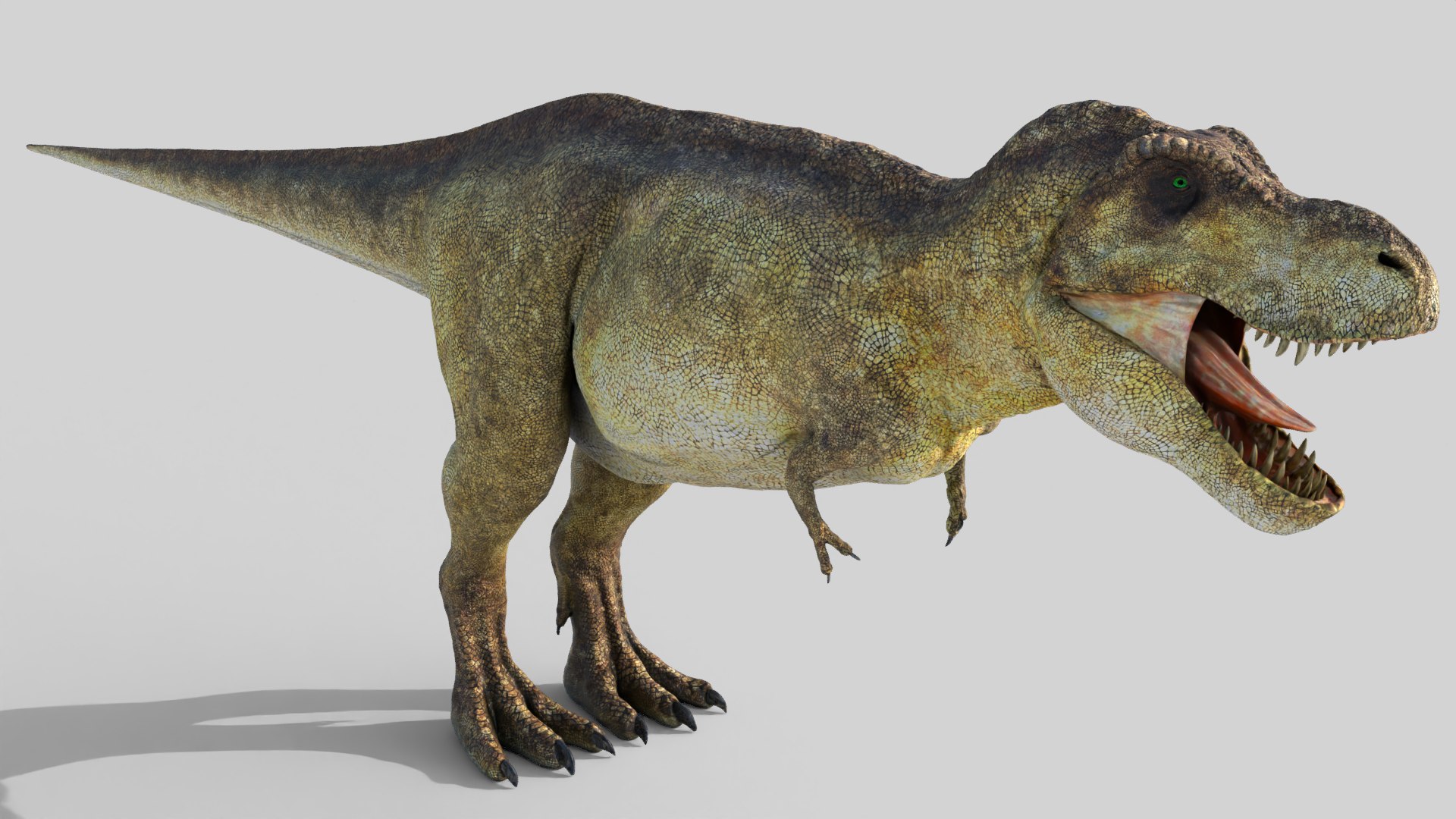
An anatomically correct Tyrannosaurus rex is a heavy-set, horizontally balanced apex predator characterized by a massive skull, forward-facing binocular vision, fleshy lips covering its teeth, reticulate skin scales, and an avian-style respiratory system. Reconstructions based on verified fossil evidence reject the outdated upright "tripod" posture and shrink-wrapped, exposed-tooth depictions seen in legacy pop culture.
The Evolution of Tyrannosaurus rex Reconstructions
Public perception of Tyrannosaurus rex has shifted dramatically since the species was formally described by Henry Fairfield Osborn in 1905. Early twentieth-century restorations depicted T. rex as a tail-dragging, kangaroo-like upright reptile. This model relied on limited skeletal articulation and an outdated understanding of archosaurian biomechanics.
Modern paleontology relies on three-dimensional computed tomography (CT) scans, finite element analysis (FEA), biomechanical modeling, and rare soft-tissue fossil preservation. These technologies demonstrate that T. rex was an agile, highly specialized carnivore engineered for extreme bite force and efficient locomotion across the Late Cretaceous floodplain habitats of Laramidia (western North America).
[1900s–1980s Legacy Model] [Modern Paleontological Consensus] - Vertical "Tripod" Posture - Horizontal Spine (Tail Counterweight) - Exposed Teeth (Crocodilian) - Fleshy Oral Tissue / Extra-Oral Lips - Shrink-Wrapped Skin - Dense Musculature & Subcutaneous Fat - Tail Dragging on Ground - Tail Elevated Clear off the Ground - Exaggerated "Feathered Monster" - Reticulate Scales (Minimal/No Plumage)
Posture, Skeletal Frame, and Mass Distribution
Horizontal Spinal Axis and Center of Gravity
An anatomically accurate T. rex maintains a nearly horizontal spinal orientation. The vertebral column runs parallel to the ground, balanced over the pelvis. The massive tail served as a dynamic counterweight to the heavy head and neck, allowing the animal to pivot and maintain stability without resting its tail on the ground.
- Cervical Vertebrae: The neck formed a tight, muscular S-curve rather than an elongated curve. Strong muscle attachment sites, including the musculus complexus, supported a head that could weigh over 500 kilograms.
- Dorsal Vertebrae and Rib Cage: The torso was broad and barrel-shaped, not laterally compressed. Deep, wide ribs protected expansive lungs and visceral organs.
- Gastralia: T. rex possessed a complex grid of abdominal ribs (gastralia) along its belly. Gastralia supported the abdominal wall, aided in respiration, and expanded the lower profile of the torso, giving the living animal a bulkier body shape than exposed skeletons suggest.
Mass Estimates and Body Volume
Body mass calculations using volumetric 3D laser scans of complete skeletons—such as FMNH PR 2081 ("Sue") and RSKM P2523.8 ("Scotty")—indicate that fully mature adults weighed between 8,000 and 10,000 kilograms (8.8 to 11 short tons).
Mass Distribution Breakdown (Adult Tyrannosaurus rex): - Skull & Neck: ~10% total body mass - Torso & Viscera (including Gastralia): ~45% total body mass - Hindlimbs & Pelvic Girdle: ~30% total body mass - Muscular Tail: ~15% total body mass
Estimates that omit gastralia or subcutaneous fat tissue produce undersized, "shrink-wrapped" reconstructions that fail to reflect the muscular volume necessary to power an animal of this scale.
Cranial Anatomy, Oral Soft Tissue, and Dentition
Binocular Vision and Sensory Adaptations
The skull of T. rex measured up to 1.5 meters (5 feet) in length. Unlike most non-avian theropods, the rear of the skull was exceptionally broad, while the snout was narrow. This anatomical arrangement positioned the eyes facing forward, granting T. rex a binocular field of view of approximately 55 degrees—surpassing that of modern hawks.
Visual Capability Comparison: - Tyrannosaurus rex: ~55° Binocular Field of View - Modern Raptor (Hawk/Eagle): ~30°–50° Binocular Field of View - Standard Non-Avian Theropod (e.g., Allosaurus): ~20° Binocular Field of View
Sclerotic rings—bony structures within the eye sockets—indicate large eyes optimized for depth perception and low-light hunting. CT scans of the braincase reveal enlarged olfactory bulbs, indicating an exceptional sense of smell capable of tracking prey across vast distances.
The Extra-Oral Tissue (Lips) Consensus
For decades, popular media depicted T. rex with exposed, interlocking teeth resembling those of modern crocodiles. However, anatomical studies published in journals such as Science (Cullen et al., 2023) established that terrestrial theropods possessed extra-oral soft tissue—commonly referred to as lips—covering their teeth when the mouth was closed.
- Enamel Preservation: Fossilized T. rex teeth show thin enamel layers without the characteristic wear patterns seen in crocodilians, whose teeth are exposed to ambient air and desiccation.
- Foramen Patterning: The size and distribution of neurovascular foramina (tiny holes in the jaw bones that feed nerves and blood vessels to soft tissues) in tyrannosaurid skulls mirror those of modern lizards with lips (such as monitor lizards), rather than crocodilians.
- Tooth-to-Skull Ratio: The relative size of T. rex teeth compared to skull volume matches the proportions found in extant covered-tooth reptiles, demonstrating that extra-oral tissue could comfortably conceal the tooth crowns.
[Cross-Section of Upper Jaw Anatomy] Bone (Maxilla) -> Neurovascular Channels -> Muscle/Subcutaneous Layer -> Extra-Oral Lip Tissue -> Enamel Shielded Tooth
Dental Mechanics and Bite Force
T. rex possessed heterodont dentition, meaning its teeth varied in shape and function along the jaw:
- Premaxillary Teeth: D-shaped in cross-section, ideal for nipping and scraping meat from bone.
- Maxillary and Dentary Teeth: Broad, banana-shaped teeth with deep roots designed to withstand lateral forces and crush bone rather than merely slice flesh.
Extremely thick tooth roots anchored these structures into deep sockets. Coupled with an kinetic skull designed to absorb mechanical stress, T. rex exerted estimated bite forces ranging between 35,000 and 60,000 Newtons—enough to pulverize bone and access nutrient-rich marrow.
Integument: Scales Versus Feathers
The debate surrounding T. rex integument (skin covering) shifted significantly following discoveries of feathered early tyrannosauroids, such as Dilong paradoxus and Yutyrannus huali. While these earlier, smaller ancestors possessed filamentous proto-feathers for insulation, evidence from giant Late Cretaceous tyrannosaurids presents a different picture.
Fossil Evidence for Scales
A comprehensive analysis of skin impressions from T. rex and its close giant relatives (Tarbosaurus, Albertosaurus, Gorgosaurus, and Daspletosaurus) published by Bell et al. (2017) demonstrated that large tyrannosaurids were predominantly covered in small, non-overlapping scales.
- Scale Structure: Impressions recovered from the neck, abdomen, hip, and tail regions show fine, reticulate scales ranging from 1 to 4 millimeters in diameter, similar to the skin on the feet of modern birds or the bodies of Gila monsters.
- Gigantothermy and Heat Dissipation: As body mass increases, the ratio of surface area to volume decreases. A fully grown 9-ton T. rex faced significant thermal management challenges. Dense plumage would have caused hyperthermia in the warm, humid climate of the Late Cretaceous.
- Potential Feather Distribution: If any filamentous feathers persisted on adult T. rex, they were likely confined to sparse, localized patches along the dorsal ridge or used for display, rather than forming a continuous coat.
Forelimb Morphology and Musculature
The reduced arms of T. rex are often mischaracterized as non-functional evolutionary remnants. While short relative to total body length (approximately 1 meter long), the pectoral girdle and forelimb bones were robust and highly muscular.
Forelimb Structural Components: - Humerus: Short, thick cortical wall resisting high bending forces - Radius & Ulna: Compact articulation preventing hyper-extension - Digits: Two functional digits (I and II) with sharp, curved claws; vestigial metacarpal III
Functional Capabilities
Biomechanical analyses reveal that the muscles controlling the forelimbs—specifically the biceps brachii and pectoralis major—were well-developed. An adult T. rex could lift estimated loads of over 180 kilograms (400 pounds) with each arm.
Hypothesized functions for these limbs include:
- Anchoring the animal's upper body while rising from a resting position.
- Securing struggling prey at close quarters during jaw alignment.
- Positioning mates during copulation.
Respiratory Infrastructure and Soft Tissue
Avian-Style Air Sacs and Postcranial Pneumaticity
T. rex possessed a complex, highly efficient respiratory system similar to that of modern birds. CT scans of vertebrae, ribs, and braincases confirm extensive pneumaticity—hollow cavities inside the bones connected to air sacs.
Airflow Path in Tyrannosaurus Respiratory System: Inhalation -> Posterior Air Sacs -> Lungs (Unidirectional Airflow) -> Anterior Air Sacs -> Exhalation
This unidirectional airflow system provided two major anatomical advantages:
- Oxygenation Efficiency: Continuous oxygen absorption occurred during both inhalation and exhalation, supporting a high metabolic rate.
- Weight Reduction: Pneumatic cavities lightened the skeleton without compromising structural integrity, reducing overall body density while maintaining muscular anchor points.
Subcutaneous Fat and Musculature
Unlike early reconstructions that depicted severe muscular hollows around the temporal fenestrae (skull openings) and hip girdles, an anatomically correct T. rex featured smooth contours.
Dense layers of fascia, subcutaneous fat, and well-developed muscle groups—such as the massive caudofemoralis muscle connecting the tail to the femur—filled these regions. The caudofemoralis provided the primary locomotive power, pulling the leg backward to propel the animal forward efficiently.
Comparison: Anatomically Correct vs. Deprecated Depictions
| Anatomical Feature | Modern Scientific Consensus (Anatomically Correct) | Deprecated / Pop-Culture Depictions | Primary Evidence Source |
|---|---|---|---|
| Spinal Posture | Horizontal; balanced over hips with tail off the ground | Vertical "kangaroo stance"; tail dragging | Vertebral articulation & trackway evidence |
| Oral Soft Tissue | Fleshy extra-oral lips completely covering closed teeth | Exposed teeth with visible gums (crocodilian style) | Enamel wear studies & foramina mapping (Cullen et al., 2023) |
| Integument / Skin | Small reticulate scales; minimal to no feathering | Smooth leather-skin or fully feathered "giant chick" | Fossilized skin impressions (Bell et al., 2017) |
| Eye Orientation | Forward-facing; ~55° binocular visual field | Lateral placement; weak depth perception | Cranial morphology & sclerotic ring positioning |
| Torso Shape | Broad, barrel-shaped with extensive gastralia basket | Narrow, slab-sided chest without gastralia | Complete articulated rib cage fossils (e.g., FMNH PR 2081) |
| Bite Mechanics | Bone-crushing force (35,000–60,000 N); heterodont teeth | Slicing / tearing motion; delicate tooth crowns | Biomechanical FEA models & coprolite analysis |
Frequently Asked Questions
Did Tyrannosaurus rex have feathers?
Extensive skin impression samples from T. rex and closely related giant tyrannosaurids show small, pebbly reticulate scales across key body regions. While smaller, earlier ancestors like Yutyrannus had feathers for insulation, giant species lost most of their plumage to avoid hyperthermia, though minor sparse filaments along the back cannot be entirely ruled out.
Why did T. rex have lips?
Studies comparing enamel wear patterns and facial bone structures (foramina) between modern reptiles and theropods indicate that T. rex possessed extra-oral tissue (lips). These tissues protected tooth enamel from desiccation and mechanical damage in terrestrial environments, sealing the mouth when closed.
How fast could an anatomically correct T. rex run?
Biomechanical stress models of skeletal structures indicate that adult T. rex could not run at high speeds without breaking their leg bones. Their maximum walking/trotting speed was between 19 and 24 kilometers per hour (12 to 15 miles per hour), using a long, efficient stride powered by the caudofemoralis tail muscle.
Was T. rex warm-blooded?
Evidence from bone histology, growth rates, oxygen isotope ratios, and respiratory air sac systems indicates that T. rex maintained an endothermic (warm-blooded) or mesothermic metabolism. This supported active hunting behaviors and rapid growth rates during adolescence.
How did T. rex stand up from a lying position?
Biomechanical models show T. rex used its strong hindlimbs in combination with its muscular forelimbs and tail counterweight to push off the ground. The pectoral girdle and reduced arms provided temporary stability to prevent slipping as the heavy upper body shifted upward over the feet.
Practical Guidance for Paleoartists and Educators
When evaluating or creating an accurate representation of Tyrannosaurus rex:
- Verify Posture and Balance: Ensure the spinal column runs horizontally, with the head balanced by a thick, muscular tail elevated off the ground.
- Cover the Teeth: Draw or sculpt extra-oral lips that completely hide the teeth when the jaw is fully closed. Avoid exposed-dentition designs unless the mouth is actively wide open.
- Reflect Realistic Musculature: Avoid "shrink-wrapping" soft tissues around skull openings or pelvic structures. Model deep neck muscles (m. complexus), broad torso contours incorporating gastralia, and a heavy caudofemoralis muscle base at the tail root.
- Use Correct Integument Texture: Depict fine, non-overlapping scales across the body rather than smooth, elephantine hide or dense avian plumage.
- Reference Modern Primary Literature: Consult peer-reviewed osteological and biomechanical studies (such as research on FMNH PR 2081 or published integument analyses) rather than relying on legacy museum displays or media renders.