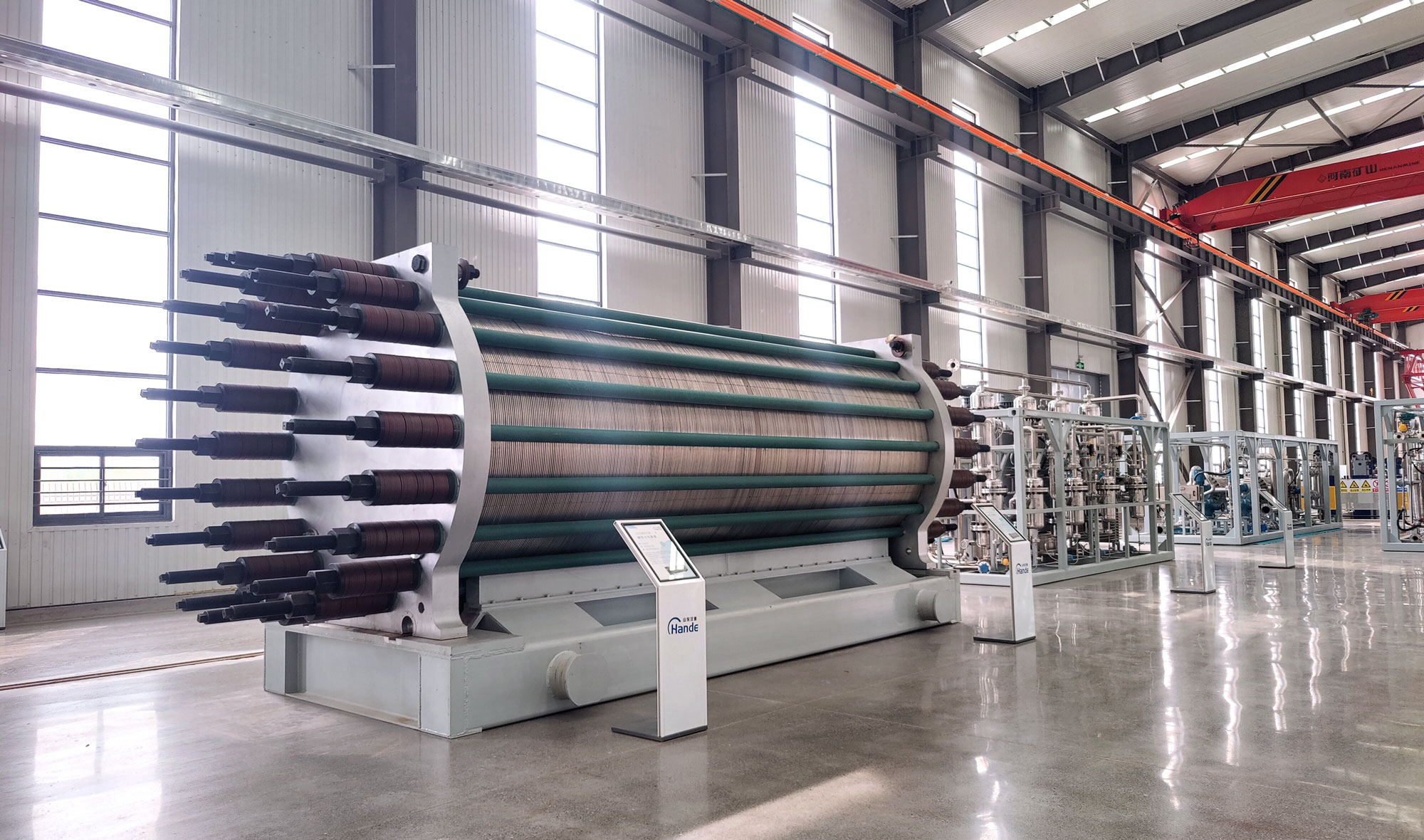
Alkaline electrolysis is a mature electrochemical process used to split water into hydrogen and oxygen gases using a liquid alkaline electrolyte, typically potassium hydroxide (KOH) or sodium hydroxide (NaOH). As of 2026, it remains the most established and cost-effective technology for large-scale green hydrogen production, utilizing non-precious metal catalysts like nickel to ensure industrial-grade scalability and long-term operational stability.
The Fundamentals of Alkaline Water Electrolysis
At its core, alkaline water electrolysis (AWE) is a redox reaction driven by an external electrical current. Unlike other forms of electrolysis that use solid membranes or high-temperature steam, AWE relies on a concentrated aqueous solution to facilitate the movement of ions between two electrodes. This technology has been used in industrial settings for over a century, but its importance has surged in 2026 as global economies transition toward decarbonized energy systems.
The Chemical Process
The electrolysis process occurs within a specialized cell consisting of an anode (positive electrode) and a cathode (negative electrode), separated by a porous diaphragm. The electrolyte, usually a 20% to 30% concentration of potassium hydroxide, does not get consumed in the reaction but provides the necessary hydroxide ions ($OH^-$) to maintain conductivity.
The reaction is broken down into two half-reactions:
- Cathode (Reduction): Water molecules receive electrons from the external circuit, producing hydrogen gas ($H_2$) and hydroxide ions.
- $2H_2O + 2e^- \rightarrow H_2 + 2OH^-$
- Anode (Oxidation): The hydroxide ions migrate through the diaphragm to the anode, where they release electrons to produce oxygen gas ($O_2$) and water.
- $2OH^- \rightarrow 1/2 O_2 + H_2O + 2e^-$
The net result is the decomposition of water into its elemental components, with hydrogen being the primary product sought for energy storage, transport, and industrial feedstock.
The Role of the Electrolyte
The choice of potassium hydroxide (KOH) as the electrolyte is not arbitrary. KOH solutions offer higher ionic conductivity than sodium hydroxide (NaOH) at standard operating temperatures. Maintaining a concentration of roughly 25-30% is critical because this range provides the maximum conductivity while balancing the corrosive nature of the fluid. In 2026, advanced monitoring systems are standard in commercial electrolyzers to maintain this concentration precisely, as any deviation can lead to increased electrical resistance and reduced system efficiency.
Key Components of an Alkaline Electrolysis System
An industrial-scale alkaline electrolyzer is more than just a pair of electrodes in a tank. It is a complex assembly of mechanical and electrical components designed to maximize gas purity and energy efficiency.
The Electrolyzer Stack
The "stack" is the heart of the system, where multiple individual cells are connected in series or parallel. There are two primary configurations used in 2026:
- Bipolar Design: Most modern commercial systems use a bipolar configuration. In this setup, a single plate acts as the anode for one cell and the cathode for the next. This reduces the footprint of the system and minimizes internal resistance, allowing for higher voltages across the stack.
- Monopolar Design: In older or very specific modular units, each electrode has a single polarity. While simpler to maintain, these systems are generally bulkier and less efficient for the high-capacity demands of modern hydrogen hubs.
The Diaphragm (Separator)
The diaphragm is perhaps the most critical technical component. Its job is to keep the produced hydrogen and oxygen gases separate to prevent the formation of explosive mixtures, while simultaneously allowing the hydroxide ions to pass through freely.
Historically, asbestos was used for this purpose, but it has been entirely phased out due to health and environmental risks. In 2026, the industry standard is Zirfon-based separators—porous membranes made from a combination of a polymer (like polyphenylene sulfide) and zirconium oxide. These advanced diaphragms offer high chemical resistance to the caustic KOH environment and allow for higher current densities than previous generations of separators.
Electrodes and Catalysts
One of the greatest advantages of alkaline electrolysis is that it does not require "platinum group metals" (PGMs). Instead, it utilizes abundant and inexpensive materials:
- Cathodes: Often made of nickel with specialized coatings like Raney nickel or nickel-sulfur to reduce the overpotential required for hydrogen evolution.
- Anodes: Typically consist of nickel or nickel-plated steel, often coated with stainless steel or nickel-cobalt oxides to facilitate the oxygen evolution reaction.
Operational Parameters and Efficiency
To operate an alkaline electrolyzer successfully in 2026, several physical parameters must be managed. The efficiency of the system is usually measured by the amount of electricity (kWh) required to produce one kilogram of hydrogen.
Temperature and Pressure
Most industrial alkaline electrolyzers operate at temperatures between 70°C and 90°C. Higher temperatures improve the kinetics of the reaction and increase the conductivity of the electrolyte, which boosts efficiency. However, exceeding 90°C significantly accelerates the corrosion of the cell components and shortens the lifespan of the stack.
Pressure is another critical variable. In 2026, there is a clear market shift toward pressurized alkaline electrolysis. While atmospheric electrolyzers are simpler, pressurized systems (operating at 10 to 30 bar) deliver hydrogen at a pressure that reduces the energy needed for downstream compression. This is vital for hydrogen refueling stations or injection into natural gas grids.
Current Density and Efficiency
Current density—the amount of electrical current per unit area of the electrode—determines the hydrogen production rate. Alkaline systems typically operate at lower current densities (0.2 to 0.4 A/cm²) compared to Proton Exchange Membrane (PEM) systems.
The typical energy efficiency for a complete alkaline system in 2026 ranges from 63% to 71% (based on the higher heating value of hydrogen). This translates to approximately 48 to 55 kWh of electricity per kilogram of hydrogen produced.
Comparing Electrolysis Technologies in 2026
While alkaline electrolysis is the market leader for large-scale applications, it competes with Proton Exchange Membrane (PEM) and Solid Oxide Electrolysis Cell (SOEC) technologies.
| Feature | Alkaline Electrolysis (AWE) | PEM Electrolysis | Solid Oxide (SOEC) |
|---|---|---|---|
| Electrolyte | Liquid KOH/NaOH | Solid Polymer Membrane | Solid Ceramic |
| Catalyst Material | Nickel / Non-precious | Platinum / Iridium | Nickel / Perovskites |
| System Maturity | Very High | High | Emerging / Industrializing |
| Capital Cost (CAPEX) | Lowest | Moderate to High | Highest |
| Dynamic Response | Moderate (Slower) | Very High (Fast) | Low (Constant) |
| Operating Temp | 70°C – 90°C | 50°C – 80°C | 600°C – 850°C |
| Stack Lifespan | 60,000 – 90,000 hours | 40,000 – 60,000 hours | 10,000 – 30,000 hours |
Advantages and Disadvantages
Benefits of the Alkaline Approach
The primary driver for the continued dominance of alkaline electrolysis in 2026 is cost. Because the system uses nickel and steel rather than iridium and platinum, the capital expenditure (CAPEX) per kilowatt is significantly lower than PEM alternatives. Furthermore, alkaline electrolyzers are incredibly durable. With proper maintenance, an alkaline stack can last for nearly a decade before requiring a major overhaul, providing a level of bankability that newer technologies still struggle to match.
Another advantage is scalability. In 2026, we are seeing the commissioning of "gigafactory" produced 100MW+ alkaline units that benefit from significant economies of scale, making them the preferred choice for green ammonia and green steel projects.
Challenges and Limitations
The most notable drawback is the dynamic response time. Alkaline electrolyzers are traditionally designed to run at a steady state. When coupled with volatile renewable energy sources like wind or solar, they can be slower to ramp up or down compared to PEM systems. If the power input drops too low (typically below 20-30% of nominal capacity), the purity of the hydrogen can suffer because oxygen can diffuse across the diaphragm more easily, creating safety risks.
Additionally, the footprint of an alkaline plant is generally larger than a PEM plant of the same capacity. The liquid electrolyte management system—including pumps, separators, and cooling loops—requires more physical space and more intensive ongoing maintenance to manage the caustic fluids.
The "Balance of Plant" (BoP)
An electrolysis facility is often referred to as a "Balance of Plant." The electrolyzer stack itself is only a portion of the total system. For a functional hydrogen production site in 2026, the following auxiliary systems are required:
- Water Purification Unit: Electrolyzers require ultra-pure water to prevent mineral buildup on the electrodes. Even trace impurities can poison the catalysts and drastically reduce the lifespan of the stack.
- Electrolyte Management: This includes the mixing tanks, circulation pumps, and heat exchangers that keep the KOH solution at the correct concentration and temperature.
- Gas-Liquid Separators: After the gases are produced, they are mixed with the electrolyte. Large separator vessels are used to "knock out" the liquid, returning the KOH to the stack and sending the gases forward.
- Gas Purification (De-Oxo Units): To reach 99.999% purity (standard for fuel cells), the hydrogen must pass through a catalyst bed that removes trace oxygen and a dryer that removes remaining moisture.
- Power Electronics: Transformers and rectifiers are needed to convert high-voltage AC power from the grid or renewable source into the precise DC current required by the stack.
Economic and Strategic Outlook for 2026
In 2026, the levelized cost of hydrogen (LCOH) from alkaline electrolysis has reached a tipping point. Due to mass production in China and Europe, and supported by frameworks like the International Energy Agency's global hydrogen tracking, the cost of green hydrogen is becoming competitive with "grey" hydrogen produced from natural gas in regions with high carbon pricing.
Strategic investments by organizations like the Hydrogen Council have pushed for standardization in alkaline stack sizes, allowing for modular "plug-and-play" installations. This has lowered the risk for project developers and made it easier to secure financing for large-scale decarbonization efforts in heavy industry.
Safety remains a top priority, governed by international standards such as ISO 22734, which defines the construction, safety, and performance requirements for water electrolysis. Compliance with these standards is mandatory for any commercial installation in 2026, ensuring that high-pressure hydrogen production remains as safe as traditional industrial processes.
FAQ
What is the typical lifespan of an alkaline electrolyzer stack?
In 2026, a high-quality industrial alkaline stack typically lasts between 60,000 and 90,000 operating hours. This equates to roughly 7 to 10 years of continuous operation. After this period, the stack can usually be refurbished by replacing the diaphragms and cleaning the electrodes, rather than replacing the entire unit.
Can alkaline electrolysis use seawater?
Currently, alkaline electrolysis requires purified fresh water. While there are research efforts to develop direct seawater electrolysis, the chlorine present in seawater causes rapid corrosion and produces toxic chlorine gas at the anode. In 2026, most coastal hydrogen plants utilize a desalination unit upstream of the electrolyzer to provide the necessary water purity.
How pure is the hydrogen produced by this method?
Straight out of the gas-liquid separator, the hydrogen is typically 99.3% to 99.9% pure. However, by adding a standard "De-Oxo" purification stage and a molecular sieve dryer, the purity is easily increased to 99.999% (5.0 grade), which is required for use in hydrogen fuel cell vehicles.
Is potassium hydroxide consumed during the process?
No, the potassium hydroxide (KOH) acts strictly as a catalyst for ionic conductivity. While small amounts may be lost through "carry-over" in the gas streams, it is captured in the separators and recycled. Under normal conditions, you only need to add water to the system, not more electrolyte.
Why is PEM electrolysis often mentioned alongside alkaline?
PEM (Proton Exchange Membrane) is the primary competitor to alkaline electrolysis. While alkaline is cheaper and uses non-noble metals, PEM is more compact and can react faster to fluctuations in renewable energy. In 2026, the choice between the two usually depends on the specific project: alkaline for large, steady industrial loads and PEM for smaller, highly variable renewable-integrated projects.
Recommendations for Implementation
For organizations looking to deploy alkaline electrolysis in 2026, the first step is to conduct a detailed "Levelized Cost of Hydrogen" (LCOH) analysis. Focus on securing a long-term, low-cost supply of renewable electricity, as power accounts for approximately 70-80% of the total operating cost.
Furthermore, ensure that the selected site has adequate water access and wastewater management protocols for the KOH electrolyte. It is advisable to partner with an engineering firm experienced in ISO 22734 compliance to navigate the safety and regulatory landscape of high-pressure hydrogen storage and production.