Filing an Ohio Bureau of Workers' Compensation (BWC) C-84 form requires confirming temporary total disability eligibility, accurately reporting your work status and disability dates, obtaining a corresponding MEDCO-14 medical report from your physician, submitting all pages to the BWC or self-insured employer, and tracking your ongoing recertification requirements.
The Form C-84 (officially titled Request for Temporary Total Compensation) is the primary mechanism through which injured workers in Ohio request wage replacement payments when a work-related injury or occupational disease prevents them from working. Temporary Total Disability (TTD) compensation compensates employees for lost wages during their recovery period, but approval hinges on strict documentation rules, medical alignment, and administrative deadlines.
Understanding how to properly navigate the C-84 process helps prevent unexpected payment interruptions, claims processing delays, and administrative denials. Below is a comprehensive guide detailing the prerequisites, step-by-step submission workflow, common pitfalls, and ongoing requirements for managing your Ohio workers' compensation lost-time benefits.
Understanding the C-84 Form and Temporary Total Disability (TTD)
Before initiating a C-84 request, it is essential to understand what Temporary Total Disability represents within the Ohio workers' compensation system. Under Ohio law, TTD benefits are intended to replace a portion of lost income when an injured employee is completely unable to perform their job duties, or when their employer cannot offer alternative light-duty work that accommodates their medical restrictions.
Ohio TTD Compensation Workflow
- Injured Worker: Submits Form C-84 (Request for TT Compensation)
- Physician of Record: Submits Form MEDCO-14 (Medical Certification)
- BWC / Self-Insured: Audits Claim, Computes AWW/FWW, Issues Payment
Purpose of Form C-84 vs. Form MEDCO-14
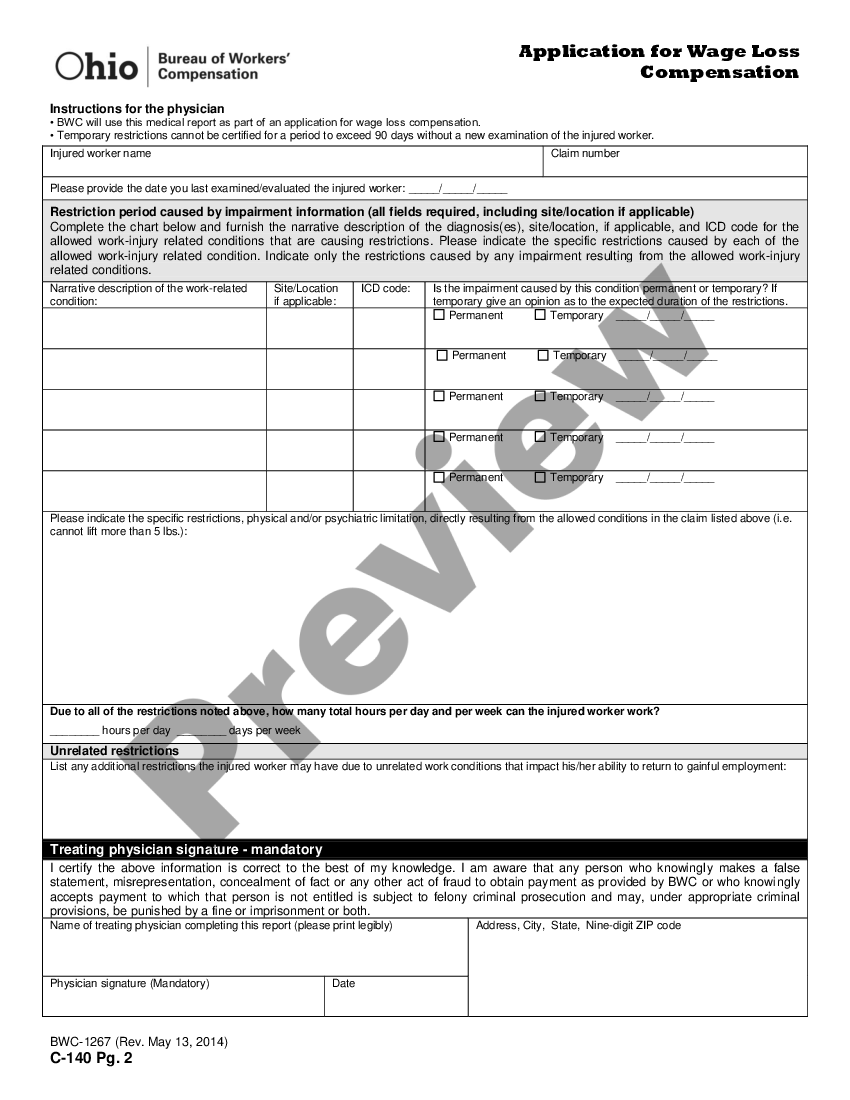
A common source of confusion for injured workers is the relationship between Form C-84 and Form MEDCO-14 (Physician's Report of Work Ability). Both forms are necessary to establish eligibility for initial and ongoing TTD payments, but they serve distinct functions:
- Form C-84 (Injured Worker Statement): Completed and signed directly by you, the injured worker. It serves as your formal statement requesting lost-time compensation, disclosing any outside earnings, confirming your employment status, and detailing the specific date range you are requesting payment for.
- Form MEDCO-14 (Physician Statement): Completed by your treating healthcare provider—known as the Physician of Record (POR). It provides objective medical evidence confirming that your inability to work is caused directly by the allowed medical conditions in your BWC claim.
Without a valid MEDCO-14 covering the exact same timeframe requested on your C-84, the Ohio BWC or self-insured employer cannot legally pay Temporary Total compensation.
Step 1: Confirm Eligibility and Gather Claim Information
The first step in completing Form C-84 is confirming that your workers' compensation claim meets the statutory prerequisites for lost-time payments and assembling your necessary administrative details.
Prerequisites for Claiming TTD Benefits
To qualify for TTD compensation via Form C-84, your claim must satisfy several foundational requirements:
- Allowed Claim: You must have an active workers' compensation claim filed with the Ohio BWC or a self-insured employer that has been officially allowed (or is currently undergoing initial allowance determination).
- Medical Disability: A recognized medical provider must certify that you are completely disabled from your regular job or that your employer has failed to provide suitable work within your functional limitations.
- Minimum Lost Time Threshold: Under Ohio law, compensation is not payable for the first seven calendar days of disability unless the period of disability extends for 14 continuous calendar days or longer.
Information Gathering Checklist
Before filling out the form, ensure you have the following information readily accessible:
- BWC Claim Number: The unique identifier assigned to your injury by the BWC (typically an eight-digit number, e.g.,
26-XXXXXX). - Social Security Number and Contact Details: Current legal address, phone number, and official identity verification details.
- Employer Information: Legal name and address of the employer where the injury occurred.
- Disability Start Date: The exact date you were forced to stop working or reduced your hours due to the allowed work injury.
- Primary Care Provider / Physician of Record Details: Name, practice location, and contact information of the doctor managing your work injury care.
Step 2: Complete the Injured Worker Sections of Form C-84
Accurately completing your portion of Form C-84 is vital. Incomplete or contradictory statements can cause the BWC to suspend processing or initiate an audit.
Section-by-Section Instructions
When accessing the current version of Form C-84 through the Ohio Bureau of Workers' Compensation, pay meticulous attention to the following key sections:
1. Personal & Claim Identification
Enter your full legal name, current mailing address, date of birth, and primary telephone number. Input your BWC claim number accurately across all pages of the document.
2. Period of Compensation Requested
Specify the precise date range for which you are seeking compensation:
- From Date: The first full day you were unable to work due to the injury.
- To Date: Either the date you expect to return to work, or the date of your next scheduled medical evaluation (if your recovery period is ongoing).
3. Employment Status and Outside Earnings Disclosure
Form C-84 asks explicit questions regarding whether you have performed any work during the requested disability period. You must disclose:
- Any secondary employment or part-time work, even if unrelated to your primary employer.
- Self-employment activities, freelance work, or side businesses (including passive management or physical labor).
- Any income received from alternative sources, such as unemployment compensation or Social Security Disability (SSDI) benefits.
Caution: Working or engaging in income-generating activity—including physical labor on personal projects that exceeds your certified medical restrictions—while collecting TTD compensation can be classified as workers' compensation fraud under Ohio Revised Code 2913.48. Always provide complete, truthful disclosures on every C-84 submission.
4. Authorization and Signature
Sign and date the declaration confirming that all statements on the form are true and correct. An unsigned Form C-84 will be rejected immediately by the claims examiner.
Step 3: Secure the Accompanying MEDCO-14 from Your Doctor
Form C-84 cannot function in isolation. The third step requires coordinating with your treating medical provider to ensure a corresponding MEDCO-14 is completed and submitted concurrently.
Coordinating with Your Physician of Record (POR)
Schedule an appointment with your treating physician well before your existing disability certification expires. During this visit:
- Discuss Functional Limitations: Clearly explain your day-to-day work duties and detail why your injury prevents you from performing them safely.
- Verify Allowed Conditions: Ensure your doctor lists only the officially allowed diagnostic codes on the MEDCO-14. If a doctor certifies disability for an unallowed condition (such as pre-existing arthritis or an unapproved shoulder tear), the BWC will deny TTD payments for that period.
- Specify Work Status: The doctor must explicitly mark whether you are:
- Completely incapable of working in any capacity.
- Capable of working with specific restrictions (e.g., maximum lifting limit of 10 lbs, no repetitive bending).
If your doctor indicates you can work with restrictions, you must present the MEDCO-14 to your employer to determine if modified light-duty work is available. If the employer offers work within those restrictions and you decline, your eligibility for TTD compensation generally ends.
Comparing C-84 and MEDCO-14 Requirements
| Feature | Form C-84 | Form MEDCO-14 |
|---|---|---|
| Primary Responsible Party | Injured Worker | Treating Physician |
| Primary Objective | Request lost wages & declare employment status | Provide objective medical proof of TTD |
| Key Information Included | Personal data, disability dates, outside earnings disclosures | Medical diagnosis, physical restrictions |
| Submission Frequency | Per initial request & periodic extensions (as required) | Every 30–90 days or upon clinical change |
Step 4: Submit the Completed Form to BWC or Self-Insured Employer
Once you have verified that your C-84 form is complete and your physician has issued a matching MEDCO-14, you must submit these documents to the appropriate administrative entity.
Identifying Your Employer's Workers' Comp Coverage Type
In Ohio, employers operate under one of two administrative systems:
- State Fund Employers: The employer pays premiums into the state insurance fund, and the Ohio BWC manages payment processing and claim administration directly.
- Self-Insured (SI) Employers: Large employers that meet state financial standards directly pay compensation benefits to their employees without utilizing state fund monies. These employers often use Third-Party Administrators (TPAs) to process claims.
Submission Channels
For State Fund claims, submit your forms directly to the BWC using one of these authorized channels:
- Online Portal: Upload PDF copies directly through your secure personal account at the BWC Employer/Employee Web Portal. This is the fastest method and generates instant electronic confirmation.
- Fax: Transmit the completed document to the specific BWC Customer Service Center handling your claim. Include your claim number prominently on the cover sheet.
- Mail: Send physical copies to the regional BWC service center assigned to your county of residence.
For Self-Insured claims, submit the completed C-84 and MEDCO-14 forms directly to your employer's Human Resources department or their designated Third-Party Administrator.
Step 5: Monitor Claim Processing, Payment Calculations, and Recertifications
Submitting your C-84 form initiates an administrative review. Step 5 involves reviewing your payment calculations, resolving any delays, and establishing an ongoing renewal schedule.
How BWC Calculates Temporary Total Compensation Rate
TTD compensation in Ohio is based on your earnings history prior to the injury date, subject to statutory minimums and maximums set annually by the state.
- Full Weekly Wage (FWW): For the first 12 consecutive weeks of disability, TTD compensation is calculated at 72% of your Full Weekly Wage (typically based on your average earnings during the 6 weeks or 52 weeks prior to the injury, whichever is higher for the worker).
- Average Weekly Wage (AWW): Starting on the 13th week of TTD compensation, the payment rate adjusts to 66.67% (two-thirds) of your Average Weekly Wage, calculated over the 52-week period preceding the date of injury.
Ohio TTD Payment Rate Calculation
| Disability Period | Payment Calculation Standard |
|---|---|
| Weeks 1 through 12 | 72% of Full Weekly Wage (FWW) |
| Weeks 13 and onward | 66.67% (2/3) of Average Weekly Wage (AWW) |
Note: Subject to annual Ohio statewide maximum/minimum cap limits.
Ongoing Renewal and Recertification
Temporary Total compensation is not paid indefinitely under a single C-84 submission. To maintain continuous wage-loss payments:
- Submitting Subsequent C-84s: You must submit updated C-84 forms periodically (often every 30 to 90 days, matching the end dates of your doctor's MEDCO-14 certifications).
- Maximum Medical Improvement (MMI): TTD payments terminate when your condition has stabilized to the point where further fundamental medical recovery is no longer expected, regardless of continuing treatment. A finding of MMI by your doctor or an Independent Medical Examination (IME) physician usually triggers the termination of TTD benefits, transitioning the claim toward Permanent Partial Disability (PPD) or vocational rehabilitation.
Common Mistakes That Delay C-84 Approval
Filing errors are the leading cause of delayed compensation checks. Review this checklist to safeguard your submission:
- Mismatched Dates: Ensure the disability start and end dates listed on your C-84 match the exact date ranges documented by your doctor on the MEDCO-14.
- Listing Unallowed Medical Conditions: Verify that your physician links your work limitations only to conditions already officially allowed by the BWC.
- Omission of Earnings Statements: Leaving the work/earnings section blank forces the BWC examiner to pause your claim to verify your status.
- Failure to Report Light-Duty Refusals: If your employer offered a legitimate, written, good-faith light-duty job within your doctor's restrictions and you rejected it without legal justification, TTD payments will likely be denied.
What to Do If Your C-84 Request Is Denied
If the BWC, MCO, or a self-insured employer issues a formal order denying your request for TTD compensation, you have a statutory right to appeal under Ohio law.
- File a Motion / Appeal: You must file a written appeal within 14 calendar days of receiving the BWC decision order.
- Industrial Commission Hearing: Appealed disputes are referred to the Industrial Commission of Ohio (IC), an independent state agency that holds quasi-judicial hearings.
- Gather Supplemental Evidence: Work with your legal representative and medical providers to submit updated clinical notes, diagnostic imaging, or clarify job duties prior to the hearing date.
Frequently Asked Questions
How long does it take for the BWC to process a C-84 form?
Once the BWC receives both a complete Form C-84 and a supporting MEDCO-14 form, initial decision processing typically takes between 7 to 14 business days. If wage documentation (such as pay stubs or W-2s) is missing to establish your Average Weekly Wage, payment issuance may take longer.
Can I submit Form C-84 online?
Yes. Injured workers can log into their account on the official Ohio BWC website (bwc.ohio.gov) to complete and submit Form C-84 electronically. You can also upload PDF copies of the accompanying MEDCO-14 directly to your claim file.
What happens if my doctor forgets to fill out the MEDCO-14?
The BWC cannot issue Temporary Total Disability payments without a valid MEDCO-14 on file. If your doctor fails to submit the form, contact their office's workers' compensation billing department immediately to request that the form be completed and faxed directly to the BWC or your claims representative.
Can I receive TTD benefits and Unemployment Compensation at the same time?
No. Under Ohio law, you cannot collect Temporary Total Disability compensation and Unemployment Compensation simultaneously. TTD certification states that you are physically unable to work, whereas unemployment benefits require you to certify that you are ready, willing, and physically able to work.
Do I need to submit a new C-84 form every month?
You must submit a new C-84 form whenever your previous disability certification period expires and your doctor extends your work restrictions on a new MEDCO-14. While some long-term disability extension cycles span 60 to 90 days, many providers issue certifications in 30-day increments.
What is Maximum Medical Improvement (MMI) and how does it affect my C-84?
Maximum Medical Improvement (MMI) is reached when your allowed conditions have stabilized and no further significant medical improvement is expected, even with continued care. Once a finding of MMI is established by the BWC or Industrial Commission, TTD payments stop, and Form C-84 can no longer be used for lost-time wage payments for those specific conditions.
Practical Action Steps
If you are currently off work due to an Ohio job injury:
- Download and print the current C-84 form from the BWC website or access the digital application portal.
- Schedule a follow-up appointment with your Physician of Record to obtain an updated MEDCO-14 before your current certification period ends.
- Review all dates and declarations carefully to ensure complete alignment between your application and your medical records.
- Keep personal copies of every form, submission confirmation receipt, and medical report for your administrative records.
- Consult a qualified Ohio workers' compensation attorney if your claim involves disputed allowances, wage calculation errors, or formal BWC denial orders.
Disclaimer: This guide is provided for educational and informational purposes only and does not constitute formal legal or medical advice. Ohio workers' compensation laws and administrative regulations (including Ohio Revised Code Chapter 4123) are subject to statutory amendments and judicial interpretations. For specific guidance regarding complex claims or appeals, consult a licensed Ohio attorney or contact the Ohio Bureau of Workers' Compensation directly.