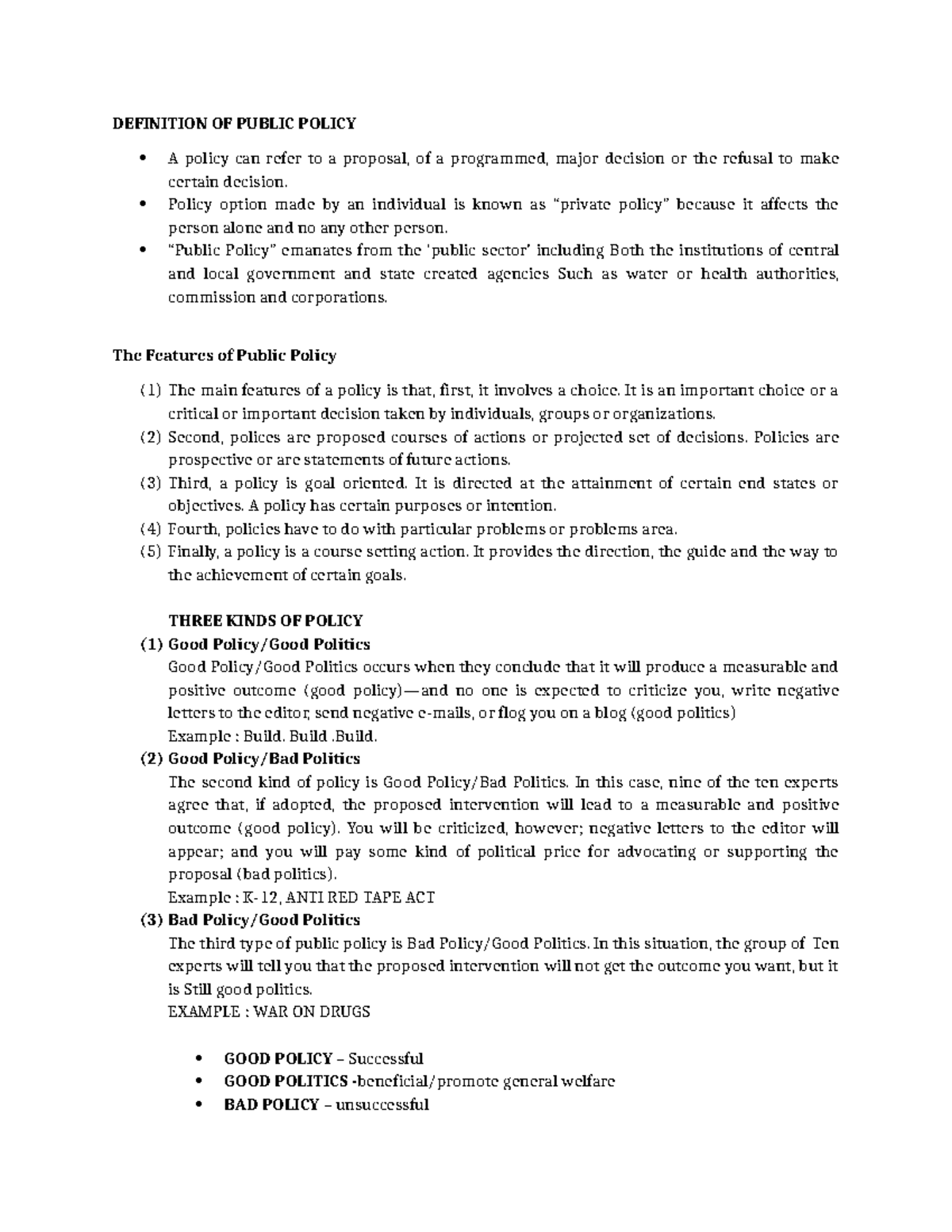
Policy concepts are the theoretical frameworks and practical principles used to guide decision-making and achieve rational outcomes within public or private sectors. These concepts encompass the entire lifecycle of a policy—from identifying a problem and formulating a response to implementation, evaluation, and eventual revision or termination in a 2026 context.
Defining the Core Anatomy of a Policy
To understand policy concepts, one must first deconstruct what a policy actually is. At its most basic level, a policy is a deliberate system of guidelines to guide decisions and achieve rational outcomes. Unlike a law, which compels or prohibits action through legal sanction, a policy provides the "why" and the "how" behind organizational or governmental direction.
A robust policy typically consists of several foundational elements. The statement of intent outlines the high-level goals and the rationale for the policy's existence. This is followed by the scope, which defines exactly who the policy applies to and under what circumstances. Definitions are crucial to prevent ambiguity, ensuring that technical terms or specific entities are understood identically by all stakeholders. Finally, the policy statements provide the specific rules or guidelines that must be followed.
In 2026, the integration of data-driven governance has added a new layer to these components: algorithmic transparency. Modern policy concepts now frequently include clauses regarding how automated systems or AI tools assist in decision-making, ensuring that the policy remains ethical and accountable to human oversight.
The Policy Lifecycle: From Identification to Evaluation
The development of a policy is not a static event but a cyclical process known as the policy lifecycle. Understanding each stage of this cycle is essential for anyone involved in governance, corporate management, or advocacy.
1. Problem Identification and Agenda Setting
The lifecycle begins when a specific issue is identified as requiring intervention. Not every problem becomes a policy issue; "agenda setting" determines which problems receive the attention of decision-makers. This stage is often influenced by external pressures, such as public opinion, economic shifts, or technological disruptions. In 2026, climate resilience and cybersecurity remain dominant drivers of policy agendas globally.
2. Policy Formulation
Once an issue is on the agenda, planners must develop specific courses of action. This stage involves deep research, consultation with subject-matter experts, and the drafting of various options. Formulators must consider the feasibility, cost, and potential unintended consequences of each option. According to the OECD, effective formulation requires a balance between technical expertise and stakeholder engagement to ensure the eventual policy is both practical and politically viable.
3. Policy Adoption
Adoption is the formal stage where a specific policy option is chosen and authorized. In a government setting, this may involve legislative approval or executive orders. In a corporate environment, this usually requires a sign-off from the board of directors or executive leadership. The legitimacy of a policy often rests on the transparency and authority of the adoption process.
4. Implementation
Implementation is the stage where "policy meets reality." This is often the most difficult phase, as it requires the mobilization of resources, the training of staff, and the communication of new rules to those affected. Effective implementation depends on clear administrative structures and sufficient funding. Failure at this stage is often referred to as the "implementation gap," where the theoretical goals of the policy are not met due to logistical or bureaucratic hurdles.
5. Evaluation and Maintenance
After a policy has been in place for a set period, it must be evaluated. Does it achieve its goals? Are there unforeseen negative impacts? Evaluation can lead to a policy being maintained, modified, or terminated. In the current 2026 landscape, real-time data analytics allow for "dynamic evaluation," where policies are adjusted incrementally based on continuous feedback loops rather than waiting for five-year reviews.
Classifying Policy Types: Public vs. Private Frameworks
Policy concepts vary significantly depending on the environment in which they are applied. While the underlying logic of decision-making remains similar, the goals and constraints differ between the public and private sectors.
Public Policy
Public policy is developed by government bodies to address societal issues. These are categorized into several types:
- Regulatory Policies: These limit the behavior of individuals or groups to protect the public (e.g., environmental regulations or food safety standards).
- Distributive Policies: These provide services or benefits to specific segments of the population (e.g., public education or infrastructure projects).
- Redistributive Policies: These involve shifting resources from one group to another, often through taxation and social welfare programs, to achieve equity.
Corporate and Organizational Policy
In the private sector, policies focus on internal governance, risk management, and strategic alignment. These include Human Resources (HR) policies, Acceptable Use Policies (AUP) for technology, and Environmental, Social, and Governance (ESG) frameworks. Corporate policies are vital for maintaining compliance with national laws and ensuring a consistent company culture.
Key Policy Instruments and Their Applications
A "policy instrument" is the tool used by decision-makers to achieve their objectives. Selecting the right instrument is a core concept in policy design. These are generally categorized into four "buckets":
- Mandates: These are rules that require compliance. They are effective when a high degree of uniformity is needed but can be costly to enforce.
- Inducements: These provide financial or other incentives to encourage desired behavior. Examples include tax credits for renewable energy or grants for small businesses.
- Capacity Building: This involves providing information, training, or resources to enable people or organizations to solve problems themselves. This is a long-term strategy often used in public health or educational policy.
- System Changes: This involves transferring authority or changing the structure of how services are delivered. For example, moving from a centralized healthcare system to a decentralized one.
As noted by The World Bank, the choice of instrument must align with the state's (or organization's) capacity to manage that specific tool. Using complex inducements in a low-capacity environment often leads to corruption or inefficiency.
Policy Analysis Frameworks: Assessing Impact and Viability
Policy analysis is the systematic evaluation of the technical and political implications of different policy options. Analysts use several frameworks to determine which path is most likely to succeed.
Cost-Benefit Analysis (CBA)
CBA is perhaps the most common framework. It involves quantifying the total expected cost of a policy against the total expected benefits. While useful for economic policies, CBA is often criticized for its difficulty in quantifying intangible benefits, such as "social equity" or "environmental beauty."
Stakeholder Mapping
This framework identifies all individuals or groups who have a "stake" in the policy. Analysts assess the power, influence, and interest of each group. Understanding stakeholder dynamics is crucial for navigating the political landscape of policy adoption and ensuring that marginalized voices are not overlooked.
The Logic Model
A logic model is a visual representation of the relationship between a policy's resources (inputs), activities, outputs, and outcomes. It helps planners see the "if-then" logic of their proposal. For example: "If we provide funding for job training (input), then 500 people will complete the course (output), then the local unemployment rate will drop by 2% (outcome)."
Differentiating Policy, Strategy, and Procedure
A common mistake in organizational management is using the terms "policy," "strategy," and "procedure" interchangeably. While related, they serve distinct functions.
| Concept | Definition | Primary Focus | Flexibility |
|---|---|---|---|
| Policy | High-level principles and rules. | The "What" and "Why" | Rigid; requires formal review to change. |
| Strategy | A high-level plan to achieve a goal. | The "Direction" | Adaptive; changes based on market or environment. |
| Procedure | Step-by-step instructions for tasks. | The "How" | Technical; updated as tools and methods evolve. |
Implementation Challenges in the 2026 Landscape
Even the most well-designed policy concepts can fail during implementation. In 2026, several unique challenges have emerged that policy-makers must account for.
Bureaucratic Inertia and Resistance to Change Large organizations often have a "this is how we've always done it" mentality. New policies that disrupt established workflows frequently face internal resistance. Overcoming this requires strong leadership and clear communication about the benefits of the new policy.
Resource Scarcity and Misallocation A policy is only as good as the resources backing it. In many cases, policies are "unfunded mandates"—rules that are passed without the necessary budget to carry them out. This leads to symbolic implementation, where the policy exists on paper but has no impact on the ground.
Rapid Technological Advancement The speed of innovation often outpaces the speed of policy-making. This is known as the "pacing problem." By the time a policy regarding a specific technology is debated and adopted, the technology may have already evolved into a new form, rendering the policy obsolete. Modern policy concepts must be "technology-neutral" to remain relevant over time.
FAQs
What is the difference between a policy and a law?
A law is a system of rules created and enforced through social or governmental institutions to regulate behavior. Laws are mandatory and carry legal penalties for non-compliance. A policy, however, is a statement of intent or a deliberate system of principles to guide decisions. While policies can lead to laws, they are often internal to an organization or used as a non-binding guideline for government action.
Why do policies need to be evaluated regularly?
Policies are designed to solve specific problems within a specific context. As the economic, social, or technological context changes, a policy that was once effective may become redundant or even harmful. Regular evaluation, such as the frameworks suggested by the Harvard Kennedy School, ensures that resources are being used efficiently and that the policy's goals are still relevant to current needs.
What is "Policy Drift"?
Policy drift occurs when a policy remains unchanged while the environment around it shifts significantly. This results in the policy no longer achieving its original goals. For example, a minimum wage policy that is not adjusted for inflation over a decade undergoes "drift," as the real value of the wage decreases while the policy itself stays the same.
How does stakeholder engagement improve policy-making?
Engaging stakeholders early in the formulation process helps identify potential pitfalls and build "buy-in." When people feel their concerns have been heard, they are more likely to support the implementation of the policy. Furthermore, stakeholders often possess "local knowledge" that experts might lack, leading to more practical and grounded policy designs.
Can a policy be both distributive and regulatory?
Yes. Many modern policies are "hybrids." For example, a carbon tax is regulatory because it limits emissions by making them costly, but it can also be distributive if the revenue generated is used to fund public transit or provide rebates to low-income families.
Practical Recommendations for Policy Development
For those tasked with creating or managing policy, the following steps are recommended:
- Establish Clear Objectives: Before drafting, define exactly what "success" looks like in measurable terms.
- Prioritize Accessibility: Use plain language. If those affected by the policy cannot understand it, they cannot comply with it.
- Incorporate a Sunset Clause: Include a date or condition under which the policy must be formally reviewed or terminated. This prevents policy drift and forces decision-makers to justify the policy’s continued existence.
- Pilot Before Scaling: If possible, test the policy in a small, controlled environment to identify implementation gaps before a full-scale rollout.