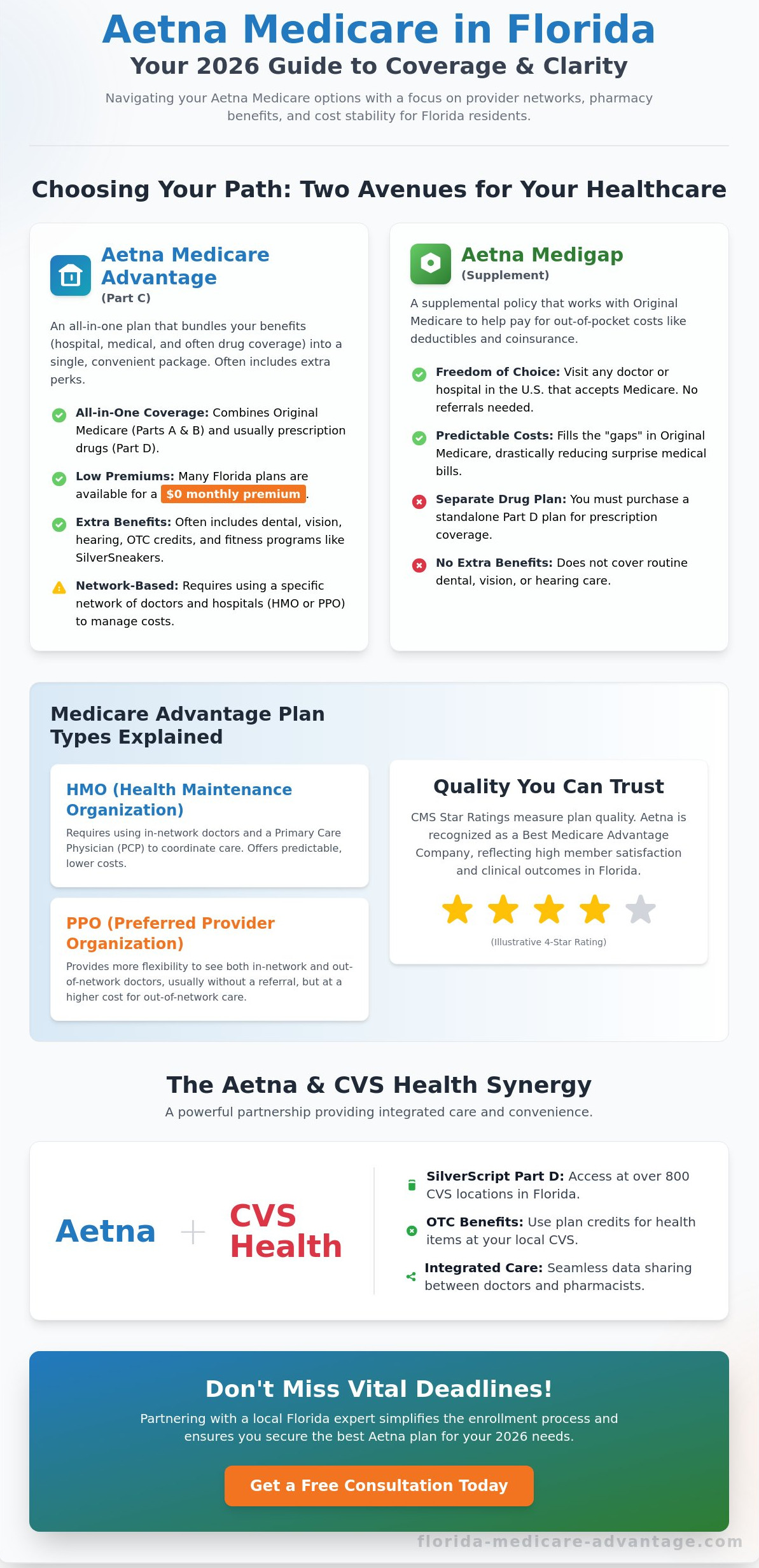
Aetna Medicare Supplement plans for seniors provide critical secondary insurance that covers out-of-pocket costs not paid by Original Medicare, such as deductibles, copayments, and coinsurance. In 2026, these plans remain a top choice for retirees seeking predictable healthcare expenses, nationwide provider access, and the financial stability of Aetna’s parent company, CVS Health.
Understanding Aetna Medicare Supplement (Medigap) Insurance
Medicare Supplement insurance, commonly referred to as Medigap, is private health insurance designed to work alongside Original Medicare (Part A and Part B). While Original Medicare covers many healthcare services and supplies, it does not cover everything. Seniors are often left with significant out-of-pocket expenses, including the 20% coinsurance for Part B services and high deductibles for hospital stays.
Aetna, a subsidiary of CVS Health, has established itself as one of the most prominent providers of these plans. Because Medigap plans are standardized by the federal government, the core benefits of a "Plan G" or a "Plan N" are the same regardless of the insurer. However, Aetna distinguishes itself through competitive pricing, household discounts, and a streamlined digital experience.
In 2026, Aetna offers these plans through several of its subsidiaries, including Aetna Health and Life Insurance Company (AHLIC), American Continental Insurance Company (ACI), and Continental Life Insurance Company of Brentwood, Tennessee (CLI). When you purchase an Aetna Medigap policy, you are securing a "guaranteed renewable" contract, meaning the company cannot cancel your coverage due to health changes as long as you pay your premiums.
Eligibility and Enrollment Guidelines for 2026
To be eligible for an Aetna Medicare Supplement plan, a senior must be enrolled in both Medicare Part A (Hospital Insurance) and Medicare Part B (Medical Insurance). Most individuals become eligible at age 65, though some younger individuals with specific disabilities or End-Stage Renal Disease (ESRD) may also qualify depending on state regulations.
The Medigap Open Enrollment Period
The most critical timeframe for seniors is the Medigap Open Enrollment Period. This is a one-time, six-month window that begins the first day of the month in which you are both 65 or older and enrolled in Medicare Part B. During this period, Aetna is legally prohibited from using medical underwriting to determine your eligibility or your premium. You cannot be denied coverage or charged more based on pre-existing conditions like diabetes, heart disease, or cancer.
Guaranteed Issue Rights
Outside of the initial open enrollment window, you may still be able to join an Aetna plan without medical underwriting if you have Guaranteed Issue Rights. These rights often apply if your current employer-sponsored coverage is ending, if you are moving out of a Medicare Advantage plan’s service area, or if your previous insurer misled you or went bankrupt.
Medical Underwriting in 2026
If you apply for an Aetna plan after your initial window has closed and you do not have a guaranteed issue right, you will likely face medical underwriting. Aetna’s underwriters will review your medical history, current prescriptions, and recent hospitalizations. Based on this risk assessment, Aetna may choose to decline your application or charge a higher monthly premium.
Standardized Plan Options Offered by Aetna
While there are 10 standardized Medigap plans (A through N), Aetna focuses on the most popular options that provide the best value for seniors in 2026. Each plan offers a different balance between monthly premium costs and the amount of coverage provided at the doctor’s office or hospital.
Plan G: The Comprehensive Choice
Plan G has become the "gold standard" for seniors who want the most comprehensive coverage possible. In 2026, Plan G covers 100% of the gaps left by Medicare, with one exception: the Medicare Part B annual deductible. Once you pay the Part B deductible (which is set by the Centers for Medicare & Medicaid Services), Plan G pays for all remaining Medicare-approved costs for the rest of the year. This includes hospital coinsurance, skilled nursing facility care, and the 20% coinsurance for doctor visits.
Plan N: The Value-Driven Option
Plan N is ideal for seniors who are willing to take on a small amount of cost-sharing in exchange for lower monthly premiums. Under Plan N, you still pay the Part B deductible. Additionally, you may have a copayment of up to $20 for office visits and up to $50 for emergency room visits (if you are not admitted). Crucially, Plan N does not cover Part B Excess Charges. If a provider does not accept "assignment" (the Medicare-approved amount), they can charge up to 15% more; Plan N users are responsible for that difference, though this is rare in many states.
Plan F: For Those Eligible Before 2020
Plan F is the most complete plan available, covering even the Part B deductible. However, federal law changed in 2020, making Plan F unavailable to anyone new to Medicare on or after January 1, 2020. If you were eligible for Medicare before that date, you can still apply for an Aetna Plan F in 2026. Because the pool of insured individuals in Plan F is aging and no "young" seniors are entering the group, premiums for Plan F tend to rise faster than those for Plan G.
High-Deductible Plan G
For seniors who want protection against catastrophic medical bills but prefer a very low monthly premium, Aetna offers a High-Deductible Plan G. You must pay a specific amount in out-of-pocket costs (the 2026 deductible amount) before the plan begins to pay. This is an excellent tool for healthy seniors who have significant savings and want to avoid high fixed monthly costs.
2026 Aetna Medicare Supplement Plan Comparison Table
| Feature | Plan A | Plan F* | Plan G | Plan N |
|---|---|---|---|---|
| Part A Coinsurance & Hospital Costs | 100% | 100% | 100% | 100% |
| Part B Coinsurance or Copayment | 100% | 100% | 100% | 100%** |
| Blood (First 3 Pints) | 100% | 100% | 100% | 100% |
| Part A Hospice Care Coinsurance | 100% | 100% | 100% | 100% |
| Skilled Nursing Facility Coinsurance | No | 100% | 100% | 100% |
| Part A Deductible | No | 100% | 100% | 100% |
| Part B Deductible | No | 100% | No | No |
| Part B Excess Charges | No | 100% | 100% | No |
| Foreign Travel Emergency (to plan limits) | No | 80% | 80% | 80% |
*Plan F is only available to those eligible for Medicare prior to January 1, 2020. **Plan N requires up to a $20 copay for some office visits and up to a $50 copay for ER visits.
Costs and Pricing Factors for Aetna Plans
In 2026, the cost of an Aetna Medicare Supplement plan varies significantly based on several demographic and geographic factors. Unlike Medicare Advantage plans, which often have $0 premiums but high out-of-pocket costs, Medigap plans require a monthly premium but drastically reduce or eliminate costs at the point of care.
Rating Methods
Aetna uses different methods to calculate premiums depending on the state where you live. Understanding these is vital for long-term financial planning:
- Community-Rated: Everyone in a specific geographic area pays the same premium regardless of age.
- Issue-Age-Rated: The premium is based on your age when you first buy the policy. Premiums do not increase because you get older, though they may rise due to inflation or increased healthcare costs.
- Attained-Age-Rated: The premium starts low but increases automatically as you age. This is the most common rating method used by Aetna in many states.
The Aetna Household Discount
One of Aetna's most attractive features is the household discount. In many states, if you live with another adult (usually a spouse or civil partner) who also has an Aetna Medigap policy, or sometimes simply if you live with another adult over a certain age, you can receive a discount of 7% to 15% on your monthly premium. This can save a couple hundreds of dollars per year.
Tobacco Use and Gender
In states where it is permitted, Aetna may charge higher premiums for tobacco users. Additionally, because women statistically have longer life expectancies but lower immediate healthcare costs in certain categories, their premiums are often slightly lower than those for men of the same age.
Key Benefits and Features Unique to Aetna
Choosing Aetna over other major carriers like UnitedHealthcare or Blue Cross Blue Shield often comes down to the ancillary benefits and the company's operational efficiency.
No Provider Networks
A significant advantage of Aetna’s Medigap plans is the lack of a network. You are not restricted to "Aetna doctors." You can visit any physician, specialist, or hospital in the United States that accepts Medicare. This is a primary reason why seniors who travel frequently or split their time between states (snowbirds) choose Medigap over Medicare Advantage.
Direct Claim Payments
Aetna uses a modernized claims processing system. When you visit a doctor, the provider bills Medicare first. Medicare pays its share and then electronically notifies Aetna to pay the remaining balance. In most cases, the senior never sees a bill, and the coordination between Medicare and Aetna happens seamlessly in the background.
CVS Health Synergy
Since CVS Health acquired Aetna, there has been an increase in value-added services. While Medigap plans are standardized, Aetna often provides members with discounts on health-related items at CVS Pharmacy locations and access to wellness programs like SilverSneakers or similar fitness initiatives in certain jurisdictions.
How to Apply and Switch Plans in 2026
If you are approaching age 65 or are currently enrolled in a Medicare Advantage plan and wish to switch to Aetna Medigap, the process requires careful timing.
- Verify Eligibility: Ensure you have Medicare Parts A and B. If you are switching from Medicare Advantage, you must wait for the Annual Election Period (AEP) or the Medicare Advantage Open Enrollment Period to drop your Advantage plan and return to Original Medicare.
- Request a Quote: Visit the official Aetna Medicare website to get a quote based on your zip code. Prices for the same Plan G can vary between neighboring counties.
- Submit the Application: You can apply online, via telephone, or through a licensed insurance agent. If you are in your Open Enrollment Period, you will skip the health questions.
- The "Free Look" Period: Every Aetna Medicare Supplement policy comes with a 30-day "free look" period. If you decide the plan isn't right for you within the first month, you can cancel and receive a refund of your premium.
- Coordinate Part D: Remember that Medigap plans do not include prescription drug coverage. To avoid late-enrollment penalties, you should also enroll in a standalone Medicare Part D plan, which Aetna also offers.
Comparing Aetna to Other Providers
When evaluating Aetna against competitors in 2026, consider the company’s financial strength and customer service reputation. Aetna consistently receives high ratings from AM Best and Standard & Poor’s, indicating a strong ability to pay claims.
While some smaller, "niche" insurance companies may offer a Plan G that is $10 cheaper per month, they may also implement higher annual rate increases. Aetna’s large "block" of business—meaning the sheer number of seniors they insure—often leads to more stable premium increases over time. Large insurers can spread the risk across a broader population, protecting individuals from sudden spikes in costs.
Common Pitfalls and Considerations
Seniors should be aware of several nuances when selecting an Aetna Medicare Supplement plan:
- Part B Excess Charges: If you choose Plan N, be aware of providers who do not accept Medicare assignment. While 95% of doctors do, specialized surgeons or high-end clinics may charge excess fees. If you live in a state like Ohio or Connecticut that prohibits excess charges, this is less of a concern.
- The "Gap" in Coverage: Medigap plans only cover costs for services that are already approved by Medicare. If Medicare denies a claim because they deem a procedure not medically necessary, Aetna will also not pay its portion.
- Switching Costs: If you have been with another Medigap carrier for five years and want to switch to Aetna to save money, you will likely have to pass a medical exam (underwriting). If you have developed health issues, you may be stuck with your current, more expensive carrier.
Frequently Asked Questions
Does Aetna Medicare Supplement cover dental and vision?
Standard Medigap plans do not cover routine dental, vision, or hearing services. Original Medicare itself does not cover these, so the "gap" insurance does not either. However, Aetna often offers separate, low-cost dental and vision riders or standalone policies that seniors can purchase alongside their Medigap plan.
Can I keep my Aetna Medigap plan if I move to another state?
Yes. Medicare Supplement plans are portable. Because they are standardized federally, your coverage remains valid anywhere in the U.S. However, your premium may change based on the cost of living and healthcare benchmarks in your new zip code. You must notify Aetna of your change of address to ensure proper billing and to see if you qualify for a different rating method.
How often do Aetna Medigap premiums increase?
Premiums typically increase once per year. These increases are usually due to two factors: your increasing age (if you have an attained-age policy) and medical inflation. In 2026, most seniors can expect an annual increase ranging from 3% to 7%, though this varies by state and plan type.
Is there a waiting period for pre-existing conditions with Aetna?
If you enroll during your six-month Medigap Open Enrollment Period, Aetna generally cannot make you wait for coverage for pre-existing conditions. However, in some specific cases, if you did not have "creditable coverage" prior to joining, there could be a waiting period of up to six months for those specific conditions. Most seniors transitioning from employer plans or other insurance will not face this.
Does Aetna offer Plan G High Deductible in all states?
Aetna offers High-Deductible Plan G in most states where they operate, but availability is subject to state insurance department approvals. This plan is highly effective for seniors who want the security of Aetna but have the financial liquidity to handle a $2,800–$3,000 (estimated 2026) deductible before the insurance pays 100%.
Final Recommendation for Seniors
For seniors entering 2026, an Aetna Medicare Supplement Plan G remains the most balanced option for financial security and healthcare freedom. If you are healthy and looking to save on monthly costs, Plan N is a formidable alternative, provided you are comfortable with small copayments. Always apply during your initial Open Enrollment Period to avoid medical underwriting, and be sure to utilize the household discount if you live with another adult to maximize your savings.