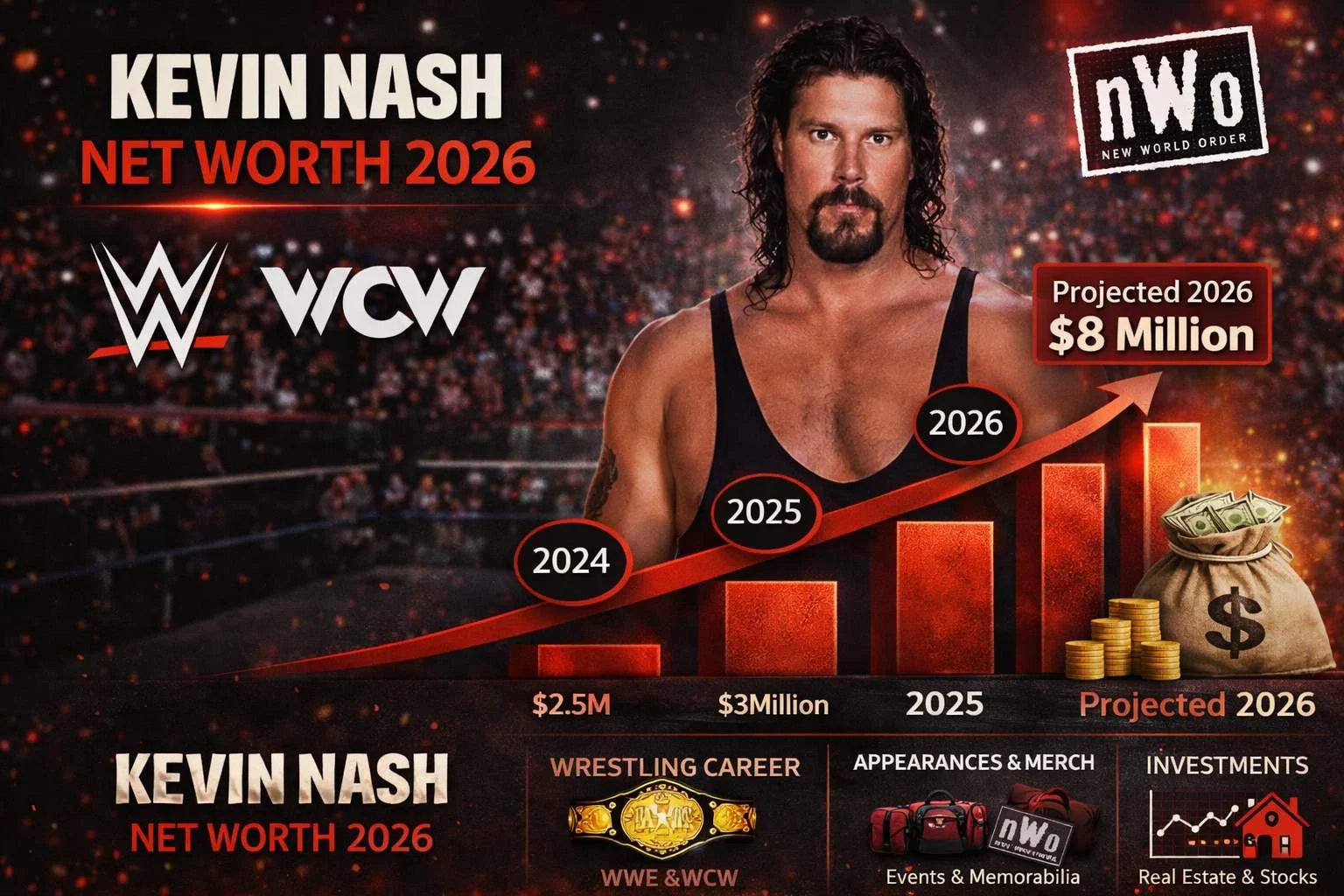
Retrospective financial evaluations and continuous earnings assessments place the estimated net worth of Kevin Nash between $8 million and $10 million. The former World Wrestling Entertainment (WWE) Champion and World Championship Wrestling (WCW) icon built his fortune through a combination of historic wrestling contracts, high-grossing Hollywood film roles, continuous merchandise licensing, real estate holdings, and modern digital media ventures.
Disclaimer: Net worth figures are estimates calculated using public financial records, court filings, industry reporting, and historical contract data. They do not constitute formal accounting statements or personal financial advice.
Understanding the Valuation of Kevin Nash's Wealth
Evaluating the net worth of a multi-decade entertainment figure requires looking beyond simple salary numbers. Kevin Nash’s financial portfolio reflects a transition from a traditional contract athlete in the 1990s to a multi-channel media brand.
Unlike many professional athletes of his generation who suffered post-retirement financial decline, Nash applied a pragmatic, business-first strategy to his career. His valuation comprises several key asset categories:
- Historical In-Ring Contracts: Multi-million-dollar guaranteed deals signed during the peak of the late-1990s "Monday Night Wars."
- Film and Television Residuals: Long-term payouts secured through Screen Actors Guild (SAG-AFTRA) agreements for feature film roles.
- Licensing and Royalties: Ongoing payments from WWE for merchandise, video games, action figures, and archival video streaming content.
- Digital Media Ownership: Revenue generated from Kliq This, his weekly podcast distributed across audio platforms and YouTube.
- Real Estate and Personal Investments: Tangible assets primarily situated in Florida, leveraging state-level tax advantages to preserve wealth.
The WCW Guarantee: How Nash Revolutionized Wrestling Pay Structures
To understand Kevin Nash's overall wealth, one must examine his role in changing the financial economics of professional wrestling in 1996. Prior to this point, professional wrestlers were treated strictly as independent contractors working under "per-date" guarantees or variable house-show payoff systems. Income was tied directly to ticket sales, leaving performers vulnerable to promoter discretion, injury, and seasonal gate declines.
The Jump to World Championship Wrestling
In 1996, Nash (then performing as "Diesel" in the World Wrestling Federation) and his colleague Scott Hall negotiated landmark contracts with Turner Broadcasting’s WCW, helmed by executive Eric Bischoff. Seeking to acquire established stars to anchor his Monday Nitro broadcast, Bischoff offered fully guaranteed, multi-year contracts—a novelty in the wrestling business at the time.
Nash signed an initial three-year deal with WCW valued at approximately $1.2 million annually in guaranteed downside earnings. Crucially, the contract included contractual clauses ensuring that if another performer was brought into the company at a higher salary tier, Nash's compensation would adjust upward accordingly (often referred to in the industry as a "favored nations" clause).
- Traditional WWF Pay Model (Pre-1996)
- Per-Date / Variable Gate Share
- No Compensation During Injury
- Unilateral Promoter Payoffs
- WCW Guaranteed Pay Model (Post-1996)
- Fixed Annual Downside ($1.2M+)
- Guaranteed Pay During Injury
- Favored Nations Escalation Clauses
The New World Order (nWo) Boom
Beyond base salaries, Nash was a founding member of the New World Order (nWo) storyline alongside Scott Hall and Hulk Hogan. The nWo became a cultural phenomenon, driving merchandise revenue to unprecedented heights.
The iconic black-and-white nWo T-shirt became one of the highest-selling apparel items in pro wrestling history. Because Nash had negotiated royalty cuts on merchandise carrying his likeness and faction branding, the nWo boom added millions in passive, high-margin revenue during his WCW tenure between 1996 and 2001.
WWE Earnings: From World Champion to Legends Licensing
While Nash made a significant portion of his initial liquid fortune in WCW, his relationships with WWE provided sustained, decades-long passive income.
Initial WWF Title Run (1993–1996)
During his first major run with World Wrestling Entertainment (then WWF) as Diesel, Nash held the WWF World Heavyweight Championship for nearly a year (358 days). While total wrestling industry revenues were lower in the mid-1990s compared to the modern era, Nash earned main-event level payoffs, bringing his annual income into the mid-six-figure range prior to his 1996 departure.
2002 Return and Subsequent Appearances
Following AOL Time Warner's liquidation of WCW in 2001, WWE acquired select contracts and intellectual property. Nash returned to WWE in 2002 under a lucrative contract reported to be in the range of $600,000 to $700,000 annually for a limited schedule. Subsequent limited in-ring returns, such as his 2011 program with Triple H and CM Punk, provided substantial pay-per-view and television appearance bonuses.
WWE Legends Contracts and Royalties
In his post-ring years, Nash signed a WWE Legends Contract. These agreements grant WWE the rights to produce merchandise, video game appearances, action figures, and digital collectibles using his likeness in exchange for routine royalty payments and an annual retainer fee.
Key drivers of his continuous WWE royalty stream include:
- Video Games: Annual releases of 2K Sports' WWE 2K franchise, in which Nash appears as multiple playable characters (Kevin Nash, Diesel, and nWo variants).
- Action Figures & Collectibles: Licensing agreements with toy manufacturers like Mattel and trading card partners like Panini and Fanatics.
- Streaming Content: Streaming rights for legacy content on platforms like Peacock in the United States and the WWE Network internationally generate pool-based royalty payments to historic talent based on viewership algorithms.
Hollywood Career: Box Office Roles and Residuals
Unlike many wrestlers whose acting endeavors are limited to low-budget direct-to-video titles, Kevin Nash successfully crossed over into mainstream Hollywood feature films. His physical presence (standing 6 feet 10 inches tall) made him a natural fit for high-profile character roles.
| Film Title | Year | Character Role |
|---|---|---|
| TMNT II: The Secret of the Ooze | 1991 | Super Shredder |
| The Punisher | 2004 | The Russian |
| The Longest Yard | 2005 | Guard Engleheart |
| Magic Mike | 2012 | Tarzan / Ernest |
| John Wick | 2014 | Francis (Bouncer) |
| Magic Mike XXL | 2015 | Tarzan / Ernest |
| Magic Mike's Last Dance | 2023 | Tarzan / Ernest |
High-Profile Film Franchises
- Magic Mike Trilogy: Nash co-starred as Tarzan (Ernest) alongside Channing Tatum in Magic Mike (2012), Magic Mike XXL (2015), and Magic Mike's Last Dance (2023). The first two films were massive commercial hits relative to their production budgets, grossing over $167 million and $122 million worldwide, respectively.
- John Wick (2014): Nash appeared as Francis, the club bouncer, in the action film that launched a multi-billion-dollar franchise.
- The Punisher (2004) & The Longest Yard (2005): Major studio releases that provided substantial upfront acting fees and long-term domestic and international broadcast syndication payouts.
The Mechanics of SAG-AFTRA Residuals
Because Nash is a member of SAG-AFTRA, he receives residual payments whenever his union-covered films and television shows are broadcast on cable television, licensed to foreign markets, or streamed on platforms like Netflix, Max, and Amazon Prime Video. While residual checks fluctuate based on platform contracts, a catalog containing major theatrical releases ensures a consistent passive baseline of income every quarter.
Modern Media and Digital Revenue: Kliq This
As traditional media shifted toward digital content, Nash adapted his revenue model. In 2022, he launched Kliq This: The Kevin Nash Podcast alongside co-host Sean Oliver.
Monetization Channels for Digital Content
The podcast format has proven to be an exceptional revenue engine for retired combat sports stars, requiring low overhead costs while leveraging a built-in fanbase. Kliq This generates income through four primary channels:
- YouTube AdSense: Video versions of episodes attract hundreds of thousands of views weekly, generating automated programmatic ad revenue.
- Host-Read Sponsorships: Direct corporate sponsorships with brands in the health, wellness, online gaming, and lifestyle spaces.
- Audio Network Distribution: Ad insertion across podcast networks like Westwood One or AdLarge for downloads on Apple Podcasts and Spotify.
- Patreon & Premium Subscriptions: Paid membership tiers offering ad-free video, early access, and exclusive live Q&A sessions.
Estimates from digital media analysts suggest that a top-tier wrestling podcast of this scale can generate between $15,000 and $35,000 per month in gross revenue, providing a modern income stream that offsets the natural reduction in live appearance opportunities.
Personal Asset Allocation, Real Estate, and Tax Planning
A vital factor in Kevin Nash’s financial endurance is his approach to asset preservation and tax management.
Real Estate Strategy in Florida
Nash has maintained primary residency in Florida for decades, living in regions such as Volusia County and Daytona Beach. From a financial standpoint, Florida offers significant wealth preservation advantages:
- Zero State Income Tax: Florida does not impose an individual state income tax. During his peak earning years in WCW and WWE, residing in Florida saved Nash hundreds of thousands of dollars annually compared to athletes residing in high-tax states like California or New York.
- Homestead Exemption: Florida’s property tax system offers homestead protections that cap annual property tax assessment increases on primary residences, helping control long-term real estate holding costs.
Financial Management Style
Nash has publicly discussed his deliberate avoidance of the financial mistakes common among sports stars of the 1980s and 1990s. Rather than purchasing luxury sports cars or maintaining extravagant lifestyle expenditures, Nash prioritized liquid savings, index funds, and real estate acquisition.
By keeping his burn rate low relative to his peak earnings, his principal investment capital was allowed to compound over thirty years.
Financial Breakdown: Revenue Streams and Net Worth Composition
The following breakdown illustrates how Kevin Nash's estimated $8M–$10M net worth is constructed across his past and present income channels.
| Income / Asset Category | Primary Historical / Current Source | Financial Impact & Characteristics |
|---|---|---|
| WCW In-Ring Contracts | Turner Broadcasting System (1996–2001) | Primary wealth foundation; $1.2M+ guaranteed annual salary plus PPV bonuses. |
| WWE Contracts & Royalties | World Wrestling Entertainment Inc. | Ongoing downside contract during active years; ongoing passive Legends deal royalties. |
| Film & TV Acting | Major Studios (Warner Bros., Lionsgate, Sony) | Upfront actor fees plus SAG-AFTRA streaming and cable residuals. |
| Digital Media & Podcasting | Kliq This Podcast / YouTube / Sponsorships | Active recurring cash flow ($200k–$400k estimated annual gross). |
| Merchandise & Licensing | nWo Apparel, Action Figures, Video Games | High-margin royalty checks stemming from timeless wrestling brand property. |
| Real Estate & Investments | Private Florida Residential Holdings / Equities | Wealth preservation via zero-state-tax domicile and diversified market holdings. |
Career Expenses: Medical Costs and Physical Overhead
An honest assessment of an athlete's net worth must account for career-related liabilities and expenses. Professional wrestling inflicts severe physical wear on the body, creating substantial ongoing medical overhead.
Surgeries and Orthopedic Expenses
Nash has undergone more than 30 surgical procedures throughout his life, including multiple total knee replacements, neck procedures, and shoulder operations.
During the majority of his active career, independent contractors in professional wrestling were required to cover their own personal health insurance, medical rehabilitation, and out-of-pocket travel costs (hotels, rental cars, transcontinental flights).
- Travel Overhead: Active performers in the 1990s frequently spent $30,000 to $50,000 annually on un-reimbursed travel costs.
- Long-Term Healthcare: Managing chronic orthopedic issues in retirement requires ongoing physical therapy, stem cell treatments, and specialized medical care, which represents a continuous cash outflow.
Despite these significant lifelong expenses, Nash’s disciplined budgeting during his peak earning years prevented medical costs from eroding his core retirement portfolio.
Frequently Asked Questions
What is Kevin Nash's estimated net worth?
As of baseline estimates, Kevin Nash's net worth is valued between $8 million and $10 million. This figure combines his historical wrestling earnings, movie roles, continuous merchandise royalties, and current podcasting income.
How much money did Kevin Nash make in WCW?
During his run in WCW from 1996 to 2001, Nash earned a guaranteed base salary of at least $1.2 million per year. With pay-per-view bonuses, favored-nations adjustments, and merchandise royalties from the nWo, his total compensation surpassed $2 million annually during peak years.
Does Kevin Nash still get royalties from the nWo T-shirt?
Yes. WWE owns the intellectual property rights to WCW and nWo branding. Under his WWE Legends deal, Nash receives regular royalty checks for any merchandise sold featuring his likeness or the nWo logos associated with his character.
What was Kevin Nash's highest-grossing movie role?
In terms of overall worldwide box office receipts, the Magic Mike franchise was his most successful acting endeavor. The first two films alone combined for over $290 million in global box office gross, providing strong upfront compensation and continued SAG-AFTRA residual checks.
How much does Kevin Nash earn from his podcast Kliq This?
While exact private earnings vary, a podcast of Kliq This's scale—with consistent YouTube views and multiple corporate sponsors—typically generates between $200,000 and $400,000 in gross annual revenue shared between the hosts and production team.
Strategic Financial Takeaways for Entertainment Professionals
Kevin Nash’s journey offers several important lessons in wealth accumulation and preservation for modern sports and entertainment professionals:
- Leverage Market Timing: Nash recognized his market value in 1996 and leveraged competition between rival companies (WWF and WCW) to secure guaranteed income structures.
- Diversify Income Streams: Rather than relying solely on wrestling, he expanded into mainstream acting, securing union protection and long-term residual income through SAG-AFTRA.
- Control Taxation and Overhead: By establishing primary residence in a tax-favorable jurisdiction (Florida) and maintaining low personal spending relative to earnings, he minimized capital destruction during his high-earning years.
- Adapt to Modern Digital Platforms: Transitioning legacy fame into self-owned digital assets like podcasts creates consistent operational income long after in-ring performance capabilities end.