Being under 30, single, and financially independent often means life insurance is the furthest thing from your mind. Yet, this exact life stage offers a unique window to lock in the lowest possible rates. When you have no dependents and minimal debt, navigating the insurance market comes down to choosing between two primary types of coverage: term life insurance and whole life insurance. Each serves a fundamentally different purpose, carrying distinct financial mechanics, cost structures, and long-term implications that require careful evaluation.
Evaluating life insurance as a young, single adult requires looking past the traditional narrative of protecting a spouse or children. Instead, the focus shifts toward locking in insurability, covering private student loans with co-signers, managing future financial liabilities, and establishing a foundation for long-term wealth accumulation. Because premiums scale aggressively with age and health status, securing a policy in your twenties can save you tens of thousands of dollars over your lifetime.
Why Buy Life Insurance When You Are Young and Single?
The primary advantage of purchasing life insurance while you are under 30 is health-related pricing. Life insurance companies calculate premiums based on statistical mortality risk. At age 25 or 28, you are statistically at your healthiest, meaning underwriters will classify you in the most favorable risk tiers, such as "Preferred Best" or "Preferred."
Beyond locking in low rates, buying early protects your insurability. If you develop a chronic medical condition in your thirties—such as type 2 diabetes, high blood pressure, or a cardiovascular issue—buying a policy later in life becomes significantly more expensive or even impossible. Furthermore, single adults often overlook hidden financial liabilities that survive them. If you have private student loans with a co-signer (such as a parent) or a shared auto loan, your death could legally transfer that debt burden to loved ones. Life insurance ensures those obligations are wiped clean without straining your family.
Common Misconceptions About Youthful Coverage
Many young adults assume they do not need coverage because employer-sponsored group life insurance provides enough protection. While a standard corporate policy typically offers coverage equal to one or two times your salary, this benefit is almost never portable. If you change jobs, get laid off, or transition to freelance work, that coverage disappears. Securing an independent, medically underwritten policy guarantees that your coverage remains yours regardless of your employment status.
Another misconception is that insurance is an unnecessary monthly expense when no one relies on your income. While day-to-day income replacement is a non-issue for single individuals without dependents, future obligations approach rapidly. Purchasing a policy now positions you to handle future family planning, mortgage acquisition, and business ventures without facing skyrocketing premium hikes later.
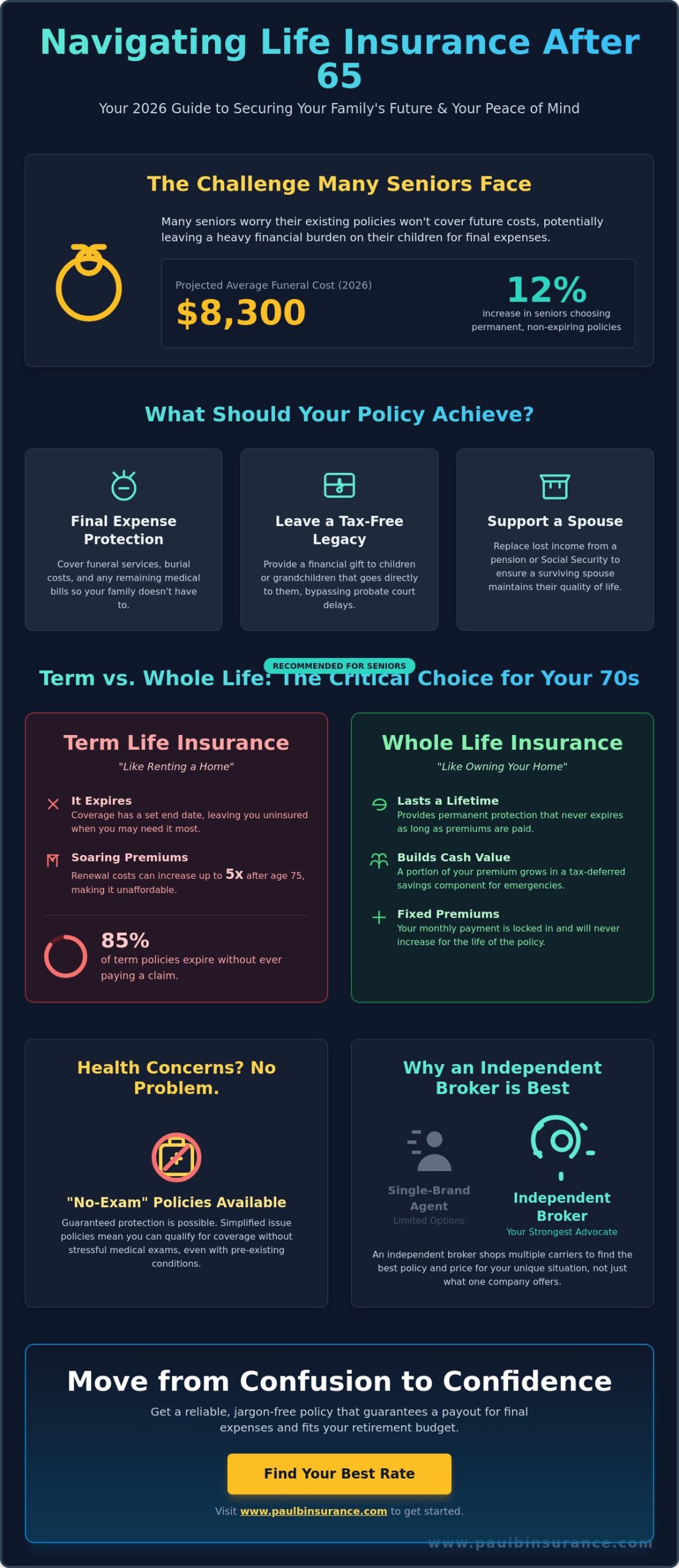
Option 1: Term Life Insurance
Term life insurance is the most straightforward, cost-effective form of coverage available. It provides a stated death benefit over a specific, predetermined period—most commonly 10, 20, or 30 years. If you pass away during the active term, your designated beneficiary receives the tax-free payout. If you outlive the term, the policy expires, and no benefits are paid out unless you have a specialized rider.
Financial Mechanics and Cost Efficiency
For a healthy 26-year-old, a 30-year term policy with a $500,000 death benefit can often be secured for less than a standard monthly utility bill. The financial mechanics are built purely on pure risk protection (mortality risk), stripping away investment components or cash value accumulations. This makes term insurance exceptionally cheap for young adults.
| Feature / Attribute | Term Life Insurance |
|---|---|
| Duration | Fixed period (e.g., 10, 20, 30 years) |
| Cost | Very low initial premiums |
| Cash Value | None |
| Primary Purpose | Pure income and liability protection |
| Renewal | Typically expires or spikes after term |
Because you are paying only for the statistical likelihood of mortality during those specific decades, your money works entirely toward risk mitigation. For single individuals under 30, a 30-year term policy bridges the gap between your current single status and the decades where you are most likely to acquire a mortgage, a spouse, and children.
Pros and Cons of Term Insurance for Young Adults
- Pros:
- Affordability: Unmatched low monthly or annual premiums.
- Simplicity: Easy to understand, compare, and purchase online or through brokers.
- High Coverage Amounts: Allows you to buy a substantial safety net ($500,000 to $1,000,000+) on an entry-level salary.
- Cons:
- Expiration Risk: If you outlive the term, you receive no return of premium and must reapply at an older age if you still want coverage.
- No Wealth Building: It does not accumulate cash value or act as an investment vehicle.
Option 2: Whole Life Insurance
Whole life insurance is a form of permanent life insurance. Unlike term policies, whole life coverage remains active for your entire life, provided you continue paying the premiums. It features a dual structure: a guaranteed death benefit and a cash-value component that grows at a fixed, tax-deferred rate over time.
Cash Value Mechanics and Dividends
A portion of every whole life premium payment goes toward the cost of insurance, while the remainder is deposited into a cash-value account managed by the insurance carrier. This cash value grows on a tax-deferred basis, meaning you do not pay taxes on the growth while it accumulates inside the policy.
Furthermore, many traditional whole life policies are issued by mutual insurance companies, which may pay annual dividends to policyholders. While dividends are never guaranteed, they can be used to reduce premium payments, purchase paid-up additions, or be collected as cash. As a young adult, starting a whole life policy gives this cash value decades to compound, creating a substantial financial reserve by mid-life.
Pros and Cons of Whole Life Insurance for Young Adults
- Pros:
- Lifetime Coverage: Never expires as long as premiums are paid.
- Cash Value Growth: Builds equity that can be borrowed against via policy loans.
- Fixed Premiums: Your premium rate locks in at your issue age and never increases.
- Cons:
- High Cost: Premiums are often 5 to 15 times more expensive than equivalent term policies.
- Low Early Liquidity: Surrendering the policy early often incurs heavy surrender charges, and cash value takes years to build meaningful momentum.
- Opportunity Cost: The high premium outlay prevents capital from being invested in higher-yielding vehicles like index funds, real estate, or retirement accounts.
Side-by-Side Comparison: Term vs. Whole Life for Under 30
Choosing between term and whole life insurance depends heavily on your current financial priorities, disposable income, and long-term wealth strategy. The following comparison highlights key operational differences:
| Metric | Term Life Insurance | Whole Life Insurance |
|---|---|---|
| Duration | Specific term (10–30 years) | Entire life (lifetime) |
| Monthly Cost | Low ($15 – $40/month typically) | High ($150 – $400+/month typically) |
| Cash Value | None | Yes, grows tax-deferred |
| Premium Stability | Level during the term | Fixed for life |
| Investment Integration | None (Buy Term, Invest the Difference) | Acts as a conservative asset class |
| Best Suited For | Budget-conscious single adults needing high coverage | High-net-worth estate planning and forced savings |
The "Buy Term and Invest the Difference" Strategy
For the vast majority of single adults under 30, financial planners advocate for the "Buy Term and Invest the Difference" (BTID) strategy. Because whole life insurance requires a massive cash commitment, choosing a low-cost term policy allows you to free up significant monthly capital. You can then direct those savings into tax-advantaged accounts such as a Roth IRA, a 401(k), or low-cost brokerage accounts.
Historically, broad-market index funds outperform the internal rates of return found in standard whole life cash-value accounts. For a 25-year-old with decades before retirement, maximizing equity exposure outside of an insurance wrapper generally yields superior long-term wealth accumulation.
Assessing Your Personal Need for Coverage
Before pulling the trigger on an application, evaluate your specific financial picture. Ask yourself the following questions:
- Do I have co-signed debt? If your parents co-signed your private student loans or car loan, look into a term policy with a death benefit matching that exact balance. This ensures your family is not legally and financially encumbered in a worst-case scenario.
- Do I anticipate supporting dependents soon? If marriage and children are on your horizon within the next five to ten years, locking in a 30-year term policy now protects you against future health declines.
- What is my monthly cash flow? If your entry-level salary leaves little room after rent, groceries, and student loan payments, whole life insurance is likely out of reach. Do not stretch your budget to buy permanent insurance when a term policy fulfills your immediate risk requirements at a fraction of the cost.
The Underwriting Process: What to Expect
Applying for life insurance in your twenties is typically fast and straightforward. Insurance companies evaluate your risk profile through a medical underwriting process that generally includes:
- An Online Health Questionnaire: Detailing your medical history, family medical history, hobbies, and occupation.
- A Paramedical Exam: A licensed nurse visits your home or office to check your height, weight, blood pressure, and pulse, and to draw blood and urine samples.
- Medical Database Checks: Reviewing your motor vehicle record (MVR), prescription history database (MIB), and past medical claims.
Being honest on your application is critical. Misrepresenting smoking habits, recreational drug use, or hazardous hobbies (like skydiving or rock climbing) can result in policy cancellation or claim denial down the road.
Frequently Asked Questions
Can I convert a term life policy into a whole life policy later?
Yes, many term life insurance policies include a "conversion rider." This allows you to convert your temporary term policy into a permanent whole life or universal life policy without undergoing a new medical exam. This is a valuable feature for young adults because it guarantees you can switch to permanent coverage later in life if your financial situation changes, regardless of any future health issues.
Do I need life insurance if I have no dependents or debt?
Strictly speaking, if you have zero debt, no dependents, and enough savings to cover your final funeral and burial expenses, life insurance is not strictly necessary today. However, buying a small term policy in your twenties acts as an insurance policy on your future health, locking in ultra-low rates before age-related medical conditions develop.
How much coverage should an under-30 single adult buy?
Even without dependents, a standard rule of thumb is to calculate your immediate liabilities (debt, funeral costs) plus a baseline multiplier for future insurability needs. Many young adults choose a $250,000 to $500,000 term policy, which provides ample coverage to clear debts and cover end-of-life expenses while keeping monthly premiums minimal.
Is employer-sponsored life insurance enough?
Usually, no. Employer-provided group life insurance is typically limited to one or two times your base salary and terminates the moment you leave the company. Relying solely on group coverage leaves you vulnerable to career transitions and provides insufficient coverage if you ever take on joint financial liabilities.
Summary and Next Actions
Navigating life insurance as a single adult under 30 comes down to prioritizing flexibility, cost, and future protection. For most individuals, term life insurance stands out as the clear winner, delivering massive coverage at a minimal price point and freeing up capital for retirement investments. Whole life insurance remains a niche tool suited primarily for high earners looking for specialized estate planning vehicles or conservative cash accumulation.
To take action, review your existing debt obligations, assess your health status, and obtain independent quotes from multiple top-rated insurance carriers. Securing a policy today locks in your youth and health as financial assets, ensuring peace of mind for whatever milestones lie ahead.