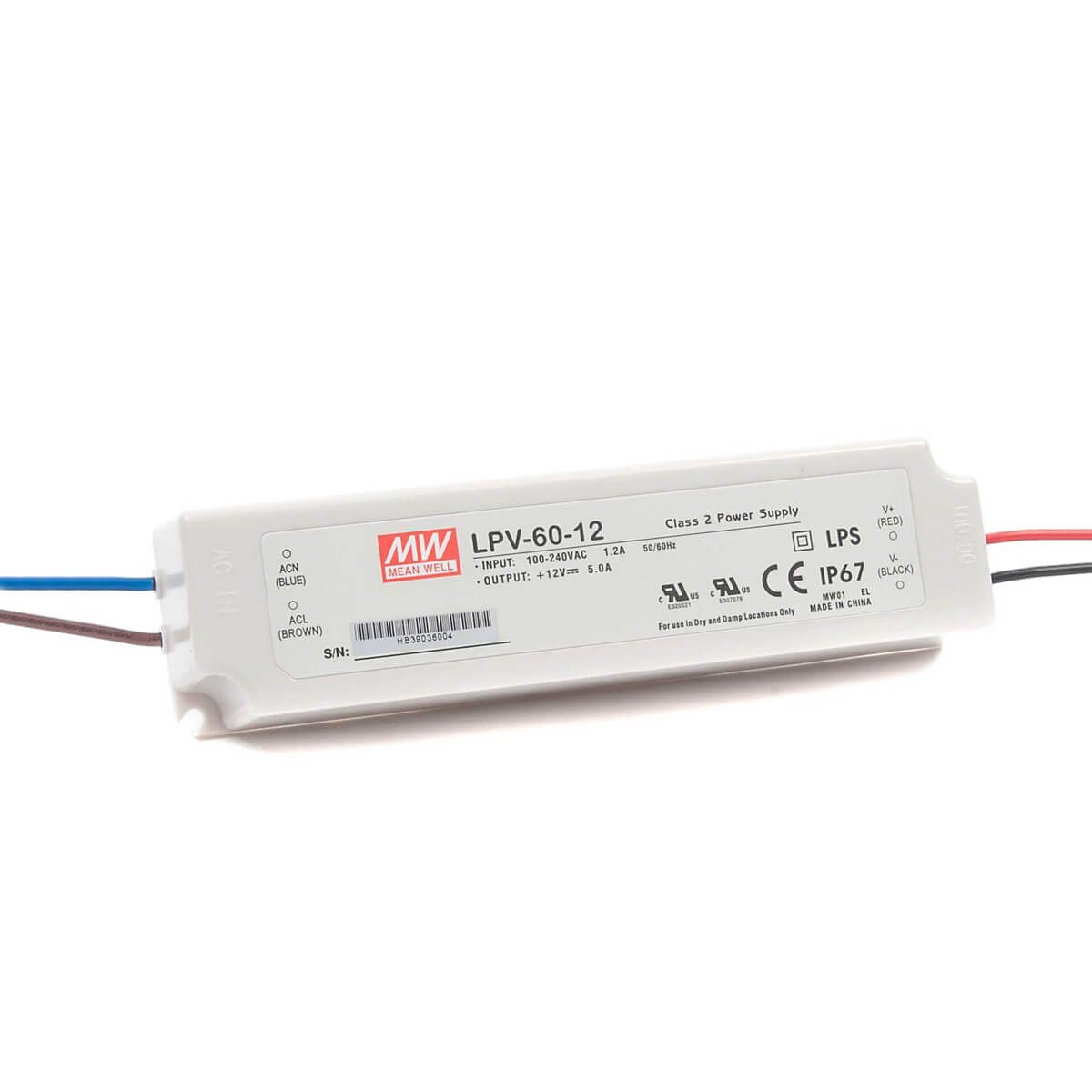
The Mean Well LPV-60-12 is a 60W constant voltage LED power supply designed for reliable performance in damp or dusty environments. It provides a stabilized 12V DC output at up to 5 Amps, featuring an IP67-rated plastic enclosure that protects against water immersion and debris, making it a standard choice for 2026 lighting projects.
Understanding the LPV-60-12 Architecture
The Mean Well LPV series has long been recognized as a "workhorse" in the LED industry. As of 2026, while higher-efficiency models like the XLG series have gained traction, the LPV-60-12 remains a preferred choice for cost-sensitive installations that require a robust, Class II (without earth pin) power isolation design. This specific model operates as a Switching Mode Power Supply (SMPS), which utilizes a high-frequency switching regulator to convert AC input power into regulated DC output efficiently.
At its core, the LPV-60-12 is a Constant Voltage (CV) driver. Unlike Constant Current (CC) drivers, which vary voltage to maintain a steady current for raw LED chips, a CV driver maintains a steady 12V. This is essential for LED products that have internal current-limiting resistors or onboard drivers, such as standard LED flexible strips, puck lights, and modular signage.
The unit is housed in a UL94V-0 flame-retardant plastic case. This material selection is critical for safety, ensuring that in the event of a catastrophic internal failure, the housing will not contribute to the spread of fire. Furthermore, the internal components are fully encapsulated (potted) with a thermally conductive silicone or epoxy, which serves two purposes: it facilitates heat dissipation to the outer shell and provides the vibration resistance necessary for industrial applications.
Key Technical Specifications
When evaluating the LPV-60-12 for a project in 2026, understanding the precise electrical boundaries is vital for system longevity. Below are the primary specifications as defined by Mean Well's engineering documentation.
| Feature | Specification Details |
|---|---|
| Output Voltage | 12V DC |
| Rated Current | 0 ~ 5A |
| Rated Power | 60 Watts |
| Ripple & Noise (Max) | 120mVp-p |
| Input Voltage Range | 90 ~ 264VAC or 127 ~ 370VDC |
| Efficiency (Typ.) | 83% |
| IP Rating | IP67 (Waterproof/Dustproof) |
| Working Temperature | -30°C to +70°C (with derating) |
| Dimensions | 162.5 x 42.5 x 32 mm (L x W x H) |
| Safety Standards | UL8750, CSA C22.2 No. 250.13-14, IP67 approved |
Input Versatility and Efficiency
The LPV-60-12 features a "Universal AC Input," meaning it can handle line voltages from almost any global power grid without the need for a manual selector switch. Whether installed in a 110V North American circuit or a 230V European circuit, the internal circuitry automatically compensates. However, it is important to note that the efficiency (the ratio of power consumed to power delivered) is typically measured at 83%. This means that at a full 60W load, the unit will draw approximately 72W from the wall, with 12W dissipated as heat.
Ripple and Noise Considerations
The 120mVp-p ripple specification is a measure of the "cleanliness" of the DC output. While 120mV is perfectly acceptable for LED lighting and simple signage, it may be too high for sensitive laboratory equipment or high-fidelity audio-visual components. For standard 2026 architectural lighting, this ripple is imperceptible to the human eye and will not cause flickering in high-speed video unless paired with a low-quality PWM (Pulse Width Modulation) dimmer downstream.
Installation and Wiring Protocols
Proper installation of the Mean Well LPV-60-12 is essential for both safety and maintaining the manufacturer’s warranty. Because the unit is IP67 rated, it is often placed in locations exposed to the elements, but "waterproof" does not mean "maintenance-free."
Input and Output Connections
The LPV-60-12 comes with pre-installed 18AWG wire leads. These leads are typically 300mm to 600mm in length.
- AC Input Side (Left): Usually consists of a Brown (Line) and Blue (Neutral) wire. In some regional variants, these may be Black and White. Since this is a Class II power unit, there is no Green/Yellow ground wire; the plastic housing provides the necessary insulation.
- DC Output Side (Right): Consists of a Red (Positive +) and Black (Negative -) wire.
In 2026, professional installers are encouraged to use IP68-rated junction boxes or heat-shrink solder sleeves when connecting these leads to the main run. Wire nuts or standard electrical tape are insufficient for outdoor or high-humidity environments, as capillary action can draw moisture into the cable jacket, eventually reaching the power supply's internal circuit board.
The 80% Rule and Derating
A critical mistake in LED system design is loading a power supply to its absolute maximum capacity. For the LPV-60-12, the maximum output is 60 Watts. However, for continuous operation (defined as more than three hours of use), industry standards suggest a 20% de-rating.
- Calculated Load: 60W x 0.80 = 48W.
- Practical Application: If you are using LED tape that consumes 10W per meter, you should limit your run to 4.8 meters on a single LPV-60-12 to ensure the components do not degrade prematurely due to heat stress.
Operating at the upper limit of the temperature range (-30°C to +70°C) also requires derating. Refer to the Mean Well Official Datasheet for the specific derating curve, which shows that output power must be reduced as the ambient temperature exceeds 50°C.
Integrated Protection Mechanisms
The LPV-60-12 is designed with several "self-healing" protection modes. These are vital for 2026 safety compliance and prevent the unit from becoming a fire hazard in the event of an external fault.
Overload Protection
If the connected LED load exceeds approximately 110% to 150% of the rated power (above 5.5A to 7.5A), the unit enters Hiccup Mode. In this state, the power supply will shut down and periodically attempt to restart. This prevents the internal transformer from overheating. Once the excess load is removed, the unit resumes normal 12V output automatically.
Short Circuit Protection
In the event of a direct short between the Red and Black output wires (often caused by staples through a wire or water in a connector), the LPV-60-12 will immediately cut power. Like the overload protection, this is a "recovery-type" system. Once the short circuit is cleared, the unit will function again without needing a manual fuse replacement.
Over Voltage Protection
If an internal component fails and the voltage attempts to spike above 13.8V ~ 16.2V, the unit will shut down to protect the connected LEDs. High-end LED strips are sensitive to voltage spikes, which can cause "thermal runaway" in the chips; this protection layer acts as a fail-safe for the expensive lighting components.
Use Cases and 2026 Applications
While the technology behind the LPV series is established, its application remains diverse in 2026.
- Landscape and Path Lighting: Due to its IP67 rating, it can be tucked into specialized landscape enclosures or buried in gravel-lined pits to power 12V DC garden lights.
- Commercial Signage: Channel letters and lightboxes often use 12V LED modules. The slim profile of the LPV-60-12 allows it to fit inside the narrow housing of sign letters.
- Kitchen Remodels: The unit is small enough to be hidden atop cabinetry or behind toe-kicks to power under-cabinet task lighting. Its Class II rating makes it safer for residential environments where a dedicated earth ground might be difficult to route to the specific cabinet location.
- Recreational Vehicles (RVs) and Marine: Though designed for AC input, its tolerance for fluctuating input and rugged, potted interior makes it a popular choice for 12V systems in stationary mobile homes or marine docks (provided it is protected from direct salt spray).
Troubleshooting Common Issues
Despite its reliability, installers may encounter issues during the commissioning of a 12V system.
Flickering or Strobing LEDs
This is rarely a fault of the LPV-60-12 itself but rather a symptom of an Overload Fault. If the LEDs are drawing 65W from this 60W supply, the unit will enter the "Hiccup Mode" mentioned earlier. This causes the LEDs to flash on and off as the unit attempts to start and then immediately protects itself. To resolve this, measure the total wattage of the strips or remove a section of the lighting to see if the flickering stops.
Voltage Drop over Long Distances
If the LEDs at the end of a long run appear dimmer than those near the power supply, you are experiencing voltage drop. While the LPV-60-12 is putting out a perfect 12V, the resistance of the wire over a long distance consumes some of that voltage.
- Solution: Use thicker gauge wire (e.g., 14AWG or 12AWG) for the run between the power supply and the start of the LED strip, or relocate the LPV-60-12 closer to the center of the lighting load.
No Output (Dead Unit)
First, verify AC input with a multimeter at the Brown and Blue wires. If AC is present but no DC is measured at the Red and Black wires, disconnect the load entirely. If the unit still shows 0V with no load attached, the internal fuse or a primary-side component may have failed, likely due to a massive surge or lightning strike. In 2026, these units are considered "non-serviceable" due to the epoxy potting; a replacement is required.
Comparative Overview: LPV vs. Other Series
In the 2026 market, you may encounter several Mean Well series that seem similar. Understanding the differences helps in choosing the right tool for the job.
- LPV vs. LPH: The LPH series is generally for lower power (up to 18W), while the LPV handles the 20W to 150W range.
- LPV vs. XLG: The XLG series is a newer design featuring a metal housing and a "Constant Power" mode. XLG is often more efficient and carries a longer warranty, but it is physically larger and more expensive than the LPV.
- LPV vs. HLG: The HLG is the flagship series. It offers a 7-year warranty and a metal case. If your project is in an area with extreme heat or requires 0-10V dimming directly on the driver, the HLG is the superior (though costlier) choice.
Frequently Asked Questions
Can the LPV-60-12 be dimmed?
The LPV-60-12 is not dimmable on the AC side. You cannot use a wall-mounted Triac (Lutron/Leviton) dimmer to control it. To dim LEDs powered by an LPV-60-12, you must place a DC-side PWM dimmer (such as a remote-controlled or Bluetooth controller) between the power supply output and the LED strip.
Is the LPV-60-12 suitable for indoor use?
Yes. While it is rated for outdoor use (IP67), it is perfectly safe and common for indoor applications. Its silent operation (no internal fan) makes it ideal for bedrooms, kitchens, and offices where fan noise would be distracting.
What does "Class II Power Unit" mean?
A Class II power unit is designed with double or reinforced insulation so that it does not require a safety connection to electrical earth (ground). This simplifies wiring in older buildings where a ground wire might not be available at the light fixture location.
Can I connect two LPV-60-12 units in parallel to get 120W?
No. Standard Mean Well LPV units are not designed for parallel connection to increase current. Doing so can cause the units to fight each other's voltage regulation, leading to overheating or immediate failure. If you need 120W, you should purchase a single LPV-150-12.
How long does the LPV-60-12 usually last?
Under standard operating conditions (staying within the 80% load rule and under 50°C), the LPV-60-12 typically has a MTBF (Mean Time Between Failures) of over 700,000 hours. In practical terms, this often translates to 5 to 10 years of reliable service in most residential or commercial environments.
Final Recommendation
For projects in 2026 requiring a 12V DC source, the Mean Well LPV-60-12 remains a top-tier recommendation for its balance of cost, durability, and safety certifications. When installing, always prioritize the 80% load rule—limiting your total LED draw to 48W—to ensure the unit survives its full expected lifespan. If your application involves extreme heat or requires integrated AC-side dimming, consider upgrading to the HLG or PWM series drivers. For standard, robust 12V waterproofing, the LPV-60-12 is an industry standard that continues to deliver consistent results.