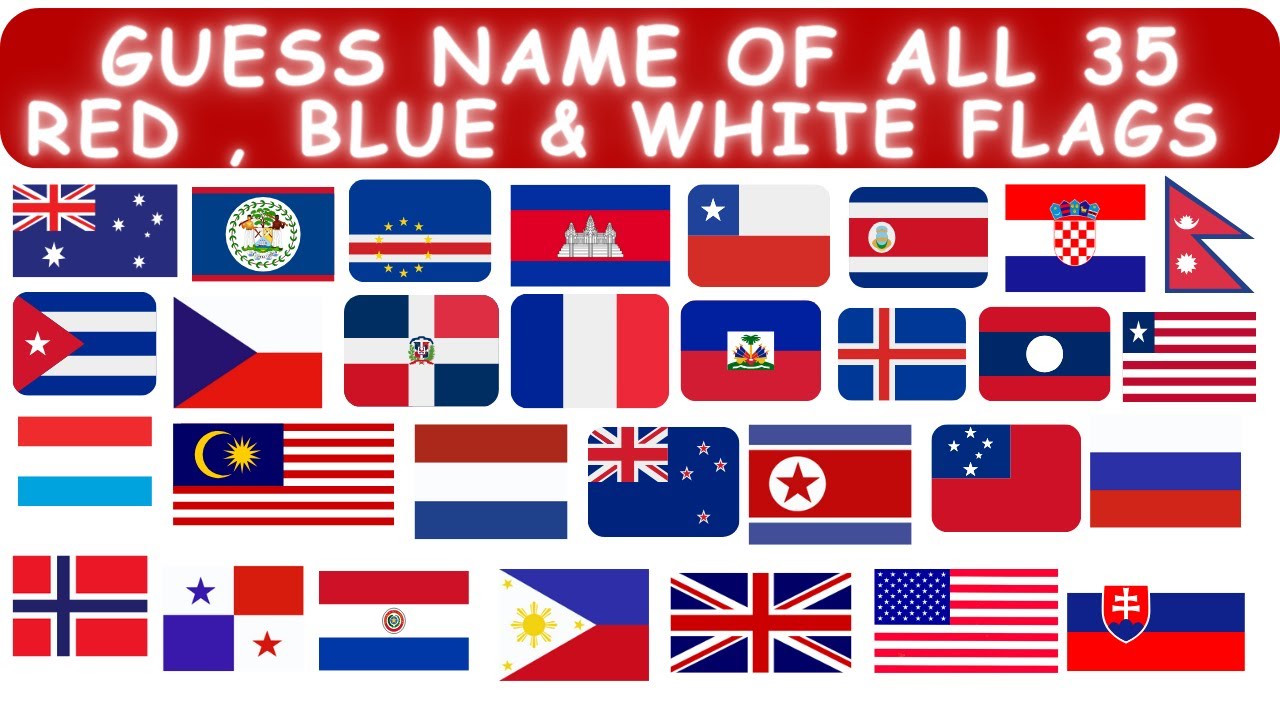
The combination of red, white, and blue remains the most ubiquitous color palette in vexillology, appearing on the national flags of dozens of sovereign states across every continent. These colors are frequently chosen for their symbolic associations with liberty, vigilance, justice, purity, and sacrifice, often stemming from shared historical influences such as the French Revolution or the British Union Jack.
Understanding the Prevalence of Red, White, and Blue
The recurring presence of the red, white, and blue tricolor or bicolor design is rarely a coincidence. Historically, these colors gained global prominence due to the colonial reach of empires that favored them, most notably Great Britain, France, and the United States. As nations transitioned to independence throughout the 19th and 20th centuries, many newly formed governments adopted these colors to reflect democratic ideals or to maintain a visual link to the revolutionary movements that championed republicanism.
In a modern context, these colors are valued for their high contrast and clear visibility. From a distance, a flag must be identifiable, and the sharp distinction between the primary red and blue against the neutral white ensures that these banners remain recognizable even in adverse weather conditions or at significant distances.
Categorizing Flags by Design Philosophy
While the colors remain constant, the arrangement of these hues varies significantly, often signaling the cultural or historical orientation of the nation. We can classify these flags into distinct design categories based on their internal composition.
1. The Tricolor Model
The most famous iteration is the vertical tricolor, popularized by the French flag. This design features three equal vertical bands. While France uses blue, white, and red, other nations have adopted similar layouts with horizontal bands or variations in tone to signify their own unique identities.
2. The Cross and Saltire
Influenced heavily by the British Union Jack, many nations in the Commonwealth or those with historical ties to the United Kingdom incorporated cross patterns into their flags. The red and white cross of St. George or the saltire of St. Andrew often serves as the foundation for the design, with blue fields representing the ocean or the sky.
3. The Commonwealth and Regional Variations
Several nations use a design that mirrors the "Stars and Stripes" or incorporates regional symbols like the Southern Cross. These flags often utilize red, white, and blue to demonstrate a transition from colonial status to a sovereign, democratic entity.
A Representative List of Red, White, and Blue Flags
The following table provides a selection of notable national flags that utilize this color scheme. Note that this is a representative list of sovereign states; it is not exhaustive, as the color combination is used by over 30 countries globally.
| Country | Primary Design Motif | Symbolic Interpretation of Colors |
|---|---|---|
| United States | Stars and stripes (canton) | Valor (Red), Purity (White), Justice (Blue) |
| France | Vertical tricolor | Liberty, Equality, Fraternity |
| United Kingdom | Union Jack (composite cross) | Union of kingdoms (England, Scotland, Ireland) |
| Australia | Commonwealth Star/Southern Cross | Federal unity and geographic location |
| Thailand | Horizontal bands | Nation (Red), Religion (White), Monarchy (Blue) |
| Norway | Nordic Cross | Historical alignment and maritime heritage |
| Chile | Bicolor with lone star | Blood of heroes (Red), Snow of Andes (White), Sky (Blue) |
Symbolic Variations and Cultural Context
It is critical to note that the meaning of these colors is not universal. While the American interpretation emphasizes "valor, purity, and justice," other nations attribute entirely different meanings to the exact same colors based on their own cultural history.
For instance, in Thailand, the red, white, and blue stripes represent the "triranga," symbolizing the nation, religion, and the monarchy. This serves as a reminder that color symbolism is subjective. When studying a flag, one must look beyond the color palette and examine the specific heraldry and national iconography, such as the placement of stars, crescents, or national emblems.
Technical Considerations in Flag Design (Vexillology)
For those interested in the technical aspects of these flags, modern vexillology focuses on the "tincture rule." In heraldry, this rule dictates that colors should generally be placed upon metals (or vice versa) to ensure the design remains distinct. Red and blue are considered "colors," while white is a "metal" (silver/argent). By placing white between red and blue, these flags often adhere to this historic rule, which prevents the colors from "bleeding" into one another when viewed from afar.
Design Standards for Durability
When commissioning or displaying flags, the material and stitching technique are as important as the design. For outdoor display in 2026, governments and organizations typically utilize:
- Material: High-tenacity nylon or polyester to withstand UV radiation and wind stress.
- Method: Lock-stitching, which prevents the fabric from unraveling if a single thread is broken.
- Finishing: Reinforced headers and brass grommets for standard flagpole attachment.
Troubleshooting Common Identification Issues
Often, people struggle to distinguish between flags that share the same color palette and similar geometry. To accurately identify a flag, follow this systematic approach:
- Check for National Symbols: Look for coats of arms, stars, or unique emblems. For example, the presence of a lone star or a specific sunburst pattern is often the deciding factor between the flags of Chile and the United States or Cuba.
- Examine the Aspect Ratio: Flags vary in their length-to-height ratio. While many follow a 2:3 ratio, some nations utilize 1:2 or even unique shapes.
- Analyze Orientation: Determine if the stripes are horizontal or vertical. This is the most common point of confusion for casual observers.
- Verify the Canton: Identify if there is a distinct box in the upper hoist (top-left) corner. The content of the canton usually contains the nation’s most specific regional or political identity.
Frequently Asked Questions
Why do so many countries use red, white, and blue?
These colors are primary or highly distinct, providing excellent visibility. Historically, the widespread adoption is linked to the 18th-century democratic revolutions, where the tricolor flag became a symbol of modern republicanism and opposition to traditional monarchical banners.
Are these flags always arranged in a tricolor format?
No. While the tricolor is popular, many nations use complex patterns. The United Kingdom, for example, uses a composite of three separate crosses, and the United States uses a canton (stars) alongside horizontal stripes.
Does the order of colors in a tricolor carry specific legal meaning?
In most cases, the order is fixed by national law or constitution. Changing the order or orientation of the bands is technically incorrect and may be viewed as disrespectful or, in some jurisdictions, a violation of flag etiquette.
What is the best way to clean a flag of this color scheme?
Because blue and red can bleed into white, especially when made of synthetic fabrics, professional dry cleaning is recommended. If washing at home, use cold water and mild detergent, ensuring the flag is air-dried to prevent shrinking and color migration.
How can I distinguish between the flags of the Netherlands and Luxembourg?
While both use horizontal red, white, and blue bands, they are distinguished by the shade of blue and the aspect ratio. The Netherlands uses a darker "navy" blue and a 2:3 ratio, while Luxembourg uses a lighter, "sky" blue and typically a 3:5 or 1:2 ratio.
Best Practices for Display and Respect
If you are displaying a national flag, ensure it is in good condition. Frayed, faded, or torn flags are generally considered disrespectful to the nation represented. If you are flying multiple flags, the national flag should always occupy the position of honor—typically to its own right, or at the center if multiple flags are flown in a row. For indoor displays, ensure the flag is not touching the ground, as this is a common protocol violation in many cultures.
For those looking to procure official national flags for 2026 events, prioritize vendors that provide "sewn" rather than "printed" flags for high-profile displays, as sewn flags offer superior longevity and depth of color.