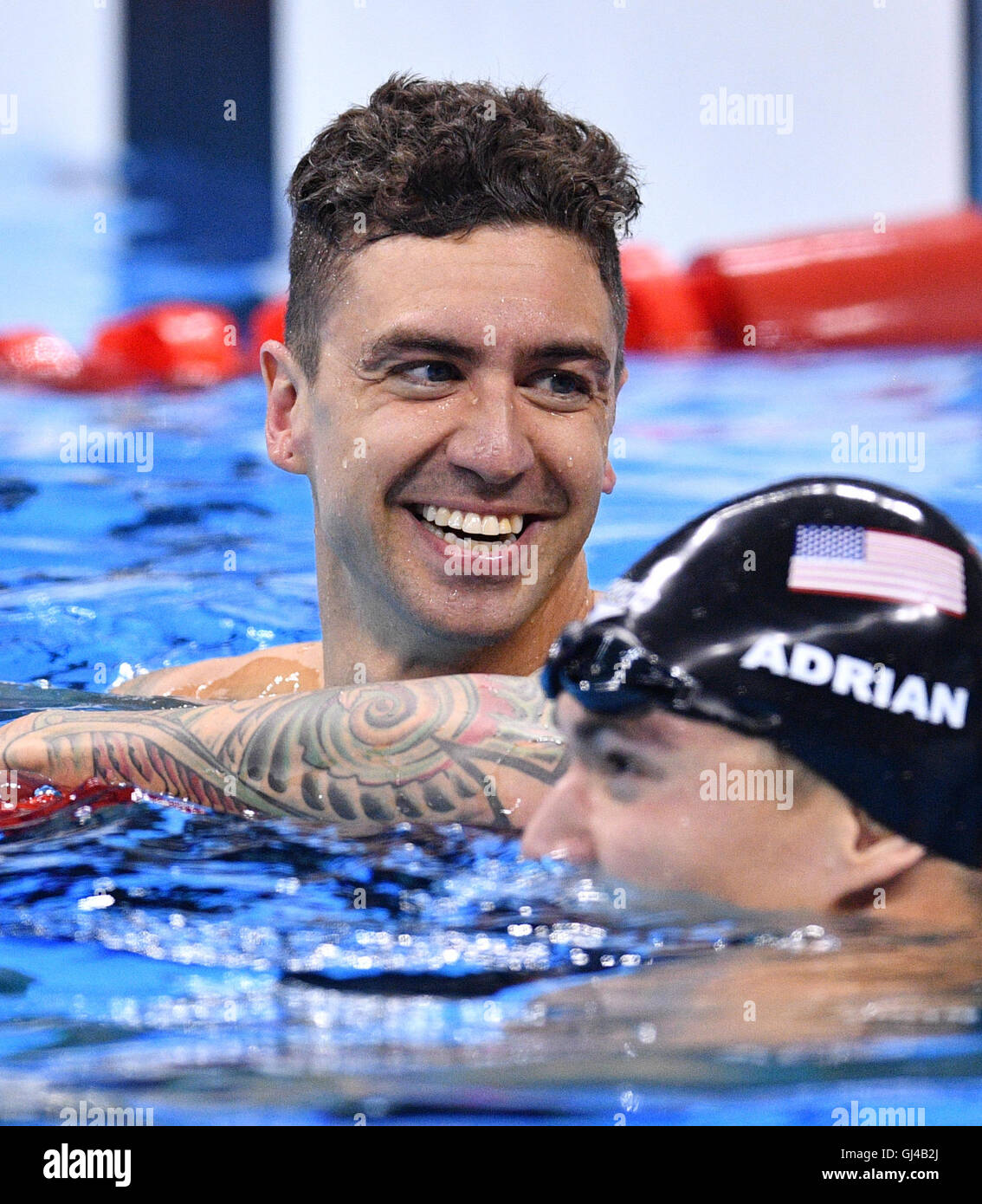
Anthony Ervin is an American competitive swimmer, three-time Olympic gold medalist, and four-time World Championship medalist who completed one of the most remarkable comebacks in sports history. After winning Olympic gold in the 50-meter freestyle at Sydney 2000 at age 19, Ervin retired at 22, walked away from the sport for nearly a decade, and returned to reclaim the same individual title at Rio 2016 at age 35.
Early Life, Heritage, and Collegiate Rise
Born on May 26, 1981, in Valencia, California, Anthony Lee Ervin grew up in a culturally diverse household. Of African American, Native American, and Jewish heritage, Ervin’s early exposure to athletics was shaped by a combination of hyper-focus, raw physiological talent, and an intricate, self-reflective personality. He began swimming at a young age in Southern California, quickly demonstrating an innate ability to generate speed in water through exceptional stroke rate and natural buoyancy.
Ervin attended Hart High School in Santa Clarita, where his speed in sprint events caught the attention of major collegiate swimming programs across the United States. He chose to swim for the University of California, Berkeley under the guidance of legendary head coach Teri McKeever and sprint specialist coaches who recognized his unique biomechanical efficiency.
At UC Berkeley, Ervin became a dominant force in NCAA Division I swimming. Representing the Golden Bears, he won multiple NCAA individual national titles in the 50-yard freestyle and 100-yard freestyle. His collegiate success served as the launchpad for his entry into international competition, establishing him as America's fastest pure sprinter at the turn of the century.
The 2000 Sydney Olympics: Rapid Ascension to Gold
At the 2000 United States Olympic Swimming Trials, 19-year-old Ervin proved that his short-course yard speed translated seamlessly to long-course 50-meter pools. He secured a spot on the U.S. Olympic team bound for Sydney, Australia, targeting the splash-and-dash event: the 50-meter freestyle.
The 50-meter freestyle is swimming’s most volatile event, where races are decided by hundredths of a second and a single misstep on the start or breath intake can eliminate a swimmer from contention. In Sydney, Ervin delivered a flawless performance in the final, stopping the clock at 21.98 seconds. In a dramatic finish, he tied his U.S. teammate Gary Hall Jr. for the gold medal.
Sydney 2000 - Men's 50m Freestyle Final Outcome:
- Anthony Ervin (USA) - 21.98 (Gold - Tie)
- Gary Hall Jr. (USA) - 21.98 (Gold - Tie)
- Pieter van den Hoogenband (NED) - 22.03 (Bronze)
In addition to his individual gold, Ervin earned a silver medal as part of the U.S. 4x100-meter freestyle relay team. Overnight, the teenage swimmer reached the pinnacle of international sports, becoming the first swimmer of African American descent to win an Olympic gold medal for the United States.
World Championships and Sudden Retirement at 22
Following his Olympic triumph in Sydney, Ervin continued to dominate sprint freestyle events globally. At the 2001 FINA World Aquatics Championships in Fukuoka, Japan, he solidified his status as the premier sprinter in the world by winning individual gold medals in both the 50-meter freestyle and the 100-meter freestyle.
Despite his unprecedented success and elite conditioning, Ervin experienced growing disillusionment with the rigid lifestyle of professional athletics, the celebrity that accompanied Olympic success, and the narrow definition of self-identity enforced by elite sports culture. In 2003, at just 22 years old—an age when most sprinters enter their physical prime—Ervin made the shocking decision to retire from competitive swimming.
The Years Away from the Pool
Ervin’s period away from competition spanned nearly a decade. During this time, he deliberately distanced himself from the swimming world:
- Academic Pursuits: He returned to UC Berkeley to complete his bachelor’s degree in English Literature and later pursued graduate studies.
- Music and Culture: He played guitar in rock bands, explored philosophy, and immersed himself in subcultures far removed from elite training centers.
- Personal Exploration: Ervin got extensive full-sleeve tattoos, representing a symbolic shedding of his former athletic skin and a redefinition of his personal identity.
- Philanthropy: In 2004, after the devastating Indian Ocean tsunami, Ervin auctioned off his 2000 Olympic gold medal on eBay, donating the entire $17,100 proceeds to tsunami relief efforts through UNICEF.
Though he occasionally coached learn-to-swim programs in New York and California to support himself, Ervin did not engage in structured workout regimes or competitive training for over seven years.
The Historic Comeback: London 2012 to Rio 2016
In 2011, driven by a renewed curiosity about the water and a desire to test his body as a mature adult, Ervin returned to the pool. Rejoining coach David Marsh and training at California Aquatics and Charlotte UltraSwim, Ervin faced steep physical hurdles after a seven-year hiatus from aerobic and anaerobic training.
Qualifying for London 2012
Ervin’s return shocked the swimming community when he qualified for the 2012 U.S. Olympic Trials. Demonstrating that his neural pathway efficiency and feel for the water remained intact, he finished second in the 50-meter freestyle at trials, earning a roster spot for the 2012 London Olympics at age 31.
In London, Ervin reached the final of the 50-meter freestyle, placing fifth overall with a time of 21.78 seconds—faster than his gold-medal time from 2000. While he missed the podium, the result validated his comeback and signaled that his career was far from over.
London 2012 - Men's 50m Freestyle Final Outcome:
- Florent Manaudou (FRA) - 21.34 (Gold)
- Cullen Jones (USA) - 21.54 (Silver)
- César Cielo (BRA) - 21.59 (Bronze) ...
- Anthony Ervin (USA) - 21.78
The Pinnacle at Rio 2016
Between 2012 and 2016, Ervin fine-tuned his approach. Working with coaches including Bruce Gemmell and Dave Durden, he emphasized power development, nervous system recovery, and mental flexibility over grueling yardage.
At the 2016 U.S. Olympic Trials in Omaha, Ervin qualified for both the individual 50-meter freestyle and the 4x100-meter freestyle relay. At 35 years old, he was the oldest male swimmer on the U.S. Olympic squad.
At the Rio 2016 Olympic Games, Ervin executed one of the most stunning races in Olympic swimming history:
- 4x100m Freestyle Relay: Ervin swam a blistering prelim leg to help set up the U.S. team, earning a Gold Medal alongside teammates Michael Phelps, Caeleb Dressel, and Ryan Held.
- 50m Freestyle Individual: On August 12, 2016, 16 years after his first Olympic gold medal, Ervin stepped up to Lane 3 in the 50m freestyle final. Executing a explosive start and maintaining an incredible stroke rate, he touched the wall in 21.40 seconds, beating defending champion Florent Manaudou by 0.01 seconds.
Rio 2016 - Men's 50m Freestyle Final Outcome:
- Anthony Ervin (USA) - 21.40 (Gold)
- Florent Manaudou (FRA) - 21.41 (Silver)
- Nathan Adrian (USA) - 21.49 (Bronze)
With this victory, Ervin became the oldest individual Olympic swimming champion in history at age 35, breaking the previous age record held by Michael Phelps. The 16-year gap between individual gold medals in the same event stands as an unmatched record in Olympic swimming history.
Technical Sprint Analysis: Biomechanics and Mindset
Anthony Ervin’s longevity and sprinting performance stem from a distinct blend of physiological traits and technical mastery. Sprint swimming, particularly the 50-meter freestyle, demands maximal power output combined with hydrodynamics that minimize surface drag.
ERVIN'S SPRINT METHODOLOGY
| Biomechanical Trait | Tactical Application |
|---|---|
| Ultra-Fast Reaction Time | Sub-0.65s block reaction |
| High Stroke Rate (Tempo) | Sustained 55-60 cycles/min cadence |
| Low Head-Position Hydrodynamics | Neutral spine reducing wave drag |
| Nervous System Regulation | Mindful breath-holding & composure |
Key Technical Elements of Ervin's Stroke
- Reaction Time Off the Block: Ervin consistently recorded reaction times below 0.65 seconds. His start utilized a quick weight transfer over the front edge of the starting block, maximizing horizontal distance before entering the water.
- Sensory "Feel for the Water": Coached extensively on fluid dynamics, Ervin possessed an elite catch phase, engaging the forearms and palms immediately upon entry without slipping through the water column.
- Neutral Head Alignment: Unlike older sprinters who held their heads high, Ervin pioneered a deep head position that lowered the hips and legs, drastically reducing frontal resistance.
- Nervous System Regulation: Ervin applied mindfulness practices to manage high-stress environments. By maintaining low muscle tension in the call room, he preserved explosive fast-twitch muscle fibers for the 21 seconds of maximal effort.
Key Career Milestones and Records
The following table summarizes Anthony Ervin's primary international accomplishments across his two-phase career.
| Year | Competition | Location | Event | Result / Time | Medal |
|---|---|---|---|---|---|
| 2000 | Olympic Games | Sydney, Australia | 50m Freestyle | 21.98 (Tied) | Gold |
| 2000 | Olympic Games | Sydney, Australia | 4x100m Freestyle Relay | 3:13.86 | Silver |
| 2001 | World Championships | Fukuoka, Japan | 50m Freestyle | 22.09 | Gold |
| 2001 | World Championships | Fukuoka, Japan | 100m Freestyle | 48.33 | Gold |
| 2012 | Olympic Games | London, United Kingdom | 50m Freestyle | 21.78 | 5th Place |
| 2013 | World Championships | Barcelona, Spain | 4x100m Freestyle Relay | 3:11.42 | Silver |
| 2016 | Olympic Games | Rio de Janeiro, Brazil | 50m Freestyle | 21.40 | Gold |
| 2016 | Olympic Games | Rio de Janeiro, Brazil | 4x100m Freestyle Relay | 3:09.92 | Gold |
Autobiography and Media: Chasing Water
In 2016, shortly before the Rio Olympics, Ervin co-authored his autobiography with writer Constantine Markides, titled Chasing Water: Elegy of an Athlete.
Unlike traditional athletic memoirs that focus strictly on training routines and victories, Chasing Water offers a raw, literary exploration of mental health, identity struggles, drug use, spiritual exploration, and the pressures placed on elite performers. The book won critical acclaim, receiving the 2018 International Swimming Hall of Fame Buck Dawson Author Award for its candid portrayal of an athlete's inner life.
Ervin’s story has been profiled extensively by international outlets, including the International Olympic Committee and USA Swimming, serving as a reference point for conversations about athlete mental health, post-career transitions, and late-career athletic performance.
Legacy and Impact on Modern Sprinting
Anthony Ervin’s influence extends far beyond his medal count. He disrupted traditional views on athletic aging and training methodologies within competitive swimming.
ANTHONY ERVIN'S DUAL-CAREER TRAJECTORY
- Phase 1: Early Peak [1999-2003]
- 2000 Sydney Gold (Age 19)
- 2001 World Champion
- Retired at age 22
- 7-Year Hiatus: 2003-2010
- Exploration, Academics, Music
- Phase 2: Historic Comeback [2011-2016+]
- 2012 London Finalist (Age 31)
- 2016 Rio Gold x2 (Age 35)
- Oldest Individual Gold Medalist
Paradigm Shifts Initiated by Ervin
- Redefining Peak Athletic Age: Prior to Ervin’s 2016 victory, conventional wisdom dictated that male sprinters peaked in their early-to-mid twenties. Ervin proved that with proper nervous system management and targeted strength conditioning, sprinters can reach peak speeds well into their thirties.
- Emphasis on Autonomy and Rest: Ervin advocated for self-directed training and mental rest, proving that stepped-away time can prevent emotional burnout without causing permanent loss of biomechanical mastery.
- Diversity in Aquatic Sports: As one of the first high-profile African American Olympic gold medalists in swimming, Ervin helped pave the way for subsequent generations of diverse swimmers, including Simone Manuel, Cullen Jones, and Shaine Casas.
Frequently Asked Questions
How old was Anthony Ervin when he won his Olympic gold medals?
Anthony Ervin was 19 years old when he won his first individual Olympic gold medal in the 50-meter freestyle at the 2000 Sydney Games. When he won the same event at the 2016 Rio Games, he was 35 years old, making him the oldest individual Olympic swimming champion in history.
Why did Anthony Ervin sell his 2000 Olympic gold medal?
In 2004, Ervin auctioned off his 2000 Sydney Olympic gold medal on eBay to raise money for survivors of the catastrophic Indian Ocean earthquake and tsunami. The medal raised $17,100, which he donated in full to UNICEF's tsunami relief fund.
How long was Anthony Ervin away from competitive swimming?
Ervin retired from competitive swimming in 2003 at age 22 and did not return to structured competitive training until 2011, marking a hiatus of nearly eight years. During this period, he completed his degree at UC Berkeley, played in rock bands, and taught swimming lessons.
What is Anthony Ervin's personal best time in the 50-meter freestyle?
Ervin’s career personal best in the long-course 50-meter freestyle is 21.40 seconds, set during his gold-medal performance at the Rio 2016 Olympic Games.
What book did Anthony Ervin write about his life?
Ervin co-authored an autobiography titled Chasing Water: Elegy of an Athlete with writer Constantine Markides. Published in 2016, the memoir explores his upbringing, athletic success, retirement, self-discovery, and eventual comeback.
Summary and Current Role
Anthony Ervin stands as one of the most distinctive figures in modern Olympic history. By combining raw physical gift with a philosophical approach to sport, he broke age barriers and established a new model for athletic longevity.
Today, Ervin remains active in the global swimming community as an author, international clinician, speaker, and ambassador for aquatic sports. He frequently works with youth clinics and international organizations, emphasizing the importance of water safety, mental wellness, and self-determination for young athletes.