Angela Howard’s exact net worth is not publicly disclosed in audited financial filings because she operates primarily as a private enterprise founder, organizational culture strategist, and corporate executive consultant. While unverified online databases estimate her wealth across wide ranges, her actual financial position is derived from private business equity, executive retainer agreements, keynote speaking fees, and advisory service contracts rather than public market equity.
1. Public Visibility and Financial Disclosure Realities
Understanding the net worth of an executive and business leader like Angela Howard requires distinguishing between public corporate disclosures and private enterprise financials. Public figures who hold executive roles or major shareholdings in publicly traded corporations are subject to mandatory disclosures governed by the U.S. Securities and Exchange Commission (SEC). SEC regulations require officers, directors, and major shareholders to file Form 4 statements for insider transactions and Schedule 13D/G filings for equity stakes exceeding 5 percent.
Because Angela Howard’s career centers on private enterprise leadership, strategic human resources consulting, organizational psychology, and founder-led boutique advisory services, her personal balance sheet remains confidential. Private business owners are under no legal obligation to publish audited balance sheets, profit-and-loss statements, or personal asset breakdowns to the public.
When evaluating net worth claims for private consultants, founders, and media commentators, observers must recognize that public databases rely almost entirely on algorithmic estimation models. These models attempt to project wealth using surface metrics such as website traffic, social media reach, general industry compensation benchmarks, and assumed corporate revenues. Consequently, any single dollar figure attached to private figures like Angela Howard should be treated as an unverified external estimate rather than an audited financial statistic.
2. Primary Revenue Streams Driving Angela Howard's Financial Profile
While precise financial statements remain private, the structural composition of Angela Howard’s earnings model can be analyzed through standard executive compensation and management consulting economics. Her multi-faceted professional activities generate cash flow and long-term asset value across four core pillars.
- Primary Revenue & Asset Drivers
- Corporate Retainers
- Private Enterprise Equity Valuation
- Speaking & Event Honorariums
- Digital IP & Media
Corporate Consulting and Strategic Advisory Services
As an organizational strategist and human-centric workplace advisor, a substantial portion of ongoing revenue stems from enterprise consulting contracts. High-level corporate advisory contracts generally operate on standard structural models:
- Monthly Retainer Agreements: Enterprise clients engage senior culture and HR strategists on recurring monthly retainers to guide organizational design, diversity and inclusion initiatives, and change management.
- Project-Based Engagements: Fixed-fee projects covering cultural audits, leadership development programs, and executive succession frameworks. According to occupational data from the U.S. Bureau of Labor Statistics (BLS), specialized management analysts and executive-level organizational consultants command premium billable hourly rates or comprehensive enterprise project pricing far above standard corporate salaries.
Enterprise Equity and Business Valuation
As a founder and executive of proprietary consulting and content ventures (such as Callie & Co. / ART culture initiatives), Angela Howard’s long-term net worth builds through business equity accumulation. Unlike liquid salary, enterprise equity represents the enterprise value of the firm itself.
Business valuation for boutique management consultancies typically relies on multiples of Seller’s Discretionary Earnings (SDE) or Earnings Before Interest, Taxes, Depreciation, and Amortization (EBITDA). A healthy, founder-led consulting firm typically trades at valuations between 2.0x to 4.5x SDE, depending on client retention rates, brand equity, recurring contract revenue, and organizational independence from the founder.
Keynote Speaking and Corporate Workshop Fees
Executive speakers specializing in human resources, corporate culture, workplace equity, and modern leadership often build secondary revenue streams through public speaking engagements. Professional keynote speaker fees for established industry leaders range according to event scale, corporate sponsorship, and travel requirements:
- Regional & Industry Conferences: Typical honorariums range from $5,000 to $15,000 per appearance.
- Fortune 500 Enterprise Events: Specialized executive keynotes and custom leadership workshops frequently command $15,000 to $35,000+ per event.
Digital Content, Media, and Intellectual Property
Modern executive consultancies expand their total addressable market through media platforms, digital products, and content distribution. Revenue generated through podcast sponsorship, educational licensing, digital courses, and published media adds scalable cash flow that carries higher profit margins than labor-intensive direct consulting. Over time, proprietary methodologies and training frameworks become intangible assets that enhance overall corporate valuation.
3. Evaluating Net Worth Scrapers vs. Financial Reporting Realities
A major challenge in analyzing search queries like "Angela Howard net worth" is the abundance of low-quality, automated content farm websites. These platforms generate speculative net worth estimates to capture search traffic without relying on accredited accounting data.
| Valuation Data Source | Methodology Used | Reliability Grade | Key Limitations |
|---|---|---|---|
| Official Regulatory Filings (SEC / IRS) | Form 10-K, Form 4, Public Tax-Exempt Disclosures | High (100% Verified for Public Entities) | Not applicable to private LLCs, private corporations, or personal non-executive holdings. |
| Independent Valuation Models (DCF / EBITDA) | Multiples of gross revenue, SDE adjustments, verified contract size benchmarks | Medium-High (Professional Estimation) | Requires accurate internal financial inputs; subject to market multiple fluctuations. |
| Third-Party Scraper Websites | Traffic volume scrapers, generic social media follower algorithms, arbitrary fixed multipliers | Very Low (Speculative) | Fails to account for business liabilities, operating taxes, employee overhead, or debt obligations. |
| Self-Reported Executive Statements | Interviews, press releases, corporate announcements | Variable (Subjective Context) | Often highlights gross revenue rather than net income or personal net asset value. |
Why Scraper Estimates Are Inaccurate
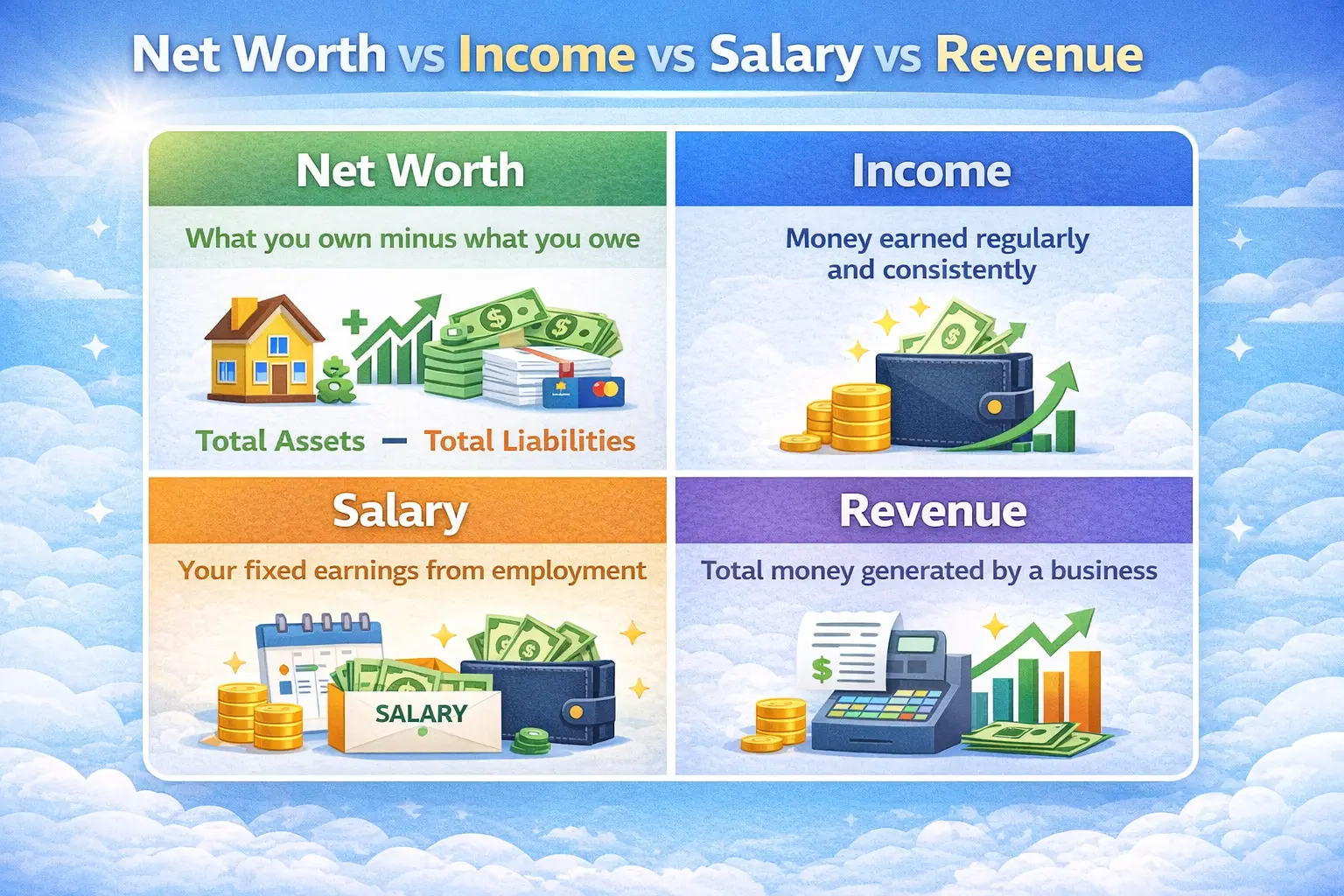
Third-party wealth tracking websites frequently confuse gross business revenue with personal net worth. For example, if a boutique firm manages $1,000,000 in annual enterprise billing, automated scrapers may falsely attribute that entire sum directly to the founder’s personal net worth.
In business operations, gross revenue is reduced by substantial operational expenses, including:
- Payroll and Benefits: Compensation for staff, associate consultants, legal counsel, and administrative team members.
- Tax Obligations: Federal, state, and self-employment taxes. Corporate entity choices affect tax liability directly; details on structures can be reviewed via the Internal Revenue Service (IRS).
- Operational Overhead: Marketing, technology software stacks, professional liability insurance, travel expenses, and office infrastructure.
- Reinvestment: Retained earnings reinvested into corporate growth rather than distributed to the owner as personal income.
4. Asset Structuring and Private Wealth Management for Executives
To understand how executive leaders like Angela Howard preserve and grow net worth over time, one must examine standard wealth accumulation and asset protection practices utilized by successful entrepreneurs.
- Personal Net Worth Structure
- Private Business Assets & Retained Earnings
- Enterprise Equity
- Corporate IP/Brand
- Personal Investment & Real Estate Portfolio
- Real Estate
- Liquid Equities / Retirement
- Private Business Assets & Retained Earnings
Entity Selection and Tax Optimization
Executive consultants typically structure their operations using Limited Liability Companies (LLCs) or S-Corporation tax elections. By taking a reasonable W-2 salary and distributing remaining profits as owner distributions, business owners minimize payroll taxes while legally shielding personal assets from enterprise liabilities.
Retirement and Tax-Deferred Vehicles
High-earning private founders utilize specialized retirement vehicles to convert enterprise income into tax-advantaged liquid net worth:
- Simplified Employee Pension (SEP-IRA): Allows self-employed individuals and small business owners to contribute up to 25% of net self-employment earnings (subject to annual IRS caps).
- Solo 401(k) / Enterprise 401(k): Enables high contribution limits, allowing rapid accumulation of public market securities (index funds, equities, bonds) outside the core business entity.
- Defined Benefit Pension Plans: Used by established corporate consultants to defer significant portions of annual profit into tax-sheltered investment accounts.
Diversification into Real Assets
A fundamental rule of personal finance for corporate founders is diversification away from single-business concentration risk. Wealth built through consulting and keynote speaking is commonly reinvested into:
- Residential and commercial real estate portfolios.
- Broad-market equity investments (low-cost index funds and mutual funds).
- Angel investments or limited partner (LP) positions in aligned venture capital or private equity funds.
5. Standard Methodology for Estimating Private Founder Net Worth
When financial analysts evaluate the net worth of a private executive where public filings are absent, they apply standard valuation frameworks recommended by guidance from institutions like the U.S. Small Business Administration (SBA).
The basic accounting formula for personal net worth is:
$$\text{Net Worth} = \text{Total Assets} - \text{Total Liabilities}$$
For a private enterprise consultant, the asset side of the ledger breaks down into:
- Liquid Assets: Cash reserves, high-yield savings, money market accounts, and publicly traded stocks/bonds held in personal brokerage or retirement accounts.
- Illiquid Enterprise Assets: Estimated market value of equity held in proprietary firms, calculated by applying standard industry EBITDA multiples to net earnings.
- Tangible Personal Assets: Primary residence equity, investment property equity, vehicle ownership, and personal property.
- Intangible IP Assets: Capitalized value of published books, trademarked frameworks, copyrighted training curricula, and digital media catalog licenses.
On the liability side, total debt obligations—such as mortgages, business lines of credit, equipment leases, and personal credit accounts—are subtracted. Because external observers do not have access to an individual's personal liability ledger, any publicly quoted net worth figure remains speculative unless backed by direct personal financial statements.
6. Frequently Asked Questions
What is Angela Howard’s confirmed net worth in 2026?
There is no publicly available, legally verified figure for Angela Howard’s exact net worth. As a private business founder and organizational executive, her financial disclosures are not filed with government regulators like the SEC. Online claims citing specific figures are unverified third-party estimates.
How does Angela Howard earn her primary income?
Angela Howard earns income through corporate consulting contracts, organizational strategy retainers, executive coaching, professional keynote speaking honorariums, enterprise workshops, and digital media platforms.
Are net worth estimates on internet scrapers accurate for private consultants?
No. Most third-party net worth scrapers use automated algorithms that rely on generic assumptions, web traffic, and gross revenue projections. They typically fail to account for business operational expenses, taxes, employee salaries, and debt obligations, leading to inaccurate figures.
How do private business owners build personal net worth compared to public executives?
Public company executives build wealth largely through SEC-reported stock options, restricted stock units (RSUs), and direct executive salary. Private business owners build net worth by accumulating private equity in their companies, retaining corporate earnings, taking owner distributions, and reinvesting profits into real estate and secondary liquid investments.
Does business equity count toward a founder's net worth?
Yes, business equity represents a major asset in a founder's net worth. However, it is classified as an illiquid asset because its value cannot be realized in cash until the business is sold, recapitalized, or evaluated through a formal third-party appraisal.
7. Key Takeaways and Practical Recommendations
When researching executive profiles, corporate leadership finances, and public net worth figures, adopt a critical analytical perspective:
- Distinguish Between Public and Private Entities: Always check whether an individual holds reportable positions in publicly traded companies. Private enterprise owners have no requirement to publish net worth figures.
- Separate Revenue from Net Worth: Never treat gross business earnings or enterprise contract values as personal net worth. Operational overhead, payroll, and taxes reduce gross revenue significantly before profit reaches an owner's balance sheet.
- Rely on Verified Financial Sources: Rely on regulatory disclosures (SEC filings), corporate annual reports, or verified financial news reporting rather than automated ad-supported aggregator websites when performing financial due diligence.