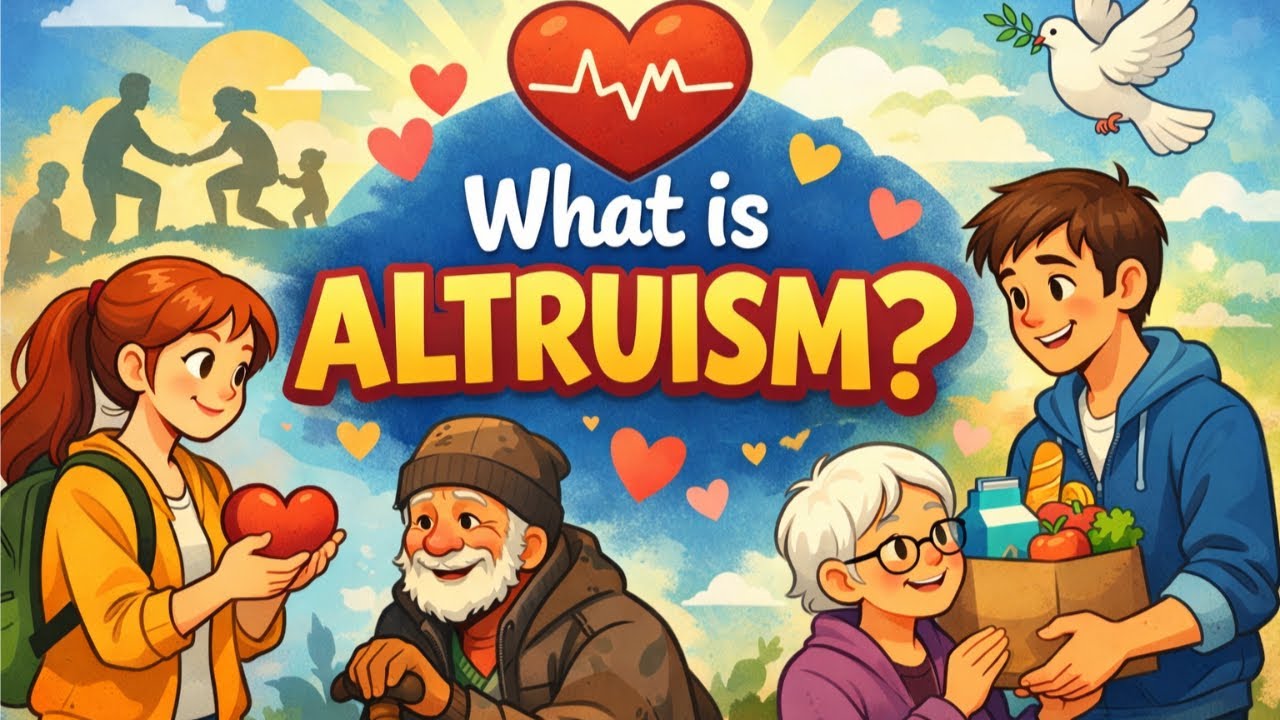
Altruism in ethics is the moral principle of selfless concern for the well-being of others. It suggests that individuals have a moral obligation to help, serve, or benefit others, often placing the interests of the collective or another individual above their own self-interest or personal gain.
In the landscape of moral philosophy, altruism serves as a cornerstone for understanding human motivation and social responsibility. The term, first coined by the French philosopher Auguste Comte in the mid-19th century, was intended to provide a secular alternative to the theological concepts of "charity" or "brotherly love." By 2026, the study of altruism has evolved far beyond its initial sociological roots, integrating insights from evolutionary biology, psychology, and data-driven philosophy to explain why and how we should care for others.
The Philosophical Foundations of Altruism
To understand altruism in ethics, one must first distinguish between its descriptive and normative applications. Descriptive altruism observes how people behave and asks whether humans are capable of truly selfless acts. Normative altruism, on the other hand, prescribes how people ought to behave, asserting that helping others is a fundamental moral duty.
Auguste Comte and the Birth of "Altruisme"
Auguste Comte, the founder of positivism, introduced the word altruisme to describe the "living for others" (vivre pour autrui) mindset. Comte believed that social progress depended on the gradual triumph of altruism over "egoism," or self-interest. He envisioned a society where individuals were educated to suppress their selfish instincts in favor of social harmony. While Comte’s specific "Religion of Humanity" did not gain permanent traction, his terminology became the standard for discussing selflessness in secular ethics. More information on Comte's contributions to sociology and ethics can be found through the Britannica entry on Auguste Comte.
Psychological vs. Ethical Altruism
A critical distinction in ethics is the difference between psychological and ethical altruism.
- Psychological Altruism: This is the claim that people can have a genuine, ultimate desire to help others. This is often contrasted with Psychological Egoism, which argues that every human action is ultimately motivated by self-interest, even if it appears selfless (e.g., helping a neighbor to feel good about oneself).
- Ethical Altruism: This is a normative theory. It states that an action is morally right if the consequences of that action are more favorable than unfavorable to everyone except the agent. Unlike Utilitarianism, which counts the agent's happiness equally with others, extreme ethical altruism suggests that the agent should prioritize others' interests over their own.
Altruism Within Major Ethical Frameworks
Altruism is not always a standalone theory; it often operates within broader ethical systems. Different schools of thought justify and limit altruistic behavior in varied ways.
Utilitarianism and the Greatest Good
Utilitarianism, popularized by Jeremy Bentham and John Stuart Mill, is often associated with altruistic outcomes. It posits that the most moral action is the one that maximizes "utility"—usually defined as happiness or pleasure—for the greatest number of people. While a utilitarian might act altruistically, their motivation is not necessarily "selflessness" for its own sake, but rather the mathematical maximization of collective well-being. If an agent’s own happiness is greater than the happiness they could provide others, a strict utilitarian might argue they should prioritize themselves. However, in practice, utilitarianism frequently demands significant altruistic sacrifice.
Deontology and the Duty to Help
Deontological ethics, most notably represented by Immanuel Kant, focuses on duties and rules rather than consequences. Kant did not necessarily use the term altruism, but his Categorical Imperative—the idea that one should act only according to rules that could be willed as universal laws—implies a duty to help others. If we would want others to help us in our time of need, we are rationally bound to help others. For Kant, the moral worth of an altruistic act depends on whether it is done out of duty, rather than mere inclination or "feeling good."
Virtue Ethics: Altruism as Character
In the tradition of Aristotle, virtue ethics focuses on the character of the person acting rather than specific rules or outcomes. Here, altruism is seen as a component of "generosity" or "magnanimousness." A virtuous person is one who has developed the habit of being helpful. In this framework, altruism is not a painful sacrifice but a fulfillment of human excellence. Being a "helper" is part of what it means to live a flourishing life (eudaimonia).
The Challenge of Psychological Egoism
The most persistent challenge to altruism is the theory of psychological egoism. This view suggests that "pure" altruism is a myth. Proponents of this view argue that whenever we help others, we are doing so to satisfy our own desires:
- The "Warm Glow" Effect: We help others because it triggers a release of dopamine or provides a sense of moral satisfaction.
- Reputation Management: We help others to be seen as "good" by our peers, which increases our social capital.
- Avoidance of Guilt: We help others to avoid the internal distress of seeing someone suffer and doing nothing.
Ethicists respond to this by noting that even if we feel good after helping, it does not mean the goal of the action was to feel good. If you save a child from a burning building, the fact that you feel relieved afterward does not negate the fact that your primary intent was the child’s safety. The Stanford Encyclopedia of Philosophy provides a deep dive into these motivational complexities and the debate over whether "pure" altruism is psychologically possible.
Evolutionary Altruism: Why Do We Help?
Biologists and evolutionary psychologists have long puzzled over how altruism could survive natural selection. If evolution favors the "survival of the fittest," why would an organism sacrifice its own resources or safety for another?
Kin Selection and Inclusive Fitness
The most basic biological explanation is kin selection. Formulated by W.D. Hamilton, this theory suggests that animals are more likely to behave altruistically toward their genetic relatives. By helping a sibling or cousin survive, an individual ensures that at least a portion of their shared genetic material is passed on. This is often summarized by the "Hamilton’s Rule" formula: $rB > C$ (where $r$ is genetic relatedness, $B$ is the benefit to the recipient, and $C$ is the cost to the altruist).
Reciprocal Altruism
Robert Trivers introduced the concept of Reciprocal Altruism to explain why we help non-relatives. This is essentially the "I’ll scratch your back if you scratch mine" principle. In social species, altruistic behavior can be an evolutionary advantage if the favor is likely to be returned in the future. For this to work, the species must have the cognitive ability to recognize "cheaters" who take help but never give it back.
Effective Altruism: A Modern Synthesis
In the early 21st century and continuing through 2026, the Effective Altruism (EA) movement has redefined how altruism is practiced. Led by philosophers like Peter Singer and William MacAskill, EA moves away from purely emotional or "impulsive" giving toward a rigorous, data-driven approach.
Effective altruism asks: "How can I use my resources to help others the most?" This often involves:
- Cause Prioritization: Determining which global problems (e.g., malaria prevention, climate change, AI safety) are most urgent, tractable, and neglected.
- Cost-Effectiveness: Using economic models to determine which charities provide the most "well-being" per dollar spent.
- Earning to Give: The practice of pursuing a high-paying career specifically to donate a large percentage of income to highly effective causes.
This movement represents a shift from "feeling altruistic" to "being effective," emphasizing that the outcome of the help is more important than the warm feeling the helper receives.
Comparing Ethical Frameworks of Giving
The following table compares how different ethical theories approach the concept of altruism.
| Ethical Theory | Primary Motivation | View on Self-Interest | Key Focus |
|---|---|---|---|
| Ethical Altruism | Benefit to others | Should be minimized or ignored | The welfare of others as the only moral end. |
| Utilitarianism | Greatest collective good | Agent's interest counts as one among many | Maximization of total happiness/utility. |
| Deontology | Moral duty/Universal law | Subordinate to the moral law | Acting according to rational, universal rules. |
| Virtue Ethics | Character development | Self-interest and altruism are aligned | Developing the habit of being a generous person. |
| Effective Altruism | Maximizing impact | Focused on resource optimization | Using evidence and reason to do the most good. |
Common Critiques of Altruism
Despite its generally positive reputation, altruism has faced significant criticism from various philosophical quarters.
Friedrich Nietzsche: The "Slave Morality"
Nietzsche was one of the most vocal critics of altruism. He argued that the glorification of self-sacrifice was a "slave morality" designed by the weak to restrain the strong. In his view, prioritizing others over oneself is a denial of life and a suppression of the "Will to Power." Nietzsche believed that individuals should strive for self-overcoming and greatness rather than being bogged down by pity for others.
Ayn Rand: The Virtue of Selfishness
In the 20th century, Ayn Rand’s philosophy of Objectivism presented a direct challenge to altruism. She argued that altruism is fundamentally destructive because it requires the individual to sacrifice their own life and values for the sake of others. Rand advocated for "Rational Self-Interest," suggesting that the most moral way to live is to pursue one's own happiness while respecting the rights of others to do the same. She viewed altruism as a tool used by "collectivists" to manipulate and control individuals.
The Problem of Paternalism
A practical critique of altruism is the risk of paternalism—the idea that by "helping" others, we are assuming we know what is best for them, potentially stripping them of their agency. Critics argue that altruism can sometimes create a power imbalance where the giver feels superior to the receiver, leading to dependency rather than empowerment.
Practical Implementation: How to Practice Altruism Today
Practicing altruism in 2026 involves more than just occasional donations. It requires a mindful integration of empathy and reason.
- Identify Your Values: Determine which causes resonate with your moral framework. Is it the immediate relief of suffering (utilitarian) or the fulfillment of a duty to your community (deontological)?
- Verify Impact: Before committing resources, use platforms like GiveWell or the Centre for Effective Altruism to research which organizations are actually achieving their stated goals.
- Practice Small-Scale Reciprocity: Altruism starts at home. Simple acts of "random kindness" contribute to the social trust necessary for larger-scale altruistic systems to function.
- Balance Self-Care: Pure ethical altruism can lead to "compassion fatigue" or burnout. Modern ethicists generally agree that maintaining one's own health and well-being is a prerequisite for being able to help others effectively over the long term.
Frequently Asked Questions
Is altruism the same as charity?
Not exactly. Charity is an act of giving, while altruism is the underlying moral philosophy or motivation. One can perform a charitable act for selfish reasons (like a tax break), but an altruistic act is defined by the selfless intent behind it.
Can a person be too altruistic?
In ethics, this is known as "pathological altruism." It occurs when the desire to help others causes harm to the helper or even the intended recipient. Examples include "enabling" someone’s self-destructive behavior or sacrificing one's own basic needs to the point of becoming a burden on others.
Does evolutionary altruism prove humans are "naturally" good?
Evolutionary altruism shows that humans are naturally social and cooperative. While we have biological predispositions toward helping our kin and those who help us, we also have predispositions toward tribalism and competition. Ethics is the tool we use to expand our natural altruistic circle to include strangers and people outside our immediate group.
What is the "Altruism Paradox"?
The paradox is the idea that if you help someone because it makes you feel good, it's no longer purely altruistic. However, many modern philosophers resolve this by arguing that the "feeling good" is a byproduct of the action, not the primary motivation. If your intention was to help, the resulting happiness doesn't cancel out the altruism.
How does Effective Altruism differ from traditional giving?
Traditional giving is often driven by emotional connection or personal stories. Effective Altruism is driven by metrics and evidence. For example, a traditional giver might donate to a local animal shelter, while an effective altruist might donate to a program that provides deworming tablets to thousands of children, because the latter has a statistically higher impact on human well-being per dollar.
Next Steps for Exploration
To deepen your understanding of altruism in ethics, consider exploring the works of Peter Singer, particularly The Life You Can Save. Additionally, reviewing the historical evolution of social contract theory can provide context on how altruism became integrated into the legal and social structures of the modern state. For those interested in the biological side, Richard Dawkins' The Selfish Gene offers a classic, albeit controversial, look at how altruistic behavior emerges from "selfish" genetic replication.