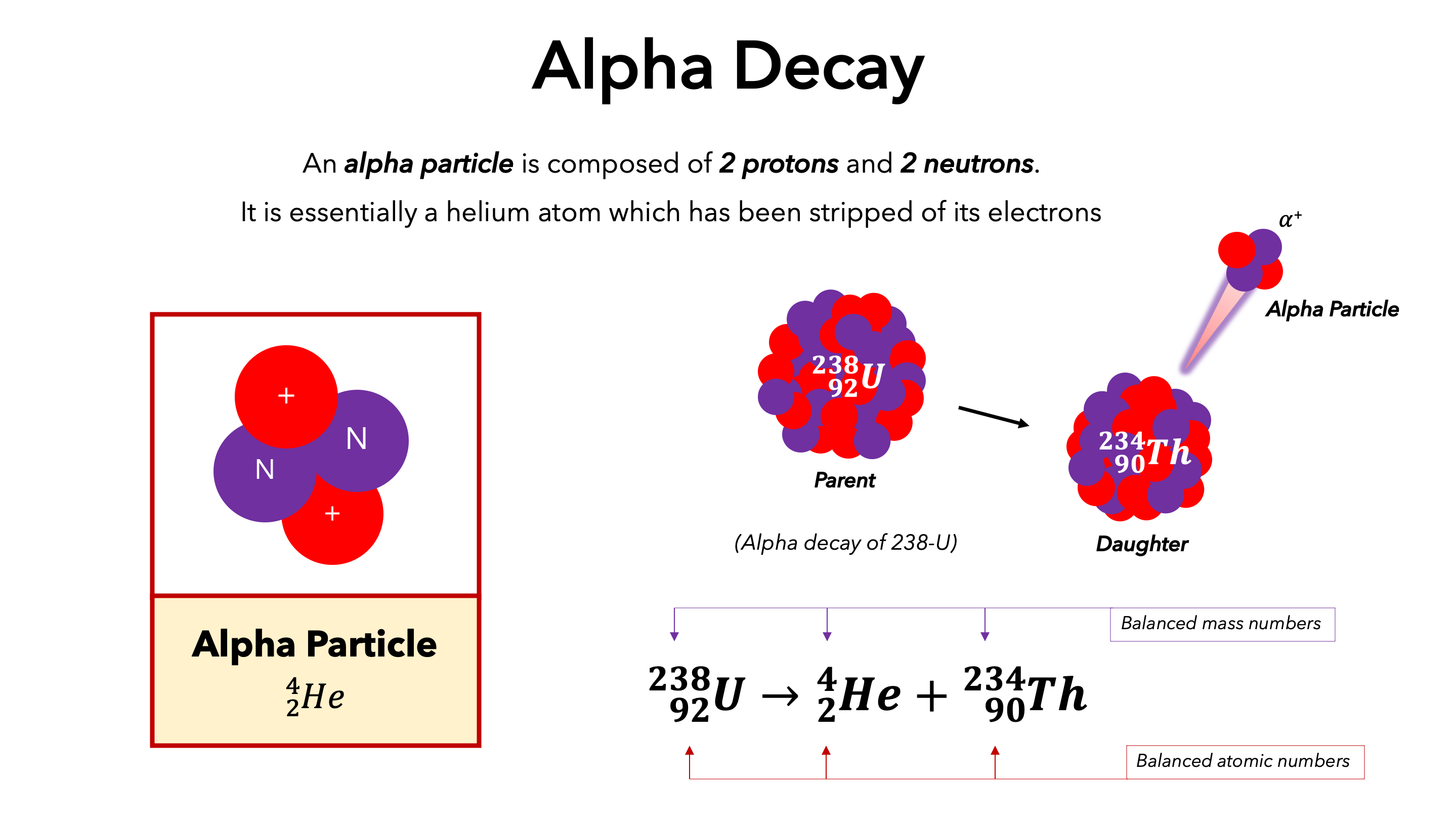
The alpha radiation equation represents the radioactive decay of an unstable nucleus into a lighter daughter nucleus by emitting an alpha particle, which consists of two protons and two neutrons (a helium-4 nucleus). The general formula is ${}^{A}{Z}X \rightarrow {}^{A-4}{Z-2}Y + {}^{4}_{2}\text{He}$, where the mass number decreases by four and the atomic number decreases by two.
In the study of nuclear physics and radiochemistry, the alpha radiation equation is the fundamental tool used to predict how heavy, unstable isotopes transform over time. Alpha decay is a primary mechanism through which heavy elements, such as Uranium, Radium, and Plutonium, seek a more stable nuclear configuration. As we examine the state of nuclear science in 2026, understanding these equations remains critical for fields ranging from clean energy production and space exploration to advanced oncological treatments.
The Anatomy of an Alpha Decay Equation
To master the alpha radiation equation, one must first understand the notation and the constituent parts of the reaction. In standard nuclear notation, an element is represented as ${}^{A}_{Z}X$, where A is the mass number (protons + neutrons), Z is the atomic number (number of protons), and X is the chemical symbol.
The Parent and Daughter Nuclei
The "parent" nucleus is the initial unstable isotope before the decay occurs. In the equation, this is the reactant on the left side. The "daughter" nucleus is the resulting isotope after the alpha particle has been ejected. Because the alpha particle carries away two protons, the identity of the element changes. For example, if the parent is Uranium (Z=92), the daughter must be Thorium (Z=90).
The Alpha Particle
The alpha particle is identical to a helium-4 nucleus. It is represented in equations as either ${}^{4}{2}\text{He}$ or ${}^{4}{2}\alpha$. It is a relatively heavy and highly charged particle compared to beta or gamma radiation. Because it has a +2 charge and significant mass, it interacts strongly with matter, leading to high ionization but low penetration depth.
Fundamental Conservation Laws in Alpha Decay
Every alpha radiation equation must satisfy two primary conservation laws. These laws ensure that the reaction is physically possible and allow scientists to balance the equation just as one would balance a chemical reaction.
Conservation of Mass Number (A)
The total number of nucleons (protons and neutrons) must remain constant. In the general equation ${}^{A}{Z}X \rightarrow {}^{A-4}{Z-2}Y + {}^{4}_{2}\text{He}$, the sum of the mass numbers on the right side is $(A-4) + 4$, which equals $A$. This reflects the fact that while nucleons are rearranged and ejected, they are not destroyed in the process.
Conservation of Atomic Number (Z)
The total electric charge of the system must be conserved. The sum of the atomic numbers on the right side is $(Z-2) + 2$, which equals $Z$. This conservation ensures that the net charge of the nuclei involved remains consistent throughout the decay event. If an equation does not balance $Z$, it is fundamentally incorrect.
Calculating the Q-Value: The Energy of Decay
The alpha radiation equation is not merely a transfer of particles; it is also an energetic event. The energy released during the decay is known as the Q-value. This energy comes from the conversion of mass into energy, as described by Albert Einstein’s famous equation, $E=mc^2$.
To calculate the Q-value, one must compare the rest mass of the parent nucleus with the combined rest masses of the daughter nucleus and the alpha particle. The formula is: $$Q = (m_{\text{parent}} - m_{\text{daughter}} - m_{\alpha})c^2$$
In spontaneous alpha decay, the Q-value must be positive. If the combined mass of the products is less than the mass of the parent, the "missing" mass (the mass defect) is converted into kinetic energy. This energy is shared between the alpha particle and the daughter nucleus, though the alpha particle, being much lighter, carries away the vast majority of it (typically about 98%).
Why Alpha Decay Occurs: The Valley of Stability
Heavy nuclei often have too many protons, leading to immense electrostatic repulsion within the nucleus. The strong nuclear force, which holds the nucleus together, has a very short range. In massive nuclei like Uranium-238, the repulsive force between the 92 protons begins to overcome the strong force. By emitting an alpha particle, the nucleus sheds four nucleons at once, effectively moving closer to the "Valley of Stability"—the ratio of protons to neutrons where the nucleus is most stable.
The Quantum Mechanics of the Alpha Decay Equation
A significant question in nuclear physics was why alpha decay takes so long for some isotopes (billions of years) while others decay in microseconds. The answer lies in quantum tunneling, a theory pioneered by George Gamow in 1928.
According to classical physics, an alpha particle inside a nucleus does not have enough energy to overcome the "Coulomb barrier"—the wall of electrostatic repulsion created by the protons. However, quantum mechanics dictates that there is a non-zero probability that the alpha particle can "tunnel" through this barrier even if it lacks the classical energy to climb over it.
The alpha radiation equation represents the end result of this tunneling. The probability of tunneling depends heavily on the energy of the alpha particle; even a small increase in energy can lead to a massive decrease in the half-life of the isotope. This relationship is quantified by the Geiger-Nuttall law, which links the decay constant of an alpha emitter to the energy of the emitted alpha particles.
Common Alpha-Emitting Isotopes and Their Equations
The following table outlines several critical alpha-emitting isotopes used in industry, medicine, and research as of 2026.
| Parent Isotope | Half-Life | Alpha Energy (MeV) | Daughter Nucleus | Primary Application |
|---|---|---|---|---|
| Uranium-238 | 4.47 billion years | 4.20 | Thorium-234 | Geologic dating / Nuclear fuel |
| Radium-226 | 1,600 years | 4.78 | Radon-222 | Historical luminous paints |
| Americium-241 | 432.2 years | 5.48 | Neptunium-237 | Ionization smoke detectors |
| Plutonium-238 | 87.7 years | 5.59 | Uranium-234 | Radioisotope Thermoelectric Generators (RTGs) |
| Polonium-210 | 138 days | 5.30 | Lead-206 | Static eliminators / Industrial heating |
| Actinium-225 | 10 days | 5.83 | Francium-221 | Targeted Alpha Therapy (Cancer) |
Practical Example: Balancing an Alpha Decay Equation
Let’s walk through the process of writing the equation for the decay of Americium-241, a common isotope found in household smoke detectors.
- Identify the Parent: The parent is Americium-241. From the periodic table, we find that Americium (Am) has an atomic number of 95. So, we write: ${}^{241}_{95}\text{Am}$.
- Determine the Alpha Particle: We know the decay involves an alpha particle: ${}^{4}_{2}\text{He}$.
- Subtract the Values:
- New Mass Number ($A$): $241 - 4 = 237$.
- New Atomic Number ($Z$): $95 - 2 = 93$.
- Identify the Daughter: We look at the periodic table for the element with atomic number 93. That element is Neptunium (Np).
- Finalize the Equation: $${}^{241}{95}\text{Am} \rightarrow {}^{237}{93}\text{Np} + {}^{4}_{2}\text{He} + \gamma$$ (Note: Alpha decay is often accompanied by gamma radiation as the daughter nucleus settles from an excited state to its ground state).
Biological Impact and Safety Considerations
Understanding the alpha radiation equation is essential for radiation protection. Because alpha particles are heavy and carry a +2 charge, they are highly ionizing. If an alpha emitter enters the human body (via inhalation, ingestion, or an open wound), it can cause significant damage to DNA in a localized area.
However, outside the body, alpha radiation is relatively harmless. The "equation of safety" for alpha particles is simple: distance and shielding. Alpha particles can be stopped by:
- A single sheet of paper.
- The dead outer layer of human skin.
- Approximately 3 to 5 centimeters of air.
In 2026, safety protocols for handling alpha emitters emphasize the prevention of "internalization." This is why laboratories working with isotopes like Actinium-225 for cancer research utilize sophisticated glove boxes and highly sensitive air monitoring systems to detect any breach in containment.
Targeted Alpha Therapy (TAT): A Modern Medical Application
One of the most exciting applications of the alpha radiation equation in 2026 is in the field of oncology. Targeted Alpha Therapy (TAT) involves attaching an alpha-emitting isotope (like Actinium-225 or Bismuth-213) to a monoclonal antibody or peptide that specifically targets cancer cells.
When the alpha particle is emitted according to its decay equation, it travels only a very short distance (the diameter of a few cells). Because alpha particles have high Linear Energy Transfer (LET), they cause double-strand breaks in the DNA of the cancer cell, which are much harder for the cell to repair than the damage caused by traditional X-ray or beta radiation. This precision allows doctors to kill tumors with minimal damage to the surrounding healthy tissue.
Common Errors in Writing Alpha Equations
Even experienced students can make mistakes when balancing these equations. Avoid these common pitfalls:
- Forgetting the Element Change: The most common mistake is keeping the parent element's symbol for the daughter nucleus. Always check the periodic table for the element corresponding to $Z-2$.
- Incorrect Mass Subtraction: Occasionally, learners subtract only the protons or only the neutrons. Remember, the alpha particle removes four nucleons in total.
- Ignoring Charge Balance: While the alpha particle is often written as "He," it is technically a $He^{2+}$ ion. In most nuclear physics contexts, we focus on the nucleus, but in a complete physical system, the daughter atom will eventually pick up two electrons to become electrically neutral.
- Omitting the Energy Component: For advanced calculations, failing to account for the recoil energy of the daughter nucleus can lead to slight inaccuracies in the predicted kinetic energy of the alpha particle.
Frequently Asked Questions
What is the difference between alpha decay and alpha radiation?
Alpha decay is the biological/physical process or event where an unstable nucleus changes. Alpha radiation refers to the stream of alpha particles that are emitted during that process. The alpha radiation equation describes the decay event specifically.
Can any isotope undergo alpha decay?
No. Alpha decay is generally restricted to heavier nuclei (usually those with an atomic number greater than 82, like lead). Lighter nuclei are more likely to undergo beta decay or positron emission to reach stability because their proton-to-neutron ratio is more easily adjusted by changing a single nucleon's identity rather than ejecting a cluster of four.
Why is an alpha particle always a Helium-4 nucleus?
A helium-4 nucleus is exceptionally stable due to its high binding energy per nucleon. It is a "doubly magic" nucleus, meaning it has a full shell of protons and a full shell of neutrons. This stability makes it the most "economical" bundle for a large nucleus to eject when it needs to lose mass quickly.
Does alpha decay affect the chemical properties of a substance?
Yes, dramatically. Because the atomic number ($Z$) changes, the element itself changes. A sample of pure Uranium-238 will, over time, contain increasing amounts of Thorium-234. This change in chemical identity is the basis for radio-analytical chemistry and nuclear transmutation.
How do you find the daughter nucleus if it isn't listed?
Use the periodic table. Subtract 2 from the atomic number of the parent isotope. The resulting number is the atomic number of the daughter element. For example, if you start with Polonium (84), the daughter will be Lead (82).
Final Recommendations for Study and Application
When working with alpha radiation equations, always begin by verifying the atomic numbers of the elements involved. Accuracy in the initial identification of the parent isotope is the foundation of a correct equation. For those pursuing careers in nuclear medicine or energy, mastering the Q-value calculation is the next step, as it allows for the prediction of thermal outputs in reactors or dosage intensities in medical treatments.
In professional settings, use digital databases such as the NNDC (National Nuclear Data Center) to find precise atomic masses for Q-value calculations, as using rounded numbers can lead to significant errors in energy predictions. As we continue to refine our use of alpha-emitters in 2026, the ability to precisely model these reactions remains a cornerstone of safe and effective nuclear science.