9:00 AM Central Standard Time (CST) represents a specific time of day within the Central Time Zone of North America, characterized by an offset of six hours behind Coordinated Universal Time (UTC-6). This mid-morning hour serves as a primary synchronization point for business, logistics, and daily life across a vast geographical corridor spanning from Canada to Central America.
In the 2026 calendar year, Central Standard Time is the legally observed time in participating regions from January 1 until the transition to Daylight Saving Time on March 8, and again from November 1 through the end of the year. Understanding 9 AM CST requires more than a simple clock reading; it involves navigating seasonal shifts, geographical boundaries, and the technical infrastructure that maintains global synchronization.
The Geographical Reach of Central Standard Time
Central Standard Time is one of the most populous and economically significant time zones in North America. It covers a broad longitudinal swathe of the continent, theoretically centered on the 90th meridian west of Greenwich. However, political and economic considerations have pushed the boundaries of this zone far beyond its strict longitudinal lines.
Regions in the United States
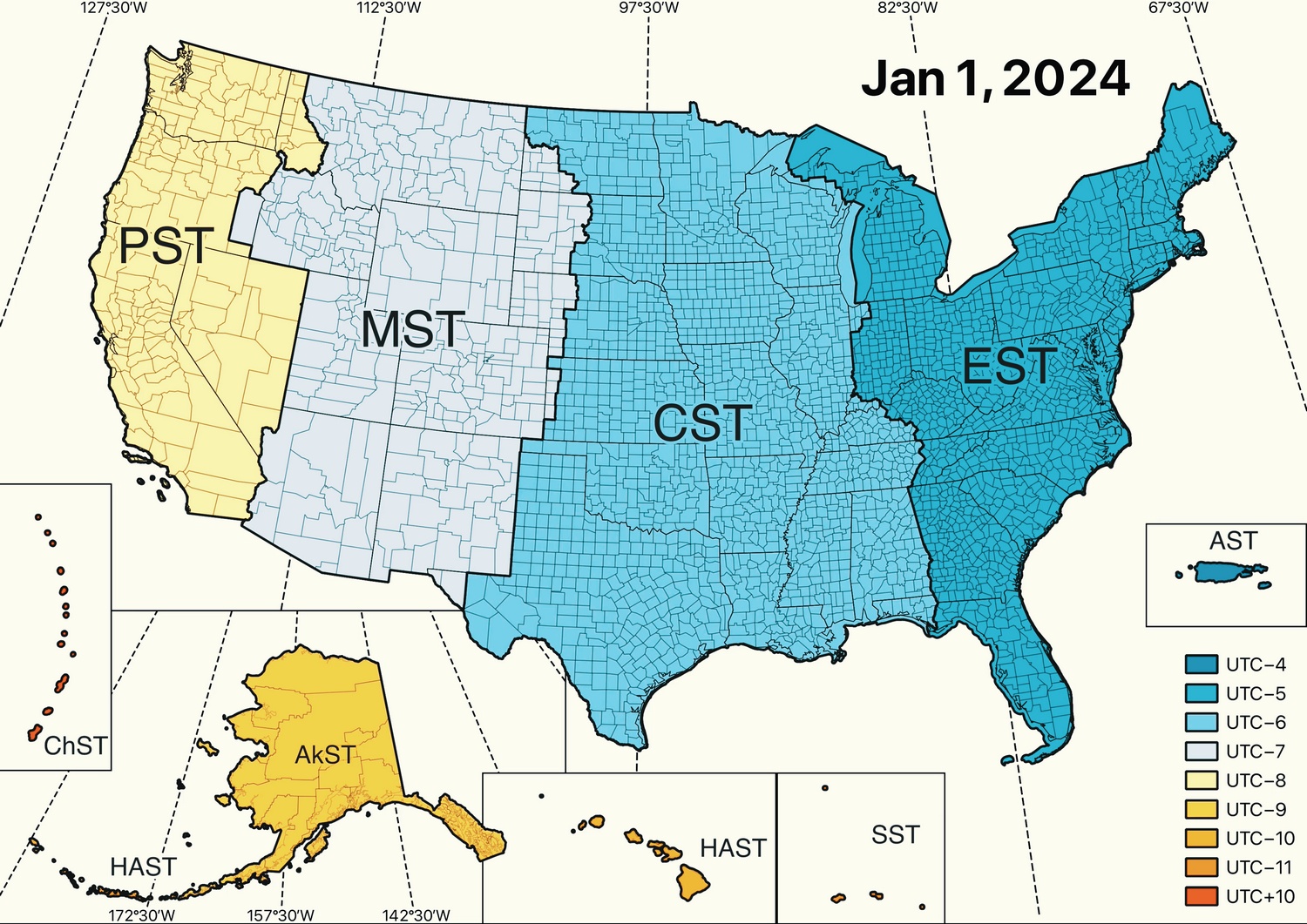
In the United States, 9 AM CST is a pivotal hour for many of the country’s major metropolitan hubs. States that observe CST in their entirety or in part include:
- Full Observation: Alabama, Arkansas, Illinois, Iowa, Louisiana, Minnesota, Mississippi, Missouri, Oklahoma, and Wisconsin.
- Partial Observation: Large portions of Texas (excluding the El Paso area), Kansas, Nebraska, South Dakota, and North Dakota observe Central Time. Furthermore, western parts of Kentucky and Tennessee, as well as the Florida Panhandle, operate on Central Time.
Because Chicago, Houston, and Dallas all operate within this zone, 9 AM CST is often the hour when major commodity markets and corporate headquarters across the "Third Coast" and the Midwest hit their full operational stride.
International Coverage: Canada, Mexico, and Beyond
North of the U.S. border, several Canadian provinces and territories utilize Central Standard Time. Manitoba is entirely within the zone, while parts of Nunavut, Ontario, and Saskatchewan also observe it. Notably, most of Saskatchewan does not observe Daylight Saving Time, meaning that while they technically remain on CST year-round, they effectively align with Mountain Daylight Time during the summer months.
To the south, Mexico’s Zona Centro covers the majority of the country, including Mexico City. While Mexico significantly reduced its use of Daylight Saving Time in recent years, the central region continues to operate at the UTC-6 offset for the vast majority of the year, making 9 AM CST a critical coordination point for cross-border trade under the USMCA framework. Further south, countries in Central America—including Belize, Costa Rica, El Salvador, Guatemala, Honduras, and Nicaragua—also utilize the UTC-6 offset year-round, though they generally do not use the term "Central Standard Time" in a domestic legal context.
CST vs. CDT: The Seasonal Shift in 2026
One of the most frequent points of confusion regarding 9 AM CST is the distinction between Standard Time (CST) and Daylight Time (CDT).
Central Standard Time (CST) is UTC-6. Central Daylight Time (CDT) is UTC-5.
In 2026, the transition occurs as follows:
- March 8, 2026: At 2:00 AM, clocks move forward to 3:00 AM. Local time transitions from CST to CDT. From this date until November, "9 AM CST" technically does not exist in regions observing Daylight Saving; it becomes 9 AM CDT.
- November 1, 2026: At 2:00 AM, clocks move back to 1:00 AM. Local time returns to CST.
For technical precision, when a meeting is scheduled for "9 AM CST" in July, it is technically a misnomer unless the participants are in a region like Saskatchewan or Central America that does not observe the seasonal shift. For most of the U.S. and Canada, the correct term during the summer is 9 AM CDT.
Converting 9 AM CST to Other Global Time Zones
To effectively coordinate meetings or broadcasts, one must understand how 9 AM CST relates to other major time zones. The following table provides the conversion for 9 AM CST (UTC-6) across various regions during the standard time months of 2026.
| Time Zone | Full Name | Offset | Equivalent Time |
|---|---|---|---|
| UTC/GMT | Coordinated Universal Time | +0 | 3:00 PM (15:00) |
| EST | Eastern Standard Time | -5 | 10:00 AM |
| MST | Mountain Standard Time | -7 | 8:00 AM |
| PST | Pacific Standard Time | -8 | 7:00 AM |
| AKST | Alaska Standard Time | -9 | 6:00 AM |
| HST | Hawaii-Aleutian Standard Time | -10 | 5:00 AM |
| CET | Central European Time | +1 | 4:00 PM (16:00) |
| JST | Japan Standard Time | +9 | 12:00 AM (Next Day) |
| AEST | Australian Eastern Standard Time | +10 | 1:00 AM (Next Day) |
The Impact on Business and Logistics
The 9 AM CST hour is a "goldilocks" time for North American commerce. It sits at the intersection of several critical daily cycles:
Synchronization with the East Coast
At 9 AM CST, it is 10 AM in New York and Washington, D.C. This is one hour after the opening of the New York Stock Exchange (NYSE) and NASDAQ. For traders and business leaders in the Central zone, 9 AM is the time when the initial market volatility of the morning has settled, and the core trading day is in full swing.
Western Coordination
While the Central zone is deep into its morning, the West Coast is just beginning. At 9 AM CST, it is 7 AM in Los Angeles and Seattle. This three-hour gap allows Central-based businesses to prepare materials or finalize reports just as their Pacific counterparts are starting their workday, facilitating a hand-off of tasks that spans the continent.
International Overlap
For companies dealing with Europe, 9 AM CST is late afternoon in London (3 PM) and Paris/Berlin (4 PM). This provides a narrow but vital window of 2 to 3 hours for real-time collaboration before the European workday ends. Conversely, for teams working with Asia, 9 AM CST is late evening or midnight, making it a common time for "night-cap" sync calls with teams in Tokyo, Beijing, or Singapore.
Technical Implementation and Timekeeping
The accuracy of 9 AM CST is maintained through a complex network of atomic clocks and digital protocols. The primary reference for time in the United States is maintained by the National Institute of Standards and Technology (NIST) and the U.S. Naval Observatory (USNO).
The IANA Time Zone Database
In the digital realm, 9 AM CST is not just a label but a data point. Computers and servers rely on the IANA Time Zone Database (often called the Olson database). This database uses identifiers like America/Chicago or America/Winnipeg to ensure that devices correctly account for local laws, DST changes, and historical shifts. When you set your phone to "Central Time," the device uses these identifiers to calculate the offset from UTC.
The Role of the 90th Meridian
Geographically, CST is tied to the 90th meridian west. This line passes through several notable locations, including East St. Louis, Illinois, and New Orleans, Louisiana. In an idealized world, time zones would extend 7.5 degrees to either side of these 15-degree meridians. In reality, the Central Time Zone extends much further west—reaching into parts of western Texas and the Dakotas—because those regions find it more economically advantageous to stay aligned with the commercial centers of the Midwest rather than the Mountain West.
International Disambiguation: Other "CSTs"
It is important for global travelers and remote workers to recognize that "CST" is an abbreviation used by three different time zones globally. While the context of "9 a m central standard time explained" almost always refers to North America, the others are:
- China Standard Time: Also UTC+8. This zone covers the entirety of China. When it is 9 AM in Chicago (CST), it is 11 PM the same day in Beijing (CST).
- Cuba Standard Time: Also UTC-5. While the abbreviation is the same, Cuba typically operates one hour ahead of North American Central Standard Time.
- Central Standard Time (Australia): Also UTC+9:30. This covers the Northern Territory and South Australia.
When scheduling international meetings, using the UTC offset (e.g., 9 AM UTC-6) is the most effective way to prevent errors resulting from these shared abbreviations.
Common Pitfalls and Troubleshooting
Errors in calculating 9 AM CST often stem from three main areas: split-state boundaries, DST transitions, and manual device overrides.
Split States and "Hidden" Time Zones
Travelers driving across the United States often encounter "time zone traps." For example, driving from Nashville, Tennessee (Central), to Knoxville, Tennessee (Eastern), involves a one-hour jump. Similarly, parts of the Florida Panhandle observe Central Time, while the rest of the state is on Eastern Time. If you have an appointment at 9 AM CST in Pensacola, but you are traveling from Tallahassee, you must remember to "gain" an hour.
The "Saskatchewan Exception"
As mentioned, Saskatchewan is a unique case in North America. While they are geographically in the Central zone, most of the province does not observe Daylight Saving. In the winter (Standard Time), they are aligned with 9 AM CST. In the summer, while the rest of the Central zone moves to UTC-5, Saskatchewan stays at UTC-6. This means that for half the year, they are effectively on Mountain Daylight Time, and for the other half, they are on Central Standard Time.
Verification Tools
To verify the current time and ensure your clocks are synchronized, official resources are the most reliable:
Frequently Asked Questions
Is 9 AM CST the same as 9 AM Central Time?
Not exactly. "Central Time" is a generic term that encompasses both Central Standard Time (CST) and Central Daylight Time (CDT). 9 AM CST specifically refers to the time when the region is at a UTC-6 offset (standard time). If you are in the middle of July, the local time is actually 9 AM CDT (UTC-5).
Which major cities are in the Central Standard Time zone?
Prominent cities include Chicago, Houston, Dallas, New Orleans, Minneapolis, St. Louis, Kansas City, Winnipeg, and Mexico City. These hubs drive the economic and cultural pulse of the zone.
Does 9 AM CST change during the summer?
In regions that observe Daylight Saving Time, the clocks move forward one hour in the spring. Consequently, during the summer, the local time is 9 AM CDT. If you strictly follow "9 AM CST" (UTC-6) during the summer, you would be one hour behind the local clocks in cities like Chicago or Dallas.
How do I convert 9 AM CST to UTC?
To convert CST to Coordinated Universal Time (UTC), you add six hours. Therefore, 9:00 AM CST is 3:00 PM (15:00) UTC.
Why do some parts of Texas have a different time?
While the vast majority of Texas observes Central Time, the far western corner—including El Paso and Hudspeth counties—observes Mountain Time. This is due to their closer proximity and economic ties to the Mountain West and the state of New Mexico.
Practical Recommendation for Scheduling
When scheduling events or setting deadlines involving 9 AM Central Standard Time, always specify the date or the UTC offset to avoid Daylight Saving confusion. For 2026, ensure that any "CST" designations for dates between March 8 and November 1 are intentionally meant to be UTC-6; otherwise, use "CT" (Central Time) or "CDT" to reflect the seasonal change. For automated systems, rely on the IANA America/Chicago time zone string to ensure the most accurate and legally compliant timekeeping.