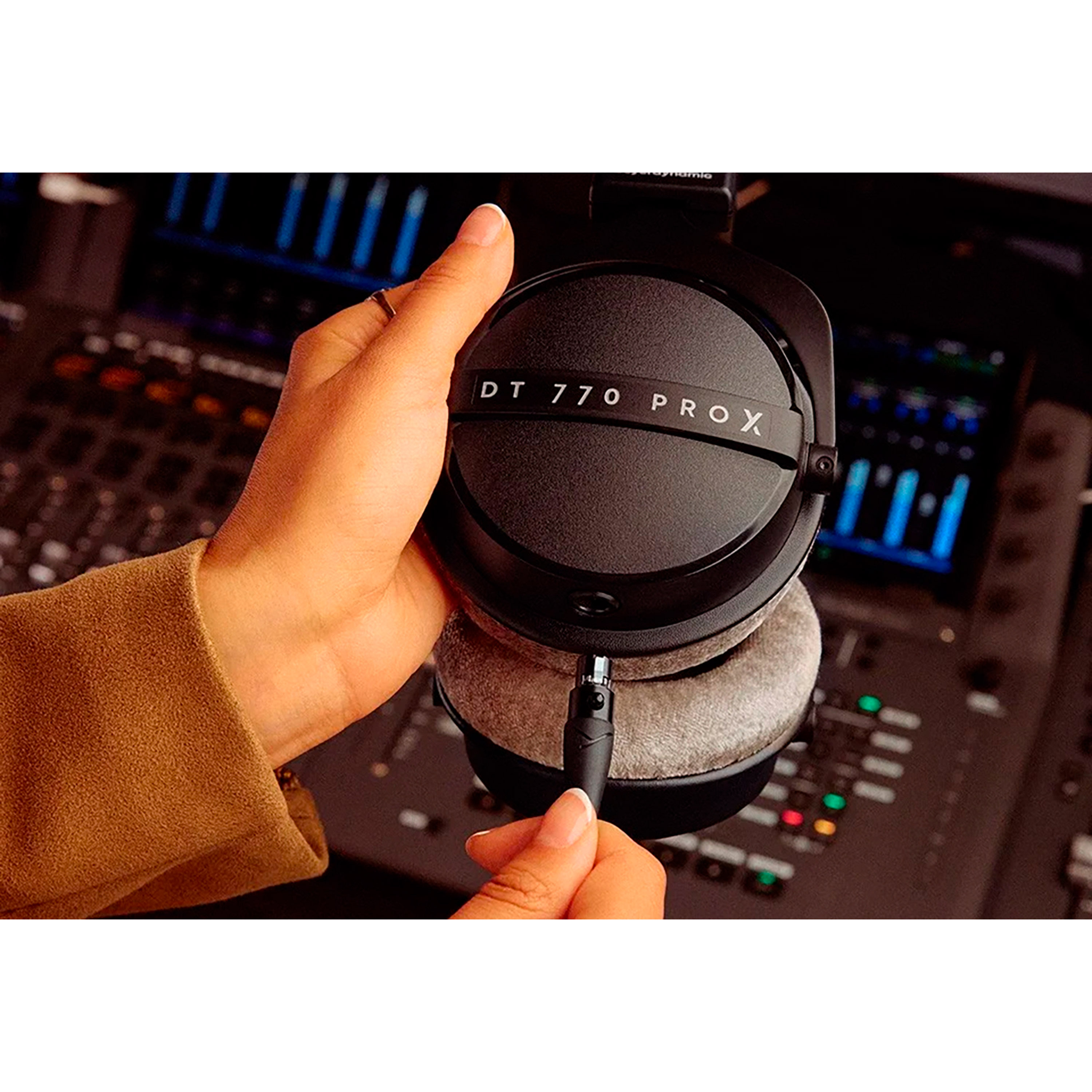
The 5 Hz to 35 kHz frequency response of the beyerdynamic DT 770 Pro represents an ultra-wide range that exceeds the standard limits of human hearing (20 Hz–20 kHz). This expansive technical specification ensures the headphones can reproduce deep sub-bass vibrations and crystal-clear high-end transients with high precision and minimal harmonic distortion across the audible spectrum.
The Technical Significance of the 5 Hz to 35 kHz Range
When evaluating professional studio headphones like the beyerdynamic DT 770 Pro, the frequency response is often the first specification users examine. In the case of this model, the range of 5 Hz to 35,000 Hz (35 kHz) is significant because it covers three distinct areas: the infrasonic (below 20 Hz), the audible (20 Hz to 20 kHz), and the ultrasonic (above 20 kHz).
The industry standard for "full range" audio has traditionally been 20 Hz to 20 kHz, which aligns with the theoretical limits of human hearing. However, beyerdynamic’s decision to extend the DT 770 Pro’s range to 5 Hz on the low end and 35 kHz on the high end is not merely a marketing tactic. It serves a functional purpose in terms of driver stability and signal integrity.
A driver capable of reaching 5 Hz is designed with enough excursion and suspension flexibility to handle the most demanding low-frequency pressure without "bottoming out" or distorting. Conversely, a driver that can vibrate at 35 kHz without breaking up into chaotic resonance ensures that the frequencies within the audible range—specifically the 10 kHz to 20 kHz region—are reproduced with exceptional smoothness and "air."
Decoding the Low End: The Power of 5 Hz
While the human ear generally cannot perceive a 5 Hz tone as a pitch, we can often feel the physical displacement of air at these frequencies. In a closed-back headphone like the DT 770 Pro, reaching down to 5 Hz provides a foundation for the entire soundstage.
The Role of the Bass Reflex System
The DT 770 Pro achieves its impressive low-frequency extension through a specialized "Bass Reflex" system. If you examine the outer shells of the earcups, you will notice small ports or holes. These are not for ventilation of the ear, but rather for tuning the internal air pressure. This design allows the 45mm dynamic drivers to move more freely, enabling the reproduction of sub-bass frequencies that would otherwise be muffled in a completely sealed enclosure.
Impact on Sub-Bass Monitoring
For producers working in genres such as EDM, hip-hop, or cinematic scoring, the 5 Hz capability is a safeguard. Even though most playback systems (and human ears) will roll off significantly below 30 Hz, having headphones that accurately track down to 5 Hz ensures that the "slope" of the bass response is linear and controlled. It prevents the "bloat" often found in consumer headphones, where the bass is artificially boosted at 100 Hz to compensate for a lack of true sub-bass extension.
Decoding the High End: The Utility of 35 kHz
The upper limit of 35 kHz is equally important, though it resides entirely in the ultrasonic realm. Most adults, especially those who have spent years in loud studio environments, rarely hear much above 15 kHz or 16 kHz. So, why does 35 kHz matter?
Phase Response and Transient Accuracy
The primary benefit of an extended high-frequency range is the improvement of phase response within the audible spectrum. All mechanical drivers have a "resonant frequency" where they naturally want to vibrate. If a headphone’s limit is exactly 20 kHz, you will often see a sharp "roll-off" and significant phase shifting occurring just before that limit, which can smear the detail of high-frequency transients like snare hits or cymbal crashes.
By pushing the limit to 35 kHz, beyerdynamic moves the driver's resonant peak far beyond the reach of human hearing. This results in a much flatter and more accurate response in the critical 10 kHz to 20 kHz range, providing the "airy" quality and precise imaging for which the DT 770 Pro is famous.
Harmonic Content
Instruments such as violins, trumpets, and synthesizers generate harmonic overtones that extend far into the ultrasonic range. While we don't hear these overtones as distinct notes, they interact with the audible frequencies to create the "timbre" or character of the sound. A headphone that can reproduce these frequencies provides a more faithful recreation of the original acoustic event.
Frequency Response vs. Sound Signature
It is a common mistake to assume that a wide frequency response (5 Hz - 35 kHz) means the headphones are "flat" or "neutral." In the case of the DT 770 Pro, this wide range is delivered with a very specific sound signature, often described as a "V-shape."
- The Sub-Bass Boost: The low end is prominent and powerful, providing a "theatrical" feel that is excellent for tracking drums or bass guitar.
- The Midrange Dip: The frequencies between 400 Hz and 2 kHz are slightly recessed. This makes the headphones sound spacious but can sometimes make vocals feel a bit distant during a critical mix.
- The "Beyer Peak": There is a well-documented emphasis in the 6 kHz to 10 kHz region. This peak enhances detail and helps engineers spot sibilance or clicks in a recording, but some users find it fatiguing for long-term casual listening.
The 5 Hz to 35 kHz spec defines the boundaries of what the headphone can do, while the sound signature defines the personality of the audio within those boundaries.
Comparing the DT 770 Pro Variants
As of 2026, the DT 770 Pro remains available in several impedance versions. While they all share the 5 Hz - 35 kHz specification, their real-world performance depends on how they are powered.
| Impedance | Primary Use Case | Performance Characteristics |
|---|---|---|
| 32 Ohm | Mobile devices, laptops, field recording. | Higher sensitivity; easiest to drive but slightly less controlled bass. |
| 80 Ohm | Universal studio use, monitoring. | The "goldilocks" version; balanced bass response and detailed highs. |
| 250 Ohm | High-end studio consoles, dedicated amps. | Most refined transient response; requires a powerful amplifier to reach 5 Hz potential. |
While the frequency range is identical on paper, the 250 Ohm version is generally considered the most accurate in its reproduction of the 35 kHz high end due to its lighter voice coil, which can move with greater speed and precision than the thicker coils found in the 32 Ohm version.
Practical Considerations for Studio Professionals
If you are using the DT 770 Pro for professional work, understanding the 5 Hz to 35 kHz range is vital for "translation"—how your mix sounds on other speakers.
Tracking and Monitoring
The DT 770 Pro is the "industry standard" for tracking (recording). The closed-back design prevents the sound from leaking into the microphone, while the 5 Hz extension allows a drummer to "feel" the kick drum and a bassist to hear the fundamental of their low E or B string clearly. The 35 kHz extension helps vocalists hear the "breath" in their performance, which can lead to better emotional delivery.
Mixing and Mastering
For mixing, the wide frequency response is a double-edged sword. While you can hear everything from the deepest sub to the highest air, the V-shaped signature might lead you to under-mix the bass (because it sounds so loud in the headphones) or over-process the mids. Most professionals use software calibration tools, such as Sonarworks SoundID Reference, to flatten the DT 770 Pro's response, making it a more reliable tool for final mix decisions.
Why the Spec Remains Relevant in 2026
In 2026, the audio industry has seen a massive shift toward high-resolution (Hi-Res) audio formats. Streaming services now routinely offer 24-bit/96kHz or 192kHz audio, which technically contains data up to 48 kHz or 96 kHz respectively.
The DT 770 Pro's 35 kHz ceiling makes it "Hi-Res Audio" compatible in spirit, if not always by official branding. As digital-to-analog converters (DACs) have become more precise, having a mechanical driver that can actually keep up with these high-resolution signals is more important than ever. The DT 770 Pro's longevity is a testament to the fact that beyerdynamic engineered these specs decades ago to be "future-proof."
Troubleshooting and Performance Optimization
To truly experience the 5 Hz to 35 kHz range, your signal chain must be capable of delivering it.
- Amplification: If you use the 250 Ohm version with a standard smartphone jack (if you can still find one in 2026), you will lose the low-end extension. The 5 Hz response requires current and voltage that small devices cannot provide. Without an amp, the bass will sound "thin" and "loose."
- Earpad Wear: The frequency response of the DT 770 Pro is heavily dependent on the seal of the velour earpads. As the pads flatten over time, the distance between the driver and your ear changes, and the seal breaks. This primarily affects the 5 Hz to 100 Hz range, causing a significant loss in bass impact. Replacing pads every 12-18 months is recommended for maintaining the spec.
- Source Quality: You cannot hear 35 kHz detail if you are listening to low-bitrate MP3s, which typically cut off all frequencies above 16 kHz to save space. To utilize the high-end capability, use lossless formats like FLAC, ALAC, or WAV.
Common Questions About the DT 770 Pro Frequency Response
Can I actually hear 5 Hz?
No, the human ear cannot hear 5 Hz as a sound. The lowest frequency humans typically hear is 20 Hz. However, frequencies below 20 Hz are felt as physical vibrations and pressure against the eardrum and skin. In a studio context, this capability ensures that the driver can handle 20 Hz–40 Hz (the audible sub-bass) without straining or distorting.
Is 35 kHz dangerous for my ears?
Frequencies at 35 kHz are not inherently "dangerous" because you cannot hear them, and most musical content has very little energy at that height. However, high-volume listening at any frequency can cause permanent hearing damage. The benefit of the 35 kHz spec is about driver precision, not about blasting ultrasonic noise into your ears.
Does the frequency response change with the 32, 80, and 250 Ohm models?
The manufacturer's specification is the same for all three: 5 Hz to 35 kHz. However, in independent laboratory tests, the 250 Ohm version often shows a slightly smoother treble response and faster transient recovery. The 80 Ohm version is often cited as having the most "perceived" bass because its damping factor is slightly different, making the 5 Hz - 100 Hz range feel a bit more "punchy."
Do I need a special DAC for 35 kHz?
To reproduce frequencies up to 35 kHz, your Digital-to-Analog Converter (DAC) needs to support a sample rate of at least 88.2 kHz or 96 kHz (based on the Nyquist theorem). If your DAC is limited to 44.1 kHz (standard CD quality), the highest frequency it can output is 22.05 kHz, meaning the headphone's 35 kHz capability will go unused.
Why is the DT 770 Pro better than consumer headphones with the same specs?
Many consumer headphones claim a 5 Hz to 40 kHz range, but they often achieve this with significant digital signal processing (DSP) or have massive "peaks" and "valleys" in the response curve. The DT 770 Pro is an analog, studio-grade tool designed for a "raw" and honest reproduction of the signal, which provides a more reliable reference for professional work.
Final Recommendation
For those seeking a headphone that offers deep, tactile sub-bass and surgically precise highs, the beyerdynamic DT 770 Pro remains a premier choice in 2026. The 5 Hz to 35 kHz frequency response is not just a set of numbers; it is a guarantee of headroom. It ensures that the audible frequencies you rely on for mixing, mastering, or critical listening are delivered with maximum clarity and minimum distortion.
If you are a professional, opt for the 250 Ohm version and pair it with a high-quality dedicated amplifier to fully exploit the 35 kHz transient response. If you are a producer or enthusiast looking for a versatile "all-rounder," the 80 Ohm version provides the most satisfying balance of that 5 Hz low-end power and 35 kHz airy detail without requiring specialized high-voltage equipment.