Amortization expense is the systematic allocation of the cost of an intangible asset over its estimated useful economic life. Recorded on the income statement as an operating expense, amortization reduces an asset’s carrying value on the balance sheet while reflecting its cost consumption over time.
Understanding how amortization expense works is essential for financial reporting, corporate tax strategy, and fundamental equity analysis. While physical assets like machinery or buildings undergo depreciation, non-physical assets—such as patents, capitalized software, customer lists, franchise rights, and non-compete agreements—are written off through amortization.
Under both U.S. GAAP (specifically FASB Accounting Standards Codification Topic 350) and IFRS (International Accounting Standard 38), businesses must evaluate whether an intangible asset has a finite or indefinite useful life. Only finite-lived intangible assets undergo routine amortization. Indefinite-lived assets, such as goodwill or perpetual brand trademarks, are not amortized; instead, they are evaluated at least annually for impairment.
This guide explores five real-world examples of amortization expense, complete with step-by-step calculations, accounting rules, journal entries, and financial statement impacts.
The Amortization Accounting Framework
Before reviewing specific examples, it is helpful to establish the standard straight-line calculation framework used for most finite-lived intangible assets.
The Straight-Line Amortization Formula
$$\text{Annual Amortization Expense} = \frac{\text{Historical Cost} - \text{Residual Value}}{\text{Useful Life (in Years)}}$$
Key variables in this equation include:
Historical Cost: The initial acquisition cost or capitalized development cost incurred to bring the asset into service.
Residual Value: The estimated amount the company expects to receive from disposing of the asset at the end of its useful life. For most intangible assets, the residual value is assumed to be $0 unless a third party has committed to purchase the asset at the end of its useful life or a reliable market exists.
Useful Life: The shorter of the asset's economic useful life or its legal/contractual life.
[ Initial Capitalized Cost ] - [ Residual Value ($0) ]
- [ Useful Economic Life ]
- = Annual Amortization Expense
Amortization vs. Depreciation vs. Depletion
Although all three concepts represent non-cash expense allocations over time, they apply to distinct asset categories:
| Parameter | Amortization | Depreciation | Depletion |
|---|---|---|---|
| Asset Type | Intangible Assets (e.g., patents, software) | Tangible Fixed Assets (e.g., machinery, real estate) | Natural Resources (e.g., timber, oil, minerals) |
| Typical Residual Value | Usually $0 | Often has scrap or salvage value | Typically $0 (residual land value accounted separately) |
| Accounting Standards | ASC 350 / IAS 38 | ASC 360 / IAS 16 | ASC 930 / IAS 16 |
| Balance Sheet Offset | Accumulated Amortization or Direct Net Reduction | Accumulated Depreciation | Accumulated Depletion |
Example 1: Patent Amortization
A patent grants an inventor the legal right to exclude others from making, using, or selling an invention for a specified period (typically 20 years from the filing date in the United States). However, a patent's economic useful life is frequently shorter than its legal life due to rapid technological obsolescence or competitive market pressures.
Scenario Details
- Acquisition/Development Cost: $150,000 (legal fees, filing costs, and defense costs associated with securing the patent).
- Legal Life: 20 years.
- Estimated Economic Useful Life: 10 years (management estimates competitive technology will render the patent obsolete after a decade).
- Residual Value: $0.
Calculation
Using the straight-line method, the calculation evaluates the shorter economic life of 10 years:
$$\text{Annual Amortization Expense} = \frac{$150,000 - $0}{10 \text{ years}} = $15,000 \text{ per year}$$
$$\text{Monthly Amortization Expense} = \frac{$15,000}{12 \text{ months}} = $1,250 \text{ per month}$$
Journal Entry
At the end of each fiscal year, the accounting department records the following entry:
- Debit: Amortization Expense – Patent ($15,000)
- Credit: Accumulated Amortization – Patent ($15,000)
(Note: Under some GAAP/IFRS practices, companies credit the Intangible Asset account directly rather than using a separate Accumulated Amortization contra-asset account. Both methods yield the same net balance sheet presentation).
Example 2: Capitalized Internal-Use Software
Under ASC 350-40 (Internal-Use Software), costs incurred during the preliminary project stage are expensed immediately. However, costs incurred during the application development stage—such as coding, hardware interfaces, and installation—must be capitalized as an intangible asset and amortized once the software is ready for its intended use.
Scenario Details
- Application Development Capitalized Cost: $600,000.
- Go-Live Date: January 1, 2026.
- Estimated Useful Life: 5 years (based on planned Enterprise Resource Planning software refresh cycles).
- Residual Value: $0.
Calculation
$$\text{Annual Amortization Expense} = \frac{$600,000 - $0}{5 \text{ years}} = $120,000 \text{ per year}$$
Financial Statement Impact
- Income Statement: Operating expenses increase by $120,000 annually under Selling, General, and Administrative (SG&A) or Depreciation & Amortization line items.
- Balance Sheet: The net book value of Capitalized Software decreases by $120,000 each year ($600,000 carrying value at Year 0, $480,000 at Year 1, $360,000 at Year 2, and so forth).
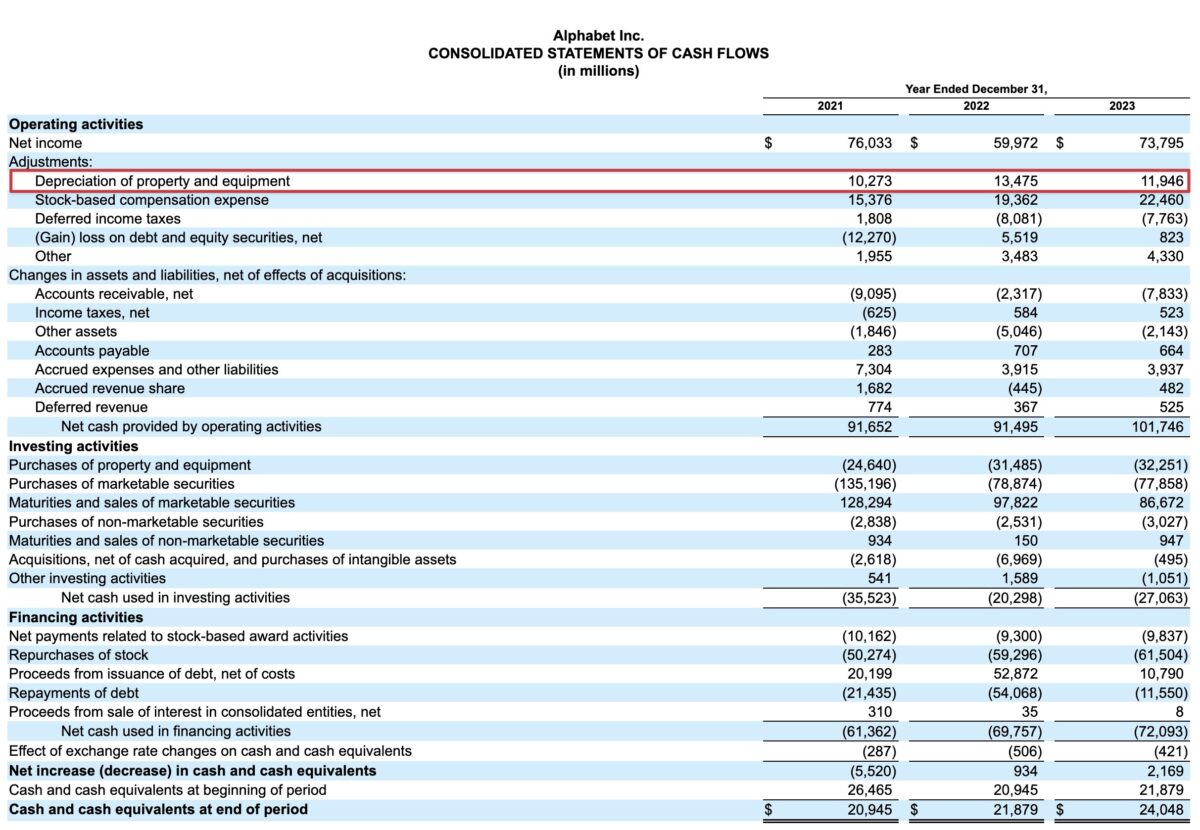
- Cash Flow Statement: Amortization is a non-cash charge. On the Statement of Cash Flows under the indirect method, $120,000 is added back to Net Income in the Operating Activities section.
Example 3: Acquired Customer Relationships (M&A)
When one company acquires another, the purchasing price must be allocated across the fair market value of all identifiable physical and intangible assets under ASC 805 (Business Combinations). Customer lists, recurring service contracts, and established customer relationships represent common finite-lived intangible assets created during acquisitions.
Scenario Details
- Assigned Fair Value at Acquisition: $2,400,000.
- Estimated Customer Attrition Rate / Useful Life: 8 years.
- Residual Value: $0.
Calculation
$$\text{Annual Amortization Expense} = \frac{$2,400,000 - $0}{8 \text{ years}} = $300,000 \text{ per year}$$
Accelerated Amortization Consideration
While straight-line amortization is standard, customer relationships sometimes experience higher attrition in early post-acquisition years. If historical data shows customer churn is front-loaded, management may use an accelerated amortization pattern (such as the sum-of-the-years'-digits method) to better reflect economic reality:
$$\text{Year 1 Expense (Accelerated Concept)} = $2,400,000 \times \left( \frac{8}{36} \right) = $533,333$$
If customer churn rates cannot be reliably measured on an accelerated basis, the straight-line method ($300,000/year) remains the default required baseline.
Example 4: Franchise Agreement Rights
A franchise agreement grants an operator the rights to utilize a franchisor's trade name, operating model, intellectual property, and proprietary systems. Initial franchise acquisition fees paid to secure a fixed-term agreement must be capitalized and amortized across the contractual term.
Scenario Details
- Initial Franchise Upfront Fee: $350,000 paid to franchisor upon signing.
- Contract Term: 10 years (with no automatic or low-cost renewal options).
- Residual Value: $0.
Calculation
$$\text{Annual Amortization Expense} = \frac{$350,000 - $0}{10 \text{ years}} = $35,000 \text{ per year}$$
Renewal Option Rules
If the franchise agreement includes a renewal option at a nominal cost, the amortization period may be extended to include the renewal term. However, if renewal requires significant capital outlays or standard market-rate renegotiations, the amortization calculation must strictly reflect the primary contract term (10 years in this example).
Example 5: Non-Compete Agreements
During executive hirings, corporate restructurings, or business purchases, companies often execute non-compete agreements. These legal covenants prevent key individuals from launching competing ventures or soliciting clients for a specified duration within a given geographical region.
Scenario Details
- Paid Consideration for Non-Compete Covenant: $180,000.
- Enforceable Covenant Period: 3 years.
- Residual Value: $0.
Calculation
$$\text{Annual Amortization Expense} = \frac{$180,000 - $0}{3 \text{ years}} = $60,000 \text{ per year}$$
$$\text{Monthly Amortization Expense} = \frac{$60,000}{12 \text{ months}} = $5,000 \text{ per month}$$
Because non-compete agreements carry short, rigidly enforced timelines, their useful life matches the legal duration of the covenant exactly.
Comprehensive Summary of the 5 Examples
The following table summarizes key details across all five examples:
| Asset Type | Primary Accounting Guidance | Capitalized Cost Example | Economic Useful Life | Annual Amortization Expense | Key Accounting Consideration |
|---|---|---|---|---|---|
| Patent | ASC 350-30 / IAS 38 | $150,000 | 10 Years | $15,000 | Useful life is the shorter of legal life or economic life. |
| Capitalized Software | ASC 350-40 / IAS 38 | $600,000 | 5 Years | $120,000 | Only internal development phase costs may be capitalized. |
| Customer List / Relationships | ASC 805 / IAS 38 | $2,400,000 | 8 Years | $300,000 | Arises primarily in M&A; may use accelerated patterns if churn is front-loaded. |
| Franchise Rights | ASC 350-30 | $350,000 | 10 Years | $35,000 | Excludes ongoing monthly royalty payments (which are expensed as incurred). |
| Non-Compete Agreement | ASC 350-30 | $180,000 | 3 Years | $60,000 | Amortization timeline strictly mirrors the legal duration of the restriction. |
Tax Treatment: GAAP vs. IRS Regulations (Section 197)
A crucial distinction in financial management exists between financial accounting (GAAP/IFRS) and tax accounting. While GAAP mandates amortizing finite intangible assets over their estimated economic useful lives, tax authorities enforce statutory schedules.
In the United States, IRC Section 197 governs tax deductions for acquired intangible assets. Key features include:
- 15-Year Mandatory Amortization: For tax purposes, most acquired "Section 197 intangibles"—including goodwill, customer lists, patents, covenants not to compete, and franchises—must be amortized straight-line over exactly 15 years (180 months), regardless of their actual economic life or financial reporting life.
- Creation of Deferred Taxes: Discrepancies between GAAP useful lives (e.g., a 3-year non-compete agreement) and the statutory tax lifespan (15 years under Section 197) create temporary timing differences. These differences require companies to establish Deferred Tax Assets (DTAs) or Deferred Tax Liabilities (DTLs) on their financial statements.
- Financial Reporting (GAAP)
- Amortized over Economic Life
- E.g., Non-Compete = 3 Years
- Impairment tests for Indefinite Intangibles
- Tax Reporting (IRS Sec. 197)
- Mandatory 15-Year Straight-Line
- Non-Compete = 15 Years
- Statutory deduction schedules
- Generates Deferred Tax Assets/Liabilities
Common Pitfalls in Accounting for Amortization
When managing amortization expense schedule preparations or reviewing corporate income statements, financial teams must avoid several common missteps:
1. Amortizing Indefinite-Lived Intangibles
Indefinite-lived intangibles are assets expected to contribute to cash flows indefinitely. Examples include goodwill, perpetual trademarks, and unrestricted taxi medallions. Amortizing these assets under GAAP is incorrect. Instead, they must undergo periodic impairment testing.
2. Failing to Review Useful Life Estimates
Under ASC 350, management must review the remaining useful life of finite-lived intangible assets each reporting period. If technological developments reduce a patent’s operational viability from 10 years down to 6 years, the remaining net book value must be amortized over the shortened remaining duration.
3. Capitalizing Early-Stage Research & Development (R&D)
Under GAAP (ASC 730), pure research and preliminary planning costs must be expensed immediately as incurred. Only development costs meeting specific capitalization criteria (such as passing the technological feasibility threshold under ASC 985-20 for commercial software) can be capitalized and subsequent amortized.
Frequently Asked Questions
What is the main difference between amortization and depreciation?
Depreciation spreads the cost of physical, tangible assets (such as machinery, vehicles, and buildings) over their useful lives. Amortization spreads the cost of non-physical, intangible assets (such as software, patents, and customer relationships) over their useful lives.
How does amortization expense impact EBITDA?
EBITDA stands for Earnings Before Interest, Taxes, Depreciation, and Amortization. Because amortization is added back to Operating Income when calculating EBITDA, high amortization charges do not lower a enterprise's reported EBITDA metric. However, amortization does lower reported Net Income and Operating Profit (EBIT).
Can an intangible asset have a salvage value?
Yes, but it is rare. Under GAAP and IFRS guidelines, the residual value of an intangible asset is assumed to be zero unless a third party has made a formal commitment to acquire the asset at the end of its useful life, or there is an active, liquid market for the asset.
What happens if an amortizable asset loses value suddenly?
If an event occurs suggesting that an intangible asset's carrying value may not be recoverable (an "impairment trigger"), the company must perform an impairment test. If the net book value exceeds the asset's fair value, the company writes down the carrying value and recognizes an immediate impairment loss on the income statement.
Is goodwill amortized under U.S. GAAP?
For public companies, goodwill is not amortized; it is evaluated at least annually for impairment. However, private companies and qualifying non-profit entities in the U.S. can elect a GAAP accounting alternative (ASC 350-20) allowing them to amortize goodwill straight-line over 10 years (or less if another period is demonstrated to be more appropriate).
Recommended Next Steps
To ensure compliance and accuracy in financial reporting:
- Maintain an Intangible Asset Sub-Ledger: Track the original capitalized value, acquisition date, amortization method, useful life, and accumulated amortization separately for every intangible asset.
- Conduct Annual Useful Life Audits: Review economic trends, contract renewal statuses, and technological advances annually to confirm whether useful life estimates remain valid.
- Reconcile Book-Tax Differences: Coordinate with tax advisory teams to maintain robust tracking of temporary differences between GAAP straight-line amortization schedules and IRS Section 197 15-year statutory schedules.