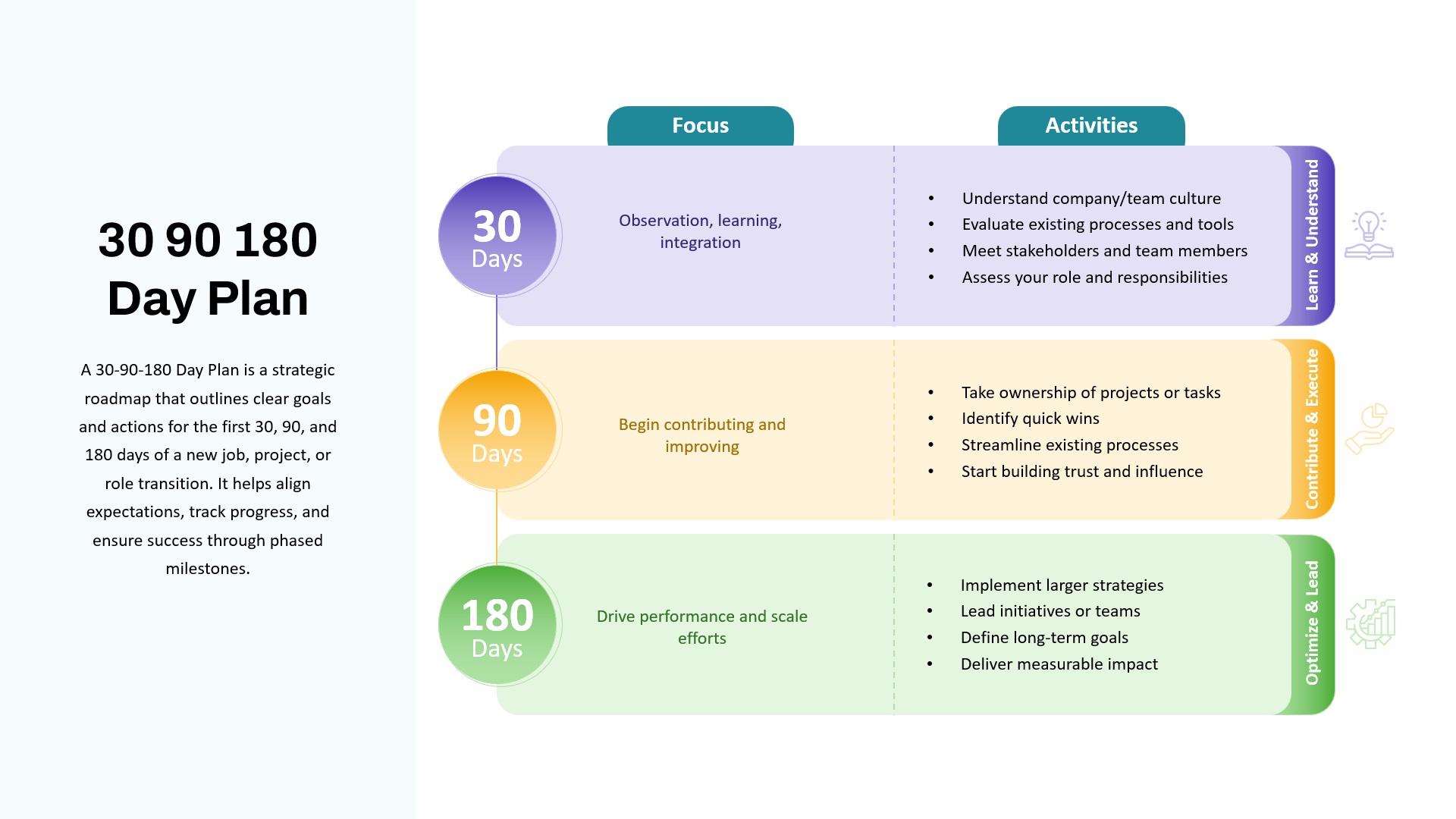
A 30 60 90 day plan is a structured strategic document that outlines an individual's goals, learning objectives, and performance milestones during their first three months in a new role, project, or leadership position. It serves as a practical roadmap to bridge the gap between initial onboarding and autonomous value creation, ensuring alignment between personal output and broader organizational expectations.
Understanding the Purpose of a 30 60 90 Day Plan
Entering a new professional environment or taking on a high-stakes project can quickly become overwhelming without a structured framework. The 30 60 90 day plan provides a disciplined approach to navigating this transition. By dividing the first three months into distinct, manageable phases, professionals can systematically absorb information, build collaborative relationships, and transition from passive learning to active contribution.
At its core, this roadmap prevents the common pitfalls of analysis paralysis and premature execution. New hires or leaders often feel pressured to prove their worth immediately, leading them to propose sweeping changes before fully understanding the operational context, cultural nuances, or technical constraints of their new setting. Conversely, without clear milestones, individuals can drift aimlessly, lacking accountability or measurable progress indicators. The structured progression of a 30 60 90 day plan instills confidence in stakeholders, managers, and team members by demonstrating intentionality, strategic thinking, and methodical execution.
Furthermore, this framework acts as a dynamic communication tool. It aligns expectations between the individual and their direct supervisor or executive sponsor. When expectations are explicitly documented and mutually agreed upon, performance reviews become objective evaluations rather than subjective impressions. This transparency fosters trust and accelerates the integration process, allowing the individual to achieve full operational productivity much faster than they would through unstructured immersion.
Phase 1: Days 1 to 30 — Learning, Listening, and Observation
The primary objective of the first thirty days is absorption. In this initial phase, the individual must resist the urge to overhaul systems, fix perceived inefficiencies, or implement radical changes. Instead, the focus should be entirely on listening, learning, and gathering contextual data.
Immersion and Information Gathering
Every organization operates within a unique ecosystem defined by unspoken rules, legacy systems, and distinct cultural norms. During the first month, the roadmap requires a deep dive into available documentation, standard operating procedures, historical project files, and technical specifications. The goal is to build a comprehensive mental model of how the business functions, where value is generated, and where bottlenecks typically occur.
Stakeholder Mapping and Relationship Building
No professional operates in a vacuum. Identifying key stakeholders, cross-functional partners, and direct reports is a critical milestone of the first thirty days. Establishing introductory meetings with these individuals creates open lines of communication and signals respect for their expertise and institutional knowledge. Effective questions to ask during these sessions include:
- What are the most pressing challenges currently facing your department?
- What does success look like in this role from your perspective?
- What historical initiatives failed, and what lessons were learned from those experiences?
Establishing Baselines and Quick Wins
While the focus is on learning, identifying low-hanging fruit or "quick wins" can build early credibility. These are minor, low-risk adjustments that require minimal resources but yield immediate, noticeable improvements. Executing one or two quick wins demonstrates competence and a proactive attitude without disrupting critical operations.
| Phase Focus | Primary Objectives | Key Activities | Measurable Outcomes |
|---|---|---|---|
| Days 1–30 | Absorb information, map stakeholders, understand constraints. | Document review, listening tours, team introductions. | Comprehensive understanding of systems, clear stakeholder map, initial quick wins. |
| Days 31–60 | Apply knowledge, contribute to ongoing projects, evaluate processes. | Process analysis, cross-functional collaboration, early ownership. | Independent contribution to tasks, identification of systemic bottlenecks, peer feedback. |
| Days 61–90 | Lead initiatives, propose strategic improvements, drive measurable results. | Strategy formulation, independent project management, outcome evaluation. | Execution of primary goals, presentation of strategic roadmap, demonstrated ROI. |
Phase 2: Days 31 to 60 — Contributing, Analyzing, and Collaborating
Transitioning into the second month, the focus shifts from passive observation to active participation. Armed with the contextual knowledge gathered during the first thirty days, the individual begins to take ownership of specific tasks and contribute meaningfully to ongoing team initiatives.
Shifting from Input to Output
By day thirty-one, the individual should possess a solid grasp of the internal tools, workflows, and communication channels. This enables them to transition from shadowing colleagues to executing core responsibilities independently. Whether writing code, drafting marketing campaigns, managing financial audits, or overseeing supply chain logistics, the expectation is consistent execution with diminishing oversight.
Critical Analysis and Gap Identification
Active contribution naturally exposes systemic inefficiencies. During this phase, the individual should critically analyze existing processes against industry standards and business objectives. Rather than merely complaining about suboptimal workflows, the practitioner should document these gaps objectively. Questions to consider include:
- Where do handoffs between departments break down?
- Which manual processes can be automated or streamlined?
- Are current metrics accurately reflecting performance and value creation?
Deepening Cross-Functional Alignment
Siloed operations hinder organizational growth. The second month requires strengthening relationships outside the immediate team. Collaborating closely with interdependent departments—such as aligning product development with customer support or linking sales targets with financial forecasting—ensures that the individual's contributions support broader enterprise goals.
Phase 3: Days 61 to 90 — Owning, Leading, and Strategizing
The final phase of the foundational roadmap marks the transition to full autonomy and strategic leadership. By day sixty-one, the individual is no longer just a participant; they are an engine of execution and a contributor to future planning.
Assuming Full Ownership
At this stage, the individual takes absolute ownership of their designated portfolio, project stream, or team leadership duties. Oversight from management should naturally decrease, replaced by autonomous decision-making within established parameters. Success in this phase is defined by the reliable delivery of high-quality outcomes without constant intervention.
Proposing Strategic Improvements
Having analyzed operational gaps during month two, the individual is now positioned to propose and implement meaningful changes. This involves drafting formal proposals, securing stakeholder buy-in, and leading implementation initiatives. Whether introducing a new software tool, restructuring a workflow, or redefining a product feature set, these initiatives should align directly with organizational Key Performance Indicators (KPIs).
Establishing Long-Term Vision and Metrics
As the initial ninety-day period concludes, the focus broadens toward the future. The individual collaborates with their supervisor to establish ongoing performance metrics, six-month objectives, and annual goals. This ensures that the momentum generated during the initial roadmap translates into sustained, long-term professional impact.
Customizing the Roadmap for Different Contexts
While the structure of a 30 60 90 day plan remains consistent, its specific contents must adapt to the unique nature of the position or project. A generic template rarely yields optimal results; customization is essential.
For New Executives and Leaders
When an executive enters a new organization, their plan must prioritize cultural assessment, financial audit, and team capability analysis. Months one through three must balance immediate operational stability with the formulation of a long-term strategic vision. Leaders must focus heavily on talent evaluation, ensuring the right people are in the right roles before initiating sweeping structural transformations.
For Individual Contributors and Specialists
Technical specialists—such as software engineers, financial analysts, or graphic designers—require a plan heavily weighted toward technical onboarding, tool mastery, and domain-specific output. Their metrics for success revolve around code deployment frequency, report accuracy, asset delivery times, and adherence to quality assurance standards.
For Project-Specific Initiatives
When deploying a 30 60 90 day plan for a specific internal project rather than a job transition, the focus centers on project lifecycles. Month one involves requirements gathering and resource allocation; month two focuses on development, testing, and milestone tracking; month three centers on deployment, evaluation, and post-launch optimization.
Common Pitfalls and How to Avoid Them
Implementing a 30 60 90 day plan requires discipline and adaptability. Several common pitfalls can derail even the most thoughtfully constructed roadmaps.
Overpromising and Under-Delivering
The most frequent mistake is attempting to revolutionize the organization too quickly. Driven by a desire to impress, individuals often commit to unrealistic goals during the first thirty days. This leads to burnout, compromised quality, and damaged credibility. Adhering strictly to the "listen first" philosophy of month one mitigates this risk.
Failing to Align with Stakeholder Expectations
A plan created in isolation rarely succeeds. If an individual builds their roadmap without continuous feedback from their direct supervisor and key peers, they risk optimizing for the wrong outcomes. Regular check-ins and iterative adjustments ensure the plan remains synchronized with shifting organizational priorities.
Treating the Plan as Static
A 30 60 90 day plan is a living document, not a rigid contract. External market conditions, budget reallocations, or internal restructuring can alter priorities overnight. Successful professionals review and adjust their plans dynamically in response to new information, maintaining strategic intent while remaining tactically flexible.
Frequently Asked Questions
Who should write the 30 60 90 day plan?
Ideally, the individual starting the role or project should draft the initial plan, drawing upon job descriptions, interview feedback, and initial research. This draft should then be reviewed, refined, and approved in collaboration with their direct manager or executive sponsor to ensure alignment.
What should I do if I fall behind schedule during the first 30 days?
Falling behind schedule during the absorption phase is common, especially in complex technical environments. Transparently communicate obstacles to your manager during regular one-on-one meetings. Adjust the timeline or seek additional resources rather than rushing through critical learning milestones.
How do I measure success at the end of 90 days?
Success is measured against the specific qualitative and quantitative milestones established in the roadmap. This includes completed deliverables, feedback from cross-functional peers, adherence to performance metrics, and the successful execution of independent initiatives proposed during month two.
Is a 30 60 90 day plan only for new hires?
No. While frequently used during onboarding, these plans are equally effective for promotions, shifting departments, launching major enterprise projects, or orchestrating organizational turnarounds where structured momentum is required.
How detailed should the plan be?
The plan should strike a balance between high-level strategic direction and actionable daily tasks. It should outline specific goals, required resources, potential obstacles, and measurable outcomes for each thirty-day block without becoming overly rigid or micromanaged.
Practical Next Steps for Implementation
To put this practical roadmap into action, begin by gathering all available documentation relevant to your new role or project. Draft your initial objectives across the three distinct phases, categorizing them into learning goals, contribution targets, and leadership milestones. Schedule a collaborative review session with your supervisor or project sponsor to validate your assumptions, refine your targets, and secure formal alignment. By maintaining transparency, embracing continuous feedback, and executing methodically through each phase, you will establish a solid foundation for sustainable, long-term success.