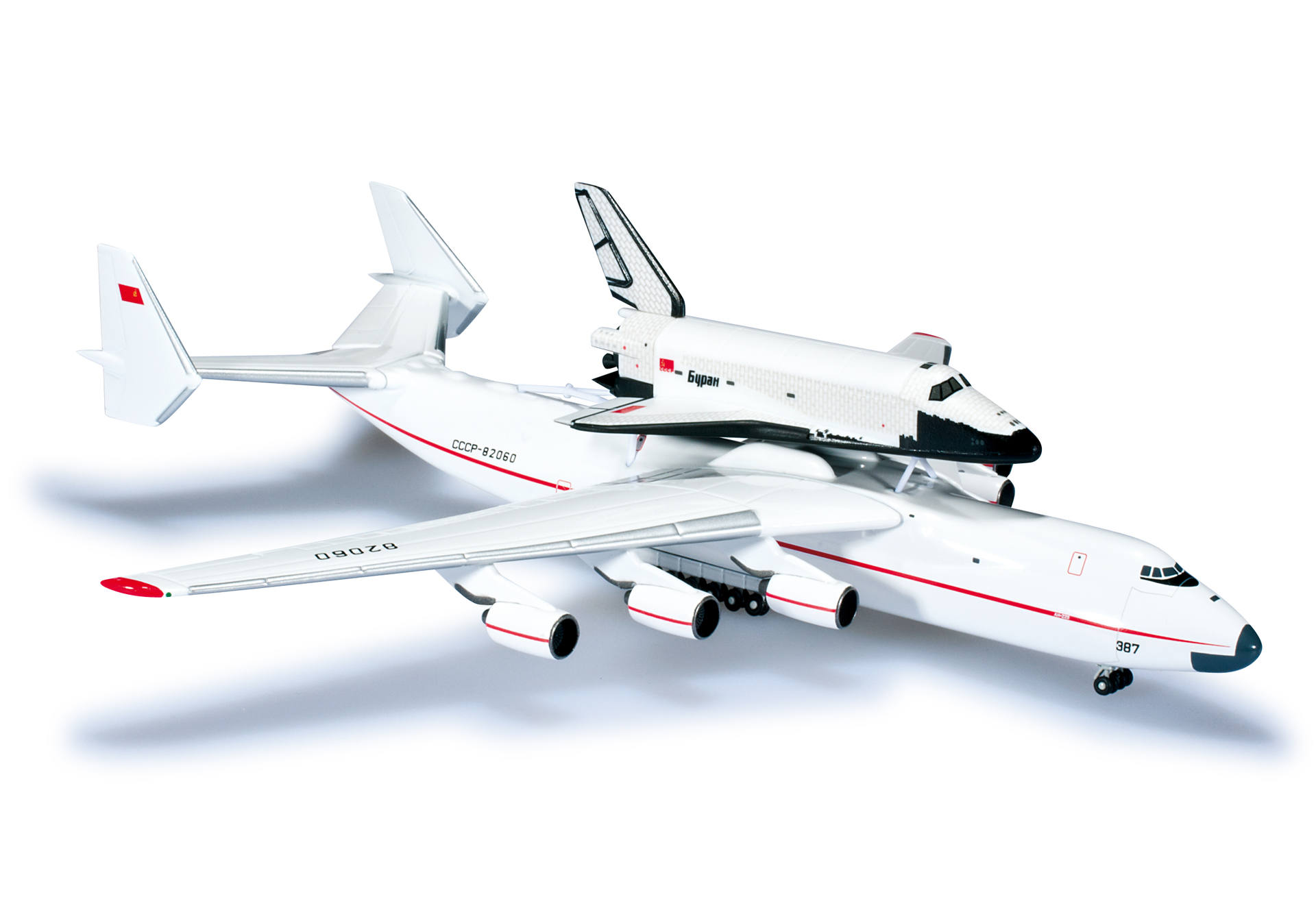
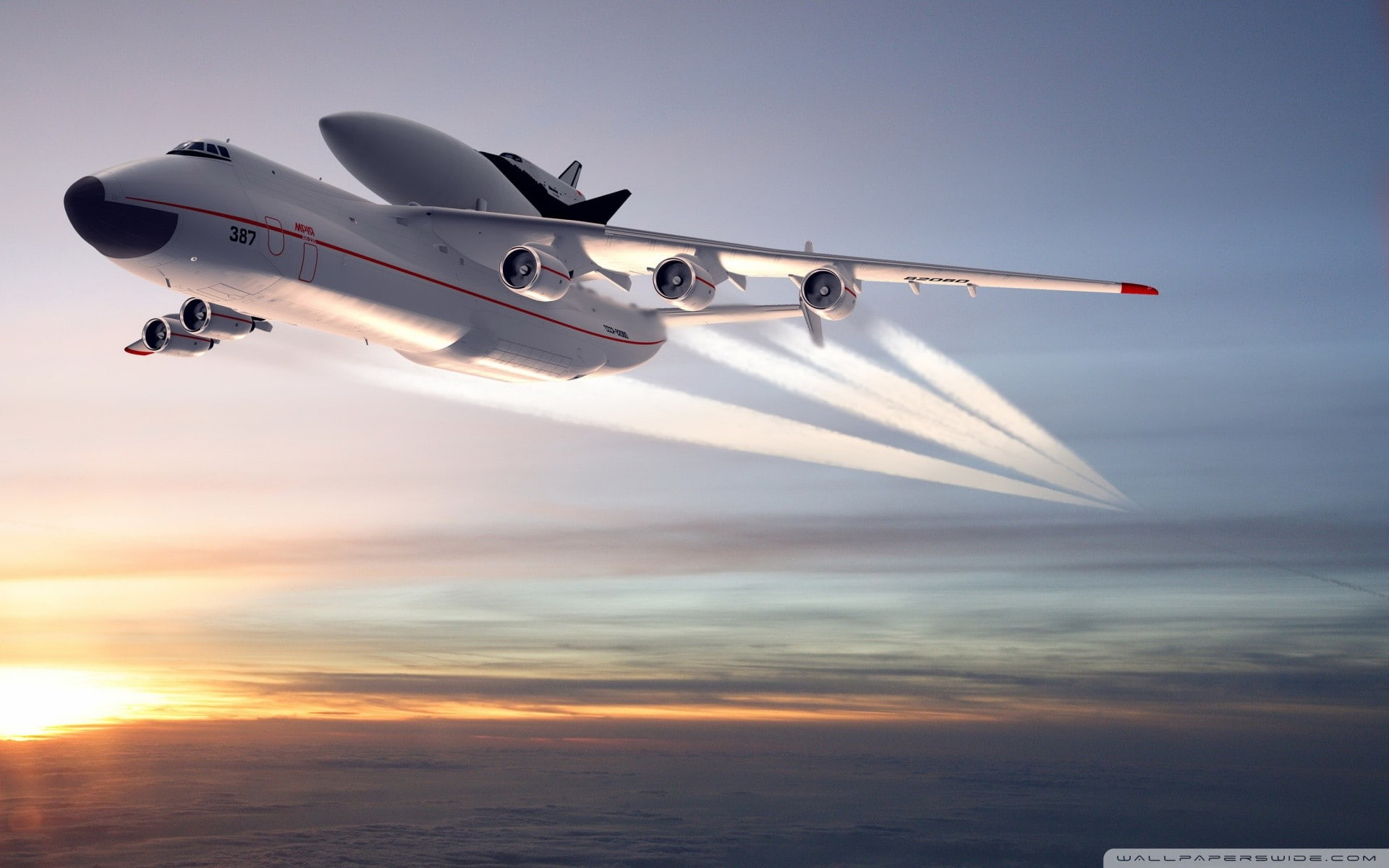
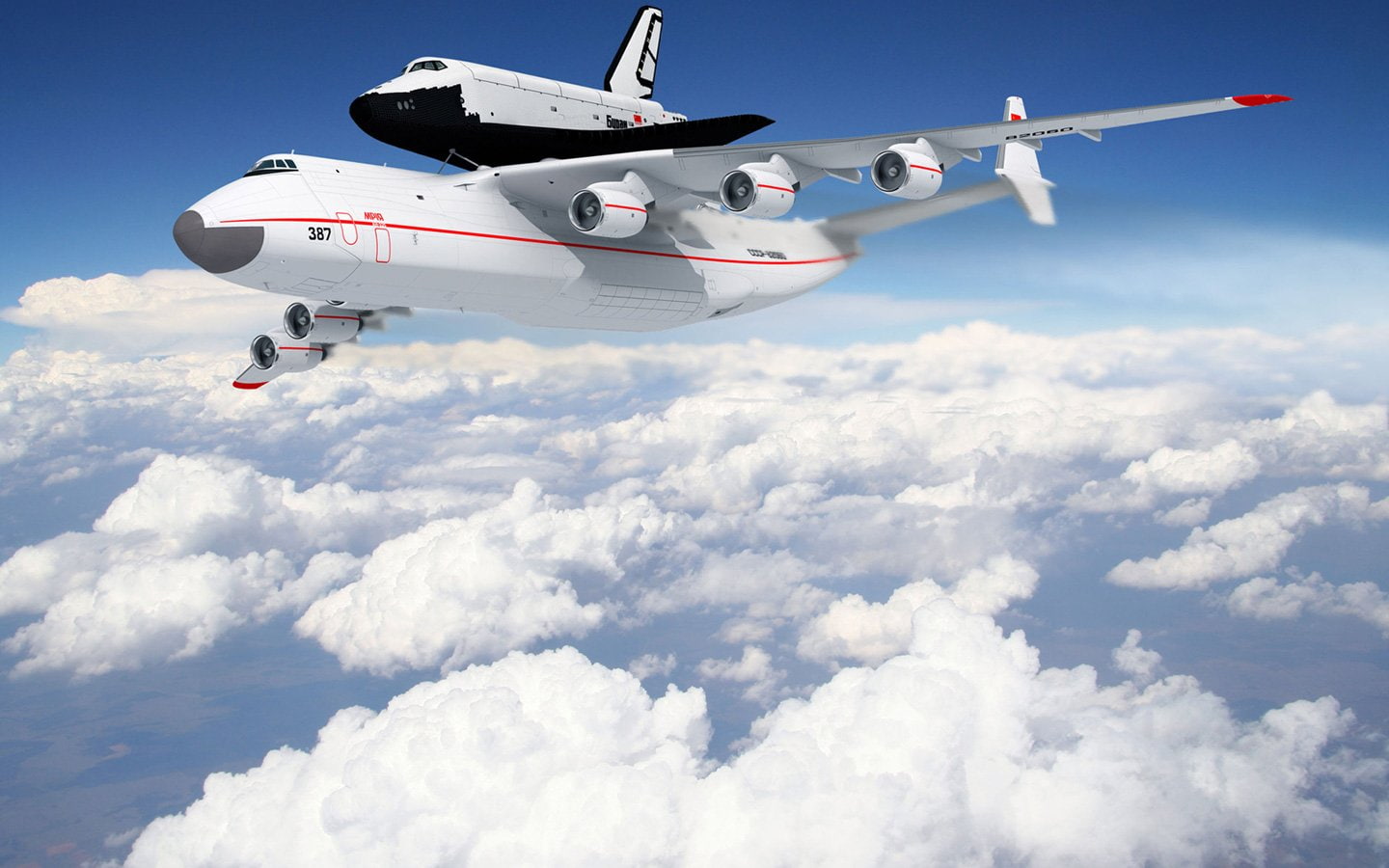
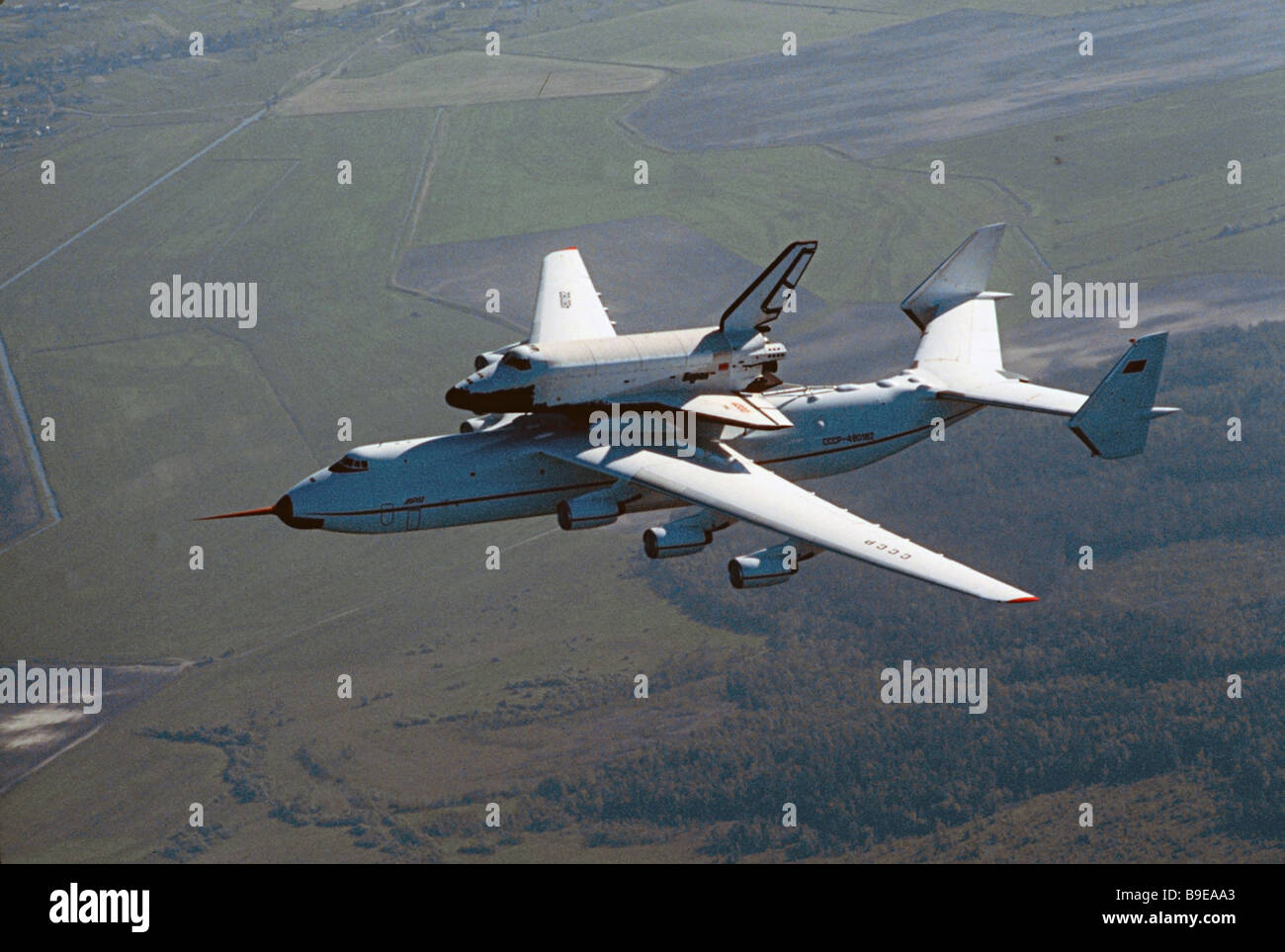
The Antonov An-225 Mriya was a strategic airlift cargo aircraft designed by the Antonov Design Bureau in the 1980s specifically to transport the Soviet Union's Buran space shuttle and Energia rocket components. Powered by six turbofan engines with an extraordinary twin-tail aerodynamic configuration, the single operational airframe represented the absolute pinnacle of heavy-lift aerospace engineering.
Genesis of the An-225: The Soviet Space Transport Requirement
The development of the Antonov An-225 Mriya (Ukrainian for "Dream," NATO reporting name Cossack) was intrinsically tied to the Soviet Union's reusable space transport system, the Vozdushno-Kosmicheskiy Kompleks (VKK) program. Initiated in the 1970s as a direct response to the United States Space Shuttle program, the Soviet effort centered on two massive components: the Buran orbiter and the super-heavy lift Energia launch vehicle.
A fundamental logistical obstacle faced by Soviet space planners was geography. Unlike NASA's Kennedy Space Center, located on the Florida coast with direct maritime access via barge, the Baikonur Cosmodrome was situated deep in the arid steppes of the Kazakh Soviet Socialist Republic. Major aerospace manufacturing facilities were dispersed across Moscow, Samara (then Kuibyshev), and Tashkent. Railway lines and existing highways could not accommodate the extreme dimensions of the Energia rocket’s core stages (which exceeded 8 meters in diameter) or the fully assembled Buran airframe.
Initial outsized transport tasks were handled by the Myasishchev VM-T Atlant, a modified strategic bomber fitted with large dorsal pods and a modified twin-tail setup. However, the VM-T Atlant suffered from significant payload and center-of-gravity limitations. It could carry the Buran orbiter only in a stripped-down state—without its vertical tail fin, main engines, or internal avionics installed.
To transport the fully integrated, flight-ready Buran orbiter and complete, non-disassembled Energia components directly to Baikonur, the Soviet Ministry of Aviation Industry mandated the creation of a dedicated, super-heavy transport aircraft. In 1985, the Antonov Design Bureau in Kyiv, led by Chief Designer Petr Balabuyev under the direction of Viktor Tolmachev, was commissioned to engineer an aircraft capable of carrying external payloads exceeding 200 metric tons.
Architectural Engineering and Technical Specifications
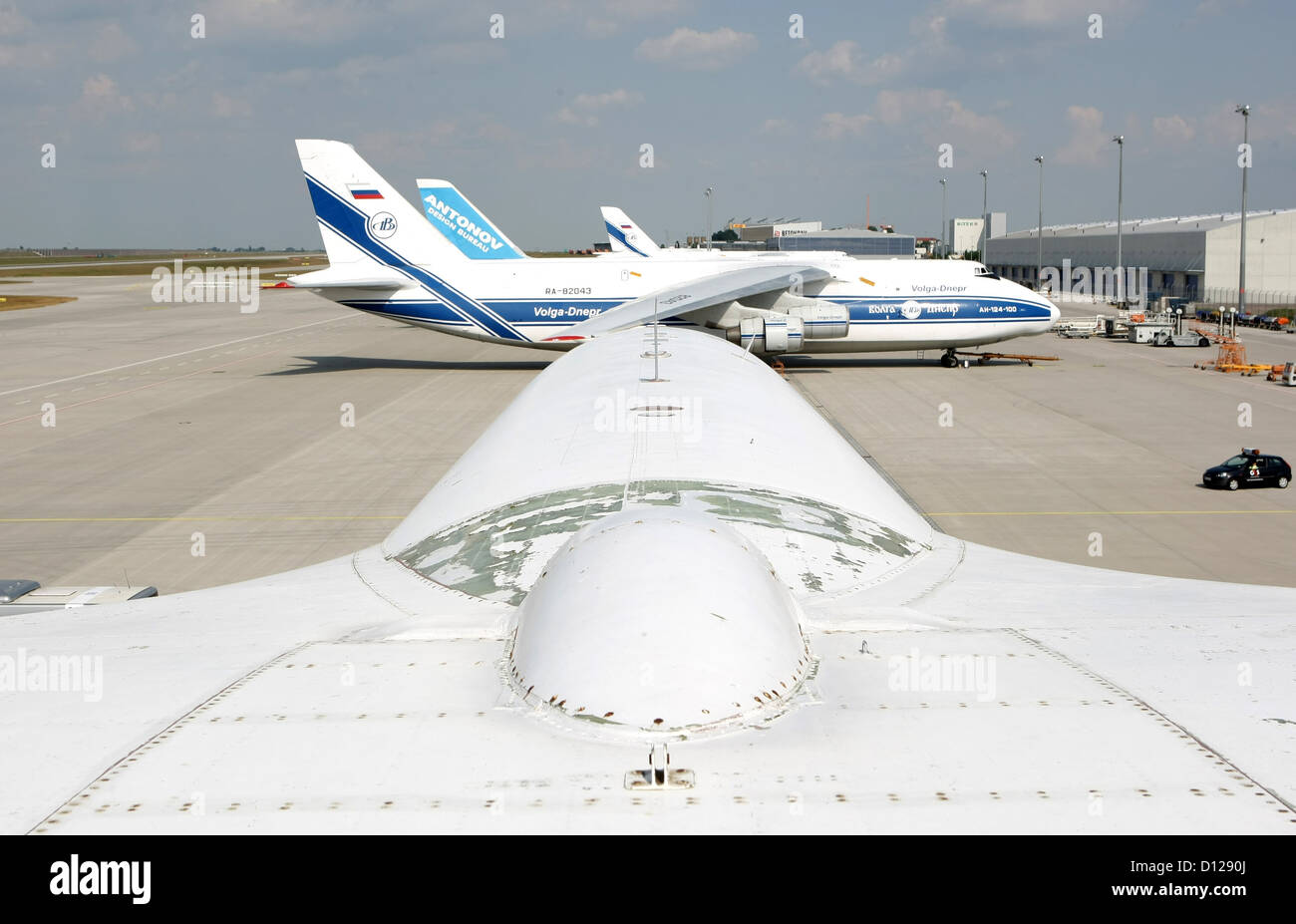
Rather than designing an entirely new airframe from scratch under tight deadlines, Antonov engineers utilized the existing An-124 Ruslan architecture as their baseline. However, to meet the radical weight, structural, and aerodynamic demands of the Buran piggyback mission, the An-124 underwent extensive redesigns.
- Buran Orbiter / External Cargo (attached via Dorsal Attachments)
- Upper Fuselage
- Internal Cargo Bay (43.3m L x 6.4m W x 4.4m H)
- Lower Fuselage
- Propulsion: 6 x Ivchenko-Progress D-18T turbofan engines
Airframe Lengthening and Structural Reinforcement
The An-124 fuselage was lengthened by adding structural fuselage plugs forward and aft of the wing roots. The wing span was significantly expanded by inserting an entirely new center section and extending the outer wing panels.
To reduce overall structural weight and offset the massive weight of dorsal external cargo, the rear cargo door and loading ramp present on the An-124 were completely eliminated on the An-225. Payload access was limited strictly to the nose cone, which hinged upward ("visor style") along with a complex kneeing front landing gear assembly that lowered the cargo floor to ground level.
The Twin-Tail Redesign
The most visible structural deviation from the An-124 was the tail assembly. The An-124 featured a single large vertical stabilizer. However, mounting a massive, wide body like the Buran space shuttle on top of the fuselage creates a severe aerodynamic wake (or "shadow") directly behind the payload.
A single central tail fin positioned in this wake would lose rudder effectiveness and suffer from severe flow separation and buffeting. Antonov engineers replaced the single tail fin with a massive H-shaped twin vertical stabilizer design. Positioned at the extreme tips of the horizontal stabilizer, these twin vertical fins operated entirely in clean airflow clear of the turbulent wake generated by the piggyback shuttle.
Propulsion and Fuel Systems
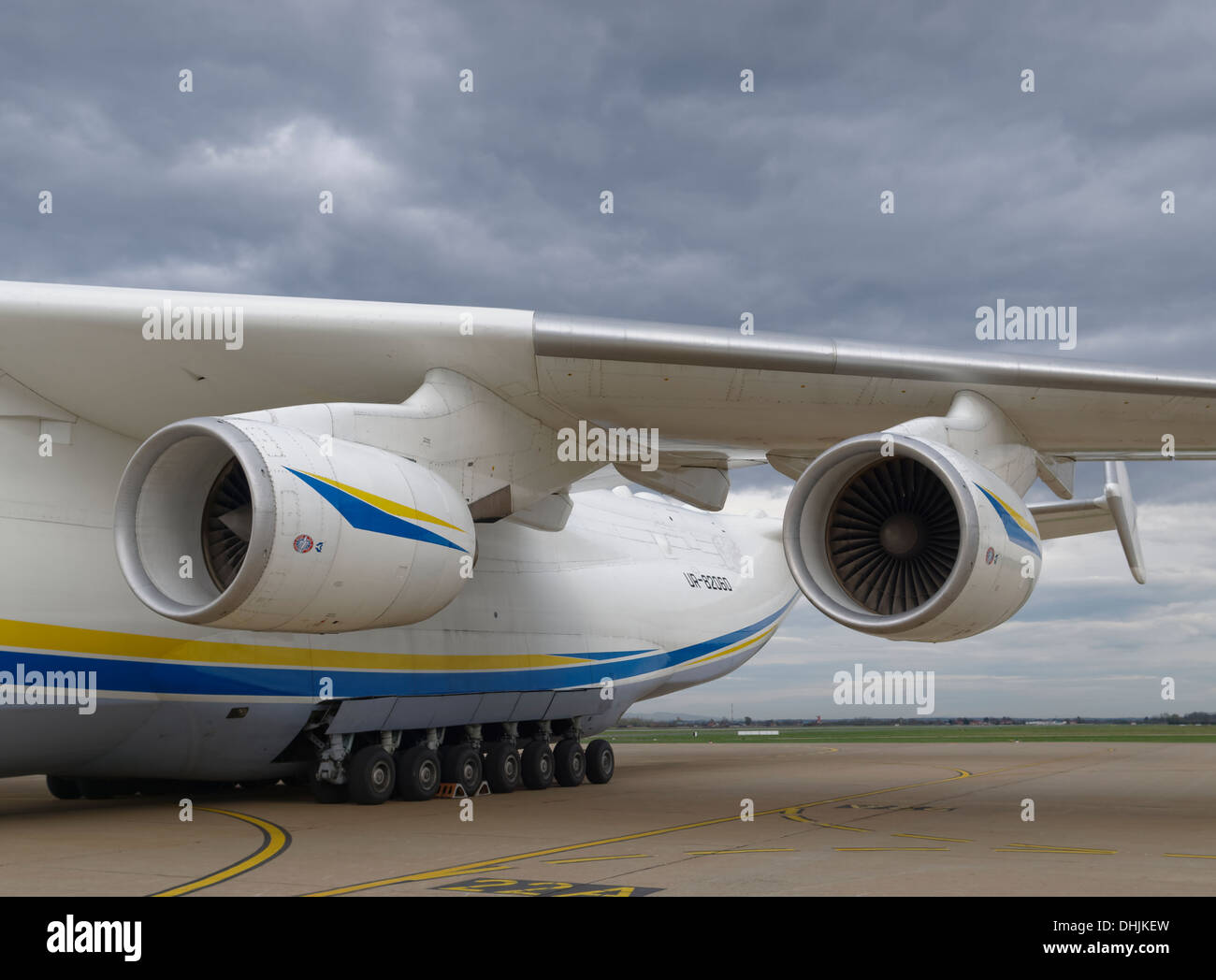
To lift a maximum takeoff weight (MTOW) of 640 metric tons (1,410,958 lbs), the An-225 was equipped with six Ivchenko-Progress D-18T high-bypass turbofan engines, three mounted on pylons beneath each wing. Each engine generated approximately 229.5 kN (51,600 lbf) of thrust, providing a cumulative take-off thrust exceeding 1,370 kN.
The aircraft incorporated a massive internal fuel system spread across 13 wing tanks, capable of holding over 300,000 kilograms of jet fuel. This provided the endurance necessary for transcontinental transport missions carrying heavy external loads without refueling.
High-Capacity Landing Gear
To distribute the immense weight across runway pavements and avoid exceeding pavement classification numbers (PCN), Antonov engineered an unprecedented 32-wheel landing gear system:
- Nose Gear: Twin two-wheel steerable nose gear struts (4 wheels total).
- Main Gear: 28 wheels arranged across 14 double-wheel bogies (7 bogies on each side of the lower fuselage).
To facilitate tight ground maneuvering on commercial taxiways, the rear four wheel bogies on each side were steerable, allowing the 84-meter-long aircraft to turn within a relatively tight radius.
Technical Specifications Matrix
The following table highlights the definitive operational and structural parameters of the Antonov An-225 Mriya in comparison with other major outsized space-hardware transport platforms:
| Feature / Specification | Antonov An-225 Mriya | Boeing 747 SCA (Shuttle Carrier Aircraft) | Myasishchev VM-T Atlant | Antonov An-124 Ruslan |
|---|---|---|---|---|
| Origin Country | Soviet Union / Ukraine | United States | Soviet Union | Soviet Union / Ukraine |
| Primary Space Role | Buran shuttle & Energia components | NASA Space Shuttle orbiter ferry | Early Buran/Energia canister ferry | Support logistics / Internal heavy transport |
| Max Takeoff Weight (MTOW) | 640,000 kg (1,410,958 lb) | 322,000 kg (710,000 lb) | 192,000 kg (423,287 lb) | 405,000 kg (892,872 lb) |
| Maximum Payload | 250,000 kg (551,156 lb) | ~71,000 kg (156,500 lb) | 50,000 kg (110,231 lb) | 150,000 kg (330,693 lb) |
| Powerplant | 6 × Ivchenko-Progress D-18T | 4 × Pratt & Whitney JT9D-7J | 4 × Dobrynin VD-7MD | 4 × Ivchenko-Progress D-18T |
| Wingspan | 88.4 m (290 ft 0 in) | 59.6 m (195 ft 8 in) | 53.14 m (174 ft 4 in) | 73.3 m (240 ft 6 in) |
| Length | 84.0 m (275 ft 7 in) | 70.5 m (231 ft 10 in) | 58.7 m (192 ft 7 in) | 68.96 m (226 ft 3 in) |
| Tail Configuration | Twin vertical stabilizers | Single tail with tip fins | Twin vertical stabilizers | Standard single vertical tail |
| Cargo Position | Internal Bay + Dorsal Hardpoints | Dorsal Hardpoints only | Dorsal Hardpoints only | Internal Bay only |
Operational History: Carrying the Buran Space Shuttle
The An-225 registered under Soviet tail number CCCP-82060 made its maiden flight on December 21, 1988, from the Svyatoshyn Airfield in Kyiv, piloted by flight crew lead Alexander Galunenko. The flight lasted 74 minutes and successfully validated the basic stability and control handling of the enlarged airframe.
- Buran Orbiter
- Dorsal Hardpoint Attachments
- Antonov An-225 Mriya airframe
- 32-Wheel Gear Array
The Piggyback Integration
To secure the Buran orbiter to the upper fuselage, engineers installed heavy structural attachment points (hardpoints) connected directly to major internal fuselage frames. The load-bearing structure included:
- Forward Support Struts: Retractable/removable bipod assemblies that attached to the forward belly of the Buran orbiter.
- Aft Support Struts: Dual heavy load-bearing attachment points situated over the main wing-box structural frame to absorb the orbiter’s tail weight and aerodynamic drag.
Beyond structural mounts, the system required specialized umbilical connections for electrical telemetry, structural vibration sensors, and purge lines to monitor the shuttle during flight.
Flight Test Program and Le Bourget Debut
On May 13, 1989, the An-225 completed its first piggyback flight with the uncrewed Buran Orbiter OK-1.01 mounted on its back, flying from the Zhukovsky Airfield near Moscow.
Shortly thereafter, in June 1989, the combination made international aviation history when the An-225 flew to the 38th Paris Air Show at Le Bourget Airport. Carrying the 80-ton Buran orbiter dorsally, the An-225 executed low-altitude passes, demonstrating stability and maneuvering authority that astounded western aerospace observers.
During flight with the Buran attached, the An-225 operated within strict envelope boundaries:
- Cruise speeds were typically restricted to roughly 500–600 km/h (270–320 knots).
- Flight ceiling was reduced to preserve structural safety margins under turbulent atmospheric conditions.
- Takeoff run requirements increased, requiring specialized long runways such as the 4,500-meter strip at Yubileiny Airfield at Baikonur.
Collapse of the Space Program
Despite the success of the test flights, the operational lifespan of the An-225/Buran combination was brief. The Buran completed only one uncrewed spaceflight on November 15, 1988, launched into orbit by an Energia rocket.
Following the dissolution of the Soviet Union in late 1991, funding for the VKK space program evaporated. In May 1993, Russian President Boris Yeltsin officially canceled the Buran space shuttle project. With no immediate operational purpose, the An-225 airframe (now re-registered under Ukrainian tail number UR-82060) was stripped of its D-18T engines to support the commercial fleet of An-124s and put into long-term outdoor storage at Hostomel Airport near Kyiv.
Commercial Rebirth: Outsized Cargo Leadership (2001–2022)
In the late 1990s, global demand for non-standard, extremely heavy freight transport surged. Antonov Airlines identified a commercial niche for a transport aircraft exceeding the capacity of the An-124 and Boeing 747-400F.
- Upward-Hinging Nose Visor
- Kneeing Front Landing Gear Assembly lowers ramp directly to ground
- Access to 43.3-Meter Cargo Bay (Generators, Locomotives, Turbines)
Commercial Modernization
In 2000, Antonov initiated a $20-million overhaul to bring the single An-225 back to airworthy status:
- Six fresh D-18T engines were re-installed.
- Advanced flight control avionics, modern navigation equipment, and satellite communications were added to comply with ICAO international civil aviation standards.
- Reinforced interior cargo floor systems were integrated to handle concentrated point loads.
The refurbished Mriya conducted its commercial maiden flight on May 7, 2001. It was officially certified by civil aviation authorities shortly thereafter, entering service under Antonov Airlines.
Guinness World Records and Unique Capability
Over two decades of commercial operations, the An-225 secured over 200 official world aviation records, certified by the Fédération Aéronautique Internationale (FAI). Key milestones included:
- Single-Item Heavy Payload: On August 11, 2009, the Mriya transported a 187.6-ton gas power plant generator from Frankfurt-Hahn Airport to Yerevan, Armenia.
- Total Cumulative Payload: On June 16, 2004, it transported 247 metric tons of pipeline machinery from Prague to Tashkent.
- Longest Single-Piece Cargo: Transported two 42.1-meter-long wind turbine blades from Tianjin, China, to Denmark in 2010.
During the global COVID-19 pandemic in 2020, the An-225 carried unprecedented volumes of medical protective gear from Asia to Europe, demonstrating that its unmatched cargo bay volume (1,300 cubic meters) was as valuable as its payload mass capability.
Destruction at Hostomel Airport and Current Status
The Loss of UR-82060
In late February 2022, during the initial military assault on Kyiv, Hostomel (Gostomel) Airport (ICAO: UKKM) became the site of fierce combat. The An-225 was undergoing routine maintenance in its open hangar at the airport.
During the Battle of Hostomel, the aircraft's hangar sustained direct artillery hits and structural fires. Subsequent photographic and drone evidence confirmed that UR-82060 was destroyed beyond repair. The forward nose section, cockpit, forward cargo bay, and wing-box structures suffered catastrophic collapse, structural melting, and separation.
- Destroyed Airframe Status (UR-82060):
- Nose/Cockpit: Catastrophic structural loss
- Wing Box/Spar: Thermal & collapse damage
- Tail Assembly: Partially intact, detached
- Second Incomplete Airframe Status (Serial No. 01-02):
- Fuselage Plug: Intact (~70% complete)
- Wing Structures: Partial components built
- Avionics/Engines: Requires fresh procurement
The Second Airframe (Serial No. 01-02)
During the late 1980s, Soviet authorities had begun construction of a second An-225 airframe (serial number 01-02) intended for space program operations. Work on this second unit ceased in 1994 when the structure was approximately 60–70% complete.
The partially completed second airframe—consisting of a primary fuselage section, wing center section, and tail components—remains stored in a protected facility at the Antonov serial production plant in Kyiv.
Reconstruction Viability and Feasibility Analysis
The State Company Antonov and Ukrainian government authorities have repeatedly expressed intent to complete the second An-225 airframe. Technical and economic assessments highlight several major challenges:
- Financial Requirements: Estimated costs to build the new aircraft range between $500 million and $3 billion USD. Commercial viability analysis suggests an airframe of this scale cannot achieve financial return through standard freight charters alone; completion would require public funding or strategic international sponsorship.
- Engineering Redesign: The original 1980s blueprints rely on obsolete materials, systems, and Manufacturing Standards. Rebuilding the Mriya requires completely re-engineering the flight control architecture to modern fly-by-wire standards, manufacturing original wing panel forgings, and sourcing engines that comply with modern noise and emissions regulations.
- Component Cannibalization: Non-damaged structural components, landing gear bogies, and surviving tail sections from the destroyed UR-82060 frame could potentially be recovered, inspected, and integrated into the second hull to reduce manufacturing lead times.
Frequently Asked Questions
Why was the An-225 designed with a twin tail instead of a single vertical stabilizer?
The An-225 was designed with twin vertical stabilizers to maintain directional stability when carrying outsized loads like the Buran space shuttle externally. A single vertical stabilizer positioned on the fuselage centerline would sit directly in the turbulent aerodynamic wake created by the dorsal payload, resulting in a severe loss of rudder authority and severe structural buffeting.
Did the An-225 ever launch the Buran shuttle in mid-air?
No. The An-225 was strictly a ferrying and transport platform for the Buran orbiter and Energia components. The Buran shuttle was designed to launch into space from a launch pad mounted on an Energia heavy-lift rocket. While future concept designs proposed using the An-225 as an air-launch platform for smaller spaceplanes (like the MAKS project), these concepts never advanced past early design stages.
How many An-225 aircraft were built?
Only one operational An-225 aircraft (tail number UR-82060) was completed and flown. A second airframe was partially constructed in the late 1980s and early 1990s, reaching roughly 60–70% completion before production halted due to lack of funding following the cancellation of the Soviet space shuttle program.
What was the maximum payload capacity of the An-225 compared to the Boeing 747 Shuttle Carrier Aircraft?
The An-225 had a maximum takeoff weight of 640 metric tons and could carry up to 250 metric tons (551,156 lbs) of cargo internally or externally. By comparison, NASA’s Boeing 747 Shuttle Carrier Aircraft (SCA) was modified specifically to carry the 78-to-80-ton Space Shuttle orbiter, with a maximum payload capacity of roughly 71 metric tons.
Can the destroyed An-225 UR-82060 be repaired?
No. The original operational airframe UR-82060 suffered catastrophic structural, thermal, and mechanical damage during the fighting at Hostomel Airport in 2022. The forward fuselage, wing attachment box, and cockpit were completely destroyed. Any future An-225 project would require constructing an aircraft around the stored, incomplete second airframe rather than repairing the original.
Recommended Next Steps for Researchers and Aerospace Historians
To further investigate the historical documentation, engineering specifications, and current status of the An-225 and Buran space program, explore the following verified technical resources:
- Examine Official Aviation Archives: Consult historical airworthiness registries published by the Federal Aviation Administration (FAA) and the European Union Aviation Safety Agency (EASA) regarding outsized cargo certification standards and heavy transport operational limits.
- Review Space Transport History: Research NASA’s technical literature on dorsal carrier aerodynamic testing preserved on the NASA Technical Reports Server (NTRS) to compare aerodynamic wake calculations between the Boeing 747 SCA and Soviet twin-tail configurations.
- Study Museum Collections: Review archived imagery, flight manuals, and exhibition records detailing the Buran OK-1.01 and VM-T Atlant program at the National Air and Space Museum.
- Monitor Antonov Company Updates: Track official technical announcements regarding the structural assessment of the second An-225 hull directly through official press releases issued by State Company Antonov.
EDITORIAL CATEGORY METADATA: