The 1969 coal mine workers compensation program timeline tracks the landmark legislative and administrative shifts that established federal accountability for coal miners suffering from coal workers' pneumoconiosis, commonly known as black lung disease. Historically, compensation for occupational illnesses in the mining industry fell almost exclusively under fragmented state-level workers' compensation systems, which frequently left disabled miners and their families without financial recourse. The passage of federal legislation fundamentally transformed this landscape by creating a dedicated federal framework to provide monetary benefits and medical care. Understanding this historical timeline provides crucial context for how modern federal black lung benefits are structured, administered, and claimed.
The Pre-1969 Landscape: State-Level Gaps and Occupational Hazard Realities
Before federal intervention in the late 1960s, addressing occupational diseases in underground mining was entirely under the purview of individual state laws. Most state workers' compensation statutes were designed around acute industrial accidents—such as roof falls, machinery failures, and explosions—rather than chronic, progressive respiratory conditions caused by prolonged exposure to respirable coal mine dust.
Under these state programs, miners faced severe obstacles in securing compensation:
- Strict Statute of Limitations: State laws often required claims to be filed within a narrow window following retirement or separation from a specific employer, making it nearly impossible for miners to claim benefits for a disease that could take decades to manifest.
- Burden of Proof: Claimants bore the difficult responsibility of proving that their specific employer directly caused their lung disease, often requiring complex medical testimony that was financially out of reach for retired workers.
- Exclusion of Occupational Diseases: Many state jurisdictions completely excluded coal workers' pneumoconiosis from compensable occupational diseases, or recognized only complicated forms of the disease while ignoring simple black lung.
These systemic inadequacies sparked intense labor activism, most notably led by the United Mine Workers of America (UMWA) and grass-roots movements of disabled miners in Appalachia. Public awareness campaigns highlighted the harrowing human toll of unchecked coal dust exposure, bringing national attention to a systemic crisis that state governments were either unwilling or unable to resolve.
The Legislative Turning Point: The Federal Coal Mine Health and Safety Act of 1969
The legislative foundation for modern federal black lung compensation was laid with the passage of the Federal Coal Mine Health and Safety Act of 1969 (Public Law 91-173). Signed into law on December 30, 1969, this sweeping legislation was primarily designed to drastically improve safety standards in the nation's coal mines and reduce the incidence of mining accidents and occupational illnesses.
Title IV of the 1969 Act, however, marked a revolutionary departure from safety regulation by establishing the federal black lung benefits program. For the first time, the federal government acknowledged a direct responsibility to provide financial compensation to coal miners totally disabled by pneumoconiosis arising out of coal mine employment, as well as to surviving dependents of miners whose deaths were due to the disease.
Key architectural elements of the 1969 Act included:
- Interim Federal Responsibility: The Social Security Administration (SSA) was designated to handle the initial surge of claims filed under Part B of Title IV, funded entirely by general federal revenues.
- Transition to Industry Liability: The legislation mandated that responsibility would eventually shift to the coal mine operators themselves through Part C, requiring companies to secure insurance or self-insurance to cover claims filed after December 31, 1973.
- Presumptions of Disability: To counter the historical difficulties miners faced in proving causation, the law authorized the creation of medical presumptions, allowing a diagnosis of pneumoconiosis under specific conditions of long-term underground coal mine employment to satisfy statutory disability requirements.
Evolution of the Program: Key Milestones and Amendments
The original 1969 framework proved to be just the beginning of a decades-long regulatory evolution. As the volume of claims overwhelmed initial administrative projections and medical understanding of black lung disease deepened, Congress repeatedly intervened to refine eligibility standards, funding mechanisms, and administrative jurisdiction.
| Year / Milestone | Legislative or Administrative Action | Core Impact on the Program |
|---|---|---|
| December 1969 | Federal Coal Mine Health and Safety Act (P.L. 91-173) | Established Title IV black lung benefits; assigned initial claim processing to the Social Security Administration (Part B). |
| May 1972 | Black Lung Benefits Act of 1972 (P.L. 92-303) | Liberalized evidentiary standards, expanded coverage to surface miners, removed certain restrictive medical criteria, and extended the federal filing deadlines. |
| March 1978 | Black Lung Benefits Reform Act of 1977 (P.L. 95-239) | Prohibited the use of certain restrictive medical evidence to deny claims, created the Black Lung Disability Trust Fund, and eased standards for miner dependents. |
| December 1981 | Black Lung Benefits Amendments of 1981 (P.L. 97-119) | Curtailed retroactive application of liberalized standards for new claims filed after 1982 and adjusted Trust Fund financing mechanisms to address mounting deficits. |
| March 2010 | Patient Protection and Affordable Care Act (P.L. 111-148) | Reinstated critical legal presumptions for total disability due to pneumoconiosis for miners with 15 or more years of underground (or comparable surface) coal mine employment where a respiratory impairment exists. |
Administrative Transitions: SSA to DOL and the Trust Fund
The management of the black lung program shifted significantly over time as administrative burdens moved between federal agencies. Under the original 1969 design, the Social Security Administration processed Part B claims filed before 1973. However, transitioning ultimate financial liability to individual coal operators under Part C required a specialized regulatory apparatus.
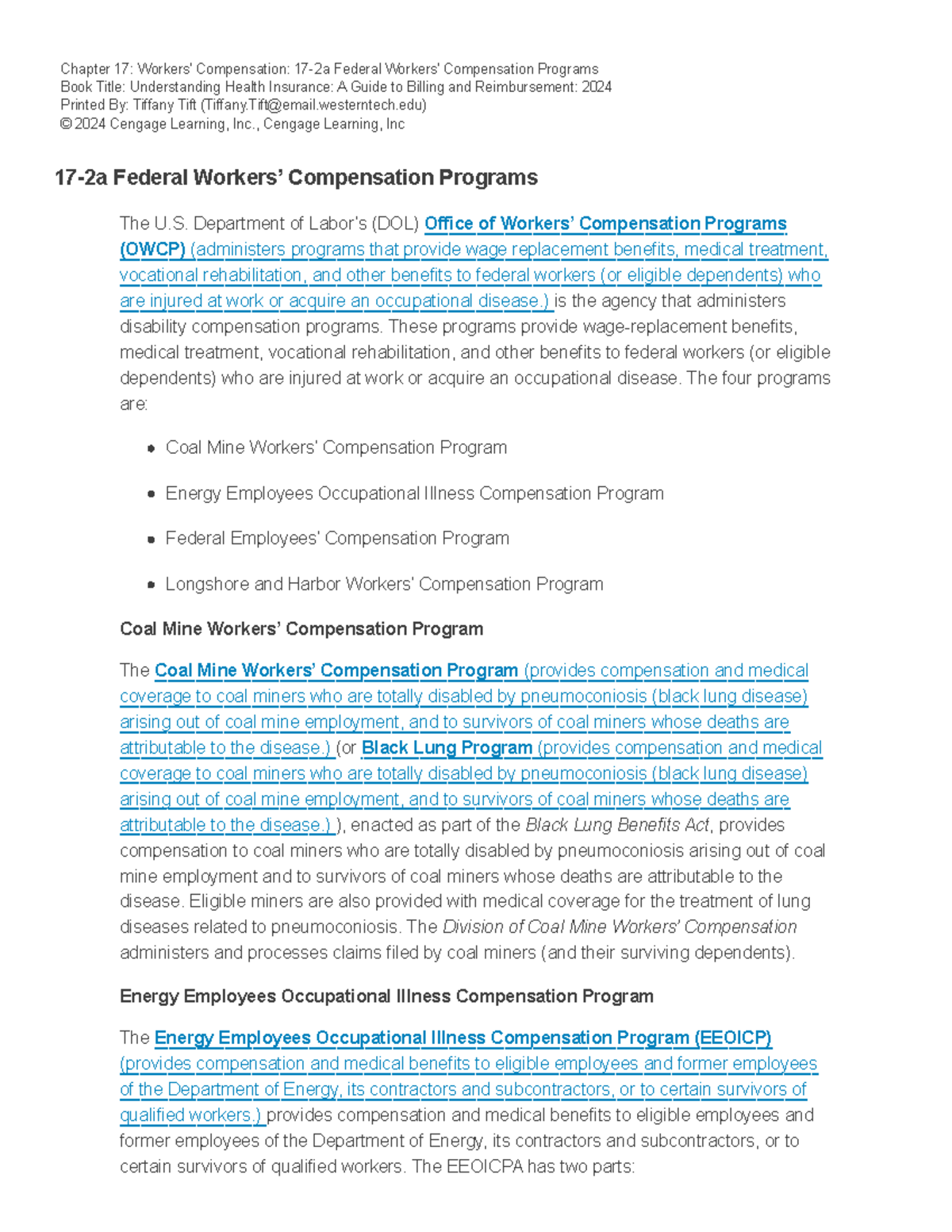
In 1973 and subsequent years, the Office of Workers' Compensation Programs (OWCP) within the United States Department of Labor (DOL) assumed administrative authority over Part C claims. This division created a dual-track system where older claims remained under SSA jurisdiction while newer claims required adjudication by DOL administrative law judges and district directors, with coal mine operators or their insurance carriers contesting liability.
To prevent situations where bankrupt or defunct coal companies left successful claimants without a recovery source, the Black Lung Benefits Reform Act of 1977 established the Black Lung Disability Trust Fund. Financed primarily by an excise tax on mined coal, this fund pays benefits when an operator cannot be identified, when an operator's liability is successfully contested, or when claims predating specific statutory windows require public subsidization.
Medical and Evidentiary Standards Development
A critical component of the 1969 program timeline is the continuous refinement of what constitutes qualifying medical evidence. Early implementation suffered from technological limitations in chest radiography and pulmonary function testing.
Over the decades, statutory amendments and judicial rulings established standardized criteria:
- Chest X-ray Classifications: Utilization of the International Labour Organization (ILO) classification system to categorize opacity sizes and concentrations indicative of pneumoconiosis.
- Blood Gas Studies: Arterial blood gas tests to measure oxygen exchange efficiency, recognizing that normal X-rays do not always capture severe functional impairment from dust exposure.
- Autopsy and Biopsy Evidence: Establishing pathological standards to confirm the presence of coal workers' pneumoconiosis posthumously, ensuring surviving dependents could secure benefits even if antemortem diagnostic tests were inconclusive.
Frequently Asked Questions
What was the main purpose of the 1969 Coal Mine Health and Safety Act regarding compensation?
The 1969 Act aimed to rectify decades of inadequate state-level workers' compensation by establishing a federal program (Title IV) to provide monetary benefits and medical treatment to coal miners totally disabled by black lung disease and to their surviving dependents.
Which government agencies administered the black lung program created in 1969?
Initially, the Social Security Administration (SSA) processed early claims under Part B. Responsibility for industry-funded claims later shifted primarily to the Department of Labor (DOL) under Part C, supported by the Black Lung Disability Trust Fund.
How did the 1969 legislation change the burden of proof for miners?
The law introduced statutory presumptions of disability. If a miner demonstrated long-term underground coal mine employment and met specific medical criteria for respiratory impairment, the law presumed the condition was caused by coal dust exposure, reducing the difficulty of proving employer liability.
Are surface coal miners covered under the provisions established in 1969?
While the original 1969 text focused heavily on underground mining, subsequent amendments—most notably in 1972—explicitly expanded eligibility criteria to include surface coal miners exposed to comparable respirable dust hazards.
How are black lung benefits funded today based on this historical framework?
Benefits are funded either directly by responsible coal mine operators (and their insurance carriers) for established employer-liability claims or through the Black Lung Disability Trust Fund, which is sustained by an excise tax on coal production.
Next Actions and Professional Guidance
For individuals seeking to research historical claims data, legislative text, or current filing procedures under the federal black lung program, consulting primary government resources is essential. Prospective claimants or researchers should review documentation provided directly by the United States Department of Labor's Office of Workers' Compensation Programs (OWCP) or the Social Security Administration. Because black lung claims involve complex administrative law, strict medical evidence requirements, and specific jurisdictional deadlines, consulting with a qualified black lung attorney or a certified miners' advocate is strongly recommended before initiating formal legal proceedings.