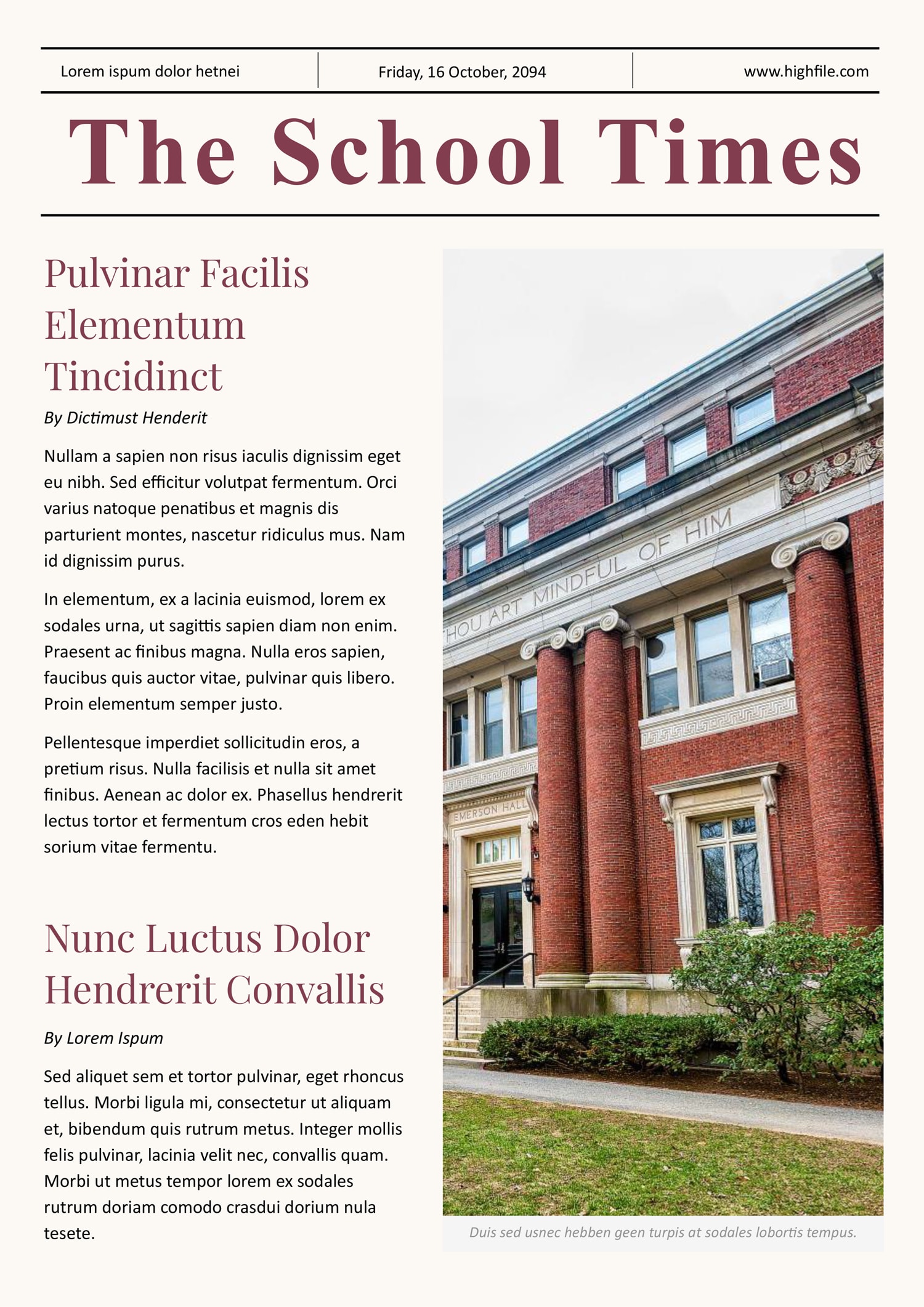
A sample of a newspaper article serves as a foundational blueprint for journalists, students, and communication professionals to understand the rigid structural, stylistic, and objective requirements of professional news reporting. Mastering this format requires balancing the inverted pyramid structure with concise, fact-driven language, ensuring that the most critical information is delivered to the reader immediately.
Understanding the Journalistic Framework
To write a effective news article, one must first understand that newspaper writing is not creative prose; it is a service-oriented craft. The primary goal is to inform the public about current events, policy changes, or community developments with absolute neutrality. Unlike blogs or opinion pieces, a standard newspaper article must strip away the author's personality to let the facts stand alone.
The core structure utilized in professional journalism is the Inverted Pyramid. In this model, the most vital information—the "who, what, when, where, why, and how"—is placed at the very top of the story. As the article progresses, the level of detail decreases, with background information and context provided toward the bottom. This structure serves a functional purpose: editors can cut the article from the bottom up to fit space constraints in a physical newspaper without losing the essence of the news.
Essential Components of a Newspaper Article
A professional article is composed of distinct, standardized parts that allow a reader to quickly digest complex information. Each component plays a specific role in capturing attention and providing authority.
- The Headline: A concise, punchy title that summarizes the core event. It must be active and descriptive.
- The Byline: The author’s name and professional title, acknowledging the reporter behind the investigation.
- The Dateline: A location identifier usually placed at the start of the first paragraph, indicating where the report originated.
- The Lede (Lead): The first sentence or two. This is the most important part of the article. It should encapsulate the most significant impact of the story.
- The Body: Supporting paragraphs that expand on the Lede. This section includes quotes from verified sources, official data, and historical context.
- The Kicker: The final sentence or paragraph, often providing a forward-looking thought or a concluding summary.
Comparison of Journalistic Styles
Professional journalism varies by intent, though the underlying commitment to accuracy remains constant. The following table differentiates the primary types of news writing.
| Article Type | Primary Goal | Tone | Source Reliance |
|---|---|---|---|
| Hard News | Inform on urgent events | Objective, urgent | Officials, experts |
| Feature Story | Explore a human interest | Narrative, descriptive | Interviews, observers |
| Editorial | Advocate a position | Persuasive, firm | Author logic/research |
| Investigative | Uncover hidden facts | Detailed, analytical | Deep record/data dives |
Drafting the Lede: The Gateway to the Story
The "Lede" is the litmus test for any journalist. If a reader does not grasp the importance of the news within the first two lines, they are unlikely to continue. Effective news writers often use the "Summary Lede," which condenses the main action into a single, declarative sentence.
For example, instead of writing "There was a city council meeting last night that discussed many things," a professional reporter would write: "The City Council voted 5-2 Tuesday night to approve a $2.5 million expansion of the downtown public library, a project expected to break ground by early 2027." This is specific, verifiable, and contains all necessary components for a quick reader to understand the stakes.
The Role of Sourcing and Attribution
An article is only as credible as its sources. In professional newspaper writing, attribution is the mechanism used to protect the journalist and prove the accuracy of the claims. Every statistic, expert opinion, or controversial statement must be linked to a source.
Direct quotes should be used sparingly. They are best reserved for capturing a subject's unique perspective or emotional reaction to an event. When using quotes, the journalist must ensure they are accurate—never fabricate a quote to make a story more interesting. If a source is unavailable for a direct comment, the journalist should describe the attempt to contact them or use secondary verified records to maintain objectivity.
Maintaining Technical Precision and Neutrality
Neutrality does not mean the absence of a perspective; it means the absence of the reporter's personal bias. To achieve this, use strong, neutral verbs rather than adverbs or adjectives that signal judgment.
Common pitfalls to avoid:
- Editorializing: Adding opinions such as "sadly," "unfortunately," or "brilliantly." Let the facts define the tone.
- Speculation: Writing about what might happen without citing an expert who has evaluated the probability of that outcome.
- Passive Voice: Newspaper articles prefer active voice. It is punchier and assigns responsibility clearly. For instance, "The committee approved the budget" is superior to "The budget was approved by the committee."
Practical Steps for Writing a News Report
- Preparation and Research: Before typing a single word, verify the facts. Consult official documents, press releases, and reputable organizations. Do not rely on hearsay.
- Structuring the Narrative: Organize your facts by priority. What does the reader need to know first? What can they live without if they stop reading halfway?
- Drafting the Lede: Spend time refining the first sentence. It should be no more than 25–30 words.
- Filling the Body: Build out your points. Each paragraph should ideally be kept short—usually no more than three to four sentences. This improves readability, especially on mobile and digital formats.
- Review and Fact-Checking: Verify spellings of names, titles, and dates. Cross-reference all numbers. If a date is written as 2026, ensure it is the relevant, current time frame.
- Refining for Conciseness: Read through your draft and remove redundant words. If a sentence can be cut without losing information, remove it.
Frequently Asked Questions
What is the standard length for a newspaper article? Hard news reports generally range from 300 to 700 words. Feature stories or investigative pieces can extend to 1,500 words or more. The length is usually determined by the complexity of the subject matter rather than a set rule.
How do I handle sensitive information in a news story? Sensitive information must be cross-verified with at least two independent sources. If information is classified or legally protected, ensure you have the proper clearance or permissions before publishing. When in doubt, consult with a legal professional.
What is the difference between a news article and an opinion piece? A news article aims to provide facts, data, and multiple perspectives to allow the reader to form their own opinion. An opinion piece—or "Op-Ed"—is designed to convince the reader of the author's specific viewpoint using rhetoric and personal argument.
Can I include images in a newspaper article? Yes, but they must be captioned accurately. Every photo, infographic, or chart must have a clear credit line and a description that adds value to the text, rather than merely repeating it.
How do I ensure my article is compliant with 2026 journalistic standards? Modern standards require transparency regarding AI use, image manipulation, and source anonymity. Always disclose if a source requested confidentiality and ensure that any data cited from 2026 is based on official, non-provisional releases where possible.
Final Next Actions for Aspiring Reporters
If you are drafting your first article, begin by selecting a local, verifiable event. Research the event thoroughly using public records or direct observations. Focus on writing the "Lede" first, then outline your supporting arguments based on the inverted pyramid structure. Once your draft is complete, read it aloud. If the flow feels clunky or the sentences are overly complex, simplify them. Professional journalism is measured by its accessibility; the most successful writers are those who can explain complex topics in clear, simple language that any member of the public can comprehend.