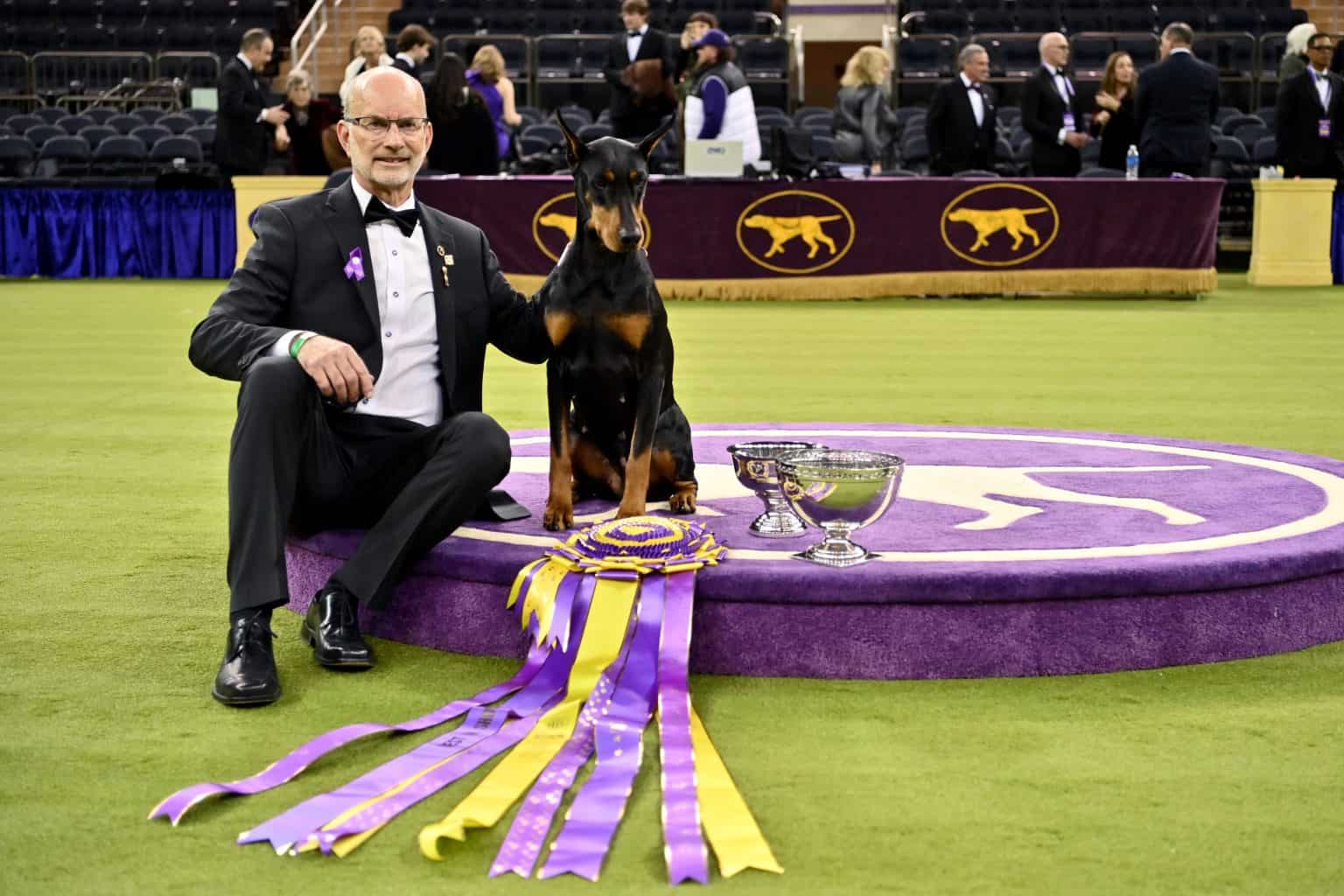
Only three individual Doberman Pinschers have ever claimed the prestigious Best in Show title at the Westminster Kennel Club Dog Show: Ch. Ferry v. Rauhfelsen of Giralda (1939), Ch. Rancho Dobe’s Storm (1952 and 1953), and Ch. Royal Tudor’s Wild as the Wind (1989). These four total victories represent the pinnacle of breed excellence in the American show ring.
The Doberman Pinscher is a breed defined by its silhouette, elegance, and undeniable power. Within the context of the Westminster Kennel Club (WKC) Dog Show—the second longest-running continuous sporting event in the United States—the Doberman has long been a crowd favorite and a perennial contender in the Working Group. Despite its popularity and frequent wins at the group level, the elusive "Best in Show" (BIS) ribbon has only been handed to a Doberman on four occasions. To understand the significance of a Doberman winning Westminster, one must look at the specific dogs that broke through the barrier of elite competition to achieve immortality in the world of purebred dogs.
The Historic First: Ch. Ferry v. Rauhfelsen of Giralda (1939)
The journey of the Doberman Pinscher at the summit of Westminster began in 1939 with a dog named Ch. Ferry v. Rauhfelsen of Giralda. Ferry was not an American-bred dog; he was an import from Germany, a fact that added to the prestige and the high expectations surrounding his appearance at Madison Square Garden.
Ferry was owned by the legendary Geraldine Rockefeller Dodge, one of the most influential figures in the history of the American dog show circuit. Mrs. Dodge’s Giralda Farms was synonymous with quality, and Ferry was the crown jewel of her kennel. When Ferry stepped into the ring in 1939, the breed was still relatively young in the eyes of the American public, having been officially recognized by the American Kennel Club (AKC) only a few decades prior.
Ferry’s win was significant because it validated the Doberman as a serious contender against the more established Terriers and Sporting dogs that had historically dominated the Best in Show lineup. Judges of the era praised Ferry for his "cleanliness of neck," his "powerful drive," and a temperament that was both alert and composed. His victory paved the way for the breed to be viewed not just as a utilitarian guard dog, but as an aesthetic masterpiece capable of winning on the world’s biggest stage.
The Legend of Ch. Rancho Dobe’s Storm (1952–1953)
If there is one name that stands above all others in the history of Doberman show dogs, it is Ch. Rancho Dobe’s Storm. Known simply as "Storm," this dog achieved a feat that remains incredibly rare in the modern era: winning back-to-back Best in Show titles at Westminster in 1952 and 1953.
Owned by Mr. and Mrs. Len Carey, Storm was the epitome of what a Doberman should be. He was a compact, powerful, and incredibly balanced animal. His handler, Peter Knoop, was able to showcase Storm’s legendary "statue-like" pose. Storm had a way of standing that made him look as though he were carved from mahogany, with a topline that never wavered and an expression of intense intelligence.
The 1952 Victory
In 1952, Storm faced a formidable lineup of champions. The Working Group at Westminster is notoriously difficult to win, often featuring massive breeds like Newfoundlands and St. Bernards alongside agile protectors like the Doberman. After winning the group, Storm entered the final ring of six dogs. The judge, Joseph P. Sims, ultimately selected Storm, noting his impeccable condition and "spirit."
The 1953 Repeat
Returning to Westminster as a defending champion is a high-risk endeavor. The pressure to repeat is immense, and judges often look for reasons to "knock off" the previous year’s winner in favor of a fresh face. However, Storm’s quality was undeniable. In 1953, under judge James Farrell, Storm once again dominated the field. This victory solidified his place in history as one of the few dogs of any breed to win Westminster twice. After this win, Storm was retired from competition, leaving the ring at the absolute top of his game.
The Modern Champion: Ch. Royal Tudor’s Wild as the Wind (1989)
After the back-to-back wins of Rancho Dobe’s Storm in the early 1950s, the Doberman Pinscher entered a long "drought" at the Westminster Best in Show level. While many Dobermans won the Working Group and placed in the final ring, the top prize remained elusive for 36 years. That changed in 1989 with a female Doberman named Ch. Royal Tudor’s Wild as the Wind, affectionately known as "Indy."
Indy was a sensation in the late 1980s. Handled by Andy Linton, she was known for her incredible showmanship and "reach and drive"—terms used by enthusiasts to describe a dog’s ability to cover ground efficiently and elegantly during the gaiting phase of judging. Indy was the first female Doberman to win Best in Show at Westminster, a milestone that highlighted the quality of the "bitch" lines in American breeding programs.
Her victory in 1989 was a masterclass in handling. In the final ring, Indy stood perfectly, her dark coat gleaming under the lights of the Garden. She possessed a "look at me" attitude that is essential for winning at Westminster. When judge Bernard Ziessow pointed to Indy as his Best in Show, it marked the fourth and most recent time a Doberman Pinscher has stood at the center of the winner's circle.
Comparative Overview of Doberman Winners
To understand the evolution of the breed and its success at the highest levels, we can compare the key details of these historic winners.
| Year | Winner (Registered Name) | Call Name | Gender | Owner(s) |
|---|---|---|---|---|
| 1939 | Ch. Ferry v. Rauhfelsen of Giralda | Ferry | Male | Geraldine Rockefeller Dodge |
| 1952 | Ch. Rancho Dobe’s Storm | Storm | Male | Mr. and Mrs. Len Carey |
| 1953 | Ch. Rancho Dobe’s Storm | Storm | Male | Mr. and Mrs. Len Carey |
| 1989 | Ch. Royal Tudor’s Wild as the Wind | Indy | Female | Arthur and Mary K. Klein / Beth Wilhite |
What Judges Look for in a Winning Doberman
The AKC breed standard for the Doberman Pinscher is the "blueprint" that judges use to evaluate the dogs. At Westminster, where the competition is composed of the top-ranked dogs in the country, the margins of victory are razor-thin. A Doberman that wins must be a near-perfect representation of the standard.
1. The Silhouette and Proportions
A Doberman is a "square" dog, meaning the length of the body from the prosternum to the rear of the thigh should be approximately equal to the height from the highest point of the wither to the ground. Winners like Storm and Indy possessed this ideal proportion, which gives the breed its characteristic compact and powerful appearance.
2. The Head and Expression
The Doberman head should be a blunt wedge when viewed from the front and in profile. The "planes" of the head—the top of the skull and the bridge of the muzzle—should be parallel. At Westminster, judges pay close attention to the eyes; they must be almond-shaped and dark, conveying an expression of alertness, intelligence, and "fire."
3. Movement and Gait
Dog shows are not just beauty pageants; they are evaluations of a dog's functional movement. The Doberman is a working breed intended for endurance and speed. A winner must demonstrate a "balanced" gait, where the reach of the front legs matches the drive of the rear legs. The topline (back) should remain firm and level while the dog is in motion, something Indy was particularly famous for.
4. Temperament and "Showmanship"
A Doberman that is shy or aggressive will never win at Westminster. The standard calls for a dog that is "watchful, determined, alert, fearless, loyal, and obedient." In the show ring, this translates to "presence." A winning Doberman carries itself with a certain nobility, looking the judge in the eye with confidence.
The Challenge of the Working Group
To win Best in Show, a Doberman must first win the Working Group. This is often cited by handlers as one of the most difficult tasks in the sport. The Working Group includes heavyweights such as the Boxer, the Rottweiler, the Great Dane, and the Akita.
Each of these breeds has a different "ideal" function, yet the judge must decide which dog most closely matches its own breed standard. The Doberman often stands out because of its clean lines and lack of "excess" (no loose skin, no heavy coat), but this also means any flaw is immediately visible. There is nowhere for a poorly structured Doberman to hide. Since Indy’s win in 1989, the Working Group has become even more competitive, with many high-profile "campaigns" for different breeds, making the Doberman's return to the BIS podium a highly anticipated event in the dog world of 2026.
Training and Preparation for Westminster
Preparing a Doberman for the Westminster stage starts years before the dog ever enters the Garden. It involves a rigorous combination of physical conditioning, social training, and meticulous grooming.
- Conditioning: A Doberman must have "hard" muscle. This is achieved through roadwork (running on soft surfaces), swimming, and a high-protein diet. A soft or overweight Doberman will be penalized immediately.
- Socialization: The environment at Westminster is chaotic. Between the crowded benching areas and the roaring fans at Madison Square Garden (or other contemporary venues like the USTA Billie Jean King National Tennis Center), a dog must remain unfazed.
- The "Stack": Handlers spend hours teaching the Doberman to "free stack"—to stand perfectly in position without the handler touching them. This demonstrates the dog's natural balance and its willingness to work with the handler.
Why Hasn't a Doberman Won Recently?
As of 2026, the Doberman "drought" has lasted nearly four decades. This is not due to a lack of quality; in fact, the caliber of Dobermans in the United States is arguably higher than ever. Several factors contribute to this:
- Group Depth: The Working Group is frequently won by Boxers or Giant Schnauzers, who have had dominant runs in recent years.
- Subjectivity of "Presence": Best in Show judges often look for a dog that "peaks" at that exact moment. While many Dobermans are technically perfect, they may be outshone by a more "glamorous" breed, like a Poodle or an Afghan Hound, in the final minutes of the show.
- Breeder Dedication: Doberman breeders are often more focused on the Doberman Pinscher Club of America (DPCA) National Specialty, which is the ultimate test for breed specialists, sometimes prioritizing that over the all-breed spectacle of Westminster.
Frequently Asked Questions
Which Doberman has won the most at Westminster?
Ch. Rancho Dobe’s Storm is the most successful Doberman in Westminster history, having won Best in Show twice (1952 and 1953). No other Doberman has won the title more than once.
Has a red Doberman ever won Best in Show at Westminster?
To date, all Doberman Best in Show winners at Westminster have been the traditional "black and rust" color. While red, blue, and fawn Dobermans are recognized by the AKC, the black and rust variety remains the most common in the winner's circle.
Who was the most recent Doberman to win Westminster?
The most recent winner was Ch. Royal Tudor’s Wild as the Wind ("Indy"), who won in 1989. Since then, several Dobermans have won the Working Group but have not taken the final Best in Show ribbon.
Are cropped ears required for a Doberman to win at Westminster?
While the AKC breed standard allows for both cropped and uncropped ears, the vast majority of Dobermans competing at the championship level in the United States, including all previous Westminster winners, have had cropped ears and docked tails. This is considered the traditional "look" for the breed in the American show ring.
How many Dobermans compete at Westminster each year?
The number of entries varies, but typically between 20 and 40 of the top-ranked Dobermans in the country receive invitations or enter the competition. They must be champions of record to compete.
Practical Advice for Breed Enthusiasts
If you are interested in following the next great Doberman at Westminster, pay close attention to the Working Group results usually broadcast on the final nights of the event. To see the breed-level judging, many fans now use official streaming services provided by the Westminster Kennel Club, which show the "Best of Breed" rounds earlier in the day. Watching these rounds allows you to see the "winners of tomorrow" and understand the high level of competition required to even make it to the main stage under the lights.