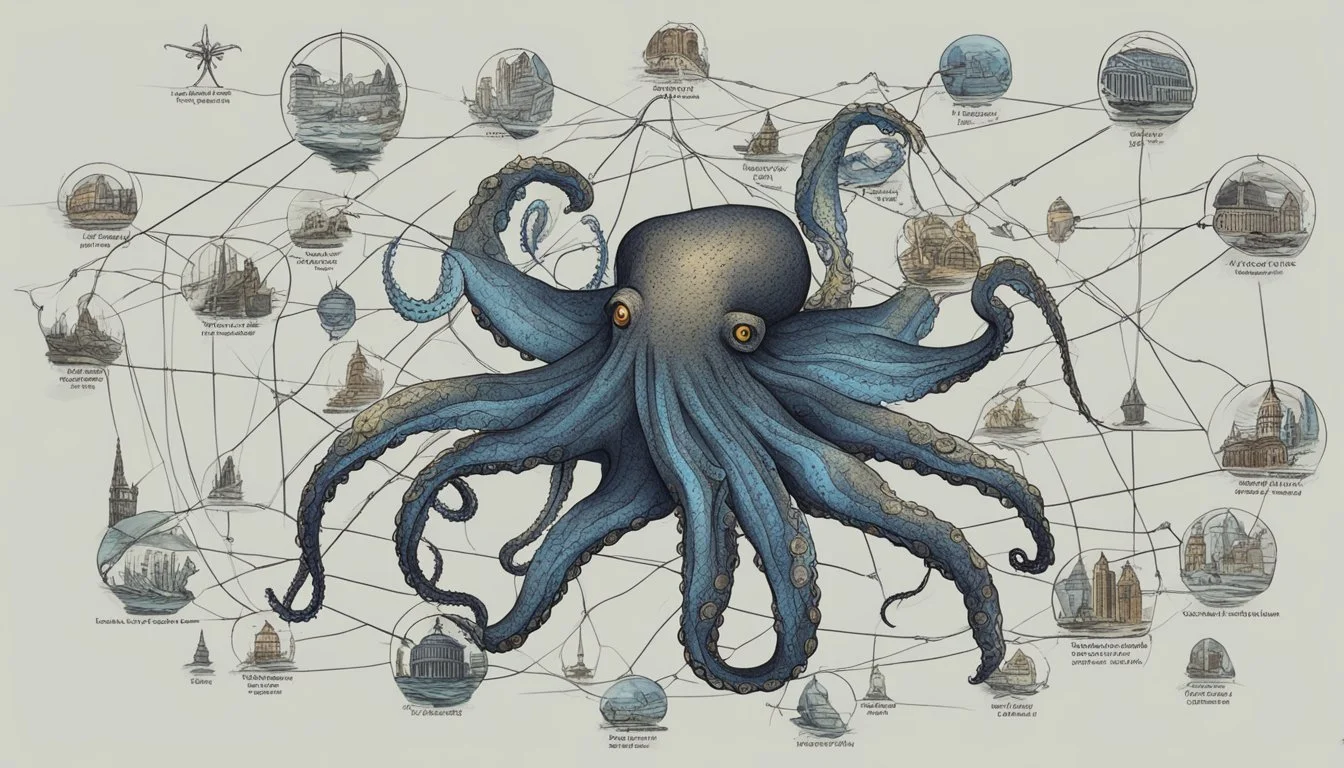
The Netflix docuseries American Conspiracy: The Octopus Murders investigates the 1991 death of journalist Danny Casolaro and his pursuit of a sprawling political conspiracy he called "The Octopus." The series explores the alleged theft of the PROMIS software by the Department of Justice and its ties to international espionage, high-level government corruption, and cold-case homicides.
In the decades since Danny Casolaro was found dead in a Martinsburg, West Virginia, hotel room, his investigation into a shadowy organization he dubbed "The Octopus" has become one of the most enduring and complex true-crime mysteries in American history. The 2024 docuseries, directed by Zachary Treitz and featuring photojournalist Christian Hansen, reignited public interest by re-examining Casolaro’s final days and the legitimacy of the leads he followed. As of 2026, the case remains a focal point for those studying the intersection of investigative journalism, government surveillance, and the psychological toll of pursuing deep-state theories.
The Death of Danny Casolaro: Suicide or Assassination?
On August 10, 1991, Danny Casolaro was discovered in a bathtub at the Sheraton Hotel in Martinsburg. His wrists had been slashed ten to twelve times—so deeply that tendons were severed. The local authorities quickly ruled the death a suicide, citing a note found in the room and Casolaro’s financial struggles. However, his family and colleagues immediately doubted this conclusion.
Casolaro had traveled to Martinsburg to meet a source who promised to provide the "missing link" in his investigation into the "Octopus." Witnesses reported seeing him with an unidentified man at a nearby restaurant shortly before his death. Furthermore, Casolaro’s briefcase, which he reportedly kept with him at all times and which contained his most recent notes and evidence, was missing from the hotel room.
The documentary "American Conspiracy: The Octopus Murders" meticulously recreates these final moments, questioning how a man who was reportedly terrified of blood and needles could have performed such a violent act on himself. By 2026, forensic experts and historians continue to debate the physical evidence, but the mystery of what happened in room 517 remains the catalyst for the entire Octopus narrative.
The First Arm of the Octopus: The Inslaw Scandal and PROMIS
To understand the conspiracy Casolaro was tracking, one must first understand Inslaw Inc. and its software, PROMIS (Prosecutor’s Management Information System). Developed by Bill and Nancy Hamilton, PROMIS was a groundbreaking database program designed to help law enforcement agencies track cases and connect disparate data points.
The Hamiltons alleged that the U.S. Department of Justice (DOJ) under the Reagan administration effectively stole their software by withholding payments and forcing the company into bankruptcy. The legal battle that followed saw a federal bankruptcy judge, George Bason, rule in favor of Inslaw, stating that the DOJ had used "trickery, fraud, and deceit" to misappropriate the software.
The Modification of PROMIS
The conspiracy deepens with the allegation that the DOJ, through various intermediaries, modified PROMIS to include a "backdoor." This allowed the U.S. government to sell the software to foreign intelligence agencies (such as Israel's Mossad) while secretly monitoring those agencies' activities and databases. This claim positioned PROMIS as one of the earliest tools of global digital surveillance, a precursor to the mass data collection systems debated in the 21st century.
Michael Riconosciuto and the Cabazon Connection
A central, and highly controversial, figure in the Octopus lore is Michael Riconosciuto. A self-described child prodigy and weapons expert, Riconosciuto claimed to have worked for the Wackenhut Corporation, a private security firm, on the Cabazon Indian Reservation in Indio, California.
Riconosciuto alleged that the reservation served as a sovereign territory where the U.S. government and private contractors could conduct illegal activities outside of federal jurisdiction. These activities allegedly included:
- Developing biological weapons and advanced munitions.
- Modifying the PROMIS software for international distribution.
- Laundering money for covert operations.
While Riconosciuto provided Casolaro with significant "evidence," his credibility has often been questioned due to his later conviction on drug charges and his reputation for being a "master of disinformation." The documentary "American Conspiracy: The Octopus Murders" explores Riconosciuto's dual nature: he is either the ultimate whistleblower who sacrificed his freedom to tell the truth, or a brilliant con man who led Casolaro down a fatal rabbit hole.
The Eight Arms: A Web of Global Intrigue
Casolaro believed that the Inslaw scandal was just one "arm" of an organization that influenced major historical events. He linked the Octopus to several high-profile scandals of the 1980s, creating a narrative that suggested a shadow government was operating behind the scenes of American democracy.
| Scandal/Entity | Description in Octopus Narrative |
|---|---|
| The October Surprise | Allegations that the Reagan campaign conspired with Iran to delay the release of American hostages until after the 1980 election to ensure Jimmy Carter's defeat. |
| Iran-Contra | The secret sale of weapons to Iran to fund the Contra rebels in Nicaragua, bypassing Congressional bans. |
| BCCI | The Bank of Credit and Commerce International, which was used for money laundering by intelligence agencies and criminal organizations. |
| Wackenhut Corp | A private security firm allegedly serving as a "shadow CIA," conducting clandestine operations on sovereign tribal lands. |
| PROMIS Software | The digital glue used to track assets, enemies, and finances across international borders. |
This table represents the core pillars of Casolaro’s theory. He argued that the same group of individuals—intelligence officers, arms dealers, and government officials—appeared repeatedly across these seemingly unrelated events.
The Cabazon Murders: A Violent Backdrop
The documentary places significant emphasis on the 1981 triple homicide of Fred Alvarez, Patty Castro, and Ralph Boger. Alvarez, a leader of the Cabazon Band of Mission Indians, had begun to blow the whistle on the illegal activities occurring on the reservation.
The failure of local law enforcement to solve these murders for decades added weight to Casolaro's theory that those involved in the Octopus were "untouchable." The documentary follows the long road to justice for the Alvarez family, illustrating how the violent reality of reservation politics merged with the high-stakes world of international espionage.
The Modern Re-investigation: Hansen and Treitz
What sets "American Conspiracy: The Octopus Murders" apart from previous documentaries on the subject is the decade-long dedication of Christian Hansen. Hansen began by retracing Casolaro’s steps, eventually moving to the same areas and interviewing many of the original players who were still alive.
Hansen’s journey serves as a cautionary tale about the psychological impact of conspiracy research. As he digs deeper, the line between objective journalism and personal obsession blurs. The docuseries doesn't just "explore" the murders; it explores the effect of the mystery on those who try to solve it. By 2026, the series is often cited as a landmark in the "meta-true crime" genre, where the investigation itself becomes as much a part of the story as the original crime.
The Legacy of the Octopus in 2026
In the years following the documentary's release, the Octopus has transitioned from a fringe conspiracy theory to a case study in government accountability. While many of Casolaro's more extreme claims remain unproven, the core facts of the Inslaw scandal have been validated by court rulings and investigative reports.
The concept of "The Octopus"—a decentralized network of powerful individuals operating across borders—has become a common framework for understanding modern geopolitical power structures. Whether Casolaro was murdered by this group or succumbed to the pressure of his own investigation, his work highlighted real vulnerabilities in the systems intended to oversee intelligence and justice.
Key Players and Their Roles
- Danny Casolaro: The journalist who gave the conspiracy its name and died while investigating it.
- Bill and Nancy Hamilton: The owners of Inslaw who spent decades fighting for justice regarding the PROMIS software.
- Earl Brian: A businessman and Reagan associate alleged to have been a key recipient of the stolen PROMIS software.
- Robert Booth Nichols: A mysterious figure with alleged ties to both intelligence agencies and the underworld, who befriended and possibly manipulated Casolaro.
Technical Analysis of the PROMIS Software
The technical depth of the Octopus mystery centers on the capabilities of PROMIS. In the early 1980s, most databases were siloed and unable to communicate with one another. PROMIS was revolutionary because it could "bridge" different computer systems, allowing for a unified view of data.
If the DOJ did indeed add a backdoor to this software, they would have had the ability to:
- Monitor Intelligence: See exactly what foreign governments were tracking in their legal and criminal systems.
- Financial Surveillance: Track the movement of money through international banking systems (like BCCI).
- Human Tracking: Follow the movements of individuals across different jurisdictions in real-time.
This level of surveillance was decades ahead of its time, which explains why the software was so highly coveted by intelligence agencies around the world.
Frequently Asked Questions
Was anyone ever charged with the murder of Danny Casolaro?
No. To this day, the official cause of death remains suicide. Despite several re-investigations and the 1992 Congressional report criticizing the DOJ's handling of the Inslaw case, no criminal charges were ever filed in relation to Casolaro's death.
Is the PROMIS software still in use?
The original version of PROMIS is obsolete by modern standards. However, the concepts it introduced—integrated database management and cross-platform tracking—are the foundations of modern law enforcement and intelligence software. Many believe the modified versions of PROMIS evolved into the sophisticated surveillance tools used today.
What was the "October Surprise" mentioned in the documentary?
The October Surprise refers to the allegation that the 1980 Ronald Reagan campaign secretly negotiated with the Iranian government to prevent the release of 52 American hostages until after the election. The goal was to prevent an "October surprise" (the release of the hostages) that might have helped incumbent Jimmy Carter win re-election.
Did Danny Casolaro actually find the "missing link"?
Casolaro told friends and family he was about to "bring home the head of the Octopus" just before he died. He believed he had found a witness who could link the Inslaw scandal directly to the October Surprise and the Cabazon weapons development. However, because his notes were never found, we cannot verify what that link was.
Is Michael Riconosciuto still alive?
Yes, Michael Riconosciuto is alive as of 2026. He was released from federal prison in 2017 after serving 26 years on drug-related charges, which he consistently maintained were fabricated as retaliation for his testimony in the Inslaw case.
Final Recommendation for Researchers
For those interested in exploring the depths of the Octopus murders, the 2024 docuseries provides the most comprehensive visual and narrative starting point. However, the case requires a critical eye. It is essential to distinguish between the documented legal facts of the Inslaw vs. Department of Justice lawsuit and the more speculative links Casolaro made to international spy rings.
To verify the details of the software theft, researchers should consult the 1992 House Judiciary Committee report titled "The Inslaw Affair." For a deeper understanding of the geopolitical context, investigating the "October Surprise" and the "BCCI Scandal" through academic and historical archives is recommended. The mystery of the Octopus is not just a true-crime story; it is a lesson in the complexity of truth in the era of information warfare.