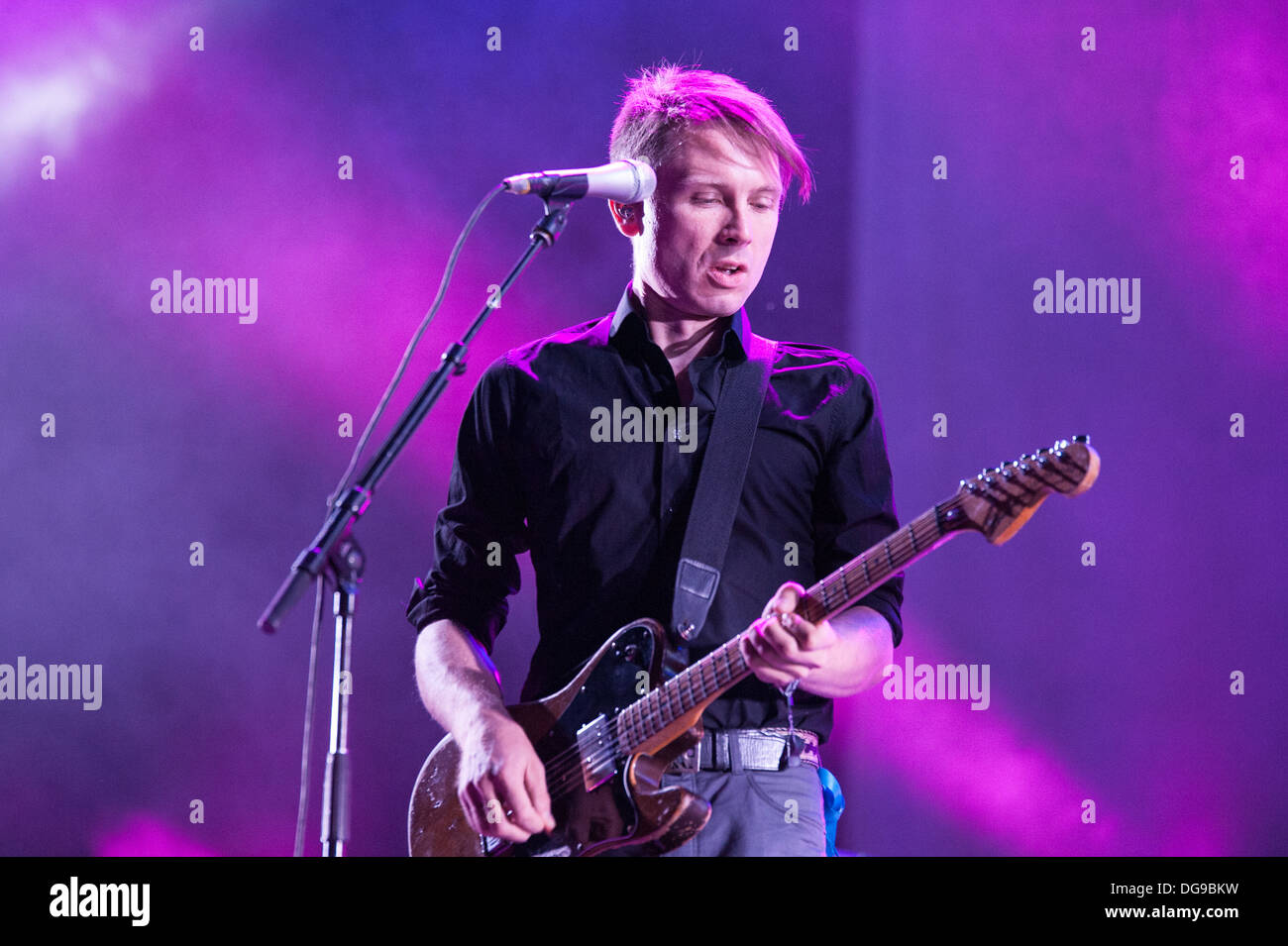
Alex Kapranos is best known as the lead vocalist, guitarist, and primary songwriter for the internationally acclaimed Scottish rock band Franz Ferdinand. Since their emergence in the early 2000s, Kapranos has become a central figure in indie rock, characterized by his distinctive vocal delivery, sharp lyrical observations, and the band's signature fusion of post-punk, dance-punk, and art-pop aesthetics.
Origins and the Formation of Franz Ferdinand
The formation of the band that would define Alex Kapranos’s career was not an overnight success story but rather the result of a deliberate artistic collision in Glasgow. In the early 2000s, the Scottish music scene was vibrant and collaborative. Kapranos, who had previously played in several local groups such as The Karelia and The Yummy Fur, sought to create a project that balanced intellectual depth with danceable, high-energy music.
In 2002, he connected with bassist Bob Hardy, drummer Paul Thomson, and guitarist Nick McCarthy. The group coalesced around a shared philosophy: they wanted to create music that could be played in art school basements yet still appeal to a mainstream audience. The name "Franz Ferdinand" was chosen as a bridge between historical significance—referencing the Archduke whose assassination sparked World War I—and an aesthetic that suggested a sense of elegance and refined disruption. Their debut self-titled album, released in 2004, became a cultural touchstone, propelled by the massive global success of the single "Take Me Out."
Defining the Franz Ferdinand Sound
The musical identity of the band is rooted in the "angular" guitar style that became synonymous with the indie explosion of the mid-2000s. Kapranos’s role as the primary songwriter involved constructing tightly coiled melodies that favored rhythmic precision over traditional rock excess.
Key elements of their sonic signature include:
- Staccato Rhythms: Heavily influenced by post-punk bands like Gang of Four and Orange Juice, the guitar work often features clean, percussive tones rather than sustained power chords.
- Literary Lyrics: Kapranos often writes from the perspective of an observer or a flawed protagonist, frequently using dry wit and observational storytelling to explore themes of romance, social tension, and modern malaise.
- Dance-Rock Integration: By prioritizing a steady, driving bassline and syncopated drumming, the band successfully bridged the gap between guitar-based indie rock and the electronic-influenced dance floor.
Beyond the Band: Collaborative Ventures and Side Projects
While Franz Ferdinand remains his primary creative outlet, Alex Kapranos has cultivated a diverse portfolio of musical projects that showcase his versatility as an instrumentalist and collaborator. His curiosity often leads him to step outside the traditional "band" structure to engage in experimental or genre-specific work.
One of the most notable collaborative efforts was the formation of FFS, a supergroup project involving Franz Ferdinand and the legendary American art-rock duo Sparks. Released in 2015, the self-titled album FFS was a critical success, blending the melodic sensibilities of Franz Ferdinand with the theatrical, eccentric composition style of brothers Ron and Russell Mael. This project demonstrated Kapranos’s ability to adapt his vocal style to suit more complex, operatic arrangements, proving that his artistic identity is fluid rather than static.
Additionally, Kapranos has engaged in various production roles and individual guest appearances, further cementing his status as a collaborator within the global music community. His work often reflects his deep appreciation for music history and his desire to work with artists who challenge his own creative comfort zone.
The Discography: A Chronological Overview
The development of the band’s catalog illustrates a progression from raw, post-punk energy to more polished, experimental production. Each album release represents a specific era in the band’s development.
| Album Title | Year of Release | Key Stylistic Focus |
|---|---|---|
| Franz Ferdinand | 2004 | Raw post-punk, minimalist, dance-focused |
| You Could Have It So Much Better | 2005 | Expansion of melody, classic rock influence |
| Tonight: Franz Ferdinand | 2009 | Electronic textures, synth-heavy, night-club mood |
| Right Thoughts, Right Words, Right Action | 2013 | Return to guitar-driven pop-rock precision |
| Always Ascending | 2018 | Sophisticated art-pop, expanded sonic palette |
| The Human Fear | 2025 | Maturity, introspection, and thematic density |
The Creative Process: Songwriting and Studio Work
For Kapranos, the songwriting process has historically been a balance between solitary reflection and group collaboration. While he often provides the lyrical core of the music, the arrangement of songs is frequently an iterative process. Within the context of the band, the recording studio serves as a laboratory.
Unlike bands that record live takes to capture an "organic" feel, the group often utilizes studio technology to layer instruments precisely. This allows for the intricate, interlocking guitar parts that define many of their tracks. Kapranos has frequently noted the importance of the studio environment in shaping the final output, often working with producers who push the group toward more unconventional sounds rather than simply replicating their live performance.
Cultural Impact and Legacy
The influence of Alex Kapranos and his band extends beyond the charts. During the mid-2000s, they helped redefine what an indie-rock band could be. By embracing fashion, art-school sensibilities, and the crossover appeal of electronic music, they dismantled the barriers between "cool" underground music and pop culture.
His lyrics have been cited for their literate, observational quality, often dealing with the complexities of human interaction in urban settings. This has granted the band a longevity that many of their contemporaries—who burned out following the initial wave of indie success—failed to sustain. The band's ability to remain relevant in 2026 is a testament to Kapranos's commitment to artistic growth, refusing to repeat the formula of their debut album indefinitely.
Requirements for Understanding the Current Era
For fans interested in engaging with the band’s current trajectory as of 2026, it is essential to recognize the shift in the group’s composition and philosophy. While the core creative vision remains anchored by Kapranos, the band has undergone various internal changes. New members have brought fresh perspectives to the instrumental delivery, ensuring that the live experience remains dynamic.
Understanding the band today requires:
- Contextualizing the Back Catalog: Listening to the transition from the minimalist debut to the more complex production of their later works.
- Tracking Collaborative Projects: Being aware that the band functions as an evolving organism rather than a static unit.
- Recognizing thematic shifts: Noticing how Kapranos’s lyrics have transitioned from the youthful energy of early tracks to the more reflective, mature themes of their 2025 release.
Frequently Asked Questions
What was the first band Alex Kapranos played in before Franz Ferdinand?
Before forming Franz Ferdinand, Kapranos was involved in the Glasgow scene with bands such as The Karelia and The Yummy Fur. These projects allowed him to hone his skills as a songwriter and guitarist in the underground Scottish indie circuit.
Does Alex Kapranos still write all the lyrics for his band?
Alex Kapranos serves as the primary lyricist and vocalist for the band. While songwriting credits have historically been shared among members to honor the collaborative nature of the arrangements, the lyrical themes and narrative perspective are consistently driven by his own experiences and observations.
How did the collaboration with Sparks (FFS) come about?
The project was born out of a mutual admiration between the bands. They had followed each other’s work for years, and upon meeting, they discovered a shared aesthetic frequency that made a collaborative album an organic progression rather than a forced professional project.
Where can I find official news and tour dates for the band?
The most reliable source for information regarding tour dates, merchandise, and new releases is the band's official website and their verified social media channels. In 2026, these remain the primary hubs for direct communication between the band and their international audience.
Has the band changed their sound significantly over the years?
Yes, the band has moved from a raw, minimalist post-punk sound toward more nuanced, electronic-inflected art-pop. This progression is evident in the inclusion of synthesizers and more experimental production techniques in their later albums compared to the guitar-centric focus of their early work.
Next Actions for Listeners and Fans
To gain a full appreciation of Alex Kapranos’s musical output, listeners should approach the work chronologically to witness the technical evolution of the songwriting. Start with the debut album for the foundational sound, and then move through the discography to observe how the band incorporates more complex, varied influences over time. If you are interested in the live experience, check the band’s official 2026 tour schedule, as their recent performances continue to prioritize a blend of historical hits and newer, more complex material.