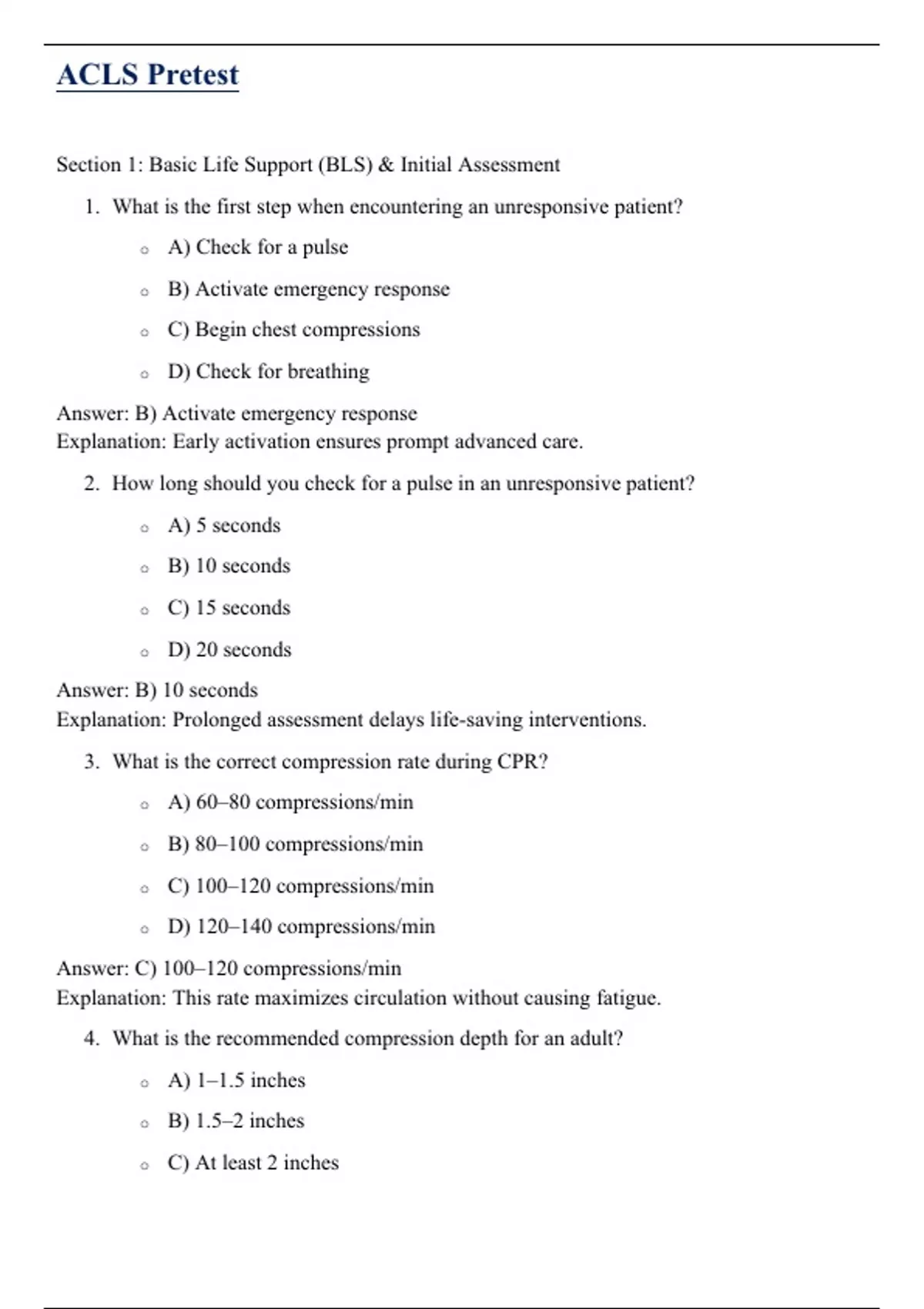
The Advanced Cardiovascular Life Support (ACLS) pretest is a mandatory assessment designed by the American Heart Association (AHA) to ensure healthcare providers possess the foundational knowledge required for advanced resuscitation training. While students often search for "acls pretest answers pdf" files online, these documents are not officially provided, and relying on them undermines the essential clinical readiness necessary for passing the actual certification course and safely managing high-acuity cardiac events.
The Role of the ACLS Pretest in Clinical Education
The ACLS pretest serves as a diagnostic tool rather than a hurdle intended to prevent certification. Its primary objective is to verify that a candidate has mastered the prerequisite knowledge—specifically Basic Life Support (BLS) rhythms, pharmacology, and ECG interpretation—before they enter the classroom. Because ACLS courses are designed to be intensive and fast-paced, they assume that participants are already competent in identifying common arrhythmias and performing high-quality cardiopulmonary resuscitation (CPR).
When candidates search for pretest answers, they typically do so out of test anxiety or a perceived lack of preparation. However, the pretest itself is an "open book" assessment. The AHA allows students to use their textbooks, the ACLS Provider Manual, and other clinical references to complete the questions. The pedagogical goal is for the student to engage with the material, identify gaps in their understanding, and use those gaps to guide their study sessions before the day of the course.
Why "Answer Keys" Are Not Authorized or Reliable
There is no official "ACLS pretest answers PDF" sanctioned by the AHA or any accredited training center. Any documents found online claiming to be official answer keys are often outdated, created by third parties, or incorrect. Using these files is counterproductive for several critical reasons:
- Versioning and Updates: The AHA periodically updates its guidelines based on the latest scientific research. An answer key circulating from five or ten years ago may contain outdated protocols for medication dosages, electrical therapy, or rhythm interpretation. Following these outdated practices could result in incorrect answers during the formal examination and, more importantly, unsafe clinical practice.
- Pedagogical Integrity: The pretest is designed to force the student to navigate the ACLS Provider Manual. The process of looking up a pharmacology dosage or identifying a specific heart block in the textbook reinforces memory retention in a way that simply reading an answer key does not.
- Misalignment with Course Material: Modern ACLS courses use a hybrid learning model. The pretest questions often align with specific chapters and case studies in the most current edition of the provider manual. Third-party answer keys often fail to account for the specific logical flow of the current curriculum.
Navigating the Official Pretest Process
To access the legitimate ACLS pretest, students must use the official portal provided by the AHA or their specific training site. Following the authorized process ensures that the student is evaluated on current, accurate data.
Step-by-Step Access and Completion
- Enroll in a Course: You must be registered for an upcoming ACLS course to gain access to the student portal.
- Access the Student Website: Your training center or the AHA website will provide a specific URL for student resources. You will need your course access key or login credentials.
- Use the Manual: Keep your copy of the ACLS Provider Manual (2020 version or current, as per your training center's requirement) next to you.
- Complete the Assessment: The pretest consists of multiple-choice questions covering rhythm identification, pharmacology, and practical application. If you miss a question, the system typically provides the correct reasoning or directs you to the relevant page in the manual.
- Print or Save Results: Upon completion, you are required to print or digitally save your passing score report. Most training centers require you to present this proof of completion before you are permitted to participate in the skills stations.
Core Competencies Tested in the Pretest
The ACLS pretest focuses on several high-priority clinical areas. Candidates should focus their study time on mastering these specific domains rather than searching for shortcuts.
| Domain | Key Focus Areas |
|---|---|
| ECG Interpretation | Identifying Sinus Bradycardia, Tachycardia, VT, VF, PEA, and Asystole. |
| Pharmacology | Epinephrine, Amiodarone, Lidocaine, and Adenosine dosages and indications. |
| BLS/CPR Basics | Compression-to-ventilation ratios, depth, rate, and chest recoil requirements. |
| Advanced Airway | Recognition of ET tube placement vs. supraglottic airway use in cardiac arrest. |
| Algorithms | Identifying the correct branch of the Cardiac Arrest algorithm based on rhythm. |
ECG Rhythm Mastery
A significant portion of the pretest requires the student to interpret heart rhythms. You must be able to recognize not just the rhythm, but its clinical significance. For example, recognizing "stable" vs. "unstable" tachycardia is vital, as the treatment paths diverge significantly at this decision point. Use the rhythm strips provided in your manual to practice; many digital versions of the manual now include interactive tools that allow for pattern recognition practice.
Pharmacology Dosage Accuracy
ACLS protocols are precise. During a code, there is no time for guessing. The pretest ensures you know the standard doses for common cardiac medications. Focus on the distinction between initial and secondary doses for drugs like Amiodarone, and remember the importance of "pushing" drugs followed by a saline flush. Memorization is not the goal; recognizing the appropriate protocol based on the patient's presentation is.
Troubleshooting Common Pretest Issues
If you find yourself struggling with the pretest, it is a clear indicator that you need to revisit the ACLS Provider Manual before your course date.
- "I am failing the rhythm section": If you struggle with ECGs, do not move on to the pharmacology section. Focus on the basic anatomy of the ECG complex (P-wave, QRS, T-wave). Use free, reputable online rhythm simulators provided by medical universities or the AHA to improve your pattern recognition.
- "The website is crashing": Ensure you are using an updated, compatible web browser. Disable pop-up blockers, as these often interfere with the portal's ability to display the results page or the completion certificate.
- "I cannot find my access code": If you purchased your book through a third-party retailer, ensure you have the correct edition that includes the code. If you are part of a hospital system, contact your clinical educator or the department responsible for staff development; they often manage the account distribution for student portals.
Professional Advice and Clinical Limitations
This article provides guidance on the administrative and preparatory aspects of the ACLS certification process. It does not constitute medical advice, nor is it a substitute for professional clinical training. All resuscitation efforts must be conducted according to the guidelines established by your local medical director and the current national standards of care.
Healthcare providers are responsible for staying current with their organization's policies, which may vary slightly from national recommendations based on local capabilities, available equipment, and legal mandates in your specific jurisdiction. Always consult your facility’s policy manuals when performing clinical duties.
Frequently Asked Questions
Is the ACLS pretest graded, or is it just for practice?
The pretest is a mandatory requirement for admission into the course. While it is not a "pass/fail" exam in the traditional sense, you are required to achieve a passing score (typically 70% or higher) to verify you are prepared for the course. It serves as proof that you have engaged with the material.
Do I have to retake the pretest if I fail?
Yes, if you do not meet the passing threshold, the system will prompt you to review the incorrect answers and retake the assessment. You can take the pretest as many times as necessary to achieve a passing score.
Can I share my pretest results with someone else?
No. The pretest is linked to your individual student account. Your training center will verify that the name on the pretest certificate matches the registration records. Attempting to circumvent this process is a violation of the academic integrity requirements of the AHA training programs.
Why does the AHA require a pretest?
The AHA implements the pretest to ensure that all students in a classroom have a baseline level of knowledge. This prevents the instructor from having to spend valuable class time teaching basic concepts like how to measure a QRS complex, allowing the focus to remain on team dynamics, leadership, and clinical decision-making during high-fidelity simulations.
How much time should I set aside for the pretest?
Plan to spend at least two to three hours on the pretest. This includes the time spent reading the manual and researching the answers to the questions. If you find yourself rushing, you are likely not absorbing the necessary information, which will make the actual ACLS practical skills testing significantly more difficult.
Next Steps for Success
To ensure you are fully prepared for your ACLS certification, your next step should be to locate your ACLS Provider Manual and verify that it is the current edition required by your training center. If you have not yet registered for the course, do so immediately, as many training sites require students to submit their pretest scores 48 to 72 hours before the in-person class begins. Once you have access to the pretest portal, treat the assessment as a study guide rather than a test. By looking up every answer and understanding the logic behind the ACLS algorithms, you will build the clinical confidence needed to perform effectively in real-world emergency scenarios.