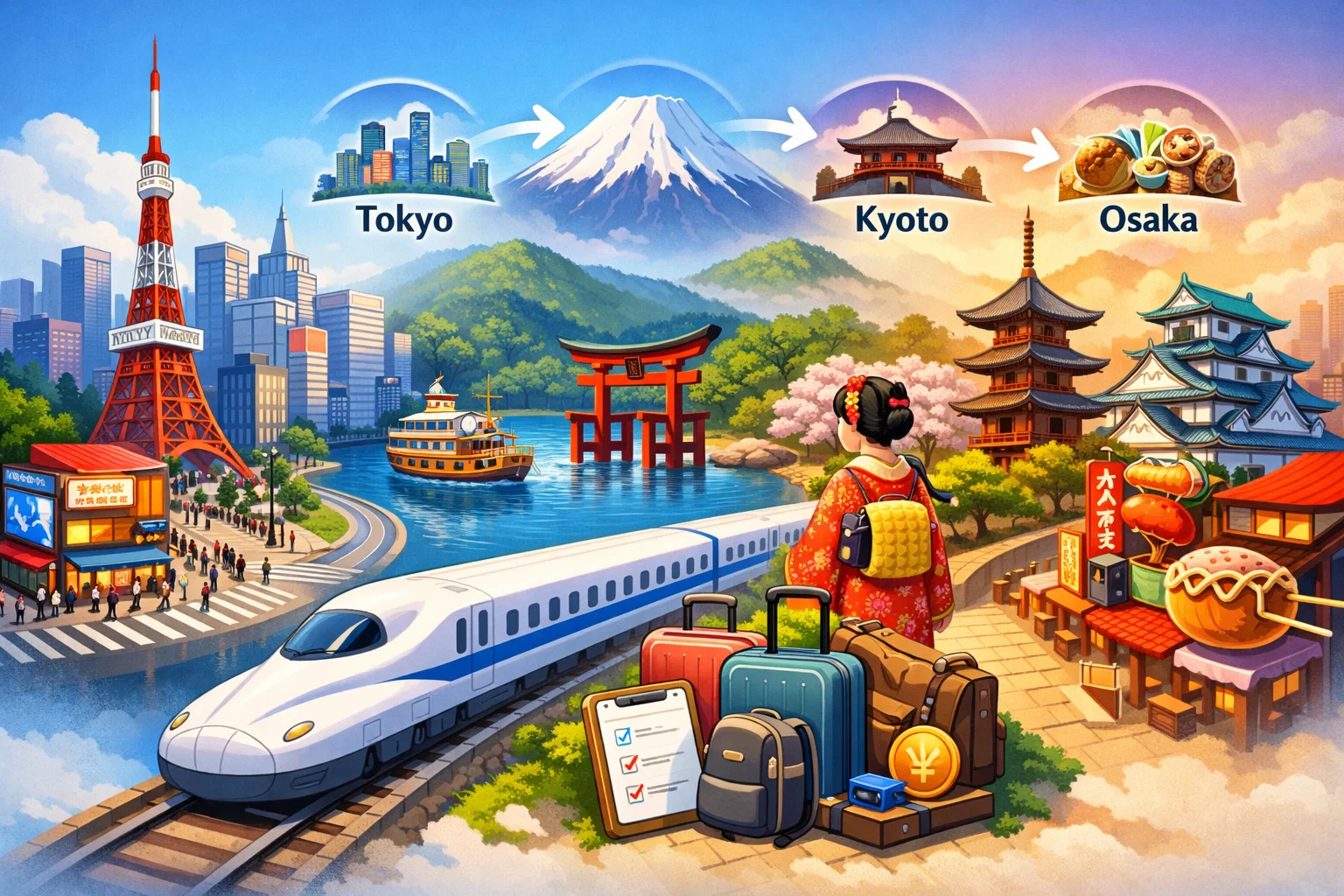
A 9-day Japan itinerary typically follows the "Golden Route," beginning in the neon-lit streets of Tokyo before moving toward the cultural heart of Kyoto and ending in the culinary capital of Osaka. This timeframe allows for a balanced immersion into Japan’s modern innovations and ancient traditions, including iconic stops at Mt. Fuji and the historic temples of Nara.
Planning a trip to Japan in 2026 requires a strategic approach to geography and transportation. With nine days, travelers can realistically cover three major regions without feeling rushed, provided they utilize the high-speed Shinkansen (bullet train) network. This guide outlines a high-efficiency route designed to maximize your time, covering essential logistics, cultural etiquette, and a day-by-day breakdown of the most significant sites in the Land of the Rising Sun.
Essential Prerequisites for Your 2026 Japan Trip
Before arriving at Narita or Haneda Airport, several logistical components must be settled to ensure a seamless experience. In 2026, Japan has further integrated digital solutions for tourism, making pre-arrival preparation more critical than ever.
Connectivity: eSIM vs. Pocket Wi-Fi
Reliable data is non-negotiable for navigating Japan's complex transit systems. Most travelers now opt for an eSIM, which can be activated instantly upon landing. Providers like Ubigi or Airalo offer Japan-specific data plans that are more cost-effective than traditional roaming. However, if you are traveling with a family or multiple devices, a Pocket Wi-Fi rental remains a viable option, offering high-speed, unlimited data that can be shared among several users.
The JR Pass Debate in 2026
The Japan Rail (JR) Pass underwent a significant price increase in late 2023, changing the "math" for travelers. For a standard 9-day Golden Route itinerary (Tokyo–Kyoto–Osaka–Tokyo), a 7-day or 14-day National JR Pass is often more expensive than purchasing individual point-to-point tickets. Travelers should use a JR Fare Calculator to verify if the pass offers actual savings for their specific route. In many cases, using an IC card (like Suica or Pasmo) paired with individual Shinkansen tickets is the more economical choice.
Luggage Forwarding (Takkyubin)
One of Japan’s most convenient services is Takkyubin, or luggage forwarding. For a modest fee (typically 2,000 to 3,000 JPY per bag), you can send your suitcases from your hotel in Tokyo directly to your hotel in Kyoto. This allows you to travel hands-free on the Shinkansen, avoiding the struggle of fitting large bags into limited overhead or end-of-car storage spaces.
Days 1–3: Tokyo – The Neon Metropolis
Tokyo is a city of distinct "neighborhood cities," each with its own character. For a 9-day trip, dedicating the first three days to the capital allows you to adjust to the time zone while checking off major landmarks.
Day 1: Modernity and High-Energy Hubs
Start your journey in Shinjuku, the world’s busiest railway station. After exploring the Omoide Yokocho (Memory Lane) for a glimpse of post-war Tokyo, head to the Tokyo Metropolitan Government Building for a free panoramic view of the skyline. As evening approaches, move to Shibuya. The iconic Shibuya Crossing and the nearby Shibuya Sky observatory provide the quintessential "modern Japan" experience. Shibuya Sky requires booking weeks in advance, as it has become one of the most sought-after views in the city.
Day 2: Culture and Tradition in Asakusa and Ueno
Switch gears by visiting Asakusa, home to Senso-ji, Tokyo’s oldest temple. Arrive before 9:00 AM to avoid the heaviest crowds on Nakamise-dori, the temple's shopping street. From Asakusa, it is a short trip to Ueno Park, which houses the Tokyo National Museum. This area offers a deeper look into Japan’s Edo-period history and art. If time permits, finish the day in Akihabara, the "Electric Town," famous for its multi-story electronics shops and anime culture.
Day 3: Harajuku’s Contrast and Meiji Jingu
Spend your third morning at Meiji Jingu, a Shinto shrine dedicated to Emperor Meiji, located within a massive forest in the heart of the city. Just outside the shrine gates lies Harajuku. Walk down Takeshita Street for "kawaii" (cute) culture and street food, but don't miss Omotesando for high-end architecture and boutique cafes. This area perfectly encapsulates the "old meets new" theme that defines Japan.
Day 4: Hakone – The Gateway to Mt. Fuji
On day four, depart Tokyo for Hakone, a mountainous resort town famous for its hot springs (onsen) and views of Mt. Fuji. Hakone is easily accessible via the "Romancecar" train from Shinjuku Station.
The Hakone Round Course is the most efficient way to see the area. This circular route involves taking a mountain railway, a cable car, a ropeway over the volcanic Owakudani Valley, and a "pirate ship" cruise across Lake Ashi. If the weather is clear, the ropeway and the lake offer some of the best views of Mt. Fuji.
For many, the highlight of Hakone is staying overnight in a Ryokan (traditional Japanese inn). These establishments typically include a multi-course kaiseki dinner and access to communal or private onsen baths. This experience provides a necessary pace change from the intensity of Tokyo.
Days 5–7: Kyoto – The Cultural Heart
On the morning of Day 5, take the Shinkansen from nearby Odawara Station to Kyoto. Kyoto was the capital of Japan for over a millennium, and it remains the country's undisputed cultural center.
Day 5: The Silver Pavilion and the Philosopher’s Path
Upon arrival, head to Eastern Kyoto. Start at Ginkaku-ji (the Silver Pavilion), known for its meticulously maintained sand gardens. From there, walk the Philosopher’s Path, a stone walkway that follows a canal lined with hundreds of cherry trees. The path leads toward the Nanzen-ji temple complex. End your day in Gion, the famous geisha district. While spotting a Geiko or Maiko is rare, the preserved wooden machiya houses offer an atmospheric evening stroll.
Day 6: Arashiyama and the Golden Pavilion
Dedicate your second day in Kyoto to the western side. The Arashiyama Bamboo Grove is best visited at sunrise to capture the ethereal light without the crowds. Nearby, the Tenryu-ji Temple offers one of the finest Zen gardens in Japan. In the afternoon, take a bus or taxi to Kinkaku-ji (the Golden Pavilion). The top two floors are completely covered in gold leaf, creating a stunning reflection in the "Mirror Pond."
Day 7: Fushimi Inari and Kiyomizu-dera
Start early at Fushimi Inari Taisha, famous for its thousands of vermilion torii gates winding up the mountainside. You do not need to hike the entire mountain; the most iconic photo opportunities are within the first 15-20 minutes of the ascent. In the afternoon, visit Kiyomizu-dera, a UNESCO World Heritage site with a massive wooden stage that offers views over the city. The surrounding streets of Sannenzaka and Ninenzaka are perfect for souvenir shopping.
Day 8: Nara and Osaka
On Day 8, take a day trip to Nara, located only 45 minutes from Kyoto by train. Nara was Japan’s first permanent capital, and its historical park is home to hundreds of freely roaming Sika deer, considered messengers of the gods in Shintoism.
The primary attraction in Nara is Todai-ji, which houses the Daibutsu (Great Buddha), one of the largest bronze statues in the world. After exploring Nara, continue your journey to Osaka in the late afternoon. Osaka is known as "Japan’s Kitchen." Spend your evening in Dotonbori, where the neon signs (including the famous Glico Running Man) and street food stalls create a sensory-rich finale to your trip. Be sure to try takoyaki (octopus balls) and okonomiyaki (savory pancakes).
Day 9: Departure from Osaka
Your 9-day itinerary concludes in Osaka. Travelers can depart from Kansai International Airport (KIX), which is well-connected to the city center via the Haruka Express or Nankai Rap:t trains. If your return flight is out of Tokyo, the Shinkansen from Shin-Osaka to Tokyo Station takes approximately 2.5 hours.
Transportation and Budget Comparison Table
To help you decide on the most efficient way to travel during your 9-day stay, consider the following cost and time estimates based on 2026 projections.
| Route Segment | Transportation Method | Approx. Cost (JPY) | Travel Time |
|---|---|---|---|
| Tokyo to Hakone | Odakyu Romancecar | ~2,500 | 85 mins |
| Hakone to Kyoto | Shinkansen (via Odawara) | ~12,500 | 120 mins |
| Kyoto to Nara | JR Nara Line | ~720 | 45 mins |
| Nara to Osaka | Yamatoji Line | ~820 | 50 mins |
| Osaka to Tokyo | Shinkansen (Nozomi) | ~14,700 | 150 mins |
| Total Individual | Point-to-Point Tickets | ~31,240 | Varies |
| 7-Day JR Pass | National Pass (Standard) | ~50,000+ | N/A |
Note: The 7-day JR Pass is generally not recommended for this 9-day itinerary unless you add significant long-distance side trips (e.g., to Hiroshima).
Frequently Asked Questions
Is 9 days enough to see Japan?
Nine days is the minimum recommended duration for a first-time visitor. While it is impossible to see the entire country, it is sufficient to experience the "Golden Route" (Tokyo, Hakone, Kyoto, and Osaka). This provides a comprehensive overview of Japan's urban innovation and historical preservation. To see more remote regions like Hokkaido or Kyushu, a 14-to-21-day trip would be required.
What is the best month to visit Japan in 2026?
The best times to visit are Spring (late March to early April) for cherry blossoms and Autumn (November) for fall foliage. Both seasons offer mild temperatures. However, these are also the busiest and most expensive times. For lower prices and fewer crowds, consider late May or early June, though you may encounter the beginning of the rainy season.
How much should I budget for a 9-day trip?
Excluding international flights, a mid-range traveler should budget between $150 and $250 USD per day. This includes accommodation in 3 or 4-star hotels, Shinkansen travel, entrance fees to major temples, and two meals out per day. Luxury travelers can expect to spend $500+ per day, particularly when staying in high-end Ryokans.
Do I need to carry cash in Japan in 2026?
While Japan has rapidly moved toward digital payments (Apple Pay, Google Pay, and credit cards are now common in cities), it remains partially cash-based. Small temples, traditional shops in rural areas, and some ramen vending machines may still require physical yen. Always carry at least 10,000 JPY in cash for emergencies.
Can I use my phone's transit card in Japan?
Yes, if you have an iPhone or a compatible Android device, you can add a digital Suica or Pasmo card to your mobile wallet. This is the most efficient way to pay for local subways and buses. You can "tap in" and "tap out" at ticket gates and top up your balance directly through your phone using a linked credit card.
Final Recommendations for Your Itinerary
To ensure your 9-day journey is successful, prioritize advance bookings. As of 2026, popular attractions like the Ghibli Museum, Shibuya Sky, and high-end restaurants in Kyoto require reservations weeks, if not months, in advance. Use the official Japan National Tourism Organization (JNTO) website to check for any seasonal festivals or closures that might overlap with your travel dates. Finally, remember to pack comfortable walking shoes; a typical day in Tokyo or Kyoto often involves 15,000 to 20,000 steps.