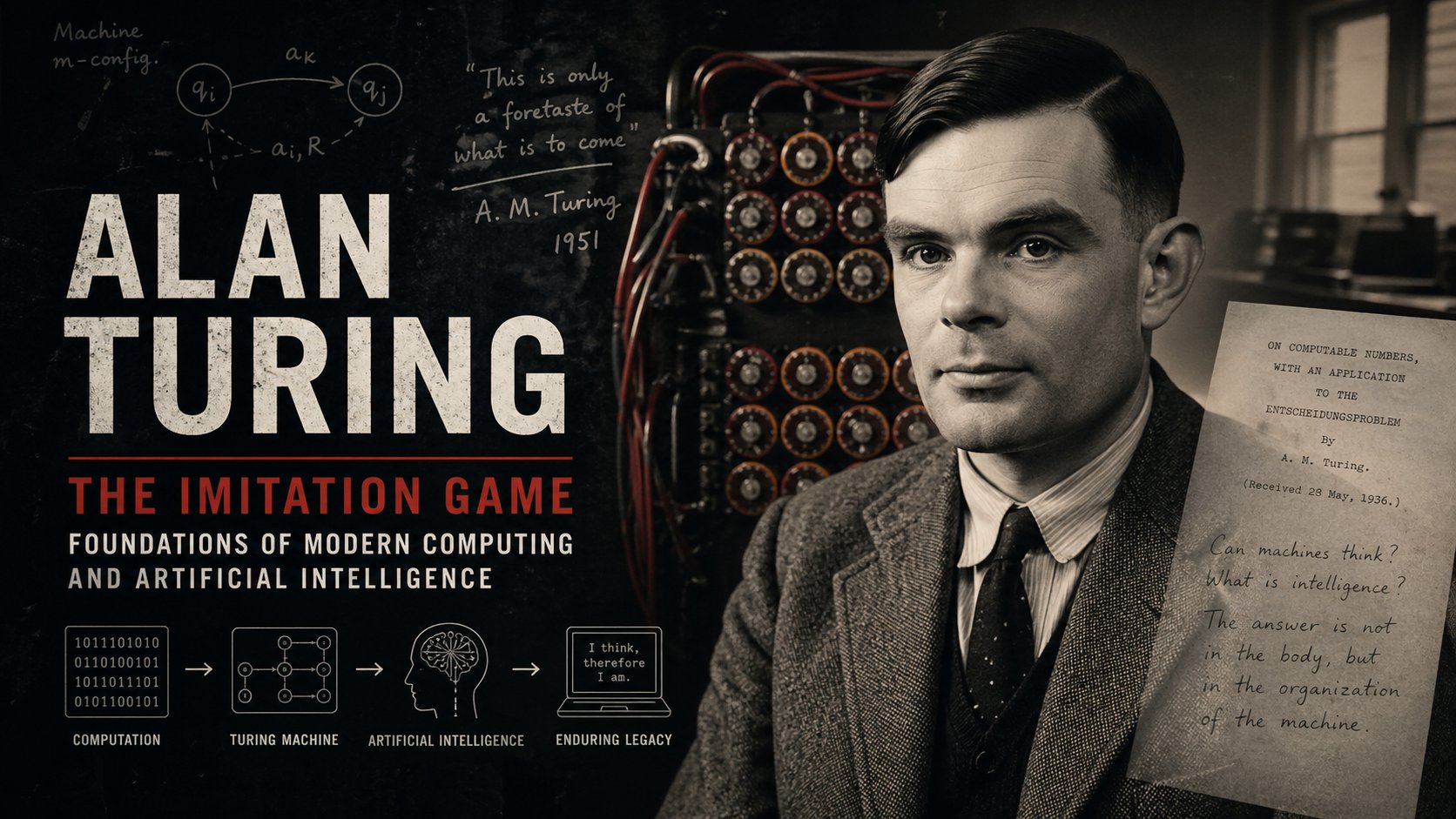
Alan Turing’s 1950 paper, "Computing Machinery and Intelligence," published in the journal Mind, fundamentally redirected the trajectory of computer science and philosophy by replacing the metaphysical question "Can machines think?" with an empirical, behavioral test known as the Imitation Game. By shifting the focus from subjective consciousness to observable performance, Turing established the bedrock for modern artificial intelligence research, setting a standard for machine-human indistinguishability that remains a point of reference in 2026.
The Shift from Metaphysics to Behavior
In the middle of the 20th century, the debate surrounding machine intelligence was largely stifled by semantic ambiguity. Philosophers and early computer scientists struggled to find a common definition for "thinking" or "consciousness." Alan Turing recognized that these abstract terms were inherently subjective and arguably unscientific. To move the field forward, he proposed a practical experiment.
Turing’s central insight was that the definition of intelligence is less important than our ability to measure it. If a machine could operate in a way that is indistinguishable from a human in a linguistic context, the machine’s internal subjective experience—whether it "truly" thinks—becomes secondary to its functional capability. This pragmatic pivot allowed researchers to move away from debates about the human soul and toward the development of algorithms, logic processing, and natural language understanding.
The Mechanics of the Imitation Game
The experiment, now widely referred to as the Turing Test, involves three participants: a human interrogator, a human subject, and a machine. The goal of the game is for the machine to convince the human interrogator that it is the human participant.
The Setup
- The Interrogator: Located in a separate room, the human interrogator communicates with the other two participants through a text-based interface.
- The Subjects: One is a human; the other is the machine being tested.
- The Interaction: The interrogator asks a series of questions. The machine’s objective is to provide answers that lead the interrogator to correctly identify the human participant less than 50% of the time (or, in more contemporary iterations, to be perceived as the human).
By limiting the scope to text-based interaction, Turing effectively abstracted away the need for physical embodiment, focusing entirely on linguistic competence, logic, memory, and the mimicry of human fallibility.
Objections and Philosophical Counterarguments
Turing was acutely aware that his proposal would face significant resistance. In the latter sections of his 1950 paper, he systematically addressed several "objections to the idea that machines can think." These sections serve as an early manifesto for the feasibility of AI.
The Theological Objection
Turing addressed the belief that thinking is a function of the human soul, which only God can grant. He countered by noting that this position limits the power of the divine, suggesting that God could grant a soul to a machine if He so chose.
The "Heads in the Sand" Objection
This is the fear that machines becoming intelligent would have terrifying consequences for human uniqueness. Turing dismissed this as an emotional argument rather than a logical one, suggesting that such fear should not dictate the limits of scientific inquiry.
The Mathematical Objection
Drawing on his own work on Gödel’s incompleteness theorems, Turing acknowledged that digital computers have limitations. However, he argued that human intelligence is likely subject to similar constraints, and that the inability of a machine to solve every possible problem does not preclude it from being intelligent.
The Argument from Consciousness
The most persistent challenge remains the "Lady Lovelace" objection: that machines can only do what they are told to do. Turing countered this by noting that humans are also influenced by their conditioning and education, and that machines can, through unexpected output (learning), surprise their creators.
Computational Requirements and Modern Relevance
In 1950, the hardware required to even approximate the human brain’s capacity did not exist. Turing acknowledged that while a digital computer was a "discrete state machine" that could simulate any other machine, the memory requirements to hold the necessary rules and internal states of a human mind were vast.
In 2026, the landscape has shifted from the theoretical to the architectural. Modern Large Language Models (LLMs) operate on principles that mirror aspects of Turing’s vision—processing vast amounts of data to produce probabilistic, human-like linguistic output. The difference is that today’s systems do not merely follow rigid, pre-programmed rules; they utilize neural networks to "learn" patterns, which aligns with Turing’s suggestion that a "child machine" could be programmed to learn through experience and feedback.
Comparison of Intelligent Systems Approaches
| Feature | Symbolic AI (Classical) | Modern Neural Architectures |
|---|---|---|
| Logic Basis | Predetermined rule sets | Probabilistic data weights |
| Learning | Static / Manual updates | Continuous fine-tuning |
| Turing-Like Interaction | Often fails due to rigidity | Highly successful in text tasks |
| Core Limitation | Brittle in edge cases | Potential for hallucinations |
The Problem of "The Simulation Trap"
One of the most critical aspects of Turing's paper is the implicit warning about the nature of intelligence. By creating a test based on imitation, Turing inadvertently highlighted the distinction between simulating intelligence and possessing it.
As we progress through 2026, AI systems can easily pass text-based variants of the Imitation Game. However, experts note that these systems lack agency and genuine understanding. When a system passes the test, it confirms its excellence in mimicry, but it does not necessarily solve the philosophical problem of consciousness that Turing sought to sidestep. The "simulation trap" is the risk of mistaking the output of a sophisticated statistical model for the presence of a sentient mind.
Common Misconceptions
There is a tendency to view the Turing Test as the ultimate goal of AI development. In reality, Turing proposed it as a framework for testing, not necessarily a blueprint for constructing the intelligence itself. Many modern developers focus on "narrow AI," which outperforms humans in specific domains like medical diagnosis or mathematical proofs, rather than "general AI" that focuses on the universal imitation of human behavior.
- "The Turing Test is a formal benchmark." It is not a standardized certification; rather, it is a conceptual framework that has been adapted by researchers into various localized benchmarks.
- "Turing predicted the exact date of AGI." Turing did not predict when machines would "think." He estimated that by the year 2000, machines would be capable of playing the imitation game well enough that an interrogator would have less than a 70% chance of making the right identification.
- "Turing believed machines could never be truly conscious." Turing remained neutral. He focused on the appearance of intelligence because he believed it was the only testable metric.
Practical Guidance for Navigating AI Claims
When evaluating claims about "Turing-complete" or "human-level" intelligence in 2026, it is essential to distinguish between performance and capability.
- Contextual Performance: Does the machine excel at a specific, constrained task (like coding or data analysis) or a broad range of human conversation?
- Verification: Look for peer-reviewed evaluations. Passing a single chat session is not a comprehensive measure of intelligence.
- Safety Constraints: Observe how the machine handles nonsense or malicious prompts. A system that mimics human bias is not necessarily "intelligent"; it is simply reflecting its training data.
Frequently Asked Questions
What was Alan Turing’s primary goal in "Computing Machinery and Intelligence"?
Turing aimed to replace the ill-defined, philosophical debate about whether machines can "think" with a concrete, behavioral experiment that could be analyzed scientifically.
Does passing the Turing Test mean a machine is intelligent?
No. In current technical discourse, passing the test implies the machine has successfully mastered the imitation of human linguistic patterns, but it does not confirm the presence of consciousness, subjective experience, or sentient understanding.
Why did Turing choose a text-based test?
Turing believed that by focusing on text, he could isolate intelligence from physical requirements (like walking or speech) and focus on the core capacity for logic, memory, and linguistic structure.
How does the 1950 paper impact AI development in 2026?
It serves as the conceptual foundation for all generative AI. The shift from "hard-coded rules" to "learning from data" in modern machine learning is the logical evolution of the "learning machine" concept Turing proposed in the final sections of his paper.
Is the Imitation Game still used in modern research?
While the classical version is rarely used as a formal test for modern systems, the underlying principle—evaluating a system by how well it mirrors human performance in natural language—remains the gold standard for LLM evaluation.
Moving Forward
The enduring power of "Computing Machinery and Intelligence" lies in its simplicity. By focusing on the interaction rather than the essence of the machine, Turing provided a path for engineers to build systems that act effectively in the world. As we continue to refine these systems, the next step is to ensure that while we develop machines that imitate human brilliance, we maintain human control over their application. Focus on verifiable performance, prioritize the transparency of model behavior, and treat AI output as a tool for human enhancement rather than a replacement for human judgment.