Aetna Medicare Supplement (Medigap) plans, issued by Aetna Life Insurance Company and its subsidiaries, provide secondary coverage that fills the "gaps" in Original Medicare. In 2026, these plans remain essential for beneficiaries seeking predictable healthcare costs, covering expenses like Part A deductibles, Part B coinsurance, and foreign travel emergencies.
Medicare Supplement insurance, commonly known as Medigap, is designed to work exclusively with Original Medicare (Part A and Part B). Unlike Medicare Advantage, which replaces your Original Medicare benefits with a private managed-care network, a Medigap plan from Aetna allows you to visit any provider in the United States that accepts Medicare patients. Because Aetna is one of the largest insurers in the country—now operating as a subsidiary of CVS Health—its Medigap products are widely recognized for their financial stability and broad availability.
Understanding the Role of Aetna in the Medigap Market
Aetna does not just offer one type of insurance; it operates through several subsidiaries depending on the state in which you reside. When researching Aetna Medigap plans in 2026, you may see policies issued under names such as Aetna Life Insurance Company, American Continental Insurance Company (ACI), or Continental Life Insurance Company of Brentwood, Tennessee (CLI). Regardless of the specific subsidiary name on the policy, these are all Aetna-branded products backed by the same corporate infrastructure.
The primary appeal of choosing Aetna for Medigap coverage lies in the standardization of these plans. The Centers for Medicare & Medicaid Services (CMS) mandates that every "Plan G" or "Plan N" must offer the exact same core benefits, regardless of the insurer. Therefore, the differentiator for Aetna is its customer service, premium stability, and financial ratings. As of 2026, Aetna continues to hold strong financial strength ratings from agencies like AM Best, which is a critical factor for seniors who want assurance that their insurer will be able to pay claims long into the future.
Core Medigap Plan Options Offered by Aetna
In 2026, Aetna typically focuses its offerings on the most popular standardized plans. While availability varies by state, the following plans represent the bulk of Aetna's Medicare Supplement portfolio.
Medigap Plan G: The Most Comprehensive Coverage
Plan G has become the "gold standard" for new Medicare enrollees. It covers every gap in Original Medicare except for the Medicare Part B annual deductible. Once you have paid your Part B deductible out-of-pocket, Plan G covers 100% of all remaining Medicare-approved expenses. This includes:
- Medicare Part A hospital coinsurance and hospital costs up to an additional 365 days after Medicare benefits are exhausted.
- Medicare Part B coinsurance or copayments.
- Blood (first 3 pints).
- Part A hospice care coinsurance or copayments.
- Skilled nursing facility care coinsurance.
- Medicare Part A deductible.
- Medicare Part B excess charges (the difference between what a doctor charges and what Medicare pays).
Medigap Plan N: The Value-Driven Alternative
Plan N is often preferred by individuals who are willing to take on a small amount of cost-sharing in exchange for lower monthly premiums. While Plan N covers the Part A deductible and Part B coinsurance, it requires the policyholder to pay:
- The Medicare Part B annual deductible.
- Copayments of up to $20 for some office visits.
- Copayments of up to $50 for emergency room visits that do not result in inpatient admission.
- Part B excess charges (in states where excess charges are permitted).
Medigap Plan F: For Eligible Legacy Enrollees
It is important to note that Plan F is only available to individuals who became eligible for Medicare prior to January 1, 2020. If you meet this criteria, Aetna may still offer Plan F, which covers 100% of all gaps, including the Part B deductible. However, for most people entering the system in 2026, Plan G has replaced Plan F as the highest level of available coverage.
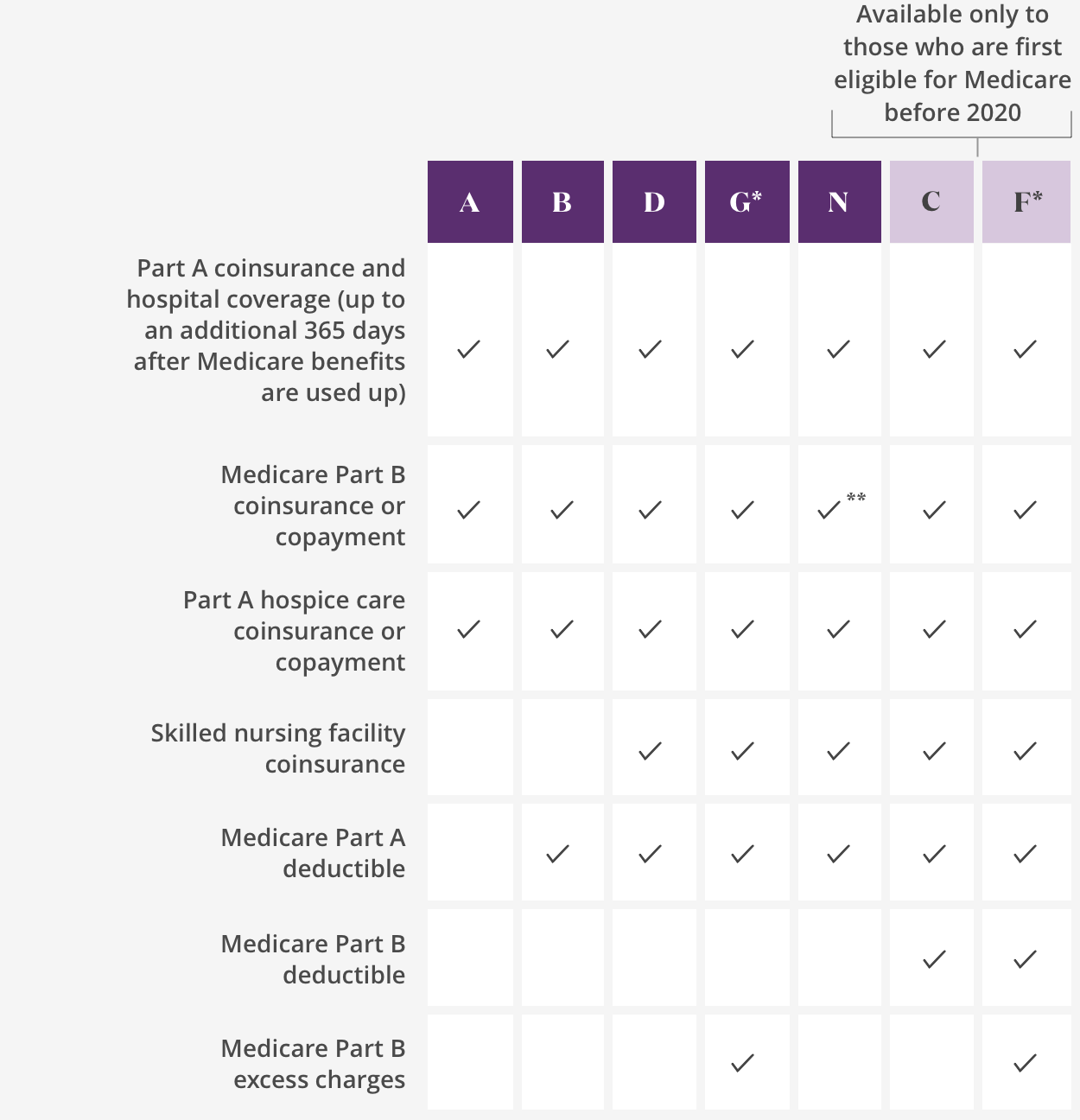
2026 Aetna Medigap Benefit Comparison Table
The following table outlines the coverage levels for the most common Aetna Medigap plans available in 2026.
| Benefit Feature | Plan A | Plan F* | Plan G | Plan N |
|---|---|---|---|---|
| Part A Deductible | No | Yes | Yes | Yes |
| Part B Deductible | No | Yes | No | No |
| Part B Coinsurance | Yes | Yes | Yes | Yes (with copays) |
| Part B Excess Charges | No | Yes | Yes | No |
| Skilled Nursing Coinsurance | No | Yes | Yes | Yes |
| Foreign Travel Emergency | No | 80% | 80% | 80% |
| Hospitalization (Part A) | Yes | Yes | Yes | Yes |
*Plan F is only available to those eligible for Medicare before Jan 1, 2020.
Cost Factors and Household Discounts
When evaluating Aetna's Medigap plans, the premium you pay is influenced by several factors beyond the plan letter itself. In 2026, Aetna utilizes several pricing models, though Attained-Age rating is the most common. In this model, premiums are based on your current age and generally increase as you get older.
One of Aetna's most competitive features is the Household Discount. In many states, Aetna offers a premium reduction (typically between 7% and 12%) if you live with a spouse or a civil union partner, or in some cases, another adult who has lived with you for the past 12 months. This discount can significantly lower the total cost of coverage for couples entering Medicare at the same time.
Other factors affecting cost include:
- Tobacco Use: Non-smokers generally receive lower rates.
- Location: Premiums vary by zip code due to local healthcare costs.
- Payment Method: Some discounts may apply if you set up automatic bank drafts (Electronic Funds Transfer).
Eligibility and Enrollment Periods
To enroll in an Aetna Medigap plan, you must be enrolled in both Medicare Part A and Part B. The timing of your application is the single most important factor in determining your premium and your ability to get coverage.
The Medigap Open Enrollment Period
This is a one-time, six-month window that begins the first month you are 65 or older and enrolled in Medicare Part B. During this period, Aetna is prohibited from using medical underwriting. This means they cannot deny you coverage or charge you more based on pre-existing conditions. If you miss this window, you may be required to answer health questions, and Aetna can deny your application based on your medical history.
Guaranteed Issue Rights
In certain situations, such as losing employer-sponsored coverage or if your Medicare Advantage plan leaves the service area, you may have "Guaranteed Issue" rights. This allows you to join an Aetna Medigap plan outside of your initial enrollment period without medical underwriting.
The Underwriting Process for Aetna Plans
If you apply for an Aetna Medigap plan after your Open Enrollment Period has ended and you do not have a Guaranteed Issue right, you will undergo medical underwriting. Aetna’s underwriters typically look at:
- Chronic Conditions: Recent diagnoses of heart disease, cancer, or COPD may lead to a denial.
- Recent Hospitalizations: Surgery or hospital stays within the last two years are closely scrutinized.
- Prescription Medications: Certain "maintenance" drugs for serious conditions can trigger a higher rate or denial.
It is worth noting that Aetna is often considered to have a "moderate" underwriting stance compared to some niche providers, making them a viable option for individuals with minor, well-controlled health issues.
Advantages and Disadvantages of Aetna Medigap Plans
Choosing an Aetna plan involves weighing the company's broad reach against the specific limitations of Medigap insurance.
Advantages
- Brand Recognition: Aetna is a household name, providing a sense of security for many beneficiaries.
- Digital Tools: Through the Aetna Medicare portal, members can easily track claims and manage billing.
- No Networks: You can see any doctor in the U.S. that accepts Medicare; there are no "in-network" restrictions like those found in HMOs or PPOs.
- Foreign Travel Benefits: Most Aetna plans (G and N) provide 80% coverage for emergency medical care outside the U.S., up to a lifetime maximum of $50,000.
Disadvantages
- No Drug Coverage: Medigap plans do not include Part D prescription drug coverage. You must purchase a separate Part D plan (which Aetna also offers via SilverScript).
- No "Extras": Unlike Medicare Advantage, Medigap plans usually do not cover routine dental, vision, or hearing services.
- Premium Increases: Like all Medigap providers, Aetna's premiums will likely rise over time due to inflation and the aging of the policyholder.
Comparison: Medigap vs. Medicare Advantage
A common point of confusion is whether to choose an Aetna Medigap plan or an Aetna Medicare Advantage plan. In 2026, the choice usually comes down to "pay now" versus "pay later."
With an Aetna Medigap plan, you pay a higher monthly premium but have almost no out-of-pocket costs when you go to the doctor (especially with Plan G). With an Aetna Medicare Advantage plan, you might pay a $0 monthly premium, but you will pay copayments every time you visit a specialist or undergo a procedure. Furthermore, Medigap offers total freedom of choice regarding providers, whereas Medicare Advantage requires you to stay within a specific network of doctors to receive the lowest rates.
Frequently Asked Questions
Does Aetna Medigap cover SilverSneakers?
Many Aetna Medicare Supplement plans include access to the SilverSneakers fitness program at no additional cost. This provides members with access to thousands of participating gyms and fitness centers nationwide. However, you should verify availability in your specific state and policy version, as "extra" benefits are not part of the standardized government core benefits.
Will my Aetna Medigap plan be canceled if I get sick?
No. As long as you pay your premiums on time, your Aetna Medigap policy is "guaranteed renewable." The insurance company cannot cancel your coverage based on your health status or the number of claims you file.
How do I file a claim with Aetna?
Medigap claims are handled through a process called "crossover." When your doctor bills Medicare, Medicare pays its portion and then automatically alerts Aetna to pay the remaining balance. In most cases, you never have to file a claim form yourself; the coordination of benefits happens behind the scenes between the Centers for Medicare & Medicaid Services and Aetna.
Can I switch from a Medicare Advantage plan to an Aetna Medigap plan?
You can switch during the Annual Enrollment Period (October 15 – December 7) or the Medicare Advantage Open Enrollment Period (January 1 – March 31). However, unless it is your first time trying Medicare Advantage (the "trial right" period), you will likely have to pass medical underwriting to qualify for an Aetna Medigap plan.
Does Aetna offer a high-deductible Plan G?
Yes, in many states Aetna offers a High-Deductible Plan G (HDG). This plan offers the same coverage as standard Plan G but only after you have met a high annual deductible (which is set by the IRS and CMS each year). This is an excellent option for those who want catastrophic coverage at a very low monthly premium.
Final Recommendation
For beneficiaries in 2026, an Aetna Medicare Supplement plan is a robust choice for those who value freedom of provider choice and budget predictability. If you are new to Medicare, Plan G is the most comprehensive option available, while Plan N offers a strategic way to lower monthly costs if you do not mind occasional small copayments.
To ensure the best rates, always apply during your initial six-month Medigap Open Enrollment Period to avoid medical underwriting. If you are applying as a couple, be sure to ask specifically about the Household Discount, as this can make Aetna one of the most cost-effective carriers in the marketplace. For personalized assistance, you can visit the Official Medicare Website to compare Aetna's local rates against other carriers in your specific zip code.