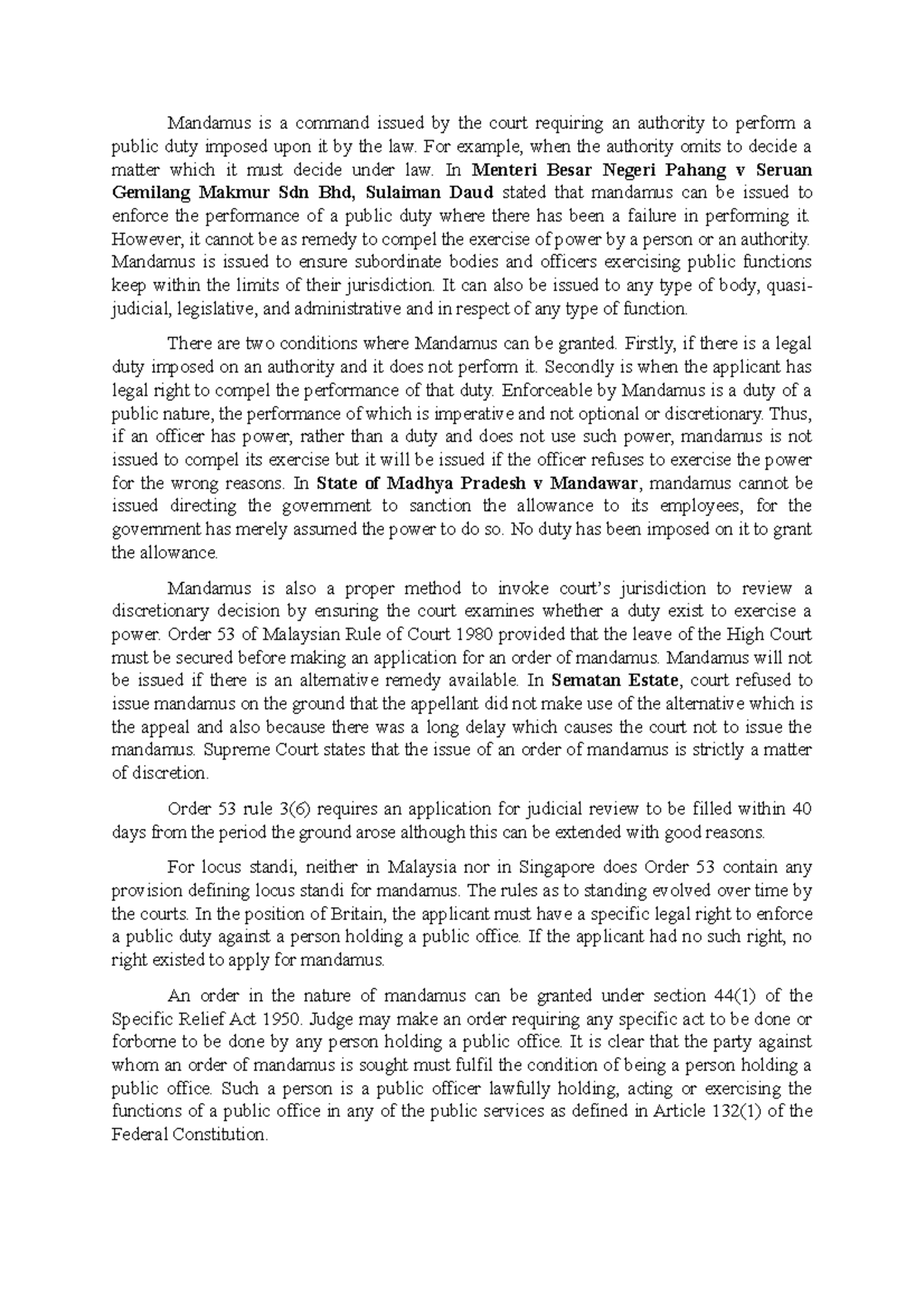
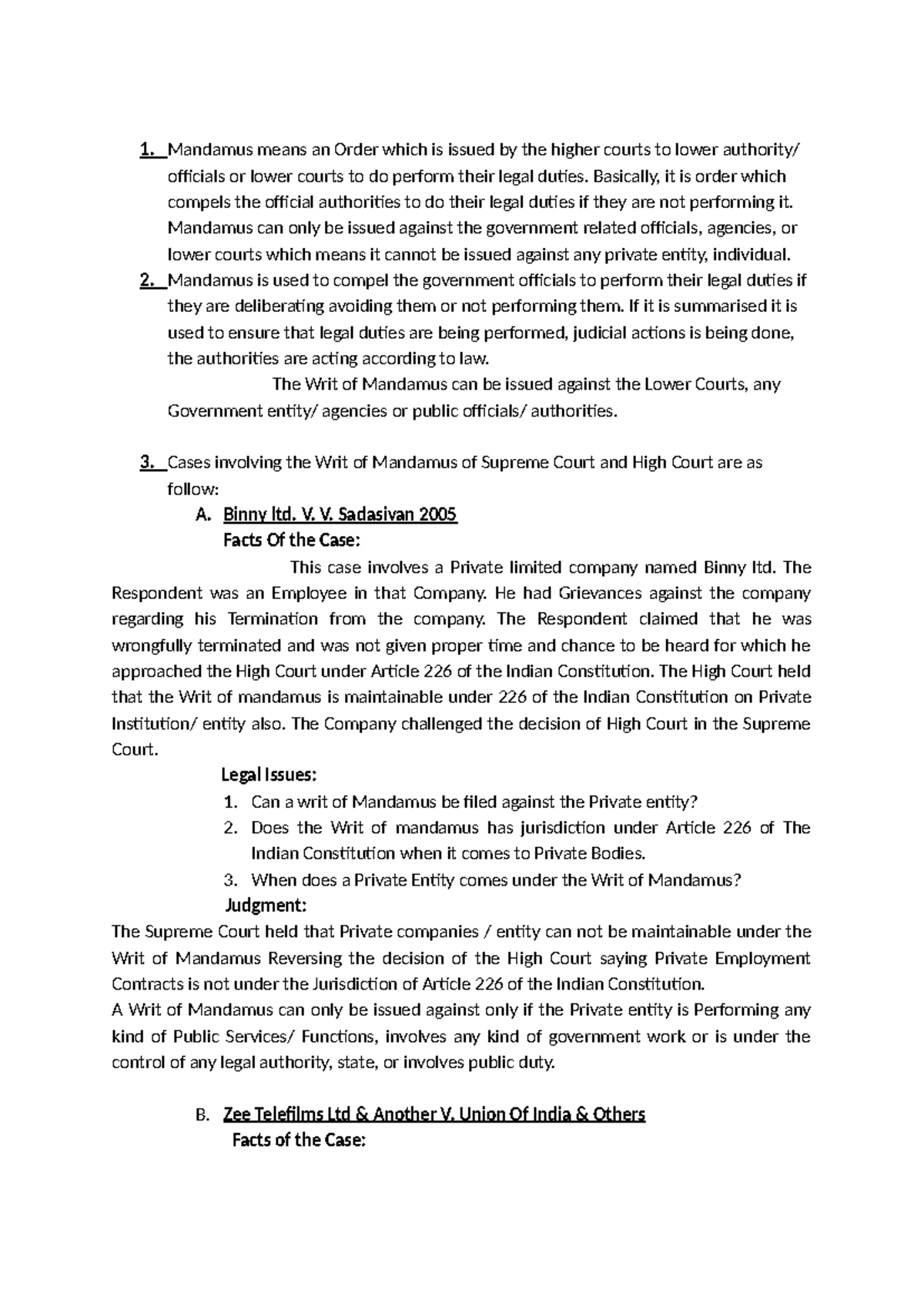
An action in mandamus is a specialized judicial remedy used to compel a government official, public body, or lower court to perform a mandatory, non-discretionary duty required by law. It serves as a vital check on administrative inaction, ensuring that public entities fulfill their legal obligations when no other adequate legal remedy exists.
In the complex landscape of administrative and constitutional law, the writ of mandamus stands as one of the most powerful "extraordinary remedies" available to litigants. Derived from the Latin word for "we command," a mandamus action seeks a court order directing a respondent to fulfill a specific legal obligation. As of 2026, this legal tool remains a critical instrument for addressing bureaucratic delays, ensuring transparency, and upholding the rule of law across various jurisdictions.
The Fundamental Nature of a Mandamus Action
A petition for a writ of mandamus is not a standard civil lawsuit for damages. Instead, it is a request for the court to exercise its equitable powers to correct an abuse of power or a failure to act. Because it is considered an "extraordinary" remedy, courts generally view it as a tool of last resort. It is reserved for situations where a public official has a clear legal duty to act, but has failed or refused to do so, leaving the petitioner with no other viable path to justice.
Historically, mandamus originated in the English common law as a "prerogative writ" issued by the Crown. In the modern American legal system, the authority to issue these writs is codified in both federal and state statutes. At the federal level, the Mandamus Act (28 U.S.C. § 1361) grants district courts original jurisdiction over any action in the nature of mandamus to compel an officer or employee of the United States or any agency thereof to perform a duty owed to the plaintiff.
The core purpose of the writ is to prevent a "failure of justice." It ensures that the machinery of government continues to move when it has ground to a halt due to negligence, stubbornness, or administrative backlog. However, its application is strictly limited by the nature of the duty involved—specifically, the distinction between ministerial and discretionary acts.
Ministerial vs. Discretionary Duties: The Critical Distinction
The success of an action in mandamus hinges almost entirely on whether the task in question is "ministerial" or "discretionary." This distinction is the most frequent battleground in mandamus litigation.
Ministerial Duties
A ministerial duty is one that is prescribed by law in such a way that it leaves nothing to the official’s individual judgment or discretion. It is a "check-the-box" obligation. If the conditions set by a statute or regulation are met, the official must perform the act.
Examples of ministerial duties include:
- A clerk filing a deed that meets all statutory requirements.
- A government agency issuing a certificate of registration once all fees are paid and forms are completed.
- A court clerk entering a default judgment when the legal prerequisites are indisputably satisfied.
In these cases, the law dictates the outcome once the facts are established. There is no room for the official to say, "I don't think I will do that today." If they refuse, mandamus is the appropriate vehicle to force action.
Discretionary Duties
Conversely, a discretionary duty involves the exercise of judgment, wisdom, or professional opinion. If a statute says an official "may" do something or that they should act "if they deem it in the public interest," the act is discretionary.
Courts are extremely reluctant to issue a writ of mandamus to compel a discretionary act. A judge cannot use mandamus to tell an official how to decide a matter that is within their discretion; the court can only compel them to make a decision if they have refused to act at all. For example, a court cannot use mandamus to force a city council to approve a specific zoning change, as zoning decisions involve policy judgments. However, if the council refuses to even hold a required hearing on the zoning change, mandamus might be used to force the hearing to occur.
Prerequisites for Filing a Mandamus Action
For a court to grant a petition for mandamus in 2026, the petitioner must typically satisfy a stringent multi-part test. While minor variations exist between state and federal courts, the "Three-Prong Test" is the standard benchmark:
- A Clear Legal Right to the Relief Sought: The petitioner must prove that they have a vested interest or a specific right under the law to the performance of the act. This cannot be a vague or generalized grievance; it must be a specific entitlement.
- A Clear Legal Duty on the Part of the Respondent: The petitioner must demonstrate that the law imposes a mandatory, non-discretionary obligation on the official to perform the act in question. This duty must be "peremptory," meaning it is absolute and not subject to the official's preference.
- The Absence of Another Adequate Remedy: This is often referred to as the "exhaustion of remedies" requirement. If the petitioner could achieve the same result through a standard appeal, a different type of lawsuit, or an administrative hearing, the court will likely deny the mandamus petition. Mandamus is only available when the legal system provides no other "plain, speedy, and adequate" way to solve the problem.
Common Scenarios for Mandamus Litigation
In contemporary practice, mandamus actions appear in several high-stakes contexts. Understanding these applications helps clarify how the writ functions in real-world scenarios.
Administrative and Immigration Delays
One of the most common uses of federal mandamus actions involves the U.S. Citizenship and Immigration Services (USCIS). When applicants face "unreasonable delays" (often spanning years) in the adjudication of green card applications or naturalization petitions, they may file a mandamus action. Under the Administrative Procedure Act (APA), agencies have a duty to conclude matters presented to them within a reasonable time. A mandamus action seeks to force USCIS to make a decision—any decision—rather than letting the application sit in a bureaucratic limbo.
Public Records Access
State-level mandamus actions are frequently used to enforce "Sunshine Laws" or Freedom of Information acts. If a government entity refuses to release public records that are not exempt from disclosure, a petitioner can seek a writ of mandamus to compel the production of those documents. Since the duty to provide public records is usually ministerial once a valid request is made, this is a highly effective use of the writ.
Judicial Mandamus
Higher courts can issue writs of mandamus to lower courts. This happens when a lower court judge refuses to exercise their jurisdiction or refuses to perform a duty required by law, such as ruling on a motion that has been pending for an unreasonable amount of time. It is important to note that mandamus cannot be used as a substitute for a standard appeal of a judge's decision; it is only used to address a judge's failure to perform a procedural duty.
The Procedural Roadmap of a Mandamus Case
Navigating an action in mandamus requires strict adherence to procedural rules, as courts are quick to dismiss petitions that do not meet formal requirements.
- Drafting the Petition: The process begins with a verified petition (a document signed under oath) filed in the court of competent jurisdiction. The petition must detail the facts, the specific legal duty involved, and the lack of other remedies.
- Order to Show Cause (The Alternative Writ): If the petition appears valid on its face, the court may issue an "Alternative Writ" or an "Order to Show Cause." This is essentially a notice to the government official saying: "Either perform the duty as requested or come to court on a specific date to explain why you shouldn't have to."
- The Respondent’s Return: The government official (represented by government attorneys) will file a "Return" or an answer. Common defenses include claiming the duty is discretionary, arguing the petitioner hasn't exhausted other options, or asserting that the delay is "reasonable" under current circumstances.
- The Hearing and Judgment: If the facts are in dispute, the court may hold an evidentiary hearing. If the court finds in favor of the petitioner, it issues a Peremptory Writ of Mandamus, which is a final, binding order commanding the official to act immediately. Failure to comply with a peremptory writ can result in the official being held in contempt of court.
Comparison of Extraordinary Writs
To understand mandamus fully, it is helpful to compare it with other "prerogative writs" that serve different functions in the judicial system.
| Writ Type | Primary Purpose | Common Application |
|---|---|---|
| Mandamus | To compel a mandatory (ministerial) act. | Forcing a decision on a delayed permit or application. |
| Prohibition | To prevent a lower court or official from exceeding their jurisdiction. | Stopping a judge from hearing a case they have no legal authority to decide. |
| Certiorari | To review the record of a lower court's decision for legal errors. | Seeking Supreme Court review of a lower appellate court's ruling. |
| Quo Warranto | To challenge a person's right to hold a specific public office. | Challenging the eligibility of an elected official or appointee. |
| Habeas Corpus | To challenge the legality of a person's physical detention. | Contesting unlawful imprisonment or custody. |
Challenges and Defenses in Mandamus Actions
The government is rarely a passive participant in these cases. In 2026, several standard defenses are frequently deployed to defeat mandamus petitions.
The Doctrine of Laches
Even if a petitioner has a clear right to action, they may lose that right if they wait too long to file. The doctrine of "laches" applies when a petitioner’s unreasonable delay in seeking a writ prejudices the government’s ability to defend the case or perform the duty.
Sovereign Immunity
While the federal Mandamus Act generally waives sovereign immunity for the purpose of compelling ministerial duties, some state-level actions may encounter hurdles related to governmental immunity. However, because mandamus is an equitable remedy seeking performance rather than money, immunity is less of a barrier than in standard tort litigation.
Mootness
If the government official performs the requested act after the petition is filed but before the court rules, the case may be dismissed as "moot." For example, if USCIS grants a visa immediately after being served with a mandamus lawsuit, there is no longer a "failure to act" for the court to correct.
Strategic Considerations for 2026
When considering an action in mandamus, timing and evidence are paramount. Litigants should meticulously document every attempt to resolve the issue through regular channels. This documentation serves as evidence that administrative remedies have been exhausted and that the delay is truly unreasonable.
It is also vital to identify the correct respondent. A mandamus petition must be directed at the specific individual or body that has the legal power to perform the act. Naming the wrong department head or agency can lead to immediate dismissal for lack of standing or jurisdiction.
Professional Advice Limitation
This overview provides general information regarding the legal concept of mandamus. It does not constitute legal advice. Jurisdictional rules vary significantly between states and federal circuits. Individuals facing administrative inaction should consult with a qualified attorney licensed in their jurisdiction to evaluate the specifics of their case and the current local rules of court.
Frequently Asked Questions
Can mandamus be used to overturn a judge's ruling?
No. Mandamus is not an alternative to an appeal. If a judge makes a ruling that you believe is legally incorrect, the proper remedy is to file an appeal with a higher court. Mandamus is only used if a judge refuses to make a ruling at all or refuses to perform a non-discretionary procedural requirement, such as allowing a party to file a specific motion mandated by law.
How long does a mandamus action typically take to resolve?
While the writ itself is intended to be a "speedy" remedy, the timeframe can vary. In federal court, once a mandamus petition is filed, the government generally has 60 days to respond. Many cases are resolved shortly after the government is served, as the threat of judicial oversight often prompts agencies to move the "stalled" file to the top of the pile. A fully litigated case, however, can take several months.
What happens if a government official ignores a writ of mandamus?
A writ of mandamus is a direct order from a court. If an official refuses to comply with a peremptory writ, they are in contempt of court. This can result in fines, and in extreme cases, the court has the authority to order the arrest of the official until the duty is performed, though such drastic measures are rare in administrative contexts.
Is an action in mandamus expensive?
The cost of a mandamus action primarily consists of court filing fees and legal fees. Because these cases involve complex constitutional and administrative law, they require specialized legal expertise. However, in some contexts—such as civil rights or certain federal agency actions—statutes like the Equal Access to Justice Act (EAJA) may allow a successful petitioner to recover their attorney fees from the government.
Can I file a mandamus petition without a lawyer?
While individuals have the right to represent themselves (pro se) in court, mandamus is one of the most technically demanding areas of law. The procedural requirements are strict, and the distinction between ministerial and discretionary acts is nuanced. Most courts hold pro se litigants to the same standards as attorneys in these proceedings, making professional representation highly advisable.
Practical Recommendation: Assessing Your Case
Before proceeding with an action in mandamus, perform a critical audit of your situation. First, verify that the duty you want performed is strictly ministerial; if there is any element of "choice" or "judgment" involved for the official, mandamus will likely fail. Second, ensure you have a paper trail showing you have exhausted every other administrative avenue. Finally, consult with counsel to determine if a "pre-litigation notice" might spur the agency to act without the need for a formal court filing, as many agencies prefer to avoid the scrutiny of a judicial order.