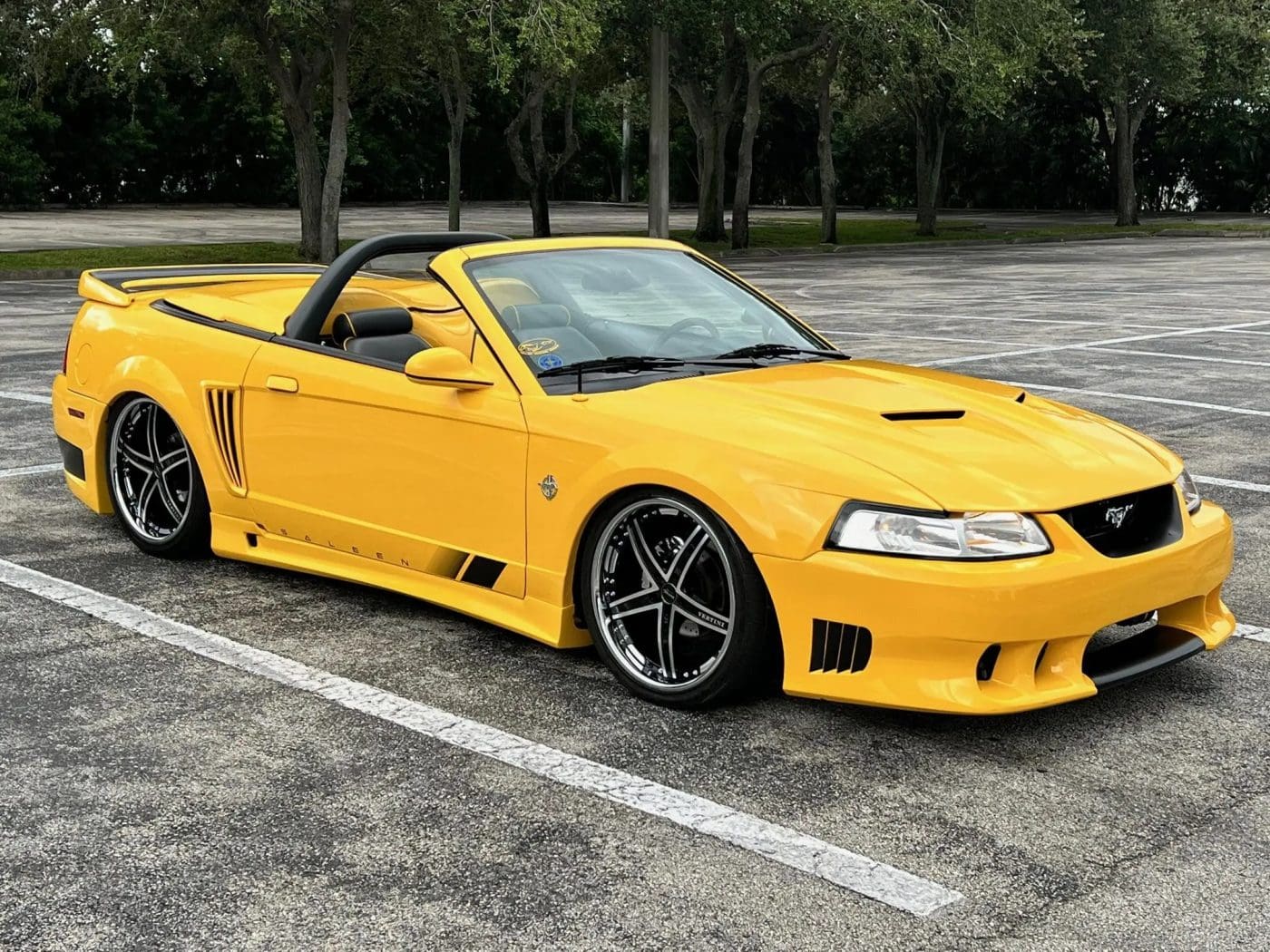
The 1999 Ford Mustang marked a pivotal shift in the pony car’s history, introducing the "New Edge" design language and significant mechanical upgrades. Available in V6, GT, and SVT Cobra trims, specifications ranged from a 190-horsepower 3.8L V6 to a 320-horsepower 4.6L DOHC V8, featuring the first-ever factory independent rear suspension in the Cobra model.
The 1999 model year was not merely a cosmetic refresh; it represented the 35th anniversary of the nameplate and a concerted effort by Ford to reclaim performance dominance. After the softer, rounded lines of the 1994–1998 SN95 generation, the 1999 Mustang arrived with sharp creases, oversized wheel arches, and a more aggressive stance. As we look at these vehicles in 2026, they have transitioned from affordable used cars into recognized "youngtimer" classics, making an understanding of their technical specifications essential for collectors, restorers, and enthusiasts alike.
The Evolution of Design: Defining the "New Edge"
The 1999 Mustang was the first to fully embrace Ford’s "New Edge" styling philosophy. Spearheaded by design chief Jack Telnack, this aesthetic sought to combine surface tension with sharp, intersecting creases. While it retained the essential proportions of the SN95 platform, nearly every exterior panel was replaced.
The front fascia became much more angular, featuring larger, multi-reflector headlamps and a more prominent corralled pony emblem in the grille. The hood gained a more aggressive scoop (non-functional on base models, functional for heat extraction on others), and the side C-scoops were deepened to provide a more muscular profile. At the rear, the iconic three-bar taillights were redesigned with a sharper, more vertical orientation that echoed the original 1964.5 models. These changes were not just for show; the revised bodywork offered slightly improved aerodynamics and paved the way for the larger wheel and tire packages that would define the era.
Powertrain and Performance: V6, GT, and SVT Cobra Engines
The 1999 model year brought substantial power increases across the entire engine lineup. Ford engineers focused on improving airflow and reducing internal friction, resulting in a lineup that felt significantly more responsive than the 1998 predecessors.
The 3.8L OHV V6 (Base Model)
The base Mustang saw its 3.8-liter V6 engine upgraded significantly. For 1999, Ford introduced a split-port induction system, which replaced the previous single-port design. This allowed for better low-end torque and higher peak horsepower.
- Horsepower: 190 hp @ 5,250 rpm
- Torque: 220 lb-ft @ 2,750 rpm
- Bore x Stroke: 3.81 in x 3.39 in
- Compression Ratio: 9.2:1
The 4.6L SOHC V8 (GT Model)
The Mustang GT benefited from what enthusiasts call the "PI" (Power Improved) upgrades. These changes included new cylinder heads with larger valves and reshaped ports, a more aggressive camshaft profile, and a revised intake manifold with longer runners.
- Horsepower: 260 hp @ 5,250 rpm
- Torque: 302 lb-ft @ 4,000 rpm
- Engine Block: Cast iron
- Cylinder Heads: Aluminum alloy "Power Improved" design
The 4.6L DOHC V8 (SVT Cobra)
The 1999 SVT Cobra featured a hand-assembled 32-valve dual-overhead-cam (DOHC) V8. While it shared displacement with the GT, the top end was entirely different, utilizing a "tumble-port" head design for high-rpm breathing.
- Horsepower: 320 hp @ 6,000 rpm
- Torque: 317 lb-ft @ 4,750 rpm
- Performance Note: The 1999 Cobra was famously subject to a recall shortly after release because many units failed to produce the advertised 320 horsepower due to casting flash in the intake manifold and restrictive exhaust components. Ford eventually rectified this through a "fix" program that involved replacing the intake manifold and computer recalibration.
Transmission and Drivetrain Configurations
The 1999 Mustang offered several transmission choices, though the specific hardware depended on the engine selected. All models remained rear-wheel drive, maintaining the traditional pony car layout.
Manual Transmissions
- Borg-Warner/Tremec T-5: Used in the V6 models. This five-speed manual was a long-standing staple of the Mustang line, known for its lightweight design and decent shift feel, though it was near its torque limit with the 1999 V6 upgrades.
- Tremec T-45: Used in the GT and SVT Cobra. This five-speed manual featured an integrated bellhousing for the 4.6L modular engine. The Cobra version received a slightly different internal specification to handle the higher 7,000 rpm redline.
Automatic Transmissions
- 4R70W Four-Speed Automatic: This was the optional automatic across the lineup. For 1999, it received software updates to improve shift points and durability. It featured a wide-ratio gear set and an electronic pressure control for smoother transitions under light load and firmer shifts under wide-open throttle.
Rear Differential and Gearing
Standard V6 and GT models used a solid rear axle. The V6 typically came with a 2.73:1 or 3.27:1 ratio, while the GT came standard with 3.27:1 gears. The SVT Cobra was the outlier, featuring an 8.8-inch differential housed within an independent rear suspension subframe, utilizing a 3.27:1 ratio.
| Feature | Base V6 | Mustang GT | SVT Cobra |
|---|---|---|---|
| Engine Type | 3.8L OHV V6 | 4.6L SOHC V8 | 4.6L DOHC V8 |
| Horsepower | 190 hp | 260 hp | 320 hp |
| Torque | 220 lb-ft | 302 lb-ft | 317 lb-ft |
| 0-60 MPH (Manual) | ~7.1 Seconds | ~5.4 Seconds | ~4.8 Seconds |
| Quarter Mile | ~15.5 Seconds | ~14.0 Seconds | ~13.5 Seconds |
| Braking (60-0) | 139 ft | 128 ft | 120 ft |
| Rear Suspension | 4-Link Solid Axle | 4-Link Solid Axle | Independent (IRS) |
Chassis, Suspension, and Braking Systems
The 1999 refresh addressed one of the biggest complaints of the previous years: steering feel and chassis rigidity. Ford engineers widened the rear track by 1.4 inches, which improved stability and filled out the new, flared wheel arches.
Front Suspension
All 1999 Mustangs utilized a modified MacPherson strut system. It featured lower A-arms, coil springs mounted on the arms, and a 27mm or 28mm stabilizer bar depending on the trim. The GT and Cobra models received stiffer spring rates and more aggressive damping to handle the increased power.
Rear Suspension
The V6 and GT continued to use the four-link solid rear axle. While criticized by purists for its behavior on bumpy mid-corner pavement, it remained a favorite for drag racers due to its durability and predictable launch characteristics.
The 1999 SVT Cobra, however, made history by incorporating an Independent Rear Suspension (IRS). This system was designed to fit into the same mounting points as the solid axle, allowing for much-improved ride quality and significantly better handling over uneven surfaces. This change fundamentally altered the Cobra's character, making it a more credible competitor to European sports coupes of the time.
Braking
- V6 Models: Used 10.8-inch vented front discs and 10.5-inch solid rear discs.
- GT Models: Upgraded to 10.8-inch vented front discs with slightly more robust calipers.
- SVT Cobra: Featured massive 13-inch Brembo-sourced vented front rotors with dual-piston PBR calipers and 11.65-inch vented rear rotors.
35th Anniversary Limited Edition
To celebrate 35 years of the Mustang, Ford offered a special 35th Anniversary Limited Edition package. This is a common point of confusion for collectors: nearly all 1999 Mustangs feature a "35th Anniversary" fender badge, but only 4,628 units were the true Limited Edition (LE) models.
The true Limited Edition was available only in GT trim (coupe or convertible) and came in four colors: Black, Silver Metallic, White, and Performance Red. The package included:
- A unique hood with a blacked-out scoop.
- Extended side rockers and a unique rear spoiler.
- Blacked-out honeycomb panel between the taillights.
- Unique five-spoke wheels with bright machined faces and silver painted inserts.
- A special interior featuring silver leather inserts in the seats, a silver shift knob, and unique floor mats.
Interior Dimensions and Tech Specifications
The interior of the 1999 Mustang was a refinement of the "dual-cockpit" design introduced in 1994. Ergonomics were improved with a focus on tactile feedback.
- Seating Capacity: 4 (2+2 configuration)
- Front Headroom: 38.1 inches
- Front Legroom: 42.6 inches
- Trunk Space: 10.9 cubic feet (Coupe) / 7.7 cubic feet (Convertible)
- Audio Systems: The base models featured a standard AM/FM cassette player, while the Mach 460 audio system was the premium option. This system utilized a specialized head unit, multiple amplifiers, and a sophisticated speaker array to provide 230 watts of RMS power.
Technological features for 1999 included the SecuriLock passive anti-theft system, which used a transponder chip in the key—a relatively advanced feature for the late 90s that drastically reduced theft rates but made duplicate keys more expensive for owners.
Ownership and Maintenance: What to Look for in 2026
When evaluating a 1999 Ford Mustang today, specific technical vulnerabilities must be checked. While these cars are robust, three decades of age require specialized attention.
- Intake Manifold Crossover: The 1999 GT models originally came with an all-plastic intake manifold. The coolant crossover at the front was prone to cracking, leading to catastrophic coolant loss. Most surviving examples have been fitted with the revised "aluminum crossover" manifold, but this is a critical inspection point.
- SVT Cobra Horsepower Fix: If purchasing a 1999 Cobra, verify if the "recall fix" was performed. You can check this by looking for a blue dot or mark on the intake manifold and checking the mufflers for specific Ford part numbers indicating the high-flow replacements.
- Spark Plug Threads: The early 4.6L modular engines (both SOHC and DOHC) have relatively few threads in the cylinder heads. Over-torquing or improper installation can lead to "spitting" a spark plug. In 2026, many owners use Time-Sert or Helicoil inserts to prevent this.
- Suspension Bushings: On the SVT Cobra, the original rubber bushings for the IRS subframe are often degraded by now. Replacing these with polyurethane or delrin components can drastically reduce "wheel hop" during hard acceleration.
Frequently Asked Questions
How do I tell a real 1999 35th Anniversary Limited Edition from a standard GT?
A true Limited Edition (LE) will have a specific interior with silver seat inserts and a unique silver-accented instrument cluster. Additionally, the exterior must have the factory-applied black honeycomb decklid applique and the specific 35th-anniversary-only wheels. Standard 1999 Mustangs have the fender badges but lack these specific interior and body modifications.
Is the 1999 Mustang GT a good project car for beginners?
Yes. The 1999 GT is one of the most accessible project cars. The 4.6L SOHC "Modular" V8 has massive aftermarket support. While the engine bay is tighter than the older 5.0L Pushrod Mustangs, the electronics are straightforward, and parts are widely available and relatively inexpensive.
Why is the 1999 SVT Cobra's IRS significant?
Before 1999, every factory Mustang had a solid rear axle. The Independent Rear Suspension (IRS) in the 1999 Cobra allowed the rear wheels to react to bumps independently, which improved mid-corner grip and ride quality. It was a bold engineering move that paved the way for the modern S550 and S650 chassis designs.
What fuel should I use in a 1999 Mustang?
The V6 and GT models were designed to run on 87-octane regular unleaded gasoline. However, the SVT Cobra requires 91-octane premium fuel or higher to prevent ignition timing pull and potential knocking, especially given its higher compression and DOHC head design.
How much does a 1999 Mustang weigh?
The curb weight varies by trim and body style. A base V6 Coupe weighs approximately 3,060 lbs, while a GT Coupe is roughly 3,250 lbs. The SVT Cobra is the heaviest of the coupes at approximately 3,430 lbs, largely due to the heavier DOHC engine and the IRS assembly. Convertibles generally add about 120-150 lbs of structural reinforcement.
Expert Recommendation
If you are looking to purchase a 1999 Mustang in today's market, the Mustang GT with a manual transmission represents the best balance of performance, reliability, and value. Ensure the intake manifold has been updated to the aluminum crossover version and check the rear differential for leaks. For those seeking a collector-grade vehicle, the 1999 SVT Cobra is the preferred choice, provided you verify the horsepower recall work was completed. Regardless of the trim, these cars benefit significantly from modern tire compounds, which can unlock the handling potential that was limited by 1990s rubber technology.