Managing a 20-person team on 12-hour shifts requires a four-crew rotation to ensure 24/7 operational coverage while maintaining safety and compliance. By dividing the 20 employees into four squads of five, organizations can implement popular patterns like the Pitman (2-2-3) or 4-on/4-off schedules, providing a balance between consistent output and employee recovery time.
The transition to 12-hour shifts is a significant operational pivot that affects productivity, employee morale, and safety protocols. In 2026, the landscape of workforce management has shifted toward higher levels of automation in scheduling, yet the fundamental human constraints—fatigue, family obligations, and biological rhythms—remain the primary factors for success. For a team of exactly 20 people, the mathematical precision of the schedule determines whether the operation thrives or suffers from chronic absenteeism and burnout.
Strategic Scheduling Models for 20-Person Teams
When managing 20 individuals, the most efficient way to maintain a continuous 24/7 operation is to divide the workforce into four distinct "crews" or "squads." With a total headcount of 20, each crew consists of five members. This symmetry allows for several standardized 12-hour rotation models that are widely recognized in manufacturing, emergency services, and healthcare.
The Pitman Schedule (2-2-3)
The Pitman schedule, often referred to as the "Every Other Weekend Off" rotation, is highly popular for teams of this size. In this model, the 20-person team is split into four crews (A, B, C, and D). Two crews handle the day shifts, and two crews handle the night shifts.
The cycle works over a 14-day period:
- 2 days on
- 2 days off
- 3 days on
- 2 days off
- 2 days on
- 3 days off
For a 20-person team, this means that at any given time, five people are on duty, five are coming on for the next 12-hour block, and ten are in various stages of their off-cycle. The primary benefit of this system in 2026 is the predictability it offers employees, allowing them to plan their lives months in advance. However, the three consecutive 12-hour shifts (totaling 36 hours in three days) can be taxing and require strict adherence to fatigue management protocols.
The 4-On, 4-Off Rotation
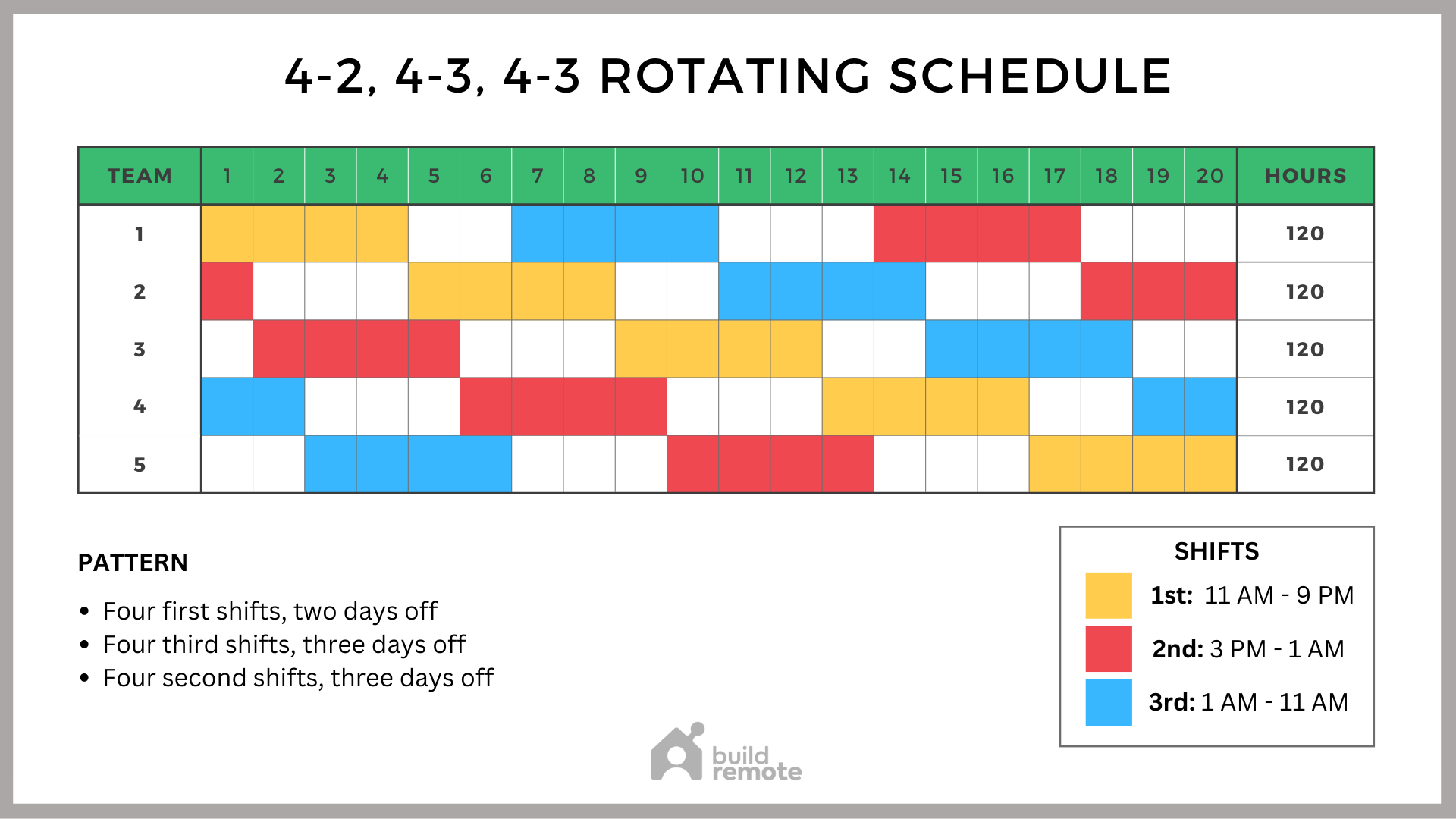
The 4-on, 4-off model is a simpler alternative that provides longer blocks of rest. Employees work four consecutive 12-hour shifts followed by four consecutive days off. For a 20-person team, this still utilizes the four-crew structure.
While the four days off are highly valued for recovery, the four consecutive 12-hour days can lead to "cumulative fatigue." By the fourth day, error rates in high-precision tasks often increase. Managers of 20-person teams must monitor performance metrics closely during that final day of the "on" cycle to ensure safety standards are maintained.
The Dupont Schedule
The Dupont schedule is a more complex 12-hour rotation that operates on a 4-week cycle. It is famous for providing a consecutive 7-day block of time off once every month. While popular for morale, it involves a "7-day stretch" of work at one point in the cycle, which requires careful management of a 20-person team to ensure that if one person calls out, the remaining four on that crew are not overwhelmed.
Workforce Math: Calculating Coverage and FTEs
To successfully run 12-hour shifts for a 20-person team, one must understand the math of Full-Time Equivalents (FTEs) and total operating hours. A single week contains 168 hours. A continuous 24/7 operation requires 168 hours of coverage per "position."
If your 20-person team is intended to cover five specific roles or "stations" simultaneously at all times:
- Total Weekly Man-Hours Needed: 168 hours x 5 stations = 840 hours.
- Average Hours per Employee: 840 hours / 20 employees = 42 hours per week.
This 42-hour average is the "sweet spot" for 12-hour shifts. It allows for a standard work week with a small, predictable amount of built-in overtime (2 hours per week on average). In 2026, labor regulations in many jurisdictions require that this "built-in" overtime be compensated at premium rates or balanced with additional "banked" time off to prevent violation of maximum working hour statutes.
The "Relief" Factor
One common mistake when managing a 20-person team is failing to account for "relief." If your operation requires five people on the floor at all times, a 20-person team provides zero margin for error. If one person is sick, on vacation, or in training, you only have 19 people to cover 840 hours, pushing the average work week to over 44 hours and forcing others to work on their scheduled days off.
To mitigate this, many managers use a "19+1" or "18+2" strategy, where 18 people are assigned to the primary rotation and two people act as "floaters" or "swing" relief to cover gaps without triggering emergency overtime for the rest of the team.
Operational Advantages of 12-Hour Shifts
The adoption of 12-hour shifts for a 20-person team is rarely accidental; it is usually driven by specific operational efficiencies that 8-hour shifts cannot provide.
Reduced Shift Handovers
The most vulnerable time in any operation is the shift change. Information is lost, machines may be powered down, and momentum stalls. By moving from 8-hour to 12-hour shifts, the number of handovers is reduced from 21 per week to 14 per week. For a 20-person team, this 33% reduction in "transition friction" can lead to significantly higher total output and fewer communication-related errors.
Improved Work-Life Balance (The "Double Weekend" Effect)
Although the workdays are long, the 12-hour model provides employees with more total days off. In a standard 5-day, 40-hour week, an employee works 260 days a year. On a 2-2-3 Pitman schedule, an employee only works approximately 182 days a year. This "extra" 78 days of time off is a powerful recruitment and retention tool in the 2026 labor market, where flexibility and time-wealth are highly prized.
Commuting and Environmental Impact
Working fewer days means fewer commutes. For a 20-person team, this reduces the collective carbon footprint and saves employees significant money on fuel or transit costs. In regions with heavy congestion, the ability to avoid rush-hour traffic by starting at 6:00 AM or 7:00 AM is a major peripheral benefit.
Critical Challenges and Mitigation Strategies
Despite the benefits, 12-hour shifts present unique risks that a manager of 20 people must proactively address.
The Fatigue Zone
Research into circadian rhythms shows that human performance drops sharply after the 10th hour of work, particularly during night shifts. For the five people on the "Night Squad," the hours between 3:00 AM and 5:00 AM are the most dangerous.
- Mitigation: Managers should schedule the most mentally taxing or physically dangerous tasks for the beginning of the shift. The final two hours of a 12-hour shift should be reserved for cleaning, administrative tasks, or lower-risk activities.
Communication Silos
With a 20-person team split into four crews, it is easy for "Crew A" to never see "Crew C." This can lead to a "we vs. them" mentality, where crews blame each other for equipment issues or messy workspaces.
- Mitigation: In 2026, digital communication platforms (like Slack, Teams, or industry-specific ERPs) are essential. Managers should also consider a monthly "overlap meeting" or a rotating "lead" position where one person from each crew meets briefly to ensure continuity of culture and standards.
Training and Development
Finding time to train 20 people who are constantly rotating is difficult. If you pull a crew for training, you lose 25% of your workforce for that day.
- Mitigation: Utilize "Online Asynchronous Learning" modules that employees can complete during lower-activity periods within their 12-hour window, rather than requiring them to come in on their days off.
Comparison of 12-Hour Shift Patterns for 20 People
| Feature | Pitman (2-2-3) | 4-On, 4-Off | Dupont |
|---|---|---|---|
| Average Hours/Week | 42 | 42 | 42 |
| Consecutive Days Off | 2 to 3 | 4 | Up to 7 |
| Weekends Off | Every other | Rotating | One full weekend per month |
| Complexity | Moderate | Low | High |
| Fatigue Risk | Moderate | High (on Day 4) | High (during 7-day stretch) |
| Team Cohesion | High (fixed squads) | High (fixed squads) | Moderate (shifting rotations) |
Compliance and Legal Considerations in 2026
When managing a 20-person team on 12-hour shifts, adherence to labor laws is non-negotiable. While specific laws vary by jurisdiction, several universal principles apply in 2026:
- Overtime Calculation: In many U.S. states and European countries, overtime is calculated daily (over 8 hours) rather than just weekly (over 40 hours). Managers must ensure the 20-person budget accounts for these "daily" overtime premiums.
- Rest Periods: Most modern regulations require a minimum of 11 consecutive hours of rest between shifts. This makes "double shifts" (working 24 hours) effectively illegal and a major liability.
- Meal and Rest Breaks: On a 12-hour shift, employees typically require at least two 30-minute meal breaks and three 15-minute rest breaks. For a crew of five, these breaks must be staggered so that the "active" headcount doesn't drop below safety requirements.
- Health Surveillance: Due to the known health risks of long-term night shift work (including cardiovascular issues and sleep disorders), many companies in 2026 provide annual health screenings for employees on 12-hour rotations.
Disclaimer: This information is for operational guidance. Labor laws are subject to jurisdictional changes; consult with a legal or HR professional to ensure specific compliance for your region.
Frequently Asked Questions
How do I handle a sick call in a 20-person team?
With four crews of five, a single sick call reduces a crew by 20%. The most common solution is to have a "call-in" list from the off-duty crews who are paid a premium to cover the shift. Alternatively, some managers use a "Relief Pool" where the 20th and 19th employees are kept on a more flexible schedule to fill gaps.
Is a 12-hour shift better than an 8-hour shift for morale?
Generally, yes. While the workdays are longer, the increased number of full days off is preferred by most employees. A study of 20-person manufacturing teams found that 75% of workers preferred the 12-hour rotation due to the "3-day weekend" every other week provided by the Pitman schedule.
Can a 20-person team run 12-hour shifts without overtime?
Mathematically, it is difficult. A 24/7 operation requires 168 hours. Divided by four crews, that is 42 hours per week per person. Unless the operation shuts down for several hours a week or you hire more staff (increasing the team size to 21 or 22), 2 hours of overtime per person per week is the standard baseline.
What is the "7-day stretch" in 12-hour scheduling?
This usually occurs in the Dupont schedule. It is a period where an employee works seven 12-hour shifts in a row (with some short breaks) to "earn" a long 7-day vacation later in the month. This is highly controversial in 2026 due to extreme fatigue risks and is often replaced by more balanced 2-2-3 patterns.
How do 12-hour shifts affect 20-person team communication?
It creates "islands" of crews. To fix this, you must implement a formal "Pass-Down" log. In 2026, most teams use digital tablets to record equipment status, pending tasks, and safety notes at the end of each 12-hour block so the incoming crew of five can start immediately without confusion.
Next Actions for Implementation
To implement or optimize 12-hour shifts for your 20-person team, start by surveying the current staff regarding their preference between the Pitman and 4-on/4-off models. Once a model is selected, create a 12-month calendar to highlight "danger zones" such as holidays or peak vacation seasons where the 20-person headcount might be strained. Finally, invest in a robust scheduling software that allows employees to swap shifts easily, as autonomy in managing their own "time off" is the leading factor in the long-term success of 12-hour shift environments.