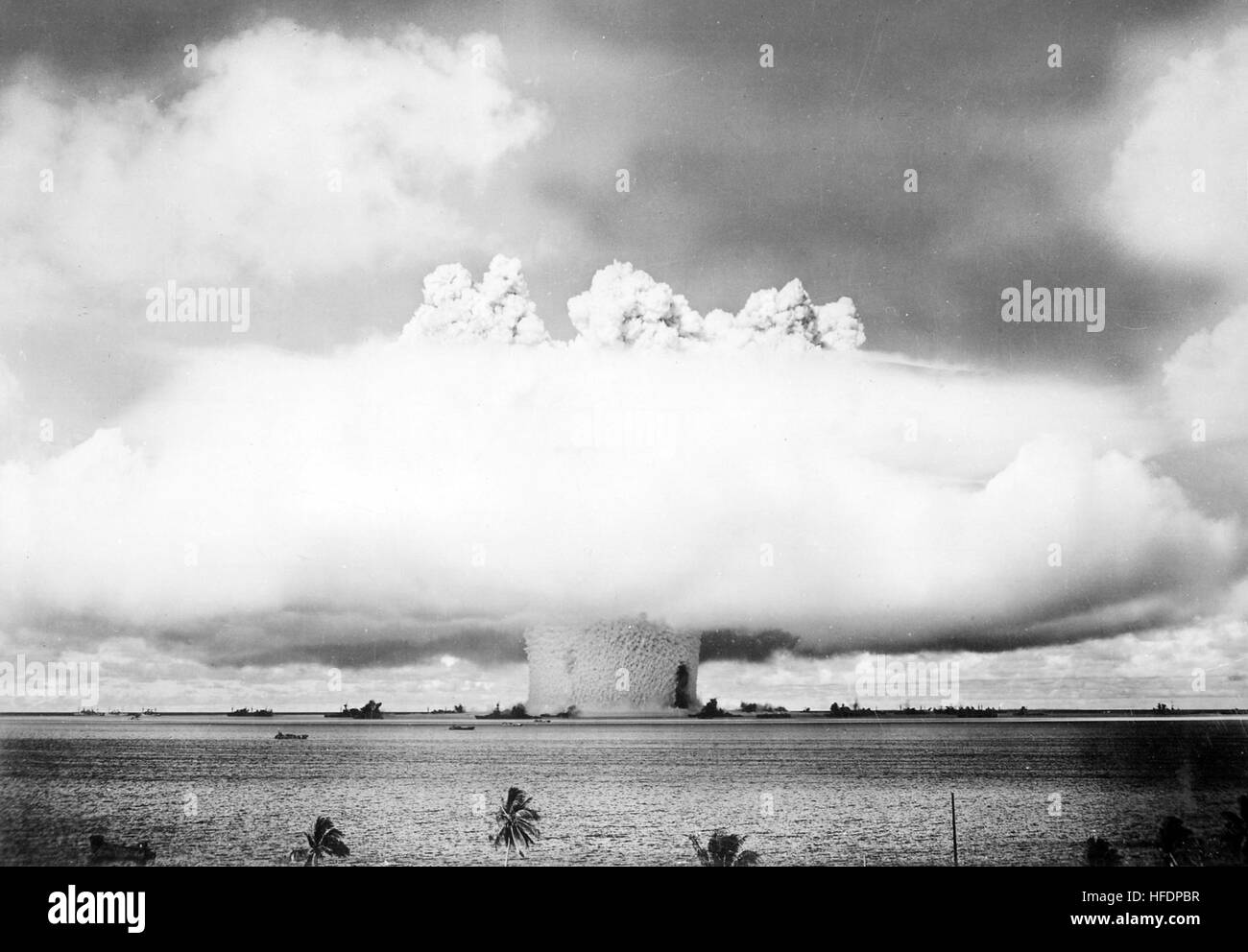
A nuclear test at Bikini Atoll refers to any of the 23 atmospheric detonations conducted by the United States between 1946 and 1958. These tests, part of the Cold War nuclear arms race, included the first underwater blast and the massive Castle Bravo hydrogen bomb, resulting in lasting environmental damage and the permanent displacement of the Bikinian people.
Bikini Atoll, a remote ring of coral islands in the Marshall Islands, remains one of the most potent symbols of the atomic age. What was once a quiet Pacific paradise became the laboratory for the world’s most destructive weapons. Even in 2026, the history of these tests continues to shape international policy on nuclear energy, environmental remediation, and the human rights of displaced populations. Understanding the scale and consequence of these tests requires looking at the technical motivations, the catastrophic failures of fallout prediction, and the enduring radioactive footprint left on the land and sea.
The Strategic Selection of Bikini Atoll
Following the end of World War II, the United States sought a location to test the effects of nuclear weapons on naval vessels. The goal was to determine how "the bomb" would redefine naval warfare in a future conflict with the Soviet Union. In early 1946, Bikini Atoll was selected for several logistical reasons. Its location in the Central Pacific was remote enough to avoid immediate fallout on large population centers, yet it possessed a large, deep lagoon suitable for anchoring a "ghost fleet" of target ships.
The Marshall Islands were at that time part of the Trust Territory of the Pacific Islands, administered by the United States on behalf of the United Nations. In February 1946, Commodore Ben H. Wyatt, the military governor of the Marshall Islands, traveled to Bikini to ask the 167 residents to temporarily leave their homes "for the good of mankind and to end all world wars." The residents, led by King Juda, agreed to leave, believing they would be able to return once the tests were complete—a promise that has remained unfulfilled for eight decades.
The relocation of the Bikinians to Rongerik Atoll marked the beginning of a long history of displacement. Rongerik was much smaller than Bikini, had inadequate food resources, and lacked a deep lagoon for fishing. Within two years, the population faced starvation, necessitating further moves to Kwajalein and eventually Kili Island, where many descendants of the original inhabitants reside today in 2026.
Operation Crossroads: Testing the Navy’s Resilience
The first series of nuclear tests at Bikini Atoll was designated Operation Crossroads. Conducted in July 1946, it consisted of two tests: Able and Baker. These tests were the first nuclear detonations since the "Trinity" test and the bombings of Hiroshima and Nagasaki in 1945.
Test Able
Test Able was an atmospheric drop on July 1, 1946. A B-29 Superfortress dropped a 23-kiloton plutonium bomb, similar to the "Fat Man" used on Nagasaki. The bomb missed its intended target, the USS Nevada, by about 2,100 feet. While the blast sank several smaller ships and caused significant structural damage to others, the Navy initially downplayed the results. Because it was an airburst, most of the radioactive products were carried into the stratosphere, leaving the lagoon relatively clean.
Test Baker
The Baker test on July 25, 1946, changed the world's understanding of radioactive contamination. It was the first underwater nuclear explosion, detonated 90 feet below the surface. The blast created a massive dome of water followed by a hollow column that ejected two million tons of water and sediment into the air.
Unlike the airburst of Able, the Baker detonation trapped the radioactive fission products in the water column. As the column collapsed, it created a "base surge" of highly radioactive mist that coated the target ships. This made the vessels virtually uninhabitable and impossible to decontaminate. The Navy attempted to scrub the ships with lye and soap, but the radiation had penetrated the steel and the wood of the decks. Eventually, most of the target fleet, including the legendary carrier USS Saratoga and the captured Japanese battleship Nagato, had to be scuttled in the lagoon.
The Thermonuclear Era and the Castle Bravo Disaster
While Operation Crossroads focused on tactical naval impacts, the tests conducted in the 1950s shifted toward the development of thermonuclear weapons (hydrogen bombs). The most significant and devastating of these was the Castle Bravo test on March 1, 1954.
Castle Bravo was the first flight-prohibitive, deliverable hydrogen bomb using lithium deuteride fuel. Scientists at Los Alamos had predicted a yield of approximately 5 to 6 megatons. However, they had misunderstood the reactivity of the lithium-7 isotope, which they believed would be inert. Instead, lithium-7 contributed significantly to the fusion reaction.
The resulting explosion had a yield of 15 megatons—roughly 1,000 times more powerful than the Hiroshima bomb. The explosion vaporized three islands of the atoll and created a crater 1.2 miles (2 kilometers) wide and 250 feet (76 meters) deep.
The Fallout Crisis
The massive yield, combined with an unexpected shift in wind patterns, sent a plume of radioactive pulverized coral dust eastward toward the inhabited atolls of Rongelap and Utirik. Within hours, "white ash" began falling on the residents. Children played in the radioactive dust, unaware of its lethality.
The fallout also reached a Japanese fishing vessel, the Daigo Fukuryū Maru (Lucky Dragon No. 5), which was 82 miles away from the blast site. All 23 crew members suffered from acute radiation syndrome, and the death of the ship’s radio operator, Aikichi Kuboyama, sparked an international outcry and fueled the burgeoning anti-nuclear movement in Japan.
Summary of Major Nuclear Tests at Bikini Atoll
The following table outlines the most significant detonations conducted during the testing period.
| Date | Operation/Shot | Yield | Type | Significance |
|---|---|---|---|---|
| July 1, 1946 | Crossroads Able | 23 kt | Air | First post-WWII test; demonstrated airburst effects on ships. |
| July 25, 1946 | Crossroads Baker | 23 kt | Underwater | First underwater test; caused massive, uncontainable contamination. |
| March 1, 1954 | Castle Bravo | 15 Mt | Surface | Largest US nuclear detonation; caused widespread fallout. |
| March 27, 1954 | Castle Romeo | 11 Mt | Barge | Proved that barges could be used for large-scale tests. |
| May 21, 1956 | Redwing Cherokee | 3.8 Mt | Air | First US air-drop of a thermonuclear weapon. |
| June 28, 1958 | Hardtack I Oak | 8.9 Mt | Barge | One of the final large-scale tests before the 1958 moratorium. |
The Radiological Legacy and Environmental Impact
The environmental impact of 23 nuclear detonations has been profound. The physical landscape of Bikini Atoll was permanently altered; where lush vegetation and sand once existed, several islands were simply vaporized.
Residual Radiation in 2026
As of 2026, the primary radiological concern on Bikini Atoll is Cesium-137. While the gamma radiation levels in the air have dropped significantly and are now lower than the background radiation in many major world cities, the soil remains heavily contaminated. Cesium-137 is chemically similar to potassium. Consequently, the roots of coconut palms, breadfruit trees, and other local flora absorb the radioactive isotope from the soil.
If a human consumes the fruit grown on the atoll, the Cesium-137 is absorbed into the body, where it can cause internal radiation exposure and increase the risk of cancers, particularly leukemia and thyroid cancer. For this reason, the atoll remains officially uninhabited for permanent residency, as a traditional diet based on local produce would exceed international safety limits for radiation exposure.
Marine Recovery
Interestingly, the marine environment has shown remarkable resilience. The "ghost fleet" of Operation Crossroads has become one of the most unique artificial reef systems in the world. The wrecks are covered in hard and soft corals, and the lagoon teems with gray reef sharks, snappers, and groupers. Scientific studies conducted into the mid-2020s indicate that while some sediment remains radioactive, the water itself is safe for swimming and diving, as the vast volume of the ocean has diluted the contaminants.
The Human Toll: Displacement and Compensation
The people of Bikini Atoll have lived in exile for eighty years. Their journey has been one of repeated hardship, from the starvation on Rongerik to the isolation of Kili Island. Kili is a "high" island without a lagoon, meaning the Bikinians, who were traditionally lagoon fishers and navigators, lost their primary way of life and cultural identity.
In the 1970s, the US government attempted to resettle the atoll after declaring it "safe." However, subsequent testing showed that the residents were absorbing dangerous levels of Cesium-137 through the food chain. In 1978, the residents were again evacuated, a traumatic event that deepened the mistrust between the Marshallese and the US government.
The legal battle for compensation has been long and complex:
- Nuclear Claims Tribunal: Established to adjudicate claims for property damage and personal injury. While the tribunal awarded over $2 billion in damages, the fund provided by the US was chronically underfunded, and many claimants died before receiving their full awards.
- Compact of Free Association (COFA): This agreement governs the relationship between the US and the Marshall Islands. Renegotiations in the early 2020s sought to address the "changed circumstances" of the nuclear legacy, but many Marshallese leaders argue the compensation still does not cover the full cost of healthcare and environmental remediation.
- The Resettlement Trust Fund: This fund was created to support the displaced community, but it has faced various management challenges and is often insufficient to provide for the growing population of Bikinian descendants living in Majuro, Ejit, and the United States.
Bikini Atoll as a UNESCO World Heritage Site
In 2010, UNESCO inscribed Bikini Atoll as a World Heritage site. Unlike many sites that celebrate human achievement, Bikini was chosen as a "site of memory" to remind the world of the power of nuclear weapons.
The UNESCO designation recognizes the atoll as the location where the Cold War was most visibly manifested. It serves as a monument to the dawn of the nuclear age and the paradox of scientific advancement and environmental destruction. For the Bikinian people, the designation is bittersweet; it provides international recognition of their suffering, yet it highlights the fact that their home remains a monument rather than a residence.
Technical Specifications of the Testing Infrastructure
The scale of the nuclear tests at Bikini Atoll required an unprecedented military and scientific effort. During Operation Crossroads, over 42,000 personnel were involved.
- Instrumentation: Scientists used high-speed cameras, pressure gauges, and Geiger counters to measure the blast. Some cameras were shielded in lead towers and designed to capture images at millions of frames per second.
- Target Fleet: The ships were not empty shells. They were loaded with fuel, ammunition, and even live animals (pigs, goats, and rats) to study the biological effects of radiation. The suffering of these animals was a major point of contention in early animal rights discourse.
- Decontamination Failures: The failure of the Navy to decontaminate the ships after Test Baker led to the development of modern "washdown" systems now found on all nuclear-capable naval vessels.
Frequently Asked Questions
Can you visit Bikini Atoll in 2026?
Yes, but access is limited. There are no commercial flights to the atoll. Most visitors arrive via specialized dive boats that depart from Kwajalein or Majuro. Visitors must bring all their own supplies, including water and food, as nothing grown on the island is safe to eat.
Is it safe to dive the shipwrecks?
Diving the shipwrecks is considered safe regarding radiation. The water acts as an excellent shield against any residual radiation from the sunken vessels. However, the dives are highly technical and deep, often exceeding 130 feet (40 meters), requiring advanced decompression diving certifications.
How many islands were destroyed in the tests?
The tests, particularly the high-yield thermonuclear tests of the 1950s, vaporized at least three islands: Bokonijien, Aerokojlol, and Namu. Significant portions of other islands were blown away or buried under radioactive sediment.
Why is the swimsuit named after the atoll?
French designer Louis Réard named the "bikini" swimsuit in 1946, just days after the Crossroads Able test. He hoped the revealing outfit would cause an "explosive commercial and cultural reaction" similar to the atomic blast at the atoll.
Will the Bikinian people ever return home?
Permanent return remains unlikely in the near future without a massive and expensive environmental cleanup. This would involve stripping the top 15 inches of soil across the entire atoll and replacing it with clean soil or treating the land with massive amounts of potassium fertilizer to block Cesium absorption. Neither option has been fully funded or implemented on a large scale.
Next Steps for Information and Advocacy
For those interested in the ongoing legal and humanitarian status of the Marshall Islands, several avenues for action and research exist:
- Support the Nuclear Survivors: Organizations such as the Marshall Islands Conservation Society and various NGOs in Majuro work to support the healthcare and education of displaced communities.
- Academic Research: The Lawrence Livermore National Laboratory continues to publish updated radiological surveys of the atoll. Reviewing these reports provides the most accurate scientific data on the decay of isotopes like Cesium-137 and Strontium-90.
- Educational Outreach: Understanding the "Castle Bravo" incident is essential for students of 20th-century history and international relations. Educators can find primary source documents, including declassified memos and footage, through the National Archives and the Atomic Heritage Foundation.