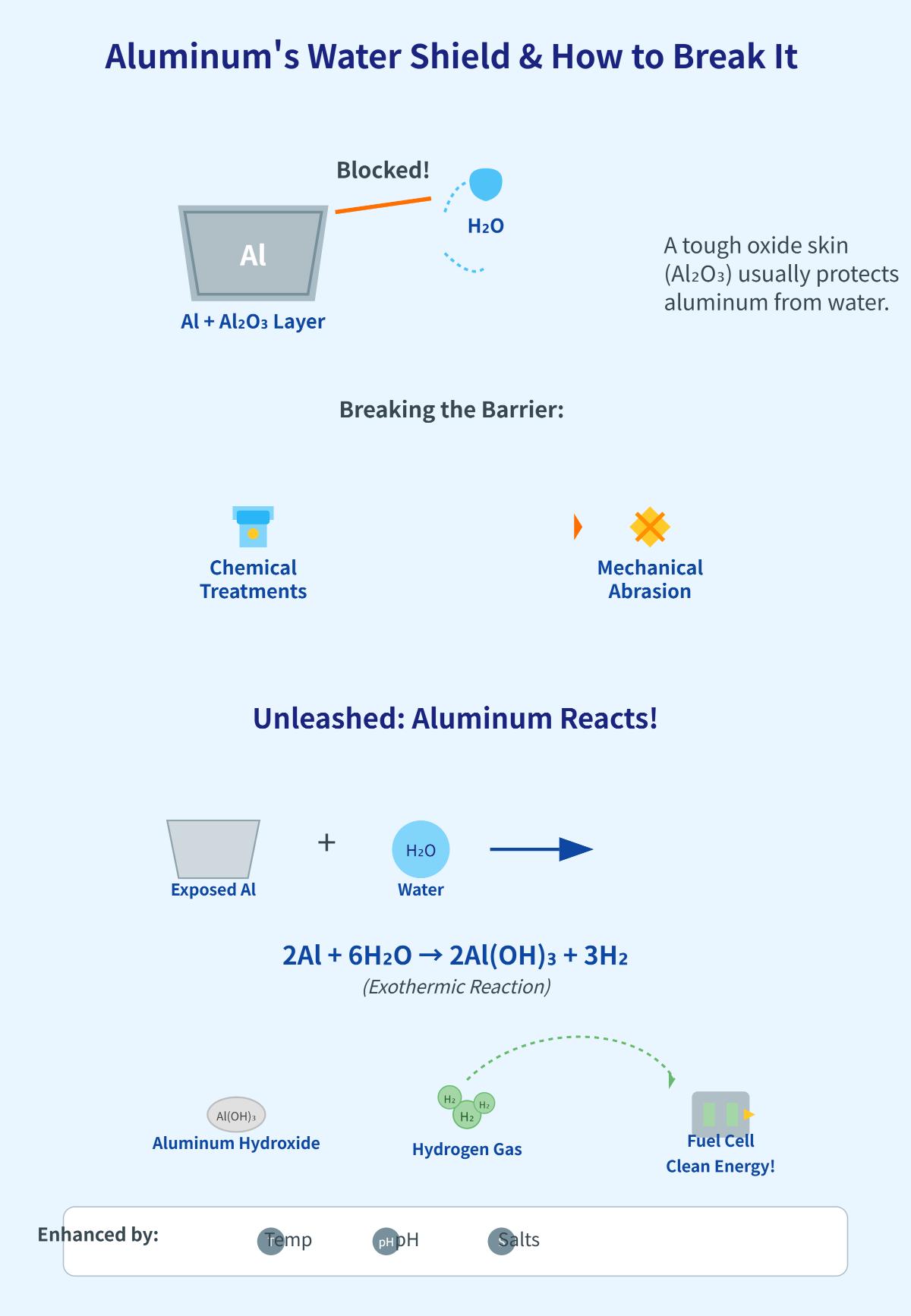
While aluminum reacts vigorously with water to produce hydrogen gas and heat, the reaction is not a practical energy source due to the immediate formation of a protective oxide layer that halts the process. Additionally, the high energy cost and carbon footprint of refining aluminum make it inefficient compared to direct electrolysis.
Hydrogen has long been hailed as the "fuel of the future," a clean-burning energy carrier that produces only water vapor as a byproduct. However, the primary challenge remains how to store and transport it safely and densely. Aluminum, a ubiquitous metal, appears to be an ideal candidate for on-demand hydrogen production. In theory, you could carry aluminum "fuel" and add water to generate power. Yet, as we look at the energy landscape in 2026, aluminum-to-hydrogen technology remains confined to niche applications and laboratory settings rather than powering our cars or homes. To understand why, we must examine the chemistry, the thermodynamics, and the harsh economic realities of the aluminum-water cycle.
The Chemistry of the Aluminum-Water Reaction
At its core, the reaction between aluminum ($Al$) and water ($H_2O$) is a simple redox reaction. When aluminum comes into contact with water, it wants to give up electrons to the hydrogen ions in the water, resulting in the production of aluminum hydroxide or aluminum oxide and the release of hydrogen gas.
The primary stoichiometric equation for the reaction at room temperature is: $$2Al + 6H_2O \rightarrow 2Al(OH)_3 + 3H_2 + \text{Heat}$$
At higher temperatures (above $280^\circ C$), the reaction typically produces aluminum oxide hydroxide ($AlOOH$): $$2Al + 4H_2O \rightarrow 2AlOOH + 3H_2 + \text{Heat}$$
And at even higher temperatures, it produces alumina ($Al_2O_3$): $$2Al + 3H_2O \rightarrow Al_2O_3 + 3H_2 + \text{Heat}$$
On paper, this is a spectacular reaction. Aluminum is lightweight and has a high energy density. One kilogram of aluminum can theoretically produce approximately 111 grams of hydrogen. Since hydrogen has an energy density of about 142 MJ/kg, that 1 kg of aluminum represents about 15.7 MJ of energy from the hydrogen alone, plus a significant amount of exothermic heat released during the reaction.
The Passivation Barrier: Nature’s Shield
The reason you can safely use aluminum foil in your kitchen or drink from an aluminum can without it exploding in contact with water is passivation. Aluminum has an extremely high affinity for oxygen. Almost instantly upon exposure to air or water, a thin, transparent layer of aluminum oxide ($Al_2O_3$) forms on the surface of the metal.
This oxide layer is incredibly stable, chemically inert, and tightly adherent to the underlying metal. It is only about 2 to 5 nanometers thick, but it acts as a highly effective barrier that prevents water molecules from reaching the raw aluminum underneath. Unlike iron rust, which is porous and allows the oxidation process to continue until the metal is consumed, the aluminum oxide layer "seals" the metal. This is the primary reason the aluminum-water reaction is not practical for hydrogen production: the reaction stops almost as soon as it begins.
Methods of Overcoming Passivation and Their Limitations
To make aluminum a viable hydrogen source, engineers must find a way to either prevent the oxide layer from forming or continuously strip it away. Several methods have been developed, but each introduces its own set of practical and economic hurdles.
1. Caustic Solutions (Chemical Stripping)
One of the most common ways to force the reaction is by using a strong base, such as sodium hydroxide ($NaOH$) or potassium hydroxide ($KOH$). The hydroxide ions react with the aluminum oxide layer, dissolving it and exposing the fresh metal: $$Al_2O_3 + 2NaOH + 3H_2O \rightarrow 2NaAl(OH)_4$$
While effective, this method creates a highly corrosive environment. Managing concentrated lye is dangerous for consumer applications, and the byproduct is a "sludge" of sodium aluminate. To keep the reaction going, you must continuously add more caustic solution, which increases the weight and complexity of the system, negating the energy density benefits of the aluminum itself.
2. Alloying with Liquid Metals (The Gallium Approach)
A significant breakthrough in this field involved alloying aluminum with low-melting-point metals, most notably gallium, indium, and tin. Gallium prevents the formation of a cohesive oxide layer by "wetting" the aluminum surface and infiltrating the crystalline grain boundaries.
Because gallium remains liquid at near-room temperatures, it keeps the aluminum in a state where the oxide cannot stick. When this Al-Ga alloy is placed in water, it reacts completely until the aluminum is consumed, leaving the gallium behind. However, gallium is expensive and rare. While it is not consumed in the reaction and can theoretically be reused, the logistical challenge of recovering 100% of the gallium from the resulting aluminum hydroxide sludge is immense. Even a 1% loss rate would make the process economically ruinous.
3. Ball Milling and Nanostructuring
Researchers also use high-energy ball milling to grind aluminum into extremely fine powders, often mixing it with salts or other additives to increase surface area and disrupt oxide formation. While nano-aluminum reacts much more readily, it is also highly dangerous. Fine aluminum powder is a potent explosive hazard (aluminum powder is a primary component in solid rocket boosters). Furthermore, the energy required to grind the metal into these specialized forms often exceeds the energy gained from the hydrogen produced.
The Thermodynamic Debt: The "Energy Carrier" Fallacy
The most significant argument against aluminum as a practical hydrogen source is the Energy Return on Investment (EROI). To understand why aluminum isn't a "source" of energy, we must look at how aluminum is made.
Aluminum does not exist in nature in its metallic form. It is refined from bauxite ore via the Hall-Héroult process, which involves dissolving alumina in molten cryolite and passing a massive electrical current through it. This process is incredibly energy-intensive.
- Refining Cost: Producing 1 kg of aluminum requires approximately 13 to 15 kWh of electricity.
- Hydrogen Yield: That same 1 kg of aluminum yields about 0.11 kg of hydrogen.
- Energy Recovery: If you burn that hydrogen in a fuel cell (at 60% efficiency), you recover roughly 2.3 kWh of electricity.
From a purely systemic view, you are spending 15 kWh to get 2.3 kWh back. This makes aluminum an "energy carrier" rather than a source, and a very inefficient one at that. Unless the aluminum is produced using 100% surplus renewable energy that would otherwise be wasted, the process is a net loss for the power grid.
Comparison of Hydrogen Production Methods
To put the practicality of aluminum into context, we must compare it to other common methods of hydrogen generation and energy storage.
| Method | Energy Density (System Level) | Cost per kg of $H_2$ | Practicality/Complexity | Main Byproduct |
|---|---|---|---|---|
| Aluminum + Water | Moderate (Reduced by sludge) | Very High ($15-$30+) | High (Requires oxide removal) | $Al(OH)_3$ Sludge |
| Steam Methane Reforming | High | Low ($1.50-$3.00) | Commercial Standard | $CO_2$ |
| Water Electrolysis | N/A (Direct conversion) | Moderate ($4-$7) | Scalable/Industrial | Oxygen |
| Compressed $H_2$ Gas | Low (Heavy tanks) | High (Compression costs) | Infrastructure intensive | None |
| Li-ion Batteries | Low (Compared to $H_2$) | N/A | High (Mature tech) | Heat |
Note: Costs are estimated based on 2026 industrial energy averages and raw material pricing.
Logistical and Environmental Hurdles
Beyond the chemistry and thermodynamics, the practical application of aluminum-to-hydrogen technology faces "boots-on-the-ground" logistical problems.
The "Sludge" Problem
When aluminum reacts with water, it doesn't just disappear. It turns into aluminum hydroxide ($Al(OH)_3$), a thick, white, gel-like substance. For every 1 kg of aluminum you start with, you end up with approximately 2.9 kg of hydroxide sludge. If you were using this in a vehicle, your "exhaust" would be a heavy solid that you have to carry around until you can find a specialized disposal or recycling center. This dramatically reduces the effective energy density of the vehicle.
The Recycling Loop
For aluminum hydrogen to be environmentally friendly, that $Al(OH)_3$ must be transported back to a refinery, dehydrated into $Al_2_3$, and smelted back into aluminum. The transportation of millions of tons of heavy, wet sludge would require a massive fleet of vehicles, adding a significant carbon footprint to a process that was supposed to be "green." Without a closed-loop infrastructure that rivals the current global recycling system, the process is not sustainable.
Water Purity Requirements
While the reaction is often described as "aluminum plus water," it often requires relatively pure water. Impurities in the water can lead to side reactions that foul the aluminum surface or contaminate the hydrogen gas, which can poison sensitive PEM (Proton Exchange Membrane) fuel cells. Carrying both the aluminum fuel and a reservoir of deionized water further reduces the practical payload of any mobile system.
Specific Use Cases: Where It Actually Works
Despite these flaws, there are specific scenarios where the "impracticality" of aluminum-water reactions is overlooked in favor of unique advantages:
- Underwater Power: For Unmanned Underwater Vehicles (UUVs), oxygen is scarce. An aluminum-water reactor doesn't need atmospheric oxygen to produce energy; it gets the oxidizer from the water it's submerged in. The high density of aluminum allows for long-duration missions where batteries would be too heavy.
- Emergency Power for Remote Areas: In a survival or military context, carrying a lightweight plate of "activated" aluminum that can be dropped into any puddle to power a radio is more practical than carrying heavy battery packs that might lose charge over time.
- Space Exploration: On the lunar or Martian surface, where water ice might be available, aluminum (perhaps scavenged from landing craft) could serve as a secondary fuel source or a way to generate heat during the long lunar night.
Frequently Asked Questions
Can I produce hydrogen at home using aluminum foil and lye?
Yes, this is a common high school chemistry demonstration. Adding aluminum foil to a solution of sodium hydroxide will produce a rapid stream of hydrogen. However, this is extremely dangerous. The reaction is highly exothermic (produces significant heat), releases corrosive lye mist, and the hydrogen produced is highly flammable and explosive when mixed with air. It should never be attempted without professional supervision and proper safety equipment.
Why not use scrap aluminum for hydrogen production?
Using scrap aluminum sounds like a great way to recycle, but scrap is often alloyed with other metals like copper, zinc, or magnesium, which can interfere with the reaction. Furthermore, the energy needed to "activate" the scrap (e.g., ball milling it or melting it with gallium) often negates the benefits of using recycled material. It is usually more energy-efficient to recycle aluminum back into new cans or parts.
Is there any way to make the reaction self-sustaining without chemicals?
Research into "superheated steam" reactions shows promise. At temperatures above $500^\circ C$, the oxide layer becomes porous or fails to protect the metal, allowing the reaction to proceed. However, the energy required to maintain those temperatures makes it impractical for small-scale or mobile use.
Does the reaction produce any greenhouse gases?
The reaction itself does not produce $CO_2$. However, the lifecycle of the aluminum does. Unless the aluminum was smelted using carbon-free electricity (like hydro or nuclear) and the anodes used in the process were non-consumable, the "hidden" carbon footprint of the aluminum is substantial.
Practical Recommendation
If you are investigating aluminum-water reactions for energy purposes, it is best to view them as a specialized energy storage medium rather than a primary fuel. For the average consumer or industrial application, direct water electrolysis using renewable electricity (Green Hydrogen) is far more efficient and avoids the logistical nightmare of handling aluminum sludge.
Investors and engineers should focus on the aluminum-water cycle only for niche, high-value applications where traditional batteries or compressed hydrogen are unusable—such as deep-sea exploration or long-term emergency backup systems. For the broader transition to a hydrogen economy, the focus remains on improving electrolyzer efficiency and developing better solid-state storage materials that do not require the sacrificial consumption of structural metals.