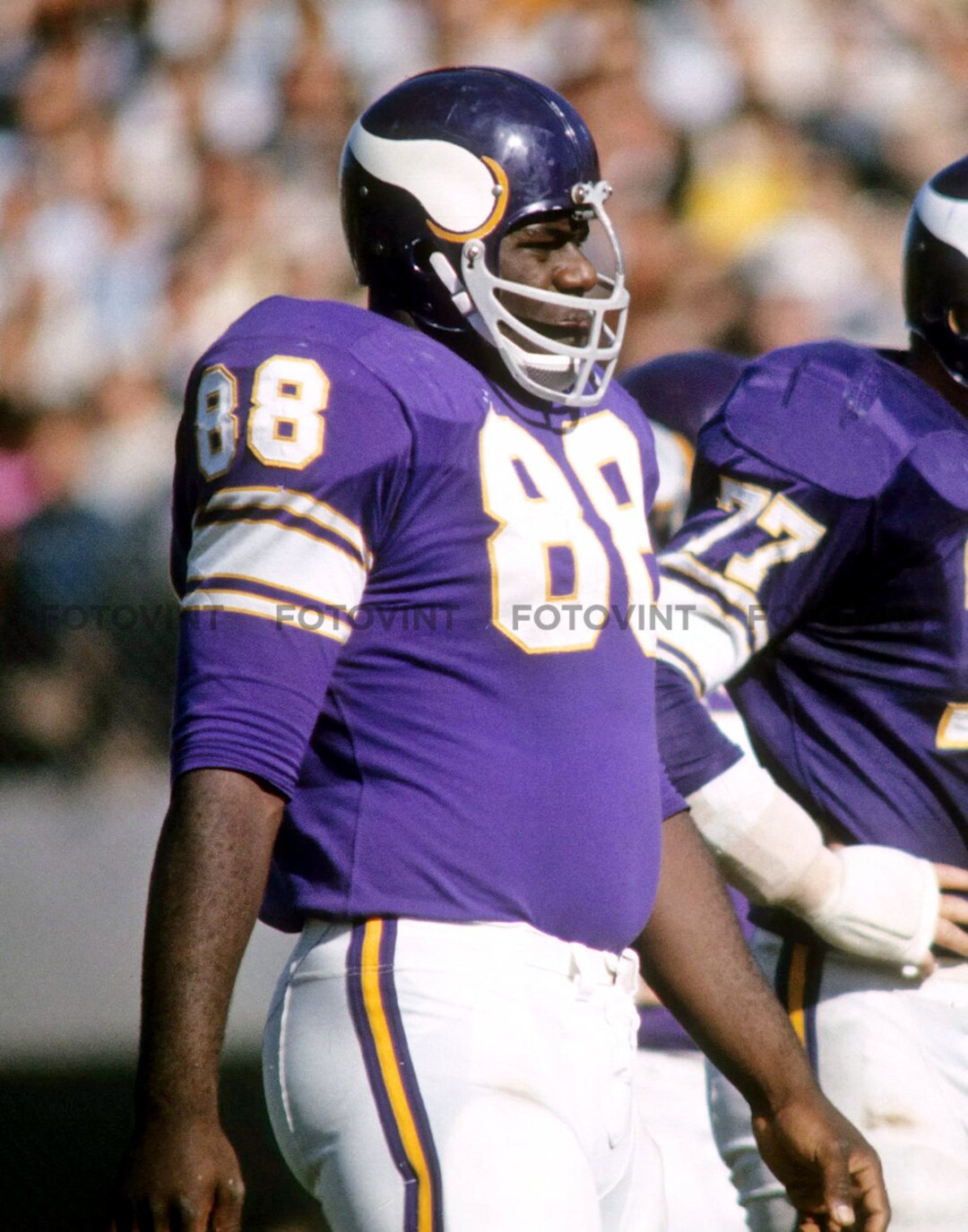
Alan Page’s NFL career spanned 15 seasons (1967–1981), primarily with the Minnesota Vikings, where he revolutionized the defensive tackle position. A nine-time Pro Bowler and six-time First-team All-Pro, Page became the first defensive player to win the NFL MVP award in 1971. His career is defined by extraordinary speed, unmatched durability, and a historic transition from professional football to the Minnesota Supreme Court.
The Genesis of a Legend: From Notre Dame to the Minnesota Vikings
Alan Page’s journey into professional football began with a stellar collegiate career at the University of Notre Dame. As a consensus All-American, he was a pivotal member of the 1966 national championship team. His performance in South Bend established him as a defensive prospect with rare athletic gifts, leading the Minnesota Vikings to select him with the 15th overall pick in the first round of the 1967 NFL Draft.
Upon arriving in Minnesota, Page joined a franchise that was still in its relative infancy. Under the leadership of head coach Bud Grant, the Vikings were building a culture predicated on discipline and physical dominance. Page was the final piece of the puzzle that would eventually become the "Purple People Eaters," one of the most feared defensive lines in NFL history.
During his rookie season in 1967, Page’s impact was immediate. Unlike the prototypical defensive tackles of the era who relied solely on bulk and power to plug gaps, Page utilized a combination of explosive first-step quickness and refined technique. He finished his rookie campaign with several forced fumbles and established himself as a permanent fixture in the starting lineup, a position he would not relinquish for over a decade.
The Purple People Eaters and Defensive Dominance
The late 1960s and 1970s marked the zenith of Alan Page’s NFL career. Alongside teammates Carl Eller, Jim Marshall, and Gary Larsen, Page formed the core of the "Purple People Eaters." This unit was the engine behind the Vikings' dominance of the NFC Central division and their four Super Bowl appearances (IV, VIII, IX, and XI).
The philosophy of this defensive line was simple yet devastating: "Meet at the quarterback." Page was the interior catalyst for this mantra. While Eller and Marshall provided pressure from the edges, Page’s ability to collapse the pocket from the inside disrupted the timing of opposing offenses. His pursuit speed was legendary; it was not uncommon to see Page, a defensive tackle, chasing down running backs 20 or 30 yards downfield.
Between 1968 and 1976, the Vikings' defense was consistently ranked near the top of the league in points allowed and total yards. Page’s presence forced opposing offensive coordinators to double-team him on nearly every snap, which in turn freed up his teammates to make plays. This collective dominance helped Minnesota secure 10 division titles in 11 seasons, cementing Page’s status as a generational talent.
The Historic 1971 MVP Season
The 1971 season remains the most significant individual milestone in Alan Page’s NFL career. In an era where the Most Valuable Player award was almost exclusively reserved for quarterbacks and running backs, Page broke the mold. To this day, he remains one of only two defensive players to win the Associated Press NFL MVP award, the other being Lawrence Taylor in 1986.
During the 1971 campaign, Page was the focal point of a Vikings defense that allowed a staggering 139 points over 14 games—an average of just 9.9 points per game. While official sack statistics were not tracked by the NFL until 1982, retrospective film study credits Page with roughly 9 to 12 sacks that season, along with numerous blocked kicks, forced fumbles, and safeties.
What truly set Page apart in 1971 was his "range." He played with a frenetic energy that allowed him to impact every facet of the game. He wasn't just a run-stuffer; he was a playmaker. His MVP win was a validation of the idea that a single defensive player could dictate the outcome of a game as effectively as an elite quarterback. This season also saw him earn the NFL Defensive Player of the Year award, a feat he would arguably repeat in spirit throughout the mid-70s.
Redefining the Defensive Tackle Position
Before Alan Page, the defensive tackle position was largely occupied by "space eaters"—large men designed to hold their ground and prevent offensive linemen from reaching the second level. Page introduced the concept of the "penetrating" defensive tackle.
Speed and Leverage
Page’s primary weapon was his get-off at the snap. He often anticipated the snap count so precisely that he was in the backfield before the offensive lineman could even set his feet. At roughly 245 to 250 pounds for much of his career, he was lighter than many of the guards who blocked him, but he used this to his advantage. His lower center of gravity and superior hand technique allowed him to "get under" larger opponents, utilizing leverage to drive them into the quarterback.
The Intellectual Approach
Page was known for his analytical approach to the game. He studied film meticulously, looking for "tells" in an offensive lineman’s stance or the quarterback’s cadence. This mental preparation allowed him to play faster than his physical attributes alone would suggest. He understood the geometry of the football field, often taking angles that cut off escape routes for mobile quarterbacks.
The Mid-Career Transition and the Move to Chicago
By the late 1970s, the relationship between Alan Page and the Vikings' coaching staff, specifically Bud Grant, began to undergo strain. Page had become a dedicated long-distance runner, a hobby that led to significant weight loss. Grant and the Vikings' staff were concerned that Page’s lower weight—which dropped to nearly 220 pounds at one point—would make him a liability against the run.
In 1978, after six games, the Vikings made the shocking decision to waive the future Hall of Famer. The Chicago Bears quickly claimed him, and Page’s career experienced a remarkable second act. Far from being "washed up," Page thrived in Chicago’s system. He played three and a half seasons for the Bears, proving that his intelligence and speed were more important than raw bulk.
In 1980, his second-to-last season, Page recorded 8.5 sacks (unofficial), demonstrating that even in his mid-30s, he remained a premier interior pass rusher. His tenure in Chicago served as a testament to his professionalism and his ability to adapt to new defensive schemes late in his career.
Career Statistics and Historical Comparison
Alan Page’s statistical output is difficult to fully quantify because he played the majority of his career before the NFL officially tracked sacks (1982) and tackles for loss. However, through the work of sports historians and the Pro Football Hall of Fame, we have a clear picture of his dominance.
| Category | Statistic (Approximate/Official) | Context |
|---|---|---|
| Seasons Played | 15 | 1967–1981 |
| Games Played | 238 | Never missed a game due to injury |
| Unofficial Sacks | 148.5 | Ranks among the all-time leaders for DTs |
| Fumble Recoveries | 22 | Second most in NFL history at time of retirement |
| Safeties | 3 | Tied for a high mark for defensive linemen |
| Blocked Kicks | 28 | Combined field goals, extra points, and punts |
| Pro Bowl Selections | 9 | Consecutive (1968–1976) |
| First-Team All-Pro | 6 | 1969, 1970, 1971, 1973, 1974, 1975 |
When comparing Page to modern icons like Aaron Donald or John Randle, the similarities in playstyle are striking. All three utilized explosive interior quickness to negate the size advantage of offensive guards. However, Page’s durability—playing 218 consecutive games—remains a benchmark that few in the modern era can match.
Academic Pursuit: Law School While Playing
One of the most extraordinary aspects of Alan Page’s NFL career was his preparation for life after football. While most players spent their off-seasons resting or working secondary jobs, Page attended the Hamline University School of Law.
He balanced the rigorous demands of professional football with the academic pressures of law school, often studying on team planes or in hotel rooms before games. He earned his Juris Doctor in 1978, the same year he was traded to the Chicago Bears. This commitment to education was not merely a hobby; it was a foundational element of his character. Page viewed the law as a vehicle for social justice and civic duty, a perspective that would define his post-NFL trajectory.
The Transition from the Gridiron to the Bench
Alan Page retired from the NFL following the 1981 season. Unlike many retired athletes who struggle to find a second calling, Page stepped immediately into the legal profession. He served as an attorney in the Minnesota Attorney General’s office before making history once again in 1992.
Page was elected as an Associate Justice of the Minnesota Supreme Court, becoming the first African American to serve on the state’s highest court. He served with distinction until reaching the mandatory retirement age in 2015. His judicial career lasted 23 years—longer than his illustrious football career. In 2018, he was awarded the Presidential Medal of Freedom, recognizing both his athletic achievements and his contributions to the American legal system and education through the Page Education Foundation.
The Enduring Legacy of Number 88
Alan Page’s legacy is multifaceted. To the NFL, he is the defensive tackle who proved that speed and intellect could overcome size. To the Minnesota Vikings, he is a cornerstone of the most successful era in franchise history. To the legal community, he is a brilliant jurist who championed equality and education.
His career serves as a blueprint for the modern professional athlete. He demonstrated that excellence on the field does not have to come at the expense of intellectual growth or community service. When fans look back at the history of the NFL in 2026, Page stands out not just as a member of the 100th Anniversary All-Time Team, but as a man who mastered two entirely different, yet equally demanding, disciplines.
Frequently Asked Questions
How many Super Bowls did Alan Page win?
Despite being a key member of the Minnesota Vikings during their most successful era, Alan Page never won a Super Bowl. He played in four Super Bowls (IV, VIII, IX, and XI), but the Vikings lost all four matchups. His lack of a championship ring is often cited as one of the great anomalies for a player of his caliber, though it does not diminish his individual Hall of Fame status.
Why did Alan Page leave the Minnesota Vikings for the Chicago Bears?
Page left the Vikings in 1978 primarily due to a philosophical disagreement regarding his weight and physical conditioning. Page had become an avid marathon runner and lost a significant amount of weight, dropping to around 220 pounds. Head coach Bud Grant felt this made Page too light to effectively play defensive tackle in his system. Consequently, the Vikings waived him, and he was claimed by the Chicago Bears.
Was Alan Page the first defensive player to win NFL MVP?
Yes, Alan Page was the first defensive player to win the AP NFL MVP award, achieving the feat in 1971. Since then, only one other defensive player has won the award: Lawrence Taylor in 1986. This highlights the rarity of defensive players being recognized as the league's most valuable individual contributor.
What is Alan Page's sack record?
Because the NFL did not officially track sacks until 1982 (one year after Page retired), he does not have an "official" NFL sack record. However, film researchers and the Vikings organization credit him with 148.5 career sacks. This total would rank him among the highest-producing defensive tackles in the history of the league.
What is the Page Education Foundation?
The Page Education Foundation is a non-profit organization founded by Alan Page and his late wife, Diane, in 1988. The foundation provides scholarships to students of color in Minnesota. In exchange for the grants, "Page Scholars" must mentor younger children in their communities, creating a cycle of service and academic achievement.
Recommendation for Further Exploration
For those looking to deepen their understanding of Alan Page’s impact, viewing archival footage of the 1971 Minnesota Vikings season is highly recommended. Witnessing his "pursuit speed" provides a visual context that statistics alone cannot convey. Additionally, exploring the archives of the Minnesota Judicial Center offers insight into his significant legal contributions, which are as much a part of his career legacy as his time on the football field.